The short answer
- Can you run a Texas plate lookup?
- Owner identity is gated by the federal Driver's Privacy Protection Act; TxDMV record requests require a permitted use. Buyers get what they actually need — decode, recalls, title history — from the VIN.
- Where is the registration sticker?
- Bottom-left of the windshield. Texas plates carry no dates — the windshield sticker is the whole status display.
- Is there still a Texas inspection?
- Safety inspections for private vehicles ended January 1, 2025 under HB 3297; a $7.50 replacement fee rides on registration instead. Emissions tests continue in the participating metro counties.
Windshield
Where the sticker lives
Plates carry no dates
2025
Safety inspections abolished
HB 3297, non-commercial vehicles
2
Plates required
Front and rear
Transit
The buyer's drive home
Free 5-day permit, not borrowed plates

The sticker is on the windshield — Texas's status display
Texas moved its registration sticker to the windshield long ago, and the “Two Steps, One Sticker” reform later merged inspection and registration into that single square. The plate itself is dateless: to judge a Texas car’s registration standing you read the windshield, bottom-left, where month and year print large. For a buyer that makes the first glance easy — an expired windshield sticker is unpaid registration riding with the car, and in an emissions county it may also hint at a test the car cannot pass.
Safety inspections ended in 2025 — what replaced them
House Bill 3297 abolished the annual vehicle safety inspection for non-commercial vehicles on January 1, 2025. In its place: a $7.50 inspection program replacement fee collected with registration ($16.75 covering two years on brand-new vehicles), and continued emissions testing in the participating metro counties around Dallas–Fort Worth, Houston, Austin and El Paso. Commercial vehicles still inspect.
The buyer-side consequence is real: the yearly mechanical once-over that used to catch bald tires, dead brake lights and cracked windshields on every Texas car is gone. A used Texas vehicle’s last safety inspection may date to 2024, and everything since is on the honor system. Budget a pre-purchase inspection accordingly — the state no longer does even the minimal version for you.
Plates leave with the seller
Texas plates belong to the person, not the vehicle. At sale the seller removes them — transferable to their next vehicle through TxDMV — and files the vehicle transfer notification that protects them from the buyer’s future tolls and tickets. A Texas car offered for sale with plates still mounted is normal; a deal that ends with you driving away on those plates is not, because the state’s toll cameras and plate readers will keep billing the seller until the paperwork catches up.
The transit permit — Texas's answer to the drive home
The gap between handshake and registration is covered by the Vehicle Transit Permit: a free, single-trip permit from TxDMV, printed at home, good for five days. It exists precisely so buyers do not borrow sellers’ plates, and it is the detail that makes Texas private sales clean: plates off, permit printed, car legally home, registration within 30 days at the county tax office.
The transit permit is one of five, and the others catch people out
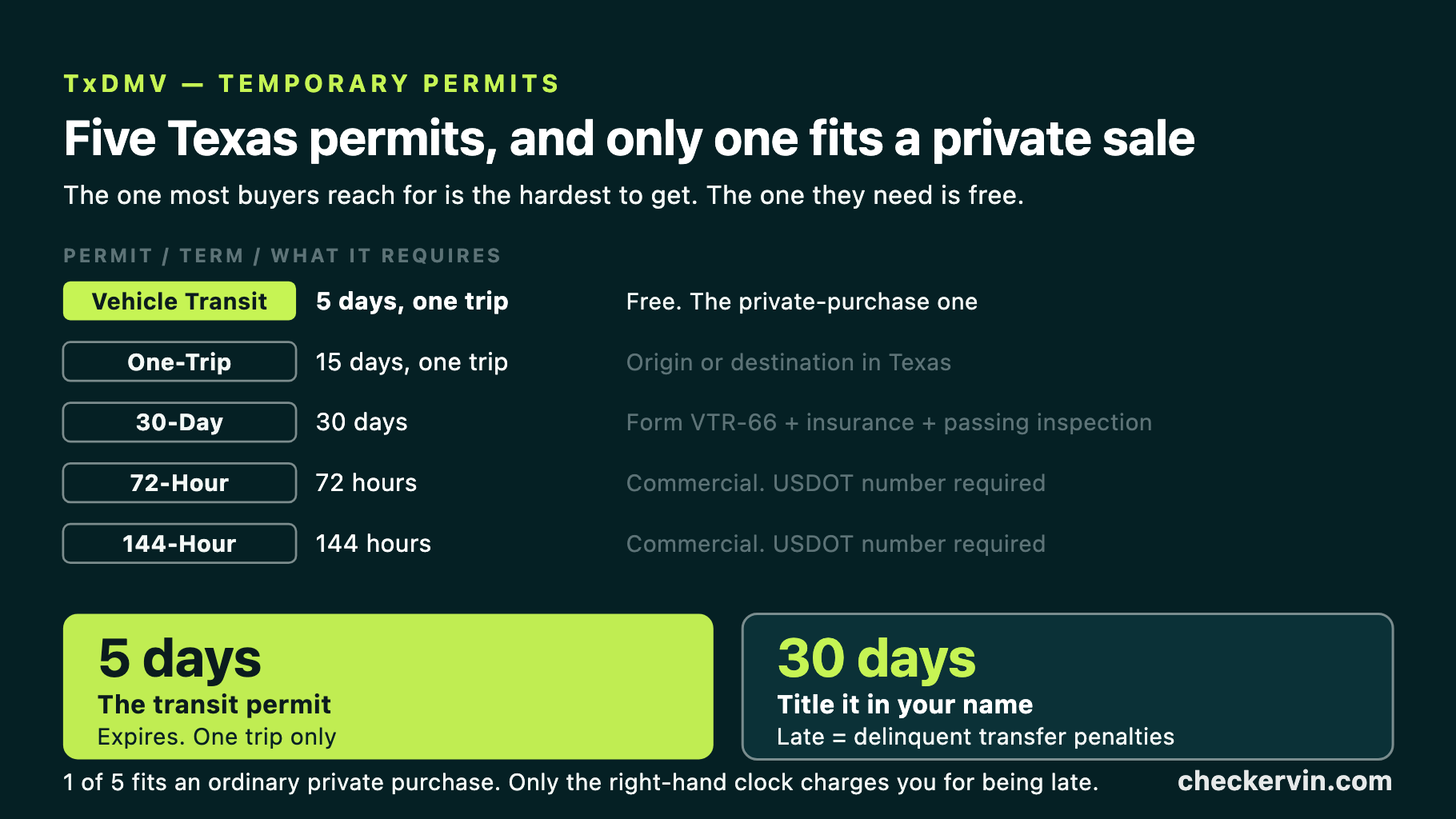
The free transit permit above is the one that fits an ordinary private purchase, but it is not the only temporary permit Texas issues, and the differences are not cosmetic. People searching for “a temporary tag in Texas” are usually picturing the thirty-day one, which is the hardest of the five to get.
| The permit | What it actually is |
|---|---|
| Vehicle Transit Permit | Five calendar days from the day it is printed, valid for one trip between the origin and destination named on it, no fee. The private-purchase permit |
| One-Trip Permit | Fifteen calendar days, one trip only between the origin and destination shown on the receipt, and one of those points must be in Texas |
| 30-Day Permit | Thirty calendar days, purchasable up to sixty calendar days before it takes effect — but it requires Form VTR-66 together with proof of insurance and proof of a passing vehicle inspection |
| 72-Hour and 144-Hour Permits | Commercial only. Laden trucks, truck-tractors, trailers, semitrailers and motor buses, and a valid USDOT number is required |
Read the third row against the first. The permit most buyers assume they want asks for a form, an insurance document and an inspection; the one that matches their situation is free, lasts five days, and covers a single journey to the county tax office. That is not a technicality — it is the difference between driving home legally today and spending a morning assembling paperwork for a permit you did not need.
Texas runs two clocks, and only one of them costs money
A Texas purchase starts two deadlines that look alike and are not. Confusing them is the most expensive ordinary mistake in this process.
| The clock | What TxDMV actually requires |
|---|---|
| The transit permit — five calendar days | How long you may legally drive, for one trip. It expires and the vehicle is then unregistered |
| The title transfer — thirty days from the date of sale | Vehicles are required to be titled in the buyer's name within 30 days from the date of sale, and failure to do so may result in delinquent transfer penalties |
Satisfying the first does nothing for the second. It is entirely possible to hold a valid permit, drive home lawfully, and still be accruing a delinquent transfer penalty because the thirty-day clock has been running since the day you shook hands. The permit is about the road; the transfer deadline is about the record, and only the record charges you for being late.
Our temporary tag guide covers why this two-clock pattern repeats in every state, with the durations set fifty different ways.
The filing that protects the seller, and what it tells a buyer
Texas gives a seller something most states do not: a way to tell the state the car is no longer theirs, immediately, without waiting for the buyer to act. It is called a Vehicle Transfer Notification, and it is filed by the seller after the sale.
Its purpose is liability. Until the buyer titles the vehicle, the state's record still shows the seller's name, and tolls, parking citations and red-light notices follow the record rather than the reality. The notification is what caps that exposure. A seller who files it the same day is not being fussy — they are closing a window that the buyer's thirty-day deadline holds open.
For a buyer, the notification is quietly informative in two ways. A seller who knows about it and files it is a seller who has done this properly before, which is a mild good sign. And a seller who is reluctant to have the sale recorded with the state at all is showing you something, because the whole point of title jumping is that no record of the intermediate owner ever gets created.
Two Texas allowances worth knowing before you need them
Two small provisions come up constantly and are almost never mentioned together, both from TxDMV's own registration guidance.
- A vehicle may be operated up to five working days after the registration expires without penalty — a genuine grace period, not a widely-shared rumor
- Someone moving to Texas has 30 days from the move to register the vehicle here
The first matters because registration lapses quietly — the sticker is on the windshield where the driver sees it least, and Texas plates carry no date at all. The second matters because new residents routinely assume their existing out-of-state registration covers them until it expires, and it does not.
Neither allowance stretches the title transfer deadline. That one runs from the date of sale regardless of where you moved from or when your old registration lapses.
Texas publishes its own title check, and it is not the same as a plate lookup
One thing worth knowing before paying anyone for a Texas record: TxDMV points buyers at a service of its own, described in its buying guidance as a way to see whether the title of the vehicle you are considering has any issues affecting its value.
That is a different question from the one a plate lookup answers, and a more useful one for a buyer. A plate identifies a registration; a title check speaks to whether the vehicle has been branded, written off or otherwise marked in the record. If you are choosing where to spend attention before a purchase, the title side is where the money is lost.
It also runs on the VIN rather than the plate, which is the same reason every other check on this page does. The plate is the number the state can change; the VIN is the one it cannot. Our Texas title check guide covers what the state record holds and our NMVTIS report page covers the national title system underneath it.
Formats on Texas roads
| Series | What it looks like |
|---|---|
| Standard passenger | Black-on-white 'The Lone Star State' base, three letters and four digits |
| Classic black | The most popular of Texas's paid specialty bases, sold through myplates.com |
| Specialty & collegiate | Hundreds of designs — causes, universities, military honors — each with its own series |
| Personalized | Owner-chosen characters on standard or specialty bases, subject to approval |
| Antique / classic vehicle | For qualifying older vehicles, with use limits that do not fit daily driving |
Why the plates leave: they follow the owner, not the car
The rule that plates stay with the seller looks arbitrary until you see the mechanism underneath it. In Texas a plate belongs to the person, and TxDMV states plainly that it is simple and free to transfer your license plates to your new vehicle.
That is the whole explanation. A seller keeps their plates because those plates are an asset they can move — onto the replacement car, at no cost. Nothing is being withheld from the buyer, and a buyer who expects the plates to come with the vehicle has imported an assumption from a state that works differently.
It also explains why the transit permit exists at all. If plates followed the vehicle, a buyer would drive away on the seller's registration. Because they follow the owner, the car leaves the sale with nothing on the back of it, and the state has to supply a temporary substitute.
Why so many Texas plates look old
Texas plates are frequently faded, and there is a specific reason. TxDMV records that as of November 1, 2016, the state no longer requires automatically replacing plates after seven years. Before that, plates aged out on a schedule. Now they do not.
Replacement is still available — you may apply at the county tax office for replacement plates where the existing ones need replacing for cosmetic or readability reasons — but it is a request rather than a requirement. The consequence is a population of plates that can be a decade or more old and still entirely legal.
For anyone reading plates that matters twice over. A weathered plate in Texas is not evidence of neglect the way it might be somewhere with mandatory replacement, so do not read it as a signal about the car. And if you are trying to record a plate from a photograph or a dashcam, expect the state's oldest plates to be genuinely hard to resolve — readability is exactly what the replacement provision exists to fix.
The disposal rule almost nobody follows
One line in TxDMV's plate guidance deserves far more attention than it gets. If you decide not to keep your plates when you sell or dispose of a vehicle, the plates should be disposed of by defacing the front of the plate with permanent black ink, or similar means.
Defacing, not binning. The reason is obvious once stated: an intact plate in a trash bag is a working plate for somebody else, and a plate attached to a car it was never issued to is the cheapest disguise in the vehicle world. Discarded plates are a supply line, and this provision is the state asking sellers to cut it.
- A plate you are not transferring should be defaced on the front before disposal
- A vehicle wearing plates that do not match its registration record is the classic cloning signature
- A seller who hands you their old plates 'to use until yours arrive' is proposing something Texas does not permit
- The transit permit exists precisely so nobody needs to borrow a plate
The third item is the one to watch in a private sale. It is usually offered as a kindness, and accepting it puts a plate on your car that the record ties to someone else — which is the situation our VIN cloning page describes from the other end.
What a Texas plate lookup can legally find
The person behind a Texas plate is protected by the federal Driver’s Privacy Protection Act, and TxDMV releases motor-vehicle records only for the statute’s permitted uses — insurers on claims, litigants, employers verifying commercial drivers, licensed investigators within the law. Texas’s size makes it a favorite target of plate-search websites; none of them has a lawful public feed, and their results are recycled scrape data.
The lawful private routes are the same three as everywhere: police with a reason, your insurer with a claim, and the VIN in a purchase. The full national picture — every permitted use and the scam patterns — lives in our license plate lookup guide.
Reading Texas plates as a buyer
- Expired windshield sticker — unpaid registration, and in a metro county possibly an emissions problem; price the catch-up
- Last safety inspection dated 2024 or earlier — normal now; treat tires, brakes and lights as unverified
- Front plate missing — two are required; check for a rear-only-state past in the title chain
- Gulf-coast history — Houston flood risk is the Texas signature; run the water checks regardless of how dry the car looks
- Paper dealer tags — Texas fought a wave of fake paper-tag fraud; verify any temporary tag's dealer actually exists
Registering a Texas purchase
- 1Take the signed title and print the transit permitSeller signs the title with odometer disclosure; the free TxDMV transit permit covers the drive home.
- 2Seller files the transfer notificationIt caps their liability for tolls and tickets — organized Texas sellers file it the same day.
- 3Register at the county tax office within 30 daysTitle transfer, sales tax and registration happen together; emissions counties require a passing test first.
- 4Mount both plates and place the stickerFront and rear plates, windshield sticker bottom-left — the whole Texas status display.
Decode a Texas car's VIN free
Decoded from official manufacturer and NHTSA records
The Texas-specific order of operations
Most buying advice is written for a generic state. Texas differs in enough places that the sequence itself changes, so here it is in the order the state actually imposes.
- 1Before money moves — read the VIN, not the plateThe plate is leaving with the seller, so it identifies nothing you are buying. Take the seventeen characters off the windshield and confirm them against the door jamb label, then run them for open recalls and the title record.
- 2At the sale — signed title with the odometer disclosure on itThe federal disclosure belongs on the title itself, not on a bill of sale. A bill of sale alongside it records the price and date, which is what the county tax office and the tax assessment will want.
- 3Before you drive — print the free transit permitFive calendar days, one trip, no fee. Not the 30-Day Permit, which needs Form VTR-66, proof of insurance and a passing inspection you almost certainly do not have yet.
- 4Same day — ask the seller to file the transfer notificationIt caps their liability for tolls and citations while the record still shows their name. It costs them minutes and tells you something either way.
- 5Within thirty days — title it in your nameThis is the clock with penalties attached. Title transfer, sales tax and registration happen together at the county tax office, and the delinquent transfer penalty starts from the date of sale rather than from when you got around to it.
- 6Afterwards — mount both plates and check the windshield stickerTexas is a two-plate state and the registration lives on the glass. If you kept an old set of plates from a previous vehicle, transfer them; if you are discarding any, deface the front before disposal.
Steps three and five are the pair worth memorizing, because they are the two clocks and only one of them costs money. Everything else on this list is cheap to do late. The title transfer is not.
Where this information comes from
- TxDMV — temporary permitsThe five Texas permits, their durations and what each one requires
- TxDMV — buying or selling a vehicleThe 30-day titling requirement, transfer penalties and the transfer notification
- TxDMV — license platesFree plate transfers, the end of 7-year replacement, and the disposal rule
- TxDMV — buying or selling a vehiclePlates, transit permits, transfer notification and registration
- Texas DPS — 2025 inspection program changesThe HB 3297 end of non-commercial safety inspections
- Driver's Privacy Protection Act, 18 U.S.C. § 2721The federal restriction on owner data in vehicle records
- NMVTIS — national title recordTitle brands from every reporting state, keyed to the VIN
Keep reading
Frequently asked questions
Can I look up the owner of a Texas license plate?
Not out of curiosity. The federal Driver's Privacy Protection Act limits owner information to permitted uses, and TxDMV releases motor-vehicle records only on requests that qualify. In a used-car deal, the VIN is the number that opens the decode, recalls and the national title record.
Why is there no sticker on a Texas plate?
Texas puts its registration sticker on the windshield, not the plate — the 'Two Steps, One Sticker' system merged inspection and registration into a single windshield sticker years ago. The plate itself carries no dates.
Does Texas still require a vehicle safety inspection?
Not for non-commercial vehicles. House Bill 3297 abolished the annual safety inspection on January 1, 2025, replacing it with a $7.50 inspection program replacement fee at registration. Emissions testing continues in the participating metro counties.
Do Texas plates stay with the car when it is sold?
No — plates belong to the seller, who removes them and may transfer them to another vehicle. The buyer drives home on a free Vehicle Transit Permit and registers the car with new plates in their own name.
Does Texas require a front license plate?
Yes — two plates, front and rear. A Texas car with a clean nose and no bracket has usually spent time in a rear-only state, or its owner gambled on enforcement.
No inspection sticker to trust — so pull the records
Decode any VIN free for the factory build, specifications and open safety recalls. No account, no card.
Run a free VIN check