The short answer
- How do you read a Suzuki VIN?
- Start with the first three characters. JS1 and LC6 are motorcycles, JS2 and KL5 are passenger cars, JS3 and 2S3 are multipurpose vehicles. The tenth character gives the model year, and on a Suzuki that character does more work than on any other marque.
- Why does the model year matter so much here?
- NHTSA lists Suzuki car models through 2014 and none from 2015 onward, while continuing to list dozens of motorcycles and ATVs each year. A Suzuki VIN reading 2015 or later is not a car.
- Is a free Suzuki VIN decode useful?
- Yes. Build data for every vehicle sold in the United States is published through the federal vPIC database, so model year, body class, engine and plant come back without charge — for a 2009 Grand Vitara exactly as for a current GSX-8R.
6
Suzuki WMIs verified
Across 4 countries
2014
Last US car model year
Per NHTSA's own database
JSA
Shared with Kawasaki
The WMI that names two marques
17
Characters, bikes included
Same federal standard
The short answer
Most marque decoder pages can assume one thing about their subject: that it is a car company. Suzuki is not, or rather it is no longer, and that single fact reorganises how its VINs should be read.
Suzuki Motor Corporation builds motorcycles, scooters, all-terrain vehicles, outboard motors and cars. In the United States the car half stopped. The motorcycle and ATV half did not — it is still filing new models with federal regulators every year. So the population of Suzuki VINs on American roads splits cleanly into a closed set of cars that stops at a particular model year, and an open set of powersports vehicles that keeps growing.
That gives you a shortcut no other mainstream marque offers. Two characters — the manufacturer identifier at the front and the model year at position ten — settle which Suzuki you are dealing with before you look at anything else.
Position 10 decides whether it is even a car
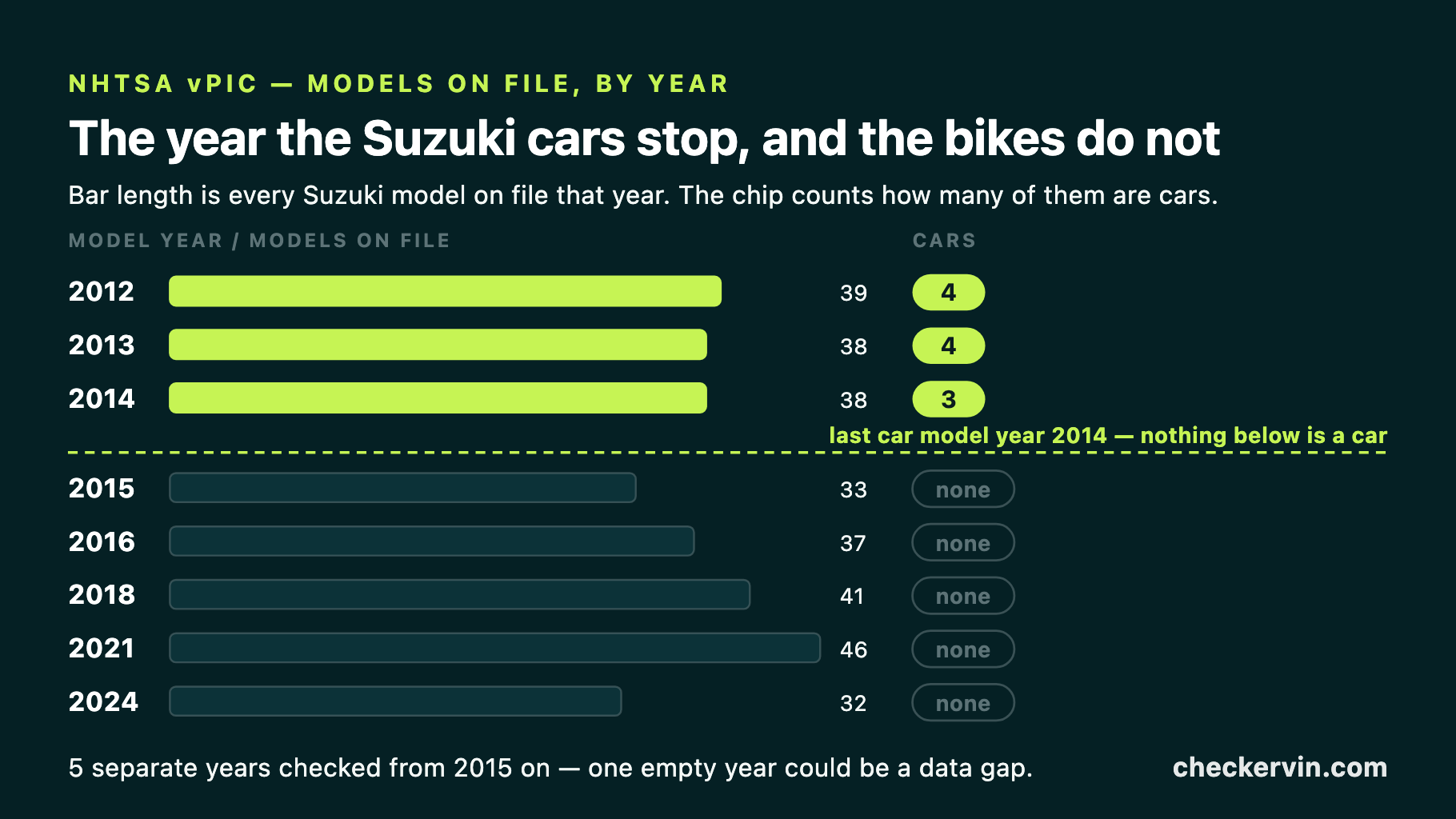
NHTSA publishes, for every make, the models it holds on file for a given model year. We queried it for Suzuki one year at a time and counted how many of the returned models are passenger vehicles rather than motorcycles, scooters or ATVs.
| Model year | Models on file with NHTSA — and how many are cars |
|---|---|
| 2012 | 39 models total — 4 of them cars |
| 2013 | 38 models total — 4 of them cars |
| 2014 | 38 models total — 3 of them cars |
| 2015 | 33 models total — no cars at all |
| 2016 | 37 models total — no cars at all |
| 2018 | 41 models total — no cars at all |
| 2021 | 46 models total — no cars at all |
| 2024 | 32 models total — no cars at all |
The car count falls from four to three and then to nothing, while the total does not fall with it — 2024 still returns 32 Suzuki models. That is the shape of a company that withdrew one product line from a market and kept the others. The last model year with Suzuki cars on file is 2014, and we checked 5 separate years from 2015 onward rather than one, because a single empty year could be a gap in the data rather than a fact about the world.
Reading that character is the only skill this page really asks of you. The tenth position runs on a thirty-year cycle that skips I, O, Q, U and Z, and across the span where the Suzuki question actually arises it reads like this.
| Character at position 10 | Model year — and what it rules in or out |
|---|---|
| C | 2012 — cars possible, four nameplates on file |
| D | 2013 — cars possible, four nameplates on file |
| E | 2014 — the last year with cars, three nameplates |
| F | 2015 — no cars on file; motorcycle, scooter or ATV |
| G | 2016 — no cars on file |
| J | 2018 — no cars on file |
| M | 2021 — no cars on file |
| R | 2024 — no cars on file |
One caution that applies to every marque and bites hardest on old vehicles: a letter alone is ambiguous across thirty years, because the same sequence ran from 1980 to 2000 and will run again. E is 2014 on a vehicle of this era and 1984 on a much older one. The generation of the machine resolves it, which is why a decoder reads position ten together with the manufacturer identifier rather than in isolation.
This is worth having because listings get it wrong in both directions. A dealer inventory system that treats everything as a car will happily describe a Boulevard as a vehicle with four doors, and a private ad for a Grand Vitara will sometimes carry a VIN copied from the wrong document entirely.
Every Suzuki manufacturer identifier, checked one at a time
The common advice — repeated by most of the decoder tools that rank for this search — is that a Suzuki VIN begins with JS. That is true of the Japanese-built ones and false of everything else. We put each identifier through NHTSA's vPIC DecodeWMI endpoint individually rather than copying a table.
| WMI | Country of assembly, and what the federal register says it is |
|---|---|
| JS1 | Japan — Motorcycle |
| JS2 | Japan — Passenger car |
| JS3 | Japan — Multipurpose passenger vehicle |
| 2S3 | Canada — Multipurpose passenger vehicle |
| KL5 | South Korea — Passenger car |
| LC6 | China — Motorcycle |
Six identifiers across Japan, Canada, South Korea, China. The first character carries the country by convention — J for Japan, 2 for Canada, K for South Korea, L for China — though it is worth being precise about where that convention comes from, because most decoder pages get it wrong. It is not in the federal rule. 49 CFR Part 565 fixes the first section at three characters identifying “the manufacturer and type of the motor vehicle,” and the word countrydoes not appear anywhere in the part. What 565.14 does say is that NHTSA “has contracted with the SAE International to coordinate the assignment of manufacturer identifiers,” and the country mapping lives in that international assignment scheme rather than in the regulation. Either way the practical point stands: a Suzuki VIN opening 2S3 was assembled in Canada, and a decoder that insists Suzukis begin JS will simply fail on it.
JSA: the identifier that names two different marques
One Suzuki WMI behaves unlike any other on this page. Decode JSA and vPIC returns the make as Suzuki and Kawasaki — both, on one identifier.
The practical consequence is precise and easy to miss: on a JSA VIN, the manufacturer identifier does not settle the marque. Everything else about the vehicle — the model line, the engine, the plant — sits in the characters after it, and the badge on the tank is not a substitute for decoding them. If you are cross-shopping and a VIN opens JSA, do not assume you have established which company built it.
This is also the cleanest illustration of a rule that applies to every VIN: the WMI identifies a manufacturer, and manufacturers are not the same thing as brands. Our Kawasaki VIN decodercovers that marque's own identifiers and how its model codes run.
So how do you resolve a JSA VIN? Not by staring harder at the first three characters, because they have already told you everything they are going to. You decode the rest of the number — the descriptor characters at positions four to eight carry the model line, and those are manufacturer-specific, so the model they resolve to is what names the marque in practice. Run the full VIN through a decoder that queries the federal build record rather than a static lookup table, and read the model it returns.
Shared identifiers are rarer than badge-engineering generally, but the underlying situation is not rare at all: two companies collaborating on a machine, one identifier on the paperwork. We met the same pattern on the Equator further down this page, and it is why the sentence “the VIN says it is a Suzuki” is worth treating as the beginning of a question rather than the end of one.
The 17 characters, and which of them Suzuki controls
The block structure is federal, not Suzuki's to choose. 49 CFR Part 565 fixes it for every manufacturer selling in the United States, which is why the same arithmetic works on a Kizashi and a DR650S.
| Position | What it encodes |
|---|---|
| 1–3 | World manufacturer identifier — country, manufacturer and vehicle class |
| 4–8 | Descriptor section — five characters of Suzuki's own coding |
| 9 | Check digit, computed from the other sixteen characters |
| 10 | Model year |
| 11 | Assembly plant |
| 12–17 | Sequential production number |
Section 565.15(b) gives the descriptor section as five characters at positions four through eight, and says the characters used within it “may be determined by the manufacturer” provided the attributes stay “decipherable with information provided by the manufacturer.” So positions four to eight are where Suzuki encodes model line, engine and body, under its own scheme — and the rule requires that scheme to be readable rather than secret. Our guide to reading a VIN works the arithmetic of the check digit in full.
The four car nameplates you will still meet
Because the car range closed, the set of Suzuki cars you can encounter on the used market is finite and small. In the final years NHTSA holds four nameplates.
| Nameplate | What it is, and why the VIN matters on it |
|---|---|
| Grand Vitara | A body-on-frame compact SUV — the longest-running of the four, and the one most often mislabeled as a crossover in listings |
| SX4 | Sold as both a hatchback and a sedan, with front- and all-wheel drive, so the descriptor characters do real work here |
| Kizashi | A sport sedan built in small numbers, which is why parts and comparable sales are thin |
| Equator | A pickup built alongside the Nissan Frontier — the one where the VIN, not the badge, tells you what the truck actually is |
The Equator is the instructive one. Badge-engineered vehicles are exactly where buyers get confused about parts, service and value, and the manufacturer identifier at the front of the VIN is what settles who built the thing. Decoding is not pedantry on a vehicle like that; it is how you find the right parts catalog.
The Korean-built Suzukis, and the marque next door
KL5 is the identifier that surprises people. It decodes as Suzuki, a passenger car, assembled in South Korea — the product of Suzuki badging cars built by the Korean operation that General Motors later absorbed.
Set it beside its neighbor and the picture is clear. KL1, one character away, decodes as General Motors, make Chevrolet. Two nearly identical identifiers, same country, two different marques on the paperwork. If you are comparing a Korean-built Suzuki against a Korean-built Chevrolet of the same era, the VIN is the only part of the vehicle that states plainly which lineage it belongs to.
Our GM VIN decoder covers the General Motors identifier map across its divisions and countries, including the codes that outlived the divisions themselves.
The Canadian-built Suzukis
2S3 decodes as Suzuki, a multipurpose passenger vehicle, assembled in Canada. The leading 2 is the country character, and it is the reason a Suzuki VIN can legitimately fail the “starts with JS” test that most decoder pages teach.
For a buyer the consequence is mundane and worth knowing anyway: country of assembly occasionally affects parts sourcing and, on older vehicles, which market's equipment the car was built to. It also matters for recalls, which manufacturers frequently scope to vehicles built at one plant between specific dates rather than to a model as a whole.
Motorcycle and ATV VINs are the live half
Everything above concerns a closed set. The open set — the Suzukis still being sold — is powersports, and there the decoding rules differ in ways worth stating.
- 1Find the frame VIN, not the engine numberOn a motorcycle the VIN is stamped into the steering head or the frame tube behind the front forks, and repeated on a label. The engine carries a separate serial number that is not the VIN and will not decode. Motors get swapped; frames carry the identity.
- 2Check the first three characters against the classJS1 and LC6 are motorcycle identifiers. A powersports vehicle whose VIN opens JS2 or KL5 is not what it is being sold as, and that is worth resolving before money moves.
- 3Read the tenth characterOn a bike this is a straightforward model year. On a Suzuki it is also the car-or-bike test: 2015 or later rules out a car entirely.
- 4Verify the frame number physicallyCompare the stamped frame number against the title and the label. A restamped or ground frame number on a motorcycle is among the strongest theft indicators there is, and it is visible to anyone who looks.
Our motorcycle VIN lookup guide covers the locations across manufacturers in detail, including the ATV and dirt bike cases where the stamping sits somewhere less obvious.
Outboard motors: the Suzuki with no VIN at all
Suzuki is also a major builder of outboard motors, and this is where people arrive at a VIN decoder holding something that will never decode. An outboard engine is not a motor vehicle. It carries a manufacturer's serial number, not a seventeen-character VIN, and no VIN decoder — ours, NHTSA's or anyone else's — will return anything for it.
The boat it is bolted to has its own identifier, and that one is real: a Hull Identification Number, twelve characters, assigned to the hull rather than the engine and administered under Coast Guard rules rather than the highway-vehicle standard. So a Suzuki-powered boat involves two separate numbers that answer different questions — the HIN identifies the hull, and the engine serial identifies the motor, which may well have been fitted years later or moved from another boat entirely.
- An outboard serial number is not a VIN and will not decode as one, whatever the seller calls it
- The hull's HIN is twelve characters, not seventeen, and follows a different scheme
- Engine and hull are separable, so the two numbers can have entirely different histories
- A trailer under the boat is a third vehicle with a third number, and that one is a real seventeen-character VIN
If that is the situation you are in, our boat HIN lookup explains the hull identifier and our trailer VIN lookup covers the one number in the set that a VIN decoder does answer.
Buying a Suzuki car now: what the VIN does and does not change
A discontinued marque changes the arithmetic of a used purchase, and it is worth being straight about how. The vehicle does not become unsafe or unsupported because the importer stopped selling new ones, but three things do shift.
- Every Suzuki car in the United States is now at least a decade old, so age-related wear is the dominant question rather than mileage alone
- Dealer service networks for the car range are gone, so routine work goes to independent shops
- Comparable-sale data is thin, especially for the low-volume nameplates, which makes valuation less reliable in both directions
- Parts availability varies sharply by nameplate, and the badge-engineered ones are often the easiest to supply
- Safety recall obligations are unaffected by any of the above
The VIN speaks to the last of those directly and to the others indirectly, by telling you exactly what the vehicle is before you start pricing parts for the wrong one.
Recalls do not expire when a marque leaves a market
This is the point most worth carrying away from the page. A safety recall attaches to specific vehicle identification numbers, and the duty to remedy a defect without charge to the owner is a duty about the vehicle, not about whether the manufacturer still sells that product line in the market.
So the right question on a used Suzuki car is not whether the marque is still here. It is whether this VIN has an open recall against it — a question NHTSA answers free, by VIN, for any vehicle in its database. Our page on buying a car with an open recall covers what an unrepaired one means for a purchase.
What a Suzuki VIN decode will not tell you
A VIN describes the vehicle as it was built. Everything that happened to it afterwards lives in separate records, and no amount of decoding will surface it.
- Accident history, insurance claims and structural repairs
- Title brands — salvage, rebuilt, flood, lemon
- Odometer readings and rollback evidence
- How many owners it has had, and how it was used
- Service and maintenance history, including whether a recall was actually performed
- Outstanding liens or theft records
Our free decode returns build data and safety information from federal sources. It does not return history records, and nothing on this page should be read as a promise that it does.
Where this information comes from
- NHTSA vPIC — DecodeWMI and GetModelsForMakeYearEvery WMI and model-year count on this page was read from these endpoints
- 49 CFR Part 565 — Vehicle Identification Number requirementsThe federal rule fixing the three sections, the check digit and the year code
- NHTSA recall lookupFree open-recall check by VIN, repaired at no cost regardless of marque status
- NICB VINCheckFree theft and salvage lookup contributed by participating insurers
Keep reading
Frequently asked questions
Do Suzuki cars and Suzuki motorcycles use the same VIN format?
Both carry a 17-character VIN built to the same federal standard, but they use different world manufacturer identifiers. JS1 and LC6 are motorcycle identifiers, while JS2, JS3, 2S3 and KL5 are car and multipurpose-vehicle identifiers. The first three characters tell you which kind of Suzuki you are holding before you decode anything else.
Why does my Suzuki VIN not start with JS?
Because not every Suzuki was built in Japan. Suzukis assembled in Canada begin 2S3, those built in South Korea begin KL5, and Chinese-built motorcycles begin LC6. The common advice that a Suzuki VIN starts with JS is true only for the Japanese-built ones.
What year did Suzuki stop selling cars in the United States?
NHTSA's vehicle database lists Suzuki car models through model year 2014 and none from 2015 onward, while continuing to list dozens of Suzuki motorcycles, scooters and ATVs every year since. So a Suzuki VIN whose tenth character indicates 2015 or later is not a car.
Can I still get a Suzuki car recall repaired for free?
A manufacturer's obligation to remedy a safety defect without charge attaches to the vehicle and does not end because a marque stopped selling cars in a market. Check the VIN against NHTSA's free recall lookup, which reports open recalls regardless of whether the model is still sold.
Where is the VIN on a Suzuki motorcycle or ATV?
On a motorcycle it is stamped into the steering head, the frame tube behind the front forks, and it also appears on a label on the frame. On an ATV it is usually stamped on the frame near the left front wheel or under the footwell. The engine carries its own separate serial number that is not the VIN.