The short answer
- How do you decode a GM VIN?
- Run the 17 characters through NHTSA's free vPIC decoder. The first three identify the manufacturer, the build country and the vehicle class, and the decoder resolves make, model and model year from the full number.
- What do the GM codes mean?
- 1G1 returns Chevrolet, 1G6 returns Cadillac, and 1GT and 1GK both return GMC. NHTSA records all of them as General Motors, splitting them by vehicle class — passenger car, truck or multipurpose passenger vehicle.
- Why does the same brand have several codes?
- Because the identifier encodes where the vehicle was built as well as who built it. Chevrolet passenger cars appear under 1G1 in the United States, 2G1 in Canada, 3G1 in Mexico and KL8 in South Korea.
1G1
Decodes to Chevrolet
General Motors passenger car
1G6
Decodes to Cadillac
General Motors passenger car
1GT / 1GK
Both decode to GMC
Truck and MPV respectively
$0
Cost of a federal decode
vPIC is public and free
What a General Motors VIN returns
GM is one of the manufacturers the federal decoder handles well, because the company submits detailed decoding rules for the vehicles it sells here.
Run a GM VIN through NHTSA’s vPIC and you should get the make, the model, the model year, the plant country and the body class, often alongside engine information. For most owner questions that is the whole answer, and it costs nothing.
What it will not give you is the option content. On a GM vehicle that lives somewhere else entirely, which is worth knowing before you go looking for it in the VIN.
The GM identifier map
The world manufacturer identifier occupies the first three characters. Decoding VINs that begin with each of these against the federal database returns the following.
| Identifier | Make and vehicle type in NHTSA's register |
|---|---|
| 1G1 | Chevrolet — passenger car |
| 1GC | Chevrolet — truck |
| 1GN | Chevrolet — multipurpose passenger vehicle |
| 1GT | GMC — truck |
| 1GK | GMC — multipurpose passenger vehicle |
| 1GD | GMC — incomplete vehicle |
| 1G6 | Cadillac — passenger car |
| 1GY | Cadillac — multipurpose passenger vehicle |
| 1G4 | Buick — passenger car |
| 1G3 | Oldsmobile — passenger car |
| 1G8 | Saturn — passenger car |
| 1GM | Pontiac — multipurpose passenger vehicle |
| 1GH | Holden and Oldsmobile — multipurpose passenger vehicle |
| 2G1 | Chevrolet — passenger car, built in Canada |
| 3G1 | Chevrolet — passenger car, built in Mexico |
| KL8 | Chevrolet — passenger car, built in South Korea |
Every row above was read back from NHTSA’s own manufacturer register rather than copied from a chart, which matters because the charts circulating online disagree with each other. One row in particular is worth pausing on: 1GH returns two makes, Holden and Oldsmobile, against a single identifier. Identifiers are assigned to a manufacturer, not to a marketing division, so a manufacturer can and does hang more than one nameplate off one code.
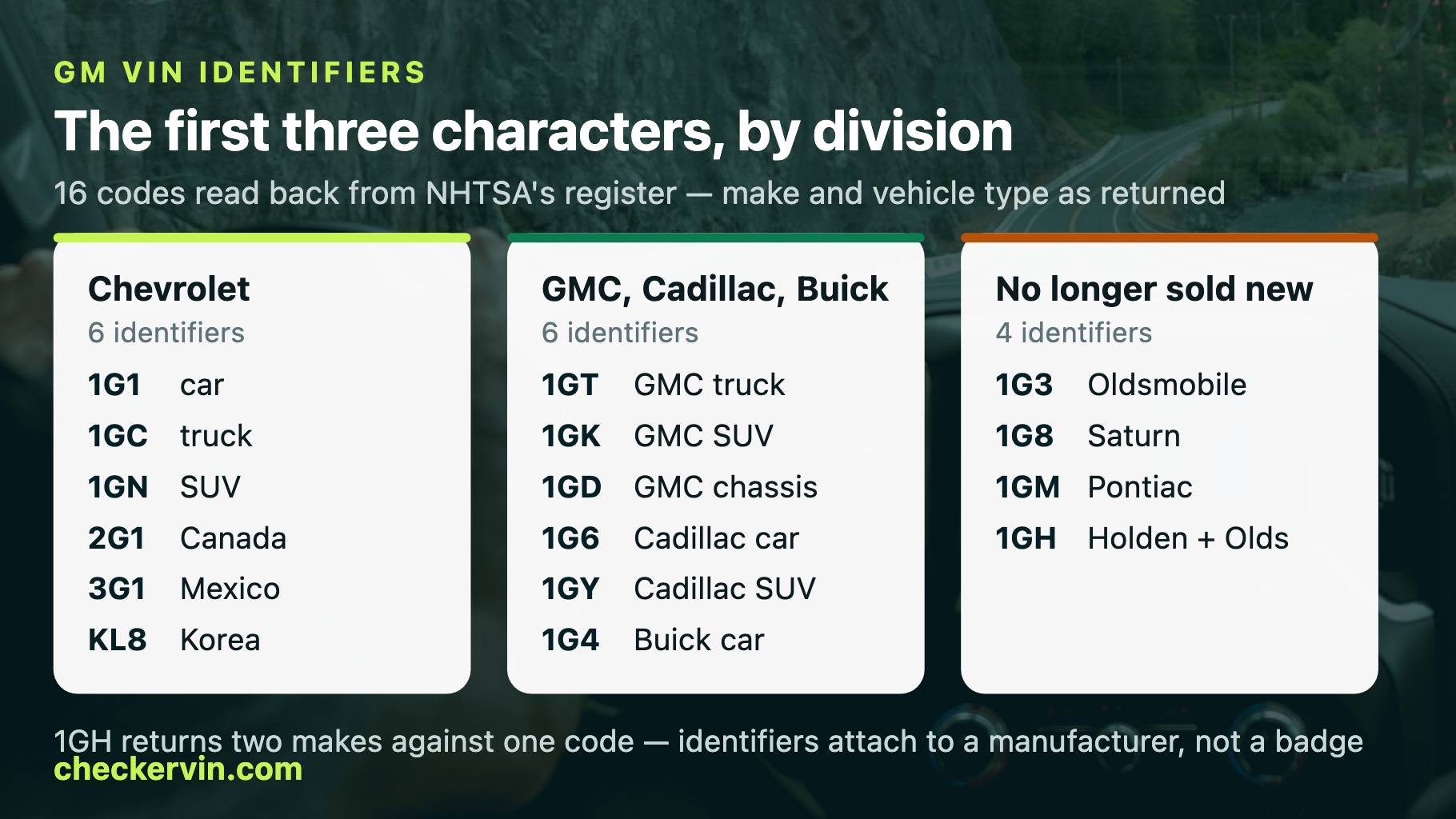
Three things fall out of that table. The identifier is not one-to-one with the division, because a division can hold several and one code can carry two. It is not one-to-one with the country either, because a division builds in more than one place — Chevrolet passenger cars alone appear under four identifiers here. And the third character is doing more work than most charts admit: within GM it separates the vehicletype, which is why 1G1, 1GC and 1GN are all Chevrolet but resolve to a car, a truck and a multipurpose vehicle respectively.
One nameplate, several identifiers
This is the part that sends people to a search engine. Somebody checks a Chevrolet VIN against a list that says Chevrolet is 1G1, finds their car starts with 2G1 or KL8, and concludes the number is wrong.
It is not. The opening character carries the build region under the international scheme — 1, 4 and 5 for the United States, 2 for Canada, 3 for Mexico, and letters in the K range for South Korea. Chevrolet has built passenger cars in all of them, so the brand legitimately appears under several identifiers.
Car, truck or multipurpose vehicle
The identifier also splits by broad vehicle class, and GM uses this consistently. Passenger cars, trucks and multipurpose passenger vehicles each get their own codes even within a single division.
GMC is the clearest illustration. A GMC truck decodes under 1GT, while a GMC multipurpose passenger vehicle decodes under 1GK — the same division, differing by what class the vehicle falls into. Chevrolet works the same way, with truck identifiers such as 1GC sitting alongside the passenger car codes.
The class matters beyond trivia, because federal safety standards are written by vehicle class. Two vehicles that look similar in a parking lot can be certified against different requirements, and the identifier is the first hint of which is which.
The divisions that no longer sell cars
GM has retired more brands than most manufacturers have launched. Pontiac, Oldsmobile, Saturn and Hummer in its original form all stopped selling vehicles, and their identifiers remain in the federal register because the vehicles remain on the road.
- Retired-division VINs decode normally against the federal database
- Recall obligations stay with General Motors, not the dead brand
- Any GM dealer can book campaign work on those vehicles
- Parts availability is the practical constraint, not the paperwork
If you are looking at a Pontiac or a Saturn, the absence of a showroom does not mean the absence of a record. The manufacturer that owes the free safety repair still exists.
| Retired division | Identifier still in the federal register |
|---|---|
| Oldsmobile — last built 2004 | 1G3, passenger car |
| Pontiac — last built 2010 | 1GM, multipurpose passenger vehicle |
| Saturn — last built 2010 | 1G8, passenger car |
| Holden — GM's Australian marque | 1GH, shared with Oldsmobile |
Those four rows are the practical reason this page exists as something separate from a Chevrolet page. A used Pontiac or Saturn is a vehicle whose brand cannot answer for it, and the reflex on encountering one is to assume the record died with the showroom. It did not. The identifier resolves, the recall file resolves, and the entity on the hook is General Motors LLC — which is also the name the register returns when you look up a current Chevrolet.
What the register pins down, and what it does not
It is worth being precise about the strength of the evidence here, because the identifier gets asked to carry more than it can. Reading a GM code back from NHTSA returns three things reliably: the make, the broad vehicle type, and the manufacturer of record. That is genuinely useful — it settles whether a listing calling something a GMC truck is describing a truck identifier or an SUV one.
It does not return the model, the trim, the engine or the options, and no amount of staring at the first three characters will produce them. Those live further along the number and, for option content, not in the VIN at all. The three characters answer “who built this and what class of vehicle is it”, which is exactly what the international scheme designed them to answer and no more.
| Question about a GM vehicle | Does the identifier answer it? |
|---|---|
| Which manufacturer built it | Yes — General Motors LLC, on every code above |
| Which division badged it | Yes, with the caveat that one code can carry two |
| Car, truck, MPV or incomplete | Yes — the register states the vehicle type |
| Which country it was assembled in | Broadly — from the first character |
| Model, trim or engine | No — later positions, and the build record |
| Which options were fitted | No — that is the RPO label, not the VIN |
The model year character
Position ten carries the model year across every manufacturer, GM included. It cycles through a defined sequence of letters and digits, skipping the characters that could be confused with numbers.
Because the sequence repeats on a thirty-year cycle, the character alone is ambiguous on an old vehicle. The federal decoder resolves it by reading the whole VIN rather than one position, which is one reason to decode rather than to look up a chart.
GM makes this concrete in a way few manufacturers do, because two of its retired divisions died either side of the boundary. The letters restart at A for 2010, having previously run A for 1980 through Y for 2000, with the digits 1 to 9 covering 2001 to 2009. Pontiac built vehicles into 2010 and Saturn into 2010; Oldsmobile stopped in 2004. So a Pontiac carrying A at position ten is a 2010 car, while the same character on an older GM vehicle means 1980 — and both are plausible sightings on a group whose products stay on the road this long.
| Character at position 10 | Model year, for a GM vehicle |
|---|---|
| A | 2010 — or 1980, three decades earlier |
| 1 through 9 | 2001 through 2009 — the digit years |
| Y | 2000 |
| L | 2020 |
| R | 2024 |
| T | 2026 |
There is a tiebreaker written into the regulation, and it is worth knowing because it costs nothing to apply. For passenger cars and for multipurpose vehicles and trucks rated at 10,000 pounds or less, the rule notes that where position seven is numeric the model year at position ten falls in 1980 to 2009, and where position seven is alphabetic it falls in 2010 to 2039. One character disambiguates three decades. It does not apply to heavier vehicles, so an incomplete-vehicle identifier like 1GD is outside it.
Where the option content actually lives
GM records what was fitted to a vehicle as regular production option codes on a label, not in the VIN. That label is the document that settles arguments about trim, axle ratio, paint and packages.
It is a genuinely useful thing about GM vehicles — few manufacturers hand owners anything so complete — but it is a separate lookup from decoding the number, and worth treating as a second step rather than expecting the VIN to answer it.
Recalls across the group
Component sharing across GM divisions is extensive, which means a defect found on one badge frequently produces campaigns on others. The federal recall lookup searches by VIN, so it finds whatever attaches to your specific vehicle regardless of which division the news coverage named.
That is not a hypothetical. The largest campaign in the company’s history reached across Chevrolet, Pontiac and Saturn at once, and owners who searched by brand rather than by number could easily have missed it.
Buying a used GM vehicle
Decode first, because it is free and it settles the basics. Confirming the division, the model year, the plant country and the body class takes under a minute and catches the errors that listings make most often.
Then read the option label rather than the advertisement. A GM vehicle described as a particular trim can be checked against the codes on that label, and the two disagreeing is a conversation worth having before money moves.
What the VIN cannot tell you
A decode reports how the vehicle was built. It says nothing about what happened to it afterward.
Collision damage, title brands, odometer accuracy and outstanding liens all sit in other systems, and a clean decode is not evidence about any of them. The number is a description of a factory order, not a biography.
NICB’s VINCheck covers theft and salvage free. The federal title record lives in NMVTIS and approved providers sell it for a few dollars. CheckerVIN returns the factory build, specifications and open recalls at no cost today; accident and title history is not part of what we offer yet, so we name the sources that hold it.
Where this information comes from
- NHTSA vPIC — public VIN decoder and WMI registerWhere every identifier on this page was decoded and its class confirmed
- NHTSA recall lookupThe free federal open-recall check, including retired GM divisions
- NHTSA — report a safety problemHow an owner complaint becomes an investigation and sometimes a campaign
Keep reading
Frequently asked questions
How do I decode a GM VIN?
Enter the 17 characters into NHTSA's free vPIC decoder or the search on this page. The first three characters identify the manufacturer, country and broad vehicle class, and the federal decoder resolves the make and model from there.
What does 1G1 mean on a GM VIN?
It is a General Motors passenger car identifier, and decoding a VIN that begins with it returns Chevrolet. NHTSA classifies 1G1 as a General Motors passenger car in its WMI register.
Why does my Chevrolet not start with 1G1?
Because the code also carries the build country. Chevrolet passenger cars appear under 1G1 from the United States, 2G1 from Canada, 3G1 from Mexico and KL8 from South Korea, among others. Same division, different plant, different identifier.
Do Pontiac and Oldsmobile VINs still decode?
Yes. The divisions stopped selling cars but their identifiers remain in the federal register, and vehicles built under them decode normally. Recall obligations also remain with General Motors rather than disappearing with the brand.
Does the VIN list the options on a GM vehicle?
No. Options are recorded as RPO codes on a label usually found in the glovebox or trunk area, not encoded in the VIN. The VIN gives you the division, plant, model line, year and engine family; the RPO label gives you what was actually fitted.
Decode your GM VIN
Enter the VIN for the factory build, the specifications and any safety campaign still open on that exact vehicle. Free, and no account needed.
Run a free VIN check