The short answer
- Where is the line?
- 10,001 pounds, by rating or actual weight, for a vehicle used in interstate commerce to carry passengers or property.
- What does crossing it require?
- An inspection against appendix A within the preceding twelve months, with the documentation physically on the vehicle.
- Why is that a buyer's problem?
- The rule bars use, not sale. A truck delivered without current documentation is one you cannot lawfully put to work.
10,001
Pounds — the threshold
49 CFR 390.5
12 months
Since the last passing inspection
396.17(c)
On board
Where the documentation must be
Report, sticker or decal
Appendix A
What the inspection must cover
At minimum
The 10,001 pound line, and the three other ways across it
49 CFR 390.5 defines a commercial motor vehicle as any self-propelled or towed motor vehicle used on a highway in interstate commerce to transport passengers or property when the vehicle meets any one of four tests:
| The test | What it captures |
|---|---|
| Weight — 4,536 kg (10,001 pounds) or more | Gross vehicle weight rating or gross combination weight rating, or actual gross vehicle or combination weight, whichever is greater |
| More than 8 passengers including the driver, for compensation | Shuttles, crew transport and similar paid passenger work |
| More than 15 passengers including the driver, not for compensation | Larger buses and vans operated without charging passengers |
| Placardable hazardous materials | Material found hazardous under 49 U.S.C. 5103 in a quantity requiring placarding |
For most buyers the first row is the one that matters, and 10,001 pounds is a lower bar than it sounds. Ordinary box trucks clear it comfortably. So do many cutaway vans and a good number of one-ton pickups once their rating is read rather than guessed. The vehicle does not look different at 10,001 pounds than at 9,900 — the paperwork obligations do. Nothing about the truck changes at that line and everything about what you must be able to produce for it does, which is why the rating is worth reading off the label rather than estimating from the size of the box.
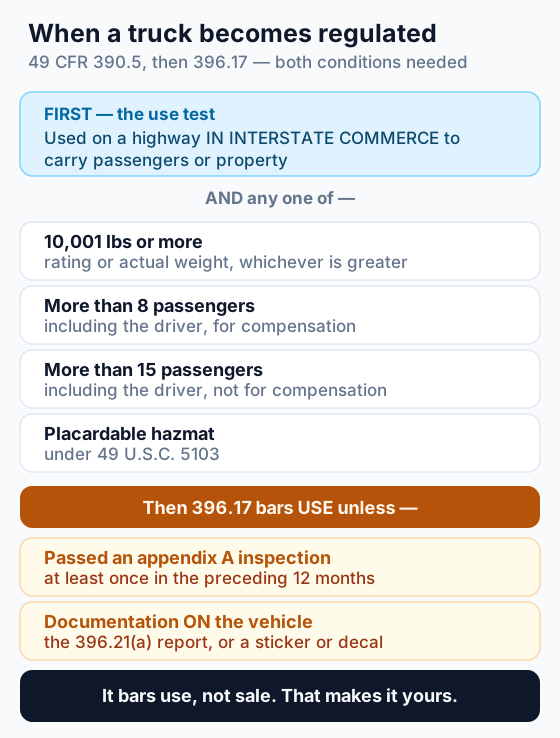
Rating or actual weight, whichever is greater
The weight test is worded more carefully than most summaries of it. The regulation reads gross vehicle weight rating or gross combination weight rating, or gross vehicle weight or gross combination weight, of 4,536 kg (10,001 pounds) or more, whichever is greater.
Two consequences follow. First, a combination counts — a lighter truck towing a trailer can reach the threshold through its gross combination figure even where the truck alone would not. Second, actual weight is in the test alongside the rating, so a vehicle loaded past a modest rating is not outside the definition simply because its label says a smaller number.
Where the number is actually written
The rating is not a specification you have to take on trust from a listing. It is on the certification label the manufacturer is required to affix, usually on the driver’s door or door jamb, and it states the gross vehicle weight rating along with the axle ratings. Our towing capacity guide covers what those figures are and are not, and the label itself is covered in the pages that deal with the federal certification requirements.
On a used truck the label is worth finding for a second reason: it is also where you discover whether the vehicle was completed by a second-stage manufacturer, which is normal on box trucks and cutaways and affects who certified what. Check that the label is present and legible. A missing certification label on a working truck is a question rather than a detail.
The twelve-month rule
49 CFR 396.17(a) requires that every commercial motor vehicle be inspected, and that the inspection cover at minimum the parts and accessories set forth in appendix A to part 396. The regulation is explicit that in a combination each unit counts separately — for a tractor, semitrailer and full trailer, each is inspected, including the converter dolly where fitted.
The operative sentence is in 396.17(c), and it is a prohibition on use rather than a duty to file something:
The paperwork has to be on the truck
The documentation requirement is specific about location, which catches people out. It may be the inspection report prepared in accordance with 396.21(a), or another form of documentation based on that report — a sticker or decal, for example. What it may not be is a report that exists only in an office or an inbox.
For a buyer that turns an abstract compliance question into a concrete thing to look for. When you go to view the truck, look for the inspection decal or the report in the cab, and ask for its date. If neither is present, you are not looking at a truck that is ready to work, whatever else is true about it.
Who is allowed to inspect it, and why that affects the price of fixing this
The rule offers more than one route, and knowing them tells you what remediation costs if the truck you want has no current inspection.
- 1The carrier may inspect its own vehicles396.17(d) allows a motor carrier to perform the required annual inspection for vehicles under its control, subject to the exception in 396.23(a)(1).
- 2Or use a commercial business as its agent396.17(e) permits a commercial garage, fleet leasing company, truck stop or similar business to perform it, provided that business operates and maintains appropriate facilities and employs qualified inspectors.
- 3The inspector has to be qualified, and the rule says howUnder 396.19, an inspector must understand the criteria in part 393 and appendix A and identify defective components, have mastered the methods, procedures, tools and equipment, and be capable by experience or training — including a Federal or State sponsored training program or a qualifying state or Canadian certificate.
- 4A qualifying state inspection can count396.17(f) recognizes vehicles passing periodic inspections performed under the auspices of a state government or an equivalent jurisdiction that meet the appendix A minimum standards.
So an out-of-date truck is not unfixable — it is a scheduling and cost problem with several routes through it. The point of establishing that before purchase is that it is a number you can put into the offer rather than a surprise you absorb afterward.
Appendix A is a pre-purchase checklist somebody already wrote for you
Appendix A to part 396 is titled Minimum Periodic Inspection Standards, and it opens with a sentence that makes it unusually useful to a buyer: a vehicle does not pass an inspection if it has one of the following defects or deficiencies. It is not a list of things to check. It is a list of things that fail.
Its fifteen top-level categories are, in the regulation’s own order:
- Brake system — including missing or broken components, loose components and audible air leaks
- Coupling devices
- Exhaust system
- Fuel system
- Lighting devices
- Safe loading
- Steering mechanism
- Suspension
- Frame
- Tires
- Wheels and rims
- Windshield glazing
- Windshield wipers
- Motorcoach seats
- Rear impact guard
Read as a shopping tool rather than as a compliance document, that list is the cheapest thing on this page. It tells you which systems a professional inspector is obliged to reject the vehicle over, which is a far better guide to where money hides on a working truck than a general used-car checklist. Frame, suspension and brakes at the top of a box truck’s problem list is not a coincidence — it is what carrying loads does.
The report has to name what failed, which makes it a history document
49 CFR 396.21(a)sets out what the qualified inspector’s report must contain, and one of its six elements is worth a buyer’s attention out of all proportion to the others.
| The report must identify | Why it matters to you |
|---|---|
| The individual performing the inspection | Traceability, and a name you can ask about |
| The motor carrier operating the vehicle | Who was running it, which is part of the truck's story |
| The date of the inspection | The twelve-month clock runs from here |
| The vehicle inspected | Ties the document to this specific truck rather than a fleet |
| The components inspected and the results — including those NOT meeting the appendix A minimums | A named list of what was wrong at the time. This is the closest thing to a service history that a commercial vehicle reliably carries |
| A certification of accuracy and completeness | The inspector is standing behind it |
A seller who can produce two or three years of these reports has handed you something better than assurances: a dated record of which systems have been failing and how often. A truck whose reports repeatedly flag the same category is telling you where its next bill is coming from, and a truck with clean consecutive reports is evidence of maintenance rather than a claim about it.
What this means when you are the one buying
The asymmetry is worth stating plainly. Nothing in 396.17 prevents anyone from selling you a truck with no current inspection. The prohibition is on use, and use is what you intend to do with it on Monday.
- A truck without current documentation is a truck you cannot lawfully put to work on delivery
- The remedy is an inspection against appendix A, which may find defects that need repair before it passes
- That is exactly why the inspection status is worth establishing before the price is agreed rather than after
- A seller who has kept current inspections is also a seller who has been maintaining to a standard — the paperwork is evidence about the truck as well as about compliance
- Conversely, a long gap in inspection history on a working truck is worth asking about directly
Decode the VIN for the build and open recalls
Decoded from official manufacturer and NHTSA records
What this page is deliberately not telling you
Commercial vehicle regulation is much larger than one inspection rule, and it would be easy to imply this page covers more than it does. It does not.
- Whether your operation is in interstate commerce is a question about the nature of the transportation, not simply about crossing a state line — get a definitive answer for your own case
- USDOT number registration, driver qualification files, hours of service, drug and alcohol programs and CDL requirements are separate obligations under other parts, and this page does not attempt to summarize them
- State rules can apply on top, and some states extend similar requirements to intrastate operations
- Nothing here is legal advice about your business — it is what two specific federal sections say, quoted so you can check them yourself
The reason to be strict about that boundary is that a buyer who reads a single compliance article and concludes they are compliant is worse off than one who knows which questions remain open. The inspection rule is the one that most directly affects the purchase decision, which is why it is the one covered here.
What to check before you pay
- The certification label, for the gross vehicle weight rating — and the combination figure if it will tow
- The inspection decal or the report in the cab, and its date
- Whether the seller can produce the previous inspection reports as a maintenance record
- Open safety recalls on the VIN, which are free to check and free to remedy
- The usual used-vehicle record checks — title brands, liens and odometer — which do not stop applying because the vehicle is commercial
- The body and its mounting on a box truck, since the body may have been fitted by a different manufacturer than the chassis
- The rear impact guard, which is its own appendix A category and an expensive item to put right on a truck that has been reversed into things
When to walk
A used commercial vehicle rewards patience more than a car does, because the population is smaller, the buyers are mostly businesses, and the ones that have been maintained to a documented standard are identifiable rather than a matter of instinct. That makes walking away cheaper than it feels: the next truck is a known quantity in a way the next used sedan is not.
- No certification label, or a rating that does not match what the seller told you
- No inspection documentation and no clear account of when it last passed
- A seller who treats the inspection question as unusual — on a working truck it is routine
- Repairs that would be needed to pass appendix A costing more than the discount on offer
- Any pressure to complete before you have established the inspection status, which takes one question
- A truck whose inspection reports keep flagging the same appendix A category year after year
Where this information comes from
- 49 CFR 390.5 — definitionsThe commercial motor vehicle definition, including the 10,001 pound test and the passenger and hazmat routes
- 49 CFR 396.17 — periodic inspectionThe appendix A scope, the 12-month prohibition on use, the documentation-on-the-vehicle requirement and the self-inspection and agent routes
- 49 CFR 396.21 — periodic inspection recordkeepingThe six things the inspector's report must identify, including the components that failed appendix A
- 49 CFR 396.19 — inspector qualificationsWhat makes an inspector qualified to perform the annual inspection
- NHTSA recall lookupOpen safety campaigns by VIN, free, and applicable to trucks as well as cars
Keep reading
Frequently asked questions
When does a used truck become a commercial motor vehicle?
49 CFR 390.5 defines it by use and weight together. A self-propelled or towed vehicle used on a highway in interstate commerce to transport passengers or property is a commercial motor vehicle when it has a gross vehicle weight rating or gross combination weight rating, or an actual gross weight, of 4,536 kg (10,001 pounds) or more, whichever is greater. Passenger counts and placardable hazmat are separate routes to the same status.
Does a used box truck need a federal annual inspection?
If it is a commercial motor vehicle, yes. Under 49 CFR 396.17 every such vehicle must be inspected against at minimum the parts and accessories in appendix A to part 396, and a motor carrier must not use it unless each of those components passed an inspection at least once during the preceding 12 months.
Does the inspection paperwork have to be in the truck?
Yes. 396.17(c) requires that documentation of the inspection is on the vehicle. That can be the inspection report prepared under 396.21(a), or another form of documentation based on that report, such as a sticker or decal. A report sitting in an office does not satisfy it.
Who is allowed to perform the annual inspection?
A motor carrier may perform it itself for vehicles under its control, or may have a commercial garage, fleet leasing company, truck stop or similar commercial business do it as its agent, provided that business has appropriate facilities and employs qualified inspectors as defined in 49 CFR 396.19. A qualifying state periodic inspection can also satisfy the requirement.
Do these rules apply if I only drive the truck locally?
The definition in 390.5 turns on use in interstate commerce, which is a question about the nature of the transportation rather than simply about crossing a state line. It is the part most first-time buyers get wrong in both directions, and it is worth getting a definitive answer for your own operation before you rely on either reading.
Check the VIN before you check the decal
Decode any VIN free for the factory build, specifications and open safety recalls. No account, no card. Full vehicle history reports are launching soon.
Run a free VIN check