The short answer
- How do you check a car's history in Ohio?
- Run the free national checks — VIN decode, NHTSA recalls, NICB theft and salvage — then the national NMVTIS title record through an approved provider. On a rebuilt Ohio car, understand what the Highway Patrol inspection covered: parts provenance, not repair quality.
- What is the Ohio-specific trap?
- Treating the salvage inspection as a quality certificate. It verifies the VIN and parts receipts against theft records — a genuinely useful anti-theft check — but says nothing about whether the frame was straightened correctly.
- Can you look up a license plate in Ohio?
- Private individuals cannot get an owner from a plate — the federal Driver's Privacy Protection Act restricts it to permitted uses. Ask the seller for the VIN, which unlocks every check that matters.
OSHP
Who inspects salvage rebuilds
Anti-theft, not quality
Notary
Required on Ohio titles
Like NC and PA
NE Ohio
Where E-Check applies
Cleveland-area counties
DPPA
Why plate lookups are restricted
Federal privacy law
The Highway Patrol salvage inspection
When an Ohio salvage vehicle is repaired and its owner wants it retitled for the road, the state requires an inspection by the Ohio State Highway Patrol first. The rebuilder brings the car, the receipts for the major parts used in the repair, and the paperwork trail; the inspector verifies the VIN is genuine and checks the parts against theft records.
This is a real and valuable process — it is one of the stronger anti-theft regimes in the country, and it makes a VIN-swapped or stolen-parts rebuild materially harder to title in Ohio than in states with no inspection at all.
What it proves — and what it deliberately does not
| The inspection checks | The inspection does not check |
|---|---|
| That the VIN is genuine and unaltered | Whether the frame was straightened to specification |
| That major parts have receipts and are not stolen | Whether the airbags were properly replaced |
| That the paperwork trail supports the rebuild | Whether the welds, alignment or structure are sound |
The notarized title
Ohio is one of the handful of states that requires the title assignment to be notarized at sale. Sign the title at a bank or in front of a notary, not in a driveway — an unnotarized Ohio title is an incomplete transfer that stalls at the county clerk of courts office, and finding the seller again to fix it is your problem, not theirs.
Ohio's titles run through the county clerks of courts under the state BMV, so the clerk's office is where the transfer completes once the notarized title is in hand.
E-Check: northeast Ohio only
Ohio's emissions program, E-Check, applies only in the Cleveland-area counties of northeast Ohio, where most gasoline vehicles within a defined age range need a passing test for registration. Columbus, Cincinnati and the rest of the state have no emissions testing at all.
A salt state, quietly
Ohio salts its roads like the rest of the Great Lakes region, and everything in the Michigan corrosion guide applies: frame rails, brake lines, subframes and fasteners, inspected on a lift, with fresh undercoating treated as a question rather than an answer.
The Ohio wrinkle is the north-south gradient — a Toledo or Cleveland car has lived a saltier life than a Cincinnati one, and the title history tells you which you are looking at.
The federal complaint record has no word for rust
If you are buying in Ohio, corrosion is the failure mode you care about most, and it is the one the national data cannot show you. We checked rather than assumed.
Across the 60 nameplates and 835 model years of NHTSA complaint data we hold, complaints resolve into 31 component categories. The number of those categories that name corrosion, rust or salt is 0. There is no such category. The taxonomy codes the system that failed — steering, brakes, structure — and never the reason it failed.
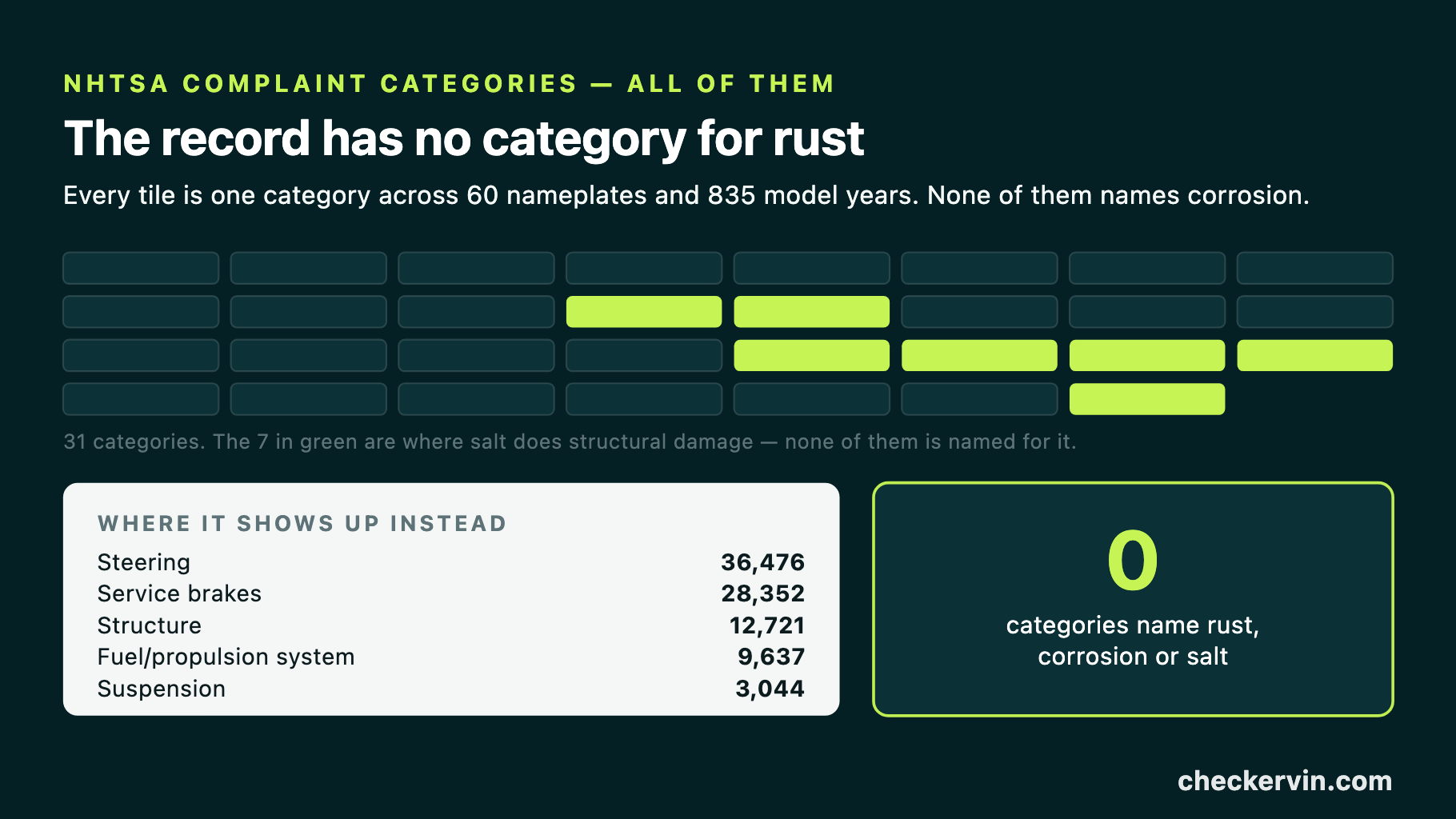
This is worth saying plainly on an Ohio page because the salt belt is exactly where buyers go looking for that reassurance, and the absence of results reads like good news when it is really no news at all.
It applies to our own report too, and we would rather say so than let the omission do the talking. A free decode returns what the vehicle was built as and any open safety recall against it, both from federal sources. Neither of those records has a corrosion field either, because neither was built to hold one. Any VIN service that claims to tell you whether a specific car has rusted is describing something it cannot see — the only instrument for that question is a person underneath the vehicle with a light.
Where salt damage does show up in the record
The cause is invisible, but the systems are not. If corrosion is going to end a vehicle's life in Ohio, it does so through a small number of load-bearing systems, and those systems carry a great deal of complaint volume nationally.
| System | Complaints in the dataset |
|---|---|
| Steering | 36,476 |
| Service brakes | 28,352 |
| Structure | 12,721 |
| Fuel/propulsion | 9,637 |
| Suspension | 3,044 |
| Fuel system | 1,402 |
| Wheels | 246 |
Those 7 systems account for 91,878 complaints, or about 22.6% of every categorized complaint in the set. Read that number carefully: it is not a rust figure. Most of those complaints have nothing to do with corrosion, and the dataset is national rather than Ohio. What the list is good for is telling you where to point a flashlight, because these are the systems where a salt state does its damage and where the consequences are structural rather than cosmetic.
- Brake and fuel lines where they run along the underbody, not just at the wheels
- Suspension mounting points and subframe seams, which fail at the attachment rather than the part
- Rocker panels and floor pans from underneath, where a repaint hides nothing
- The spare well and trunk floor, which collect water nobody looks for
- Exhaust hangers and heat shields, the cheapest early warning you will get
One practical note on timing. Salt damage is easiest to read in late winter and early spring, when the season's residue is still on the car and nothing has been washed away for a summer of photographs. A vehicle listed in March with a filthy underbody is showing you more than the same vehicle listed in August after a detail — which is an argument for looking underneath at the least convenient time of year rather than the most pleasant one.
Plate privacy is federal here too
Ohio's BMV, like every state agency, answers to the DPPA: owner identities go to permitted users, not private lookups. The full legal picture is on the license plate lookup guide.
Why Ohio's notarized title is a stronger document than most
Ohio's notarization requirement is usually described as friction — one more errand between you and the car. Set it against the federal odometer rule and it turns into something more useful than friction.
The federal rule is 49 CFR Part 580, and it is specific about location. Section 580.5(c) requires the seller to disclose the mileage “on the physical or electronic title,” and where the vehicle is titled in the seller's own name it says the disclosure goes on the title “and not on a reassignment document.” The phrase bill of sale appears nowhere in Part 580.
So the odometer statement lives on the title, and in Ohio that title is executed in front of a notary. The practical consequence is that an Ohio transfer produces a mileage statement made by an identified person whose identity was checked at the moment of signing. In most states the same statement is a signature nobody witnessed.
| What the federal rule requires in the disclosure | Why it matters to you |
|---|---|
| The odometer reading at transfer, not including tenths | The number a later rollback would have to contradict |
| The date of transfer | Anchors the reading to a point in the chain |
| The seller's printed name and current address | Names the person who made the statement |
| The buyer's printed name and current address | Puts you in the chain rather than beside it |
| Make, model, year, body type and the VIN | Ties the statement to one specific vehicle |
The last row is the one to hold onto. The disclosure is required to carry the VIN, which is why the number on the title and the number on the car have to agree before you sign anything — and why our odometer rollback check starts from the VIN rather than from the number on the dash.
What Ohio sends to the national record, and what it does not
Behind every state title system sits the National Motor Vehicle Title Information System, and what states must feed it is set federally by 28 CFR Part 25. Knowing the list tells you what an Ohio history can contain at best.
- The VIN
- Any description of the vehicle on the certificate of title, including every brand on it
- The name of the individual or entity the certificate was issued to
- Information from junk yards, salvage yards and insurers about acquiring the vehicle
- The odometer disclosure required by 49 U.S.C. 32705
Five elements, transmitted at least once every twenty-four hours, and every one of them text. There is no photograph in that list, no inspection report, and no record of the rust that will actually decide how long the car lasts here. Section 25.55 asks insurance carriers for the fact of a total loss and only encouragesthem to say why — so “this was a flood car” and “this was a collision” can both arrive as the same entry.
That is the honest ceiling on any Ohio VIN check, ours included. It is a title and brand record, and it is very good at what it does: it will tell you that a vehicle was branded, by whom and when. Our NMVTIS report page covers the system in full.
The Ohio check sequence
- 1Run the free national checksVIN decode, NHTSA recalls, NICB theft and salvage — all free, all before money moves.
- 2Pull the national title record — a few dollarsThrough an NMVTIS approved provider. On a rebuilt car, this shows the salvage history the inspection was built on.
- 3On a rebuilt car, get your own inspectionThe Highway Patrol checked the parts' provenance. Frame, airbags and repair quality are still yours to verify.
- 4Inspect underneathSalt-state rules apply, hardest on cars from the lake counties.
- 5Check the E-Check positionNortheast Ohio registrations carry the testing obligation; the rest of the state does not.
- 6Close in front of a notary, then the clerk of courtsNo notary, no complete transfer. The county clerk's office finishes the job.
A missing E-Check record is a fact about geography
Ohio's emissions program is county-scoped rather than statewide, which produces a second absence worth understanding alongside the corrosion one. A used Ohio car may have no emissions test history at all, and that tells you almost nothing about the car.
Two vehicles in identical condition will have completely different records depending on where they were registered. One accumulates a test history; the other never enters the program. So an empty emissions record is a statement about the county the car lived in, not about its exhaust — and reading it as reassurance is the same error as reading an empty rust search as reassurance.
| What you might conclude | What the record actually supports |
|---|---|
| No failed tests, so it runs clean | It may never have been tested at all |
| It has a test history, so it is a city car | Only that it was registered in a program county |
| Testing lapsed, so something is wrong | Registration may simply have moved counties |
| A pass means the engine is healthy | A pass is an emissions threshold, not a mechanical opinion |
The useful move is to find out where the car actually spent its life and let that inform what you inspect, rather than treating the presence or absence of a test as a verdict. A vehicle that lived where roads are salted and never saw an emissions bay is not a suspicious car; it is a rural Ohio car, and the thing to examine is underneath it rather than in its paperwork.
Why we are not ranking nameplates by rust risk
Having established that the record has no corrosion category, the obvious next move is to build a proxy — rank nameplates by how much of their complaint volume sits in the exposed systems and publish the leaderboard. We built it, looked at it, and are not publishing it. The reason is worth more to you than the table would have been.
The spread across the 60nameplates is enormous, from roughly half of a model's categorized complaints sitting in those systems down to almost none. That looks like signal. It is not, or at least not the signal an Ohio buyer wants, because the systems concentrate complaints for reasons that have nothing to do with salt. A nameplate with a well-documented power-steering fault posts thousands of steering complaints in Arizona and Florida too. The proxy cannot separate a rusted brake line from a brake design that was recalled, and on a page about a salt state, publishing it would invite exactly that inference.
What survives is the narrower claim already made above: these are the systems where salt does structural damage, so these are the systems to inspect on a car that has wintered here. That is a statement about where to look, and it does not pretend to be a statement about which badge to buy.
Reading a car that has spent winters here
Everything above points the same way: the paperwork answers identity and legal status, and the metal answers the question that decides whether the car is worth owning in Ohio. Both matter, and they are checked in a particular order because each one can end the conversation.
- 1Start with the VIN, before you travelDecode it and run it for open safety recalls, which are repaired free by the manufacturer regardless of how many owners the car has had. This costs nothing and rules out a wasted trip.
- 2Read the title before you read the carOhio's notarized title carries the federal odometer disclosure and any brand on the vehicle. A brand or a mileage that disagrees with the advert ends it here, on paper, at no cost.
- 3Then get underneath it, in daylightBrake and fuel lines along their whole run, suspension mounting points, subframe seams, rocker panels and the spare well. A car that photographs beautifully from three feet can be finished underneath.
- 4Treat a fresh undercoating as a question, not an answerNew underbody coating on a used car is either diligent maintenance or a covering. It is not possible to tell from above, and the seller will know which it is.
- 5Book the inspection for what the record cannot holdStructure, welds and corrosion are precisely the things absent from every database on this page. That is the gap a physical inspection exists to fill, and in a salt state it is the gap that matters most.
The order matters because it is cheapest at the top. The VIN check is free, the title reading is free, and only the last step costs money — by which point you already know whether the car is worth spending it on.
Where this information comes from
- Ohio BMVOhio's vehicle agency — titles run through county clerks of courts
- NMVTIS — National Motor Vehicle Title Information SystemThe national title record, covering brands from every reporting state
- NICB VINCheckFree theft and salvage lookup from participating insurers
- NHTSA recall lookupFree open-recall check by VIN
Keep reading
Frequently asked questions
How do I check a VIN in Ohio?
Run the free national checks — a VIN decode, the NHTSA recall lookup and the NICB theft and salvage search — then pull the national NMVTIS title record through an approved provider. Ohio titles run through the county clerks of courts under the state BMV, and transfers must be notarized.
What is Ohio's salvage inspection?
Before a salvage vehicle can be retitled for road use, Ohio requires an inspection by the State Highway Patrol. It verifies the VIN and checks receipts for major parts against theft records. It is an anti-theft inspection — it does not certify that the repair was done well.
Does Ohio require notarized titles?
Yes. Like North Carolina and Pennsylvania, Ohio requires the title assignment to be notarized when a vehicle is sold. A title signed in a driveway without a notary is an incomplete transfer that will stall at the clerk of courts office.
Does Ohio have emissions testing?
Only in the Cleveland-area counties of northeast Ohio, where the E-Check program applies to most gasoline vehicles within a defined age range. The rest of the state — including Columbus and Cincinnati — has no emissions testing.
Can I look up a license plate owner in Ohio?
Not as a private individual. The federal Driver's Privacy Protection Act limits personal information in motor vehicle records to enumerated permitted uses, and checking on another driver is not among them. In a purchase, ask for the VIN instead.
Check an Ohio car before the deposit
Decode any VIN free for the factory build, specifications and open safety recalls. No account, no card.
Run a free VIN check