The short answer
- How do you read a Buick VIN?
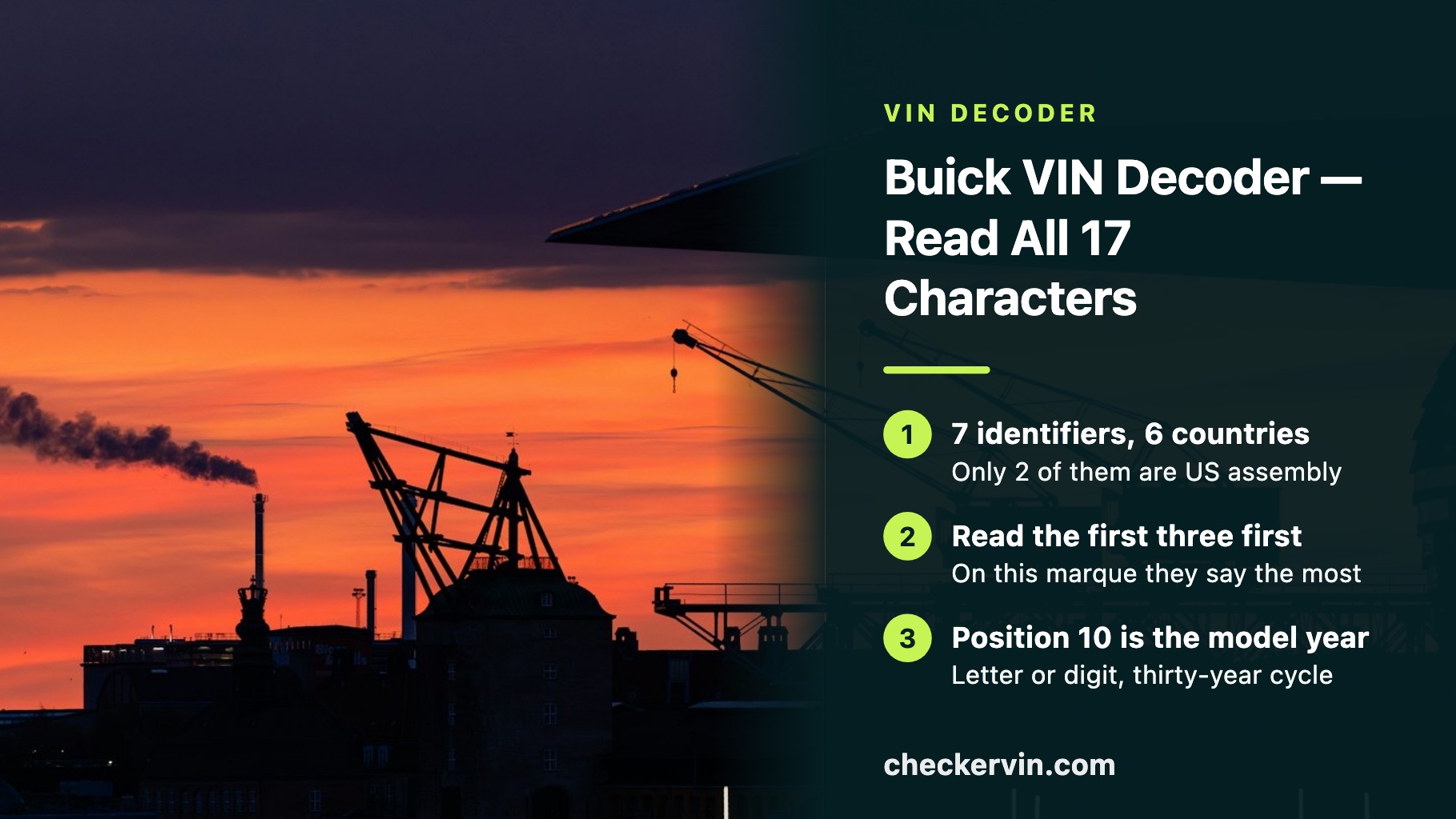
- The first three characters identify the manufacturer and vehicle type — 1G4 for a US-built Buick car, 5GA for a US-built Buick SUV, and KL4, LRB or W04 for the imported ones. Positions four to eight are General Motors' own coding, nine is a check digit, ten is the model year and eleven is the assembly plant.
- What is unusual about Buick VINs specifically?
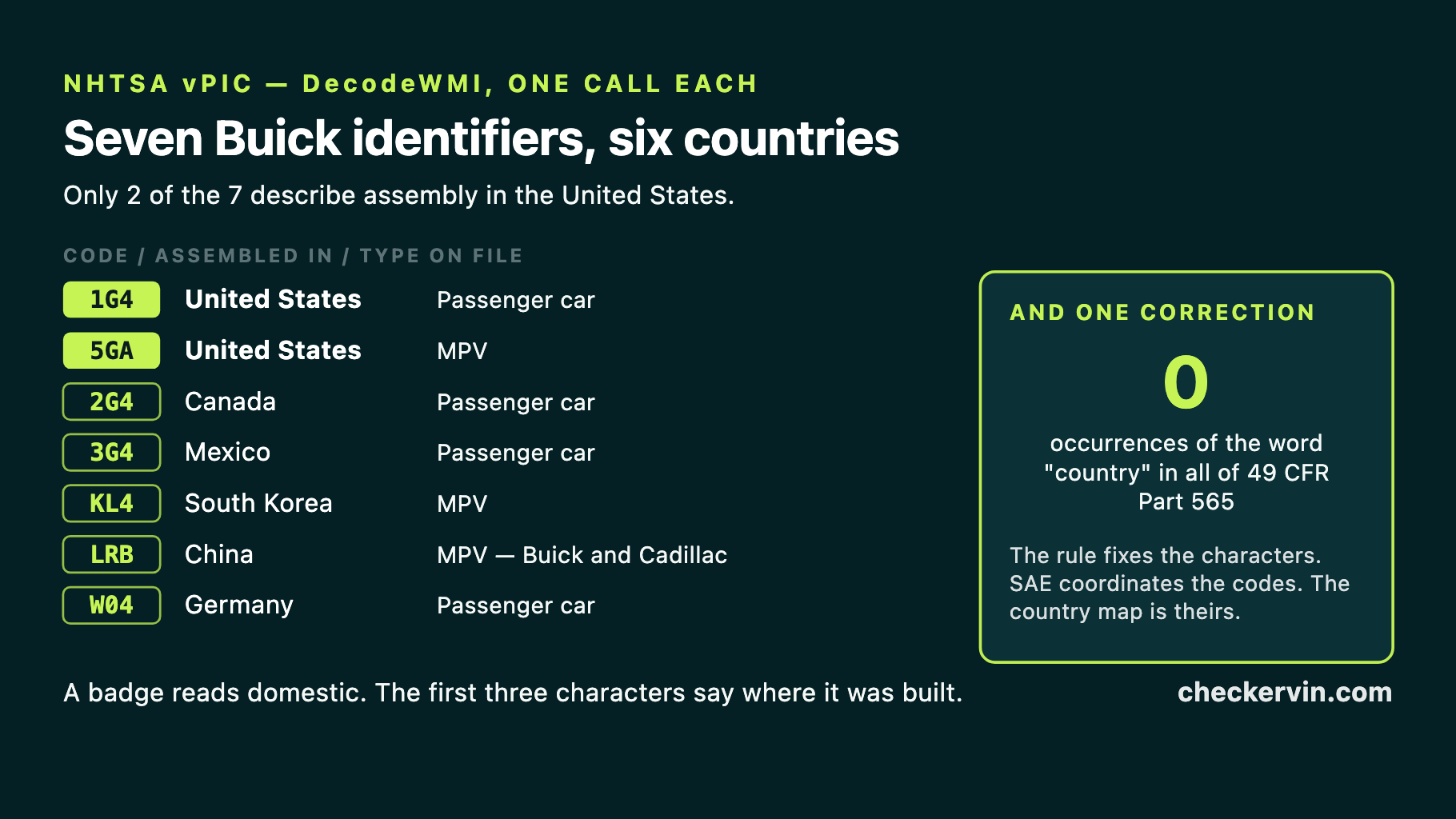
- The spread. 7 identifiers across 6 countries, of which only 2 are United States assembly. For a marque most people read as domestic, 5 of its 7 codes describe a vehicle built somewhere else.
- Does a free Buick VIN decode tell me enough?
- For build facts, yes. Model year, body class, engine, drivetrain, restraint system and plant come back free from the federal vPIC database, along with any open safety recalls on that specific vehicle.
7
Buick identifiers verified
Across 6 countries
2
Of them are US assembly
5 are not
0
Times 'country' appears in 49 CFR 565
The rule never mentions it
10th
Character is the model year
Letter or digit, 30-year cycle
The short answer
A VIN is an identity document for a machine. It records what the vehicle was built as and where it was put together, and it does not change for the life of the car. On most marques the first three characters are a formality — you already know who made it. On Buick they are the most informative characters in the number.
General Motors has assembled Buicks in North America, Asia and Europe, and each combination of plant country and vehicle type gets its own manufacturer identifier. So the badge on the grille tells you the marque and almost nothing else about origin, while the first three characters of the VIN tell you precisely.
Seven identifiers across six countries
We put each Buick manufacturer identifier through NHTSA's vPIC DecodeWMI endpoint individually rather than copying a table from another decoder. Every one returns General Motors as the manufacturer; what differs is the vehicle type and, by the leading character, the place of assembly.
| Identifier | Where it was assembled, and what the federal database calls it |
|---|---|
| 1G4 | United States — Passenger car |
| 5GA | United States — Multipurpose passenger vehicle |
| 2G4 | Canada — Passenger car |
| 3G4 | Mexico — Passenger car |
| KL4 | South Korea — Multipurpose passenger vehicle |
| LRB | China — Multipurpose passenger vehicle (returns make as Buick and Cadillac) |
| W04 | Germany — Passenger car |
Read the middle column and the shape is obvious: 2 of the 7 identifiers describe United States assembly and 5 do not. That is not a criticism of the marque and it does not make an imported Buick a lesser one — it is simply a fact about a global manufacturer that the badge cannot convey and the VIN states plainly.
Where the country rule actually lives, and where it does not
Almost every decoder page states that the first character of a VIN is the country of manufacture “under federal regulation.” We went to read the regulation and that is not what it says.
49 CFR § 565.15(a) provides that the first section “shall consist of three characters that occupy positions one through three” and “shall uniquely identify the manufacturer and type of the motor vehicle.” Manufacturer and type. Searching the whole of Part 565 for the word country returns nothing at all — the regulation never mentions it, and it does not use the phrase world manufacturer identifier either.
What the rule does say is who hands the codes out. Under § 565.14, NHTSA “has contracted with the SAE International to coordinate the assignment of manufacturer identifiers to manufacturers in the United States,” supplied at no charge. The country mapping — 1 for the United States, 2 Canada, 3 Mexico, K South Korea, L China, W Germany — belongs to that international assignment scheme, not to the Code of Federal Regulations.
Why one marque needs seven codes at all
A reasonable question at this point is why General Motors does not simply use one identifier for every Buick. The answer is in the regulation, and it is the piece that makes the whole table above make sense rather than look arbitrary.
Section 565.15(a) requires the first three characters to identify “the manufacturer and typeof the motor vehicle.” Not the manufacturer alone — the type as well. And § 565.12 defines type narrowly: “a class of vehicle distinguished by common traits, including design and purpose,” going on to state that “passenger cars, multipurpose passenger vehicles, trucks, buses, trailers, incomplete vehicles, low speed vehicles, and motorcycles are separate types.”
So a passenger car and a multipurpose passenger vehicle are, in federal terms, two different kinds of thing, and a manufacturer identifier that covered both would fail to identify the type. That is why 1G4 and 5GA are both United States Buick codes and both necessary: one carries cars, the other carries the vehicles classified as MPVs. Multiply that by the countries of assembly and seven codes stops looking like clutter and starts looking like arithmetic.
The Chinese-built Buicks
LRB is the identifier that surprises people most, and it is not a marginal one. It decodes as General Motors, multipurpose passenger vehicle, with the make returned as Buick and Cadillac, and the leading L places assembly in China.
This matters commercially because the badge gives no hint of it. A buyer comparing two Buick crossovers on a lot may be looking at one assembled in the United States and one assembled in China, with nothing on the exterior to distinguish them and nothing in the sales conversation likely to raise it. The VIN raises it in three characters.
Whether that should change your decision is a separate question, and the honest answer is that country of assembly is a weak predictor of how a particular car will hold up compared with model year, maintenance and how it was driven. What it does reliably affect is parts sourcing on older vehicles and, occasionally, the scope of a recall.
The Korean-built Buicks
KL4 decodes as General Motors, a multipurpose passenger vehicle, with the leading K placing assembly in South Korea — the same manufacturing base that supplies several other General Motors marques.
The instructive comparison is with its neighbors in the identifier list. KL7 decodes as Chevrolet and KL1 also as Chevrolet, from the same Korean operation. Three identifiers, one country, two badges — which is the cleanest possible demonstration that the manufacturer identifier records a manufacturer and a plant, not a brand identity. Our GM VIN decodercovers the group-level map across all of General Motors' divisions.
The German-built Buick
W04 is the outlier that most surprises people who know the marque. It decodes as General Motors, passenger car, and the leading W places assembly in Germany.
For a period General Motors owned a European car maker, and vehicles engineered and built there were sold in the United States wearing a Buick badge. The VIN is the part of such a car that never pretended otherwise: whatever the grille said, the first three characters recorded a German-built passenger car.
If you are looking at an older Buick sedan and the VIN opens W04, that is what you have — and it is worth knowing before you order parts, because the supply chain for a European-built car is not always the one a domestic parts catalog assumes.
The 17 characters, position by position
| Position | What it encodes |
|---|---|
| 1–3 | Manufacturer identifier — the manufacturer and vehicle type |
| 4–8 | Descriptor section — five characters of General Motors' own coding |
| 9 | Check digit, computed from the other sixteen characters |
| 10 | Model year |
| 11 | Assembly plant |
| 12–17 | Sequential production number, unique to that vehicle at that plant |
Those boundaries are federal. Section 565.15(b) fixes the second section at five characters occupying positions four through eight, and says the characters used within it “may be determined by the manufacturer” provided the attributes remain “decipherable with information provided by the manufacturer.” So General Motors chooses what goes in positions four to eight, and is required to make it readable rather than secret. Our guide to reading a VIN works through the check digit arithmetic in full.
Position 10: reading the model year
The tenth character encodes model year on a thirty-year cycle, skipping I, O, Q, U and Z because they are too easily confused with digits and with each other.
| Code | Model year |
|---|---|
| A | 2010 |
| B | 2011 |
| C | 2012 |
| D | 2013 |
| E | 2014 |
| F | 2015 |
| G | 2016 |
| H | 2017 |
| J | 2018 |
| K | 2019 |
| L | 2020 |
| M | 2021 |
| N | 2022 |
| P | 2023 |
| R | 2024 |
| S | 2025 |
| T | 2026 |
The digits 1 through 9 covered model years 2001 to 2009, and before that the same letters ran from 1980 to 2000. A letter alone is therefore ambiguous across thirty years, which is resolved by reading it together with the manufacturer identifier and the vehicle's generation rather than in isolation.
Position 11: which plant assembled it
The eleventh character identifies the assembly plant. Because Buick production has moved between countries and facilities over the years, plant codes have been reassigned as sites opened, closed and changed products, so a static table is a poor guide.
A decode resolves the character against the model year and vehicle line, which is the only reliable way to name a plant correctly. It also matters more than most people expect for recalls, because manufacturers frequently scope a recall to vehicles built at one plant between two specific dates rather than to a model line as a whole.
What country of assembly does and does not change
It would be easy to over-read the origin story on this page, so here is the honest balance.
- Warranty terms attach to the vehicle as sold in this market, not to the plant that built it
- Safety recall obligations are identical regardless of assembly country
- Parts availability can differ on older vehicles, particularly for European-built cars
- Recall scope is often plant-specific and date-specific, so origin decides whether a given recall applies
- Country of assembly is a weak predictor of durability next to model year, maintenance and use
- Resale value responds to model, mileage and condition rather than to the leading VIN character
The reason to decode is not that an imported Buick is worse. It is that you should know what you are buying before you price parts for something else, and that a seller who cannot tell you where the car was built has told you how well they know it.
The recall point deserves expanding, because it is the one place where origin has a hard, checkable consequence rather than a vague one. Manufacturers routinely scope a recall not to a model but to vehicles produced at a named plant between two dates — because that is how a defective batch of parts actually enters production. When a recall is written that way, two cars of the same model year and trim can sit side by side with only one of them inside the population, and the thing that separates them is the plant character at position eleven together with the build date on the door label.
This cuts both ways, and the second way is the one people miss. A recall that does not apply to your car is as useful to know as one that does: it stops you paying for an inspection you do not need, and it stops a seller discounting a car for a defect it was never exposed to. On a marque assembled in six countries that is not a rare situation — it is the normal one, and the VIN is what resolves it in either direction.
Reading origin off your own Buick in ten seconds
None of this requires a tool. If the car is in front of you, the whole question resolves from the windshield plate.
- 1Read the first character only1, 4 or 5 is United States assembly. 2 is Canada, 3 is Mexico. A letter means it was not built in North America at all — K for South Korea, L for China, W for Germany on this marque.
- 2Read characters two and three for the typeOn a Buick the pairing tells you what the federal record calls it: G4 with a leading 1, 2 or 3 is a passenger car, GA with a leading 5 is a multipurpose passenger vehicle, and the imported codes carry their own pairings.
- 3Confirm against the door jamb labelThe label inside the driver's door frame repeats the VIN and adds the month of manufacture. If the plate and the label disagree on any character, stop and resolve that before anything else — it is one of the clearest signs of a cloned or rebuilt identity.
- 4Run the full number for the restOrigin is the part you can read unaided. Engine, drivetrain, restraint system and open recalls come from decoding the whole VIN against the federal database, which costs nothing.
Doing this before a conversation with a seller is worth more than doing it afterwards. A seller who describes a Korean-built crossover as American-made is not necessarily being dishonest — most people genuinely do not know — but it tells you how much of the rest of their description to take on trust.
Decoding a pre-1981 Buick
The 17-character standard became mandatory for the 1981 model year. Buicks built before that use shorter manufacturer-specific formats encoding series, body style, engine, plant and year under General Motors' own scheme rather than the international one.
Modern decoders, including NHTSA's public database, generally do not cover them, which is why the enthusiast references that rank for this search stop around 1980. For a classic Buick you are working from marque-specific documentation and the cowl tag rather than a VIN lookup — our classic car VIN decoder guide covers what those shorter numbers hold, and our GM build sheet page covers the RPO codes and cowl tags that carry the rest.
Checking Buick recalls by VIN
Safety recalls attach to specific VIN ranges rather than to models in general, which is why “was this model recalled?” is the wrong question. The right one is whether this vehicle has an open recall against it.
- 1Read the VIN off the car, not the advertTake it from the windshield plate and confirm it against the driver's door jamb label. A VIN that differs between the two locations is a serious problem in itself.
- 2Run it through NHTSA's free recall lookupThe federal recall service reports open recalls by VIN at no charge, and a manufacturer must remedy a safety defect without cost to the owner however many owners the vehicle has had.
- 3Ask specifically whether a scoped recall appliesWhere a recall is limited to one plant and a date range, the eleventh character and the build date on the door label decide whether your car is inside it.
An unrepaired open recall on a used purchase is both a safety matter and a negotiating point — our page on buying a car with an open recall covers how to treat one.
What a Buick VIN decode will not tell you
A VIN describes the vehicle as built. Everything that happened to it afterwards lives in separate records, and no amount of decoding will surface it.
- Accident history, insurance claims and structural repairs
- Title brands — salvage, rebuilt, flood, lemon
- Odometer readings and rollback evidence
- Number of previous owners and how the vehicle was used
- Service history, including whether a recall was actually performed
- Outstanding liens or theft records
Our free decode returns build data and safety information from federal sources. It does not return history records, and nothing here should be read as a promise that it does.
Where this information comes from
- NHTSA vPIC — DecodeWMIEvery identifier on this page was decoded here individually, not copied
- 49 CFR Part 565 — Vehicle Identification Number requirementsFixes the sections and the check digit; never mentions country
- NHTSA recall lookupFree open-recall check by VIN, repaired at no cost by the manufacturer
- NICB VINCheckFree theft and salvage lookup contributed by participating insurers
Keep reading
Frequently asked questions
What do the first three characters of a Buick VIN mean?
They are the manufacturer identifier, and on a Buick they vary more than on most marques. 1G4 and 5GA are United States assembly, 2G4 is Canada, 3G4 is Mexico, KL4 is South Korea, LRB is China and W04 is Germany. All of them decode to General Motors as the manufacturer.
Why does my Buick VIN start with a letter instead of a number?
Because it was not assembled in North America. A leading K indicates South Korean assembly, L indicates China and W indicates Germany. A Buick with a VIN starting KL4 or LRB is exactly as much a Buick as one starting 1G4 — the character records where it was put together, not what it is.
Is the first character of a VIN really the country?
By convention, yes, but not by federal rule. 49 CFR Part 565 defines the first three characters as identifying the manufacturer and type, and the word country does not appear anywhere in the part. NHTSA contracts with SAE International to coordinate identifier assignment, and the country mapping belongs to that international scheme rather than to the regulation.
Does a Chinese-built Buick have a different warranty?
No. Warranty terms attach to the vehicle as sold in the market, not to the plant that assembled it, and a vehicle sold new through a United States dealer network carries the same coverage regardless of country of assembly. The same is true of safety recall obligations.
Can a VIN decoder identify a pre-1981 Buick?
Generally not. The 17-character standard became mandatory for the 1981 model year, and earlier Buicks use shorter manufacturer-specific schemes that modern decoders, including NHTSA's public database, do not cover. Those need marque-specific references instead.