The short answer
- What does it cost?
- J.D. Power: $80-$250 for a basic change, $230-$475 with a flush and filter. KBB: $150-290. Attributed figures, not ours.
- Is it always 'just maintenance'?
- Almost always — except on two nameplates. POWER TRAIN complaints reach the top five in literally all 9 of the Jeep Cherokee's model years, and 10 of the Ford Focus's 11.
- Why those two?
- Each carries one of the industry's most litigated transmission defects: Jeep's ZF 9-speed (two recalls, two class actions) and Ford's PowerShift dual-clutch (a settlement approved in 2020).
The published cost, attributed
Four sources, four different numbers, none of them ours. J.D. Power puts a basic automatic-transmission fluid change at $80 to $250, averaging around $100 — rising to $230-$475 once a flush and filter replacement are added. A manual-transmission service runs as low as $150, since there is no filter in the job. Kelley Blue Book’s general figures sit close to that: $150-175 for a change, $165-290 for a flush, though its ZIP-based, model-specific estimates run higher — $312-407 for a 2019 Chevrolet Trax near Columbus, $249-327 for a 2023 Mazda3 near Grand Rapids. RepairPal’s own per-location example runs higher still, around $294-356. Every one of those figures is quoted with attribution; we sell VIN checks, not service.
That spread invites the obvious question: is a wide quote a sign something is actually wrong, or just shop-to-shop pricing noise? For the overwhelming majority of cars, the record says it is noise. For two nameplates, it is not.
What 'routine' means across 838 model years
Our corpus holds 432,995 federal complaints across 60 nameplates and 838model-year records. NHTSA’s POWER TRAIN category — transmissions, transfer cases, differentials, driveshafts and the clutch assemblies that connect them — reaches a given model year’s own top-5 complaint categories in 505 of those 838 rows, or 60.3%. On its face, that reads as "sometimes a top concern, usually not" — a reasonable match for "routine service, occasional problem car."
A corpus-wide rate only tells half the story, though. It treats every nameplate as interchangeable, and they are not. The more useful question is not "how common is this overall" but "how common is this for my specific car" — and ranked that way, the record stops looking even at all.
Where it stops being routine
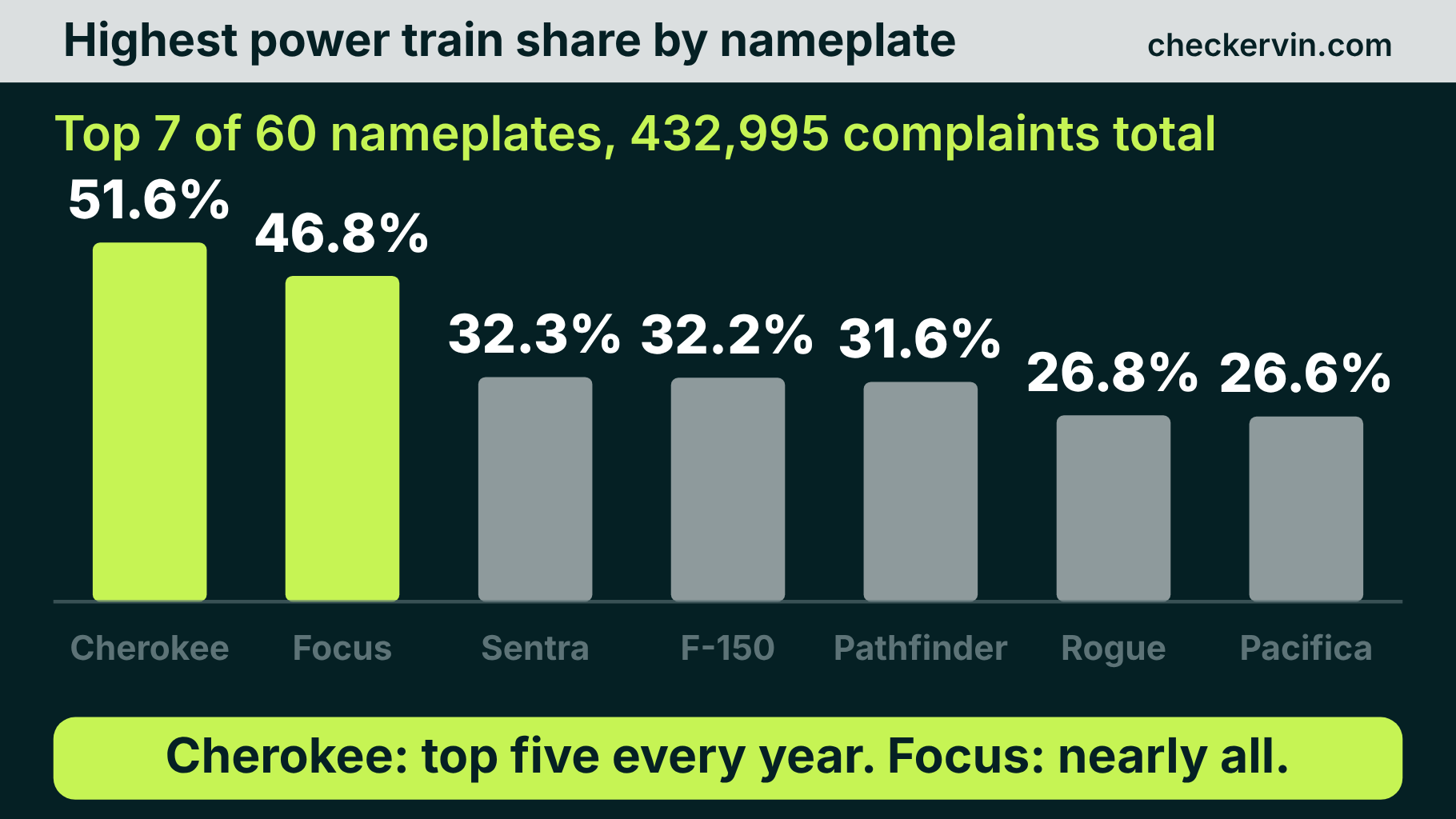
Ranked by each nameplate’s own POWER TRAIN share of its own total complaints — not raw count, so a low-volume nameplate cannot hide behind a popular one’s numbers — two nameplates sit well clear of everything else in our 60-model corpus:
| Nameplate | Power train share of its own complaints |
|---|---|
| Jeep Cherokee | 51.6% (top five in 9 of 9 years) |
| Ford Focus | 46.8% (top five in 10 of 11 years) |
| Nissan Sentra | 32.3% (top five in 11 of 15 years) |
| Ford F-150 | 32.2% (top five in 14 of 15 years) |
| Nissan Pathfinder | 31.6% (top five in 11 of 14 years) |
| Nissan Rogue | 26.8% (top five in 12 of 15 years) |
| Chrysler Pacifica | 26.6% (top five in 6 of 6 years) |
The Jeep Cherokee and Ford Focus are not merely at the top of this list — they are the only two nameplates in the corpus where POWER TRAIN makes a model year’s own top five in nearly every single year the nameplate has on file. That is not how a routine wear item behaves across a 60-model, 15-year dataset. It is how a documented defect behaves.
Jeep Cherokee: every year on record
Across 9model years in our corpus, POWER TRAIN complaints reach that year’s own top-5 category in all 9 of them — 51.6% of every complaint the nameplate has ever logged, the highest share of any of the 60 nameplates we track. The Cherokee’s nine-speed automatic, built by ZF and installed by FCA starting with the 2014 model year, has its own paper trail. Per secondary sources that mirror NHTSA’s recall record, campaign 19V-447 (2019) covers roughly 81,615 model-year-2014 Cherokees with the 3.2-liter V6: a stuck clutch inside the transmission could command a shift to neutral without warning, fixed with a free software update. An earlier campaign, 16V-529 (2016), addressed a wiring-crimp defect producing the same unexpected-neutral symptom on a separate set of cars.
Litigation followed the complaints, not the other way around. Oquendo v. Chrysler Group, filed in New Jersey federal court over 2014 Cherokees, alleged the transmission did not shift properly; it was dismissed in May 2016. Cummings v. FCA US LLC, filed in 2018 in the Northern District of New York, made a similar allegation about 2016 Cherokees. Separately, FCA ran an extended-warranty settlement for 2014-2015 cars equipped with the ZF 9HP, stretching coverage to 6 years or 100,000 miles — its claims deadline, May 15, 2019, has since passed. None of this is a lemon-law verdict on any individual car; it is the documented backdrop against which the Cherokee’s complaint share makes sense.
Ford Focus: the other name on this list
The Focus’s own record is close behind: POWER TRAIN reaches the top five in 10 of its 11 model years, 46.8% of its total complaints. The cause here is one of the most reported transmission stories in the industry — Ford’s PowerShift DPS6, a dry dual-clutch automatic sold on the Focus and Fiesta, which drew Vargas v. Ford Motor Company, a class action covering 2012-2016 Focus and 2011-2016 Fiesta models. An earlier settlement attempt was sent back by the Ninth Circuit; a revised version received final approval on March 5, 2020, offering cash payments for owners with a history of repeat dealership visits and, in some states, a lemon-law buyback path.
Ford’s own response predates the settlement: Customer Satisfaction Program 14M02 extended the warranty on the DPS6’s transmission control module to 10 years or 150,000 miles. NHTSA, for its part, reviewed complaints spanning the affected model years but did not order a formal safety recall over the clutch issue itself — a customer-satisfaction program and a class-action settlement are not the same thing as a recall, and this page treats them as the separate instruments they are.
By manufacturer, the same pattern holds
The concentration is not only a two-nameplate story. Summed by brand across every model in our corpus, POWER TRAIN’s share of a manufacturer’s own complaint total runs highest for Chrysler (22.9%), Jeep (22.8%), Nissan (22.6%) and Ford (20.9%) — and lowest for Honda (4.4%), Kia (5.5%) and Dodge (5.8%). A brand-level share is a blunter instrument than a single nameplate’s own record — it pools very different transmissions sold under one badge — but it points the same direction as the nameplate ranking above, not a contradictory one.
Where it really is just maintenance
The other end of the ranking is the honest comparator. The Toyota Prius shows POWER TRAIN at just 0.2% of its complaints (13 of 7,406), and the Honda Accord at 0.6%. On nameplates like these, a transmission fluid change is exactly what every estimator says it is: a scheduled service with no elevated signal behind it. The spread in quoted price on a car like this is shop labor rates and whether a flush is bundled in — not a hidden defect.
The interval, and the 'sealed for life' trap
The one place owners of a trouble-free nameplate still get misled is the interval itself. AAA lists "sealed transmissions don’t require maintenance" directly on its own list of transmission fluid myths. Even manufacturers that market a "filled for life" transmission often specify a severe-service interval in the same manual — one 2022 Chevrolet Silverado owner’s manual, cited by a fluid manufacturer’s own technical blog, calls for a change at 45,000 miles under severe service despite the filled-for-life label. J.D. Power’s general guidance is every 2 to 5 years or 30,000 to 50,000 miles, shorter for vehicles that tow or spend most of their life in stop-and-go traffic, both of which run the fluid hotter and shorten its working life faster than highway miles do.
| Label on the transmission | What it actually means |
|---|---|
| "Sealed for life" | No dipstick for a quick check — not a guarantee the fluid never degrades |
| "Filled for life" | Normal-service claim; the same manual often lists a shorter severe-service interval |
| No listed interval at all | Check towing/stop-and-go exposure, then default to the 30,000-50,000-mile range |
Before you pay for the service
- Ask whether the quote is a drain-and-refill or a full flush — the price difference above is mostly that distinction, not a sign of trouble
- If your car is a Jeep Cherokee or Ford Focus from the affected years, check the VIN's open recalls before paying out of pocket for a transmission symptom
- Pull the service history if you're buying used — a missing interval is a real number to account for, not an emergency
- Confirm your transmission's actual fluid spec before any shop substitutes a generic one; manufacturers vary this by model year
- Do not assume a 'sealed for life' or 'filled for life' label means no interval exists — check the severe-service table in the owner's manual
If you're buying one of these two, not maintaining it
A Jeep Cherokee or Ford Focus from the affected years is not a car to avoid on sight — it is a car to ask two specific questions about before you buy, instead of one generic question about transmission fluid. On a Cherokee: has the transmission software update from campaign 19V-447 been applied, and was the 2014-2015 extended-warranty work (if any was needed) done before its claims window closed? On a Focus: does the service history show repeated dealership visits for shifting complaints, which is exactly the pattern the Vargas settlement was built to compensate?
Our Jeep Cherokee years-to-avoid breakdown and Ford Focus years-to-avoid breakdown score every model year against each nameplate’s own median, from the same corpus this page computes from. A Jeep VIN decoder or Ford VIN decoder confirms the exact build, and the free recall check by VIN settles whether either documented campaign is still open on that specific car before you price any of it into an offer.
Where this information comes from
- NHTSA — datasets and APIsThe federal complaint data this page's corpus-wide and per-nameplate figures are computed from.
- NHTSA — recall lookup by VINThe free federal check for open recalls, including the two Jeep Cherokee transmission campaigns named above.
- J.D. Power — transmission fluid change cost guideThe $80-$475 cost range and the 2-5 year / 30,000-50,000-mile interval guidance quoted above.
- Cars.com — the Ford PowerShift transmission settlementReporting on Vargas v. Ford Motor Company's March 2020 final settlement approval.
Keep reading
Frequently asked questions
How much does a transmission fluid change cost?
Published figures vary by service type. J.D. Power puts a basic automatic-transmission fluid change at $80 to $250 (average roughly $100), rising to $230-$475 once a flush and filter are added; it lists a manual-transmission service as low as $150, since there is no filter to replace. Kelley Blue Book's general range is $150-175 for a change and $165-290 for a flush, though its model-specific ZIP-based estimates run higher — $312-407 for a 2019 Chevrolet Trax, $249-327 for a 2023 Mazda3. RepairPal's own per-location example runs higher still, around $294-356. None of these figures are ours; we sell VIN checks, not service.
Is a transmission fluid change ever not routine?
Usually yes, but not evenly. Across our 432,995-complaint, 60-nameplate corpus, POWER TRAIN reaches a model year's own top-5 complaint category in 60.3% of all 838 model-year records — and two nameplates sit far above that baseline: the Jeep Cherokee, where it happens in literally every one of its 9 model years on file, and the Ford Focus, in 10 of its 11. Neither is a coincidence of how NHTSA categorizes complaints; each traces to a specific, long-litigated transmission defect, covered below.
Why does the Jeep Cherokee top this list?
The Cherokee's nine-speed automatic (built by ZF, installed by FCA) is the subject of two federal recalls reported by secondary sources mirroring NHTSA's record — campaign 19V-447 in 2019 (roughly 81,615 model-year-2014, 3.2-liter V6 Cherokees, where a stuck clutch could command an unwanted shift to neutral, fixed with a free software update) and an earlier 16V-529 in 2016 for a wiring-crimp issue producing the same symptom — plus two class actions, Oquendo v. Chrysler Group (dismissed in 2016) and Cummings v. FCA US LLC (2018), and an FCA extended-warranty settlement for 2014-2015 cars with the ZF 9HP (6 years or 100,000 miles; its claims deadline has passed).
What's the Ford Focus's story?
The Focus's PowerShift DPS6 dual-clutch automatic was the subject of Vargas v. Ford Motor Company, a class action covering 2012-2016 Focus and 2011-2016 Fiesta models that reached final settlement approval on March 5, 2020, after Ford's earlier settlement attempt was sent back by the Ninth Circuit. It offered cash payments for repeat dealership visits and possible lemon-law buybacks in some states. Separately, Ford ran Customer Satisfaction Program 14M02, extending the transmission control module's warranty to 10 years or 150,000 miles. NHTSA reviewed complaints on the affected model years but did not order a safety recall for the clutch issue itself.
How do I know if my car's transmission fluid actually needs changing?
Start with the owner's manual, not the 'sealed for life' label on the case. AAA lists 'sealed transmissions don't require maintenance' as a myth, and even manufacturers that use the term often specify a severe-service interval anyway — one 2022 Chevrolet Silverado manual calls for a change at 45,000 miles under severe service despite a filled-for-life design. J.D. Power's general guidance is every 2 to 5 years or 30,000-50,000 miles, shorter for vehicles that tow or see stop-and-go driving, which raises fluid temperature and shortens its working life.
Check the VIN before you price any transmission quote
A free CheckerVIN report shows the factory build, specifications and open recalls for any VIN — five minutes that separates a documented defect from a routine service bill.
Run a free VIN check