The short answer
- What does it cost?
- YourMechanic averages $224 ($70 parts, $154 labor). KBB's ZIP-specific ranges run $430–$505 (2016) and $512–$617 (2019). Their figures, retrieved November 22, 2026.
- When is it due?
- Every 60,000 miles or 60 months on 2011-and-later Foresters and all turbo models, per Subaru's booklets. The non-turbo 2008–2010 car was on 30,000.
- Is a misfire code a plug job?
- Not by default. Subaru bulletins name non-plug misfire causes for 2011–2017, 2019–2021. Match the code to the year before you buy plugs.
$224
YourMechanic average
$70 parts, $154 labor
60k
Miles between plugs
2011 on, and every turbo
10 of 15
Years with misfire bulletins
Subaru documents, read in full
15/15
Years ENGINE is top five
federal complaint record
The prices, and whose they are
YourMechanic, a mobile-mechanic service, lists a $224 average for a Forester spark plug replacement: $70 in parts and $154 in labor. Kelley Blue Book prices the job by model year and ZIP code. Its fair repair range, parts and labor, is $430 to $505 for a 2016 Forester in ZIP 53511 (Beloit, Wisconsin) and $512 to $617 for a 2019 Forester in ZIP 85374 (Surprise, Arizona). We read all three on November 22, 2026, from the pages’ search-served text: KBB would not load a price for a direct request, and YourMechanic refused one. We sell VIN checks, not service, and price none of it ourselves.
Why a shop charges more than a driveway job, and why a 60,000-mile service invoice gets remembered as “the plugs,” is the same story on every Subaru flat-four; our Outback spark plug cost breakdown covers it. This page is about the Forester’s own paperwork, and that paperwork raises a cheaper question first: does this car need plugs at all, or does it need the fix Subaru already wrote for its misfire code?
Which interval your Forester is on
Subaru’s Warranty & Maintenance Booklets settle when the plugs are due, and the answer changed partway through the nameplate. The 2008 and 2010 booklets list two spark plug lines: the turbo engines every 60 months or 60,000 miles, and “All Others” (the non-turbo 2.5-liter Forester among them) every 30 months or 30,000 miles. From the 2011 booklet on, the Forester moves to the long interval, and the 2012, 2014 and 2022 booklets give the Forester a single line: replace at 60,000 miles or 60 months, again at 120,000. We could not find the 2016–2021 booklets in Subaru’s archive; the schedules on either side of that gap match.
One detail owners often get wrong: the severe-driving notes do not touch the plugs. Subaru’s 2022 schedule shortens oil changes, air filter checks and brake fluid service for short trips, dust, mud, humidity or mountains, but the spark plug row carries no remark at all. Towing, short commutes and dirt roads do not move the plug interval, so a shop recommending plugs at 30,000 miles on a 2011-or-later Forester is going past what Subaru asks for, unless it has found a fouled or damaged plug and can show it to you.
| Forester | Plug interval in Subaru's booklet |
|---|---|
| 2008–2010 2.5 non-turbo | 30,000 miles or 30 months |
| 2008–2013 XT, 2.5 turbo | 60,000 miles or 60 months |
| 2011–2018 2.5 non-turbo (FB25) | 60,000 miles or 60 months |
| 2014–2018 2.0XT, 2.0 direct-injection turbo | 60,000 miles or 60 months |
| 2019–2022 2.5 direct injection | 60,000 miles or 60 months |
Two practical consequences. An early non-turbo Forester at 90,000 miles has, by the schedule, needed three sets of plugs, not one, so a seller’s “plugs were done once” leaves a gap. And the engine list matters when you order parts: the EPA’s fuel-economy records show a 2.5-liter turbo through 2013, a 2.0-liter turbo from 2014 through 2018, and no turbo from 2019. A Subaru VIN decode tells you which one is in the car before anyone quotes plugs for it.
What the Forester's record shows
Our corpus of federal NHTSA complaints holds 5,090 reports against the 2008–2022 Forester. ENGINE is among the five most-reported components in all 15 of 15 model years and is the single largest category in 2011–2013, 2015. Across the record we count at least 752 engine complaints, about 15% of the total. That is a minimum, because each year stores only its top five components. The peak engine year is 2015 at 131, and the 2008–2010 years, the only ones on 30,000-mile plugs, hold just 9% of the engine complaints we count.
ENGINE is every engine fault: oil consumption, noises, stalls, leaks, sensors. It is not a spark-plug count, and it is not close to one. Reading the complaint narratives for every model year, spark plugs come up in only a handful of reports across the whole record. One 2016 owner describes a dealer replacing plugs and coils first, without curing the misfire, before finding the actual fault elsewhere. That is the pattern this page is built around: the plug job is the obvious first guess, and on a Forester it is often the wrong one.
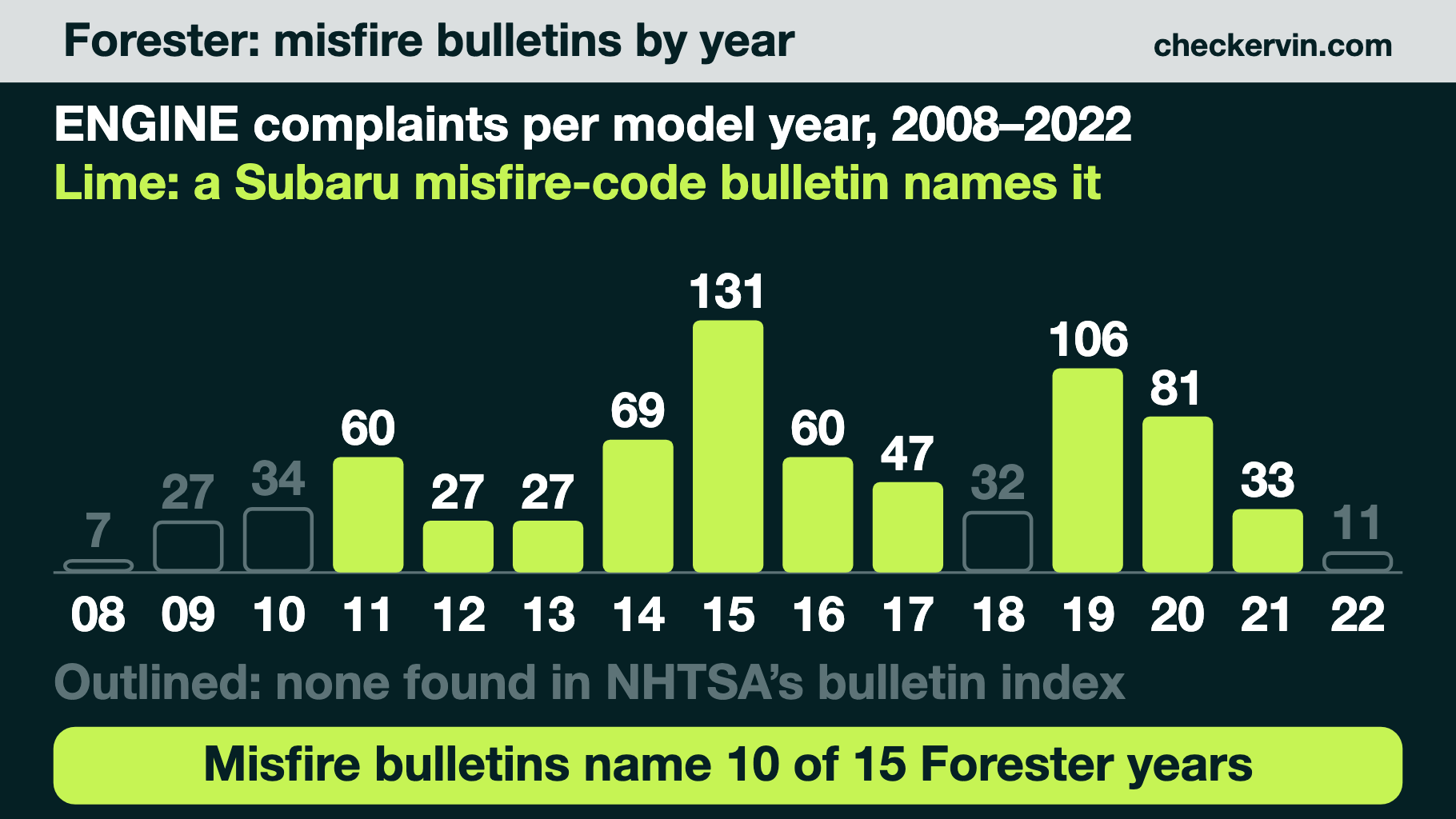
Misfire codes Subaru traced to something else
A misfire code says a cylinder fired unevenly. It does not say why. We searched NHTSA’s index of manufacturer communications for every Forester model year and read each misfire bulletin in full. In most of them the plugs are fine and the cause is somewhere else. Three of them say outright that the code can set when the engine is not actually misfiring.
| Subaru document, Forester years | What sets the misfire code |
|---|---|
| 11-116-12R, 2011–2012 | ECM logic: misfire codes with no drivability problem; reprogram |
| 11-130-13R, 2011–2014 | Cam position sensor clearance out of spec; shim the sensor |
| 07-96-15, 2012–2013 Turbo | Engine harness ground near the turbo; P0300 among codes |
| 07-112-16R, 2014–2016 2.5L | Alternator resonance; P0300 with no actual misfire |
| 07-136-18, 2014–2017 Turbo | Alternator, belt and tensioner resonance; false P0300–P0304 |
| 11-161-16, 2015 2.0 Turbo | Rough idle after a warm restart; reprogram |
| 09-81-21R, 2019–2021 2.5L DI | Fuel injector wear; carbon cleaning first |
The alternator bulletins are the clearest case. Subaru writes that resonance in the alternator pulley can set P0300 and that “there is not an actual misfire of the engine.” The warranty labor for the fix is 0.7 hours. A shop that goes straight to plugs and coils on one of those cars charges for boxer-engine access and can leave the light coming back. Every Forester year from 2011 through 2017, and 2019 through 2021, is named in at least one of these documents; NHTSA’s index turned up none for 2008–2010, 2018, 2022. Those 10 named years hold 85% of the engine complaints we count.
The 2.0XT program that inspects the plugs for you
One Subaru document goes the other way, treating the plugs as evidence. Service program WQW-58 covers certain 2014 and 2015 Forester 2.0XT models built between January 15, 2013 and November 4, 2014. Subaru’s owner letter says that under high load, combustion could start before the spark, causing rough idle and engine noise and, left alone, “excessive erosion of the spark plugs and possible engine damage.”
The dealer procedure reprograms the engine computer, then pulls and inspects each plug for damage, erosion or melting, and runs a cylinder leak-down test. If the plugs show that damage, the remedy is a replacement engine assembly, not new plugs. The letter says the work is done at no cost and takes about three hours. Those two XT years account for 200 of the engine complaints we count, a figure that covers every 2014–2015 Forester, not only the turbo. On a 2014–2015 XT, ask a Subaru dealer whether WQW-58 is on the VIN before you pay anyone for plugs. A damaged plug on that engine is covered evidence, not a maintenance item.
2019–2021: clean before you replace
The 2019 redesign moved the 2.5-liter engine to direct injection, and Subaru’s bulletin 09-81-21R, revised in July 2026, covers the 2019–2021 Forester for misfire codes and engine vibration caused by internal wear in the fuel injectors. The bulletin warns that carbon buildup produces the same symptoms, and tells technicians to run two carbon-cleaning treatments before replacing anything.
For an owner, that sets the order of spending: scan the code, clean per the bulletin, then injectors if the problem stays. Plugs are due at 60,000 miles on this engine like every other modern Forester, but new plugs will not cure a starved injector. Those three model years hold 220 engine complaints in our count, and 2019 is the first year of this engine, so confirm which generation you are pricing before you approve parts.
Why the boxer layout sets the labor line
Every Forester engine is a horizontally opposed four. The cylinders lie flat in two banks, so each cylinder head sits low on its own side of the engine bay and the plugs thread in sideways, pointing at the frame rails. On an upright inline four the plugs are on top under a cover. On a boxer they are reached from the sides, around the intake plumbing, battery and fluid reservoirs, with a socket on an extension and not much room to swing it.
You can see it in the published numbers. In YourMechanic’s Forester average, labor is 69% of the bill, more than twice the parts. Subaru’s own procedures show the same thing from the dealer side: the WQW-58 inspection, which mostly consists of getting the plugs out and testing the cylinders, is booked at about three hours. If the plugs come out for any reason, such as a coil, a compression test or a program inspection, ask whether new plugs can go in on the same labor. That is the one place the boxer rewards bundling.
Symptoms, and how long you can drive on bad plugs
Worn plugs show up as a rough or shaking idle, a stumble when you accelerate, longer cranking, weaker fuel economy and eventually a check-engine light with P0300 (random misfire) or P0301 to P0304 (one cylinder). A steady light on a smooth-running engine gives you time to book a scan. A flashing light is different: it signals a misfire heavy enough to overheat the catalytic converter, and that repair costs many times the plug job. Ease off and get it read.
A Forester that stalls or suddenly loses power is a recall question before it is a plug question. NHTSA lists a cracking turbo intake duct on certain 2015–2016 2.0XT models (16V162000), a low-pressure fuel pump on certain 2018 models (21V587000), and a PCV valve that can come apart inside the engine on certain 2019 models (19V856000). All three can feel like ignition trouble from the driver’s seat, and all three are fixed free. Our Subaru recall check shows what is open on a VIN, and the OBD-II code guide explains what the misfire codes mean.
The 2015 Forester, the year people ask about
The 2015 is the Forester year searchers ask about most, and the record shows why. Its 615 federal complaints put ENGINE first at 131, ahead of air bags at 102 and power train at 95. The engine count covers more than ignition. Subaru’s oil-consumption bulletin includes 2015 manual-transmission Foresters, covered in our Forester head gasket cost guide, and the 2015 2.0XT carries both WQW-58 and the warm-restart rough-idle bulletin 11-161-16.
For a 2015 owner facing a misfire code, that narrows the sequence. On the 2.5, check the alternator bulletin’s criteria before paying for ignition parts. On the XT, check WQW-58 completion first. On either, note the mileage: at 60,000 the plugs are due anyway, and one labor charge can cover the plugs and the inspection.
Before you authorize it
- Get the stored code read and written on the estimate: P0300 vs. P0301–P0304, plus any cam sensor code
- Match the model year to the Subaru bulletins above; several fixes cost less than plugs and coils
- On a 2014–2015 2.0XT, ask a dealer whether WQW-58 is open on the VIN
- On a 2019–2021, ask whether the carbon-cleaning step in 09-81-21R was done before injectors or plugs
- Check open recalls by VIN; three Forester campaigns cause stall or power-loss symptoms
- If plugs are genuinely due, ask for the plug labor itemized apart from any service bundle
If you are buying a Forester rather than servicing one, the interval becomes a service-history test: past 60,000 miles expect a plug line item, and on a 2008–2010 non-turbo expect one every 30,000. The Forester years-to-avoid page scores every model year against the nameplate’s own median, and the TSB vs. recall explainer covers why a bulletin, unlike a recall, is usually free only while the car is under warranty.
Where this information comes from
- Subaru bulletin 07-112-16R (NHTSA-hosted)2014–16 Forester 2.5L: alternator resonance can set P0300 with no actual misfire; 0.7-hour fix.
- Subaru bulletin 11-130-13R (NHTSA-hosted)2011–2014 Forester: cam position sensor clearance behind misfire and cam codes.
- Subaru service program WQW-58R (NHTSA-hosted)2014–2015 Forester 2.0XT pre-ignition program: plug inspection, owner letter, no-cost repair.
- Subaru bulletin 09-81-21R (NHTSA-hosted)2019–21 Forester 2.5L DI: injector wear and misfire codes, with carbon cleaning required first.
- Subaru bulletin 07-136-18 (NHTSA-hosted)2014–17 Forester Turbo: alternator, belt and tensioner resonance producing false misfire codes.
- NHTSA recalls API — ForesterSource for 21V587000; the same query by year returns 16V162000 (2015–16) and 19V856000 (2019).
- NHTSA — Forester complaint databaseThe federal complaint record this page's engine figures are computed from.
- EPA fueleconomy.gov — Forester enginesEPA engine listings (2014 shown; same query by year): 2.5 turbo through 2013, 2.0 turbo 2014–2018, none from 2019.
- Subaru 2010 Warranty & Maintenance BookletSpark plugs every 30,000 miles for the non-turbo Forester, 60,000 for turbo models.
- Subaru 2014 Warranty & Maintenance BookletThe 2014 Forester schedule page: spark plugs at 60,000 miles or 60 months.
- YourMechanic — Forester spark plug estimateThe $224 average ($70 parts, $154 labor), quoted from search-served text on November 22, 2026.
- Kelley Blue Book — 2019 Forester spark plug replacement$512–$617 for ZIP 85374; the 2016 page shows $430–$505 for ZIP 53511. Read November 22, 2026.
Keep reading
Frequently asked questions
How much should I pay for spark plug replacement on a Subaru Forester?
YourMechanic lists a $224 average for a Forester ($70 parts, $154 labor). Kelley Blue Book's fair repair range, parts and labor, is $430 to $505 for a 2016 Forester in ZIP 53511 and $512 to $617 for a 2019 in ZIP 85374. These are their figures, read November 22, 2026; KBB's change by ZIP and year. Ask for the plug job itemized so you are not comparing a plug quote against a 60,000-mile service bundle.
How do you replace Subaru spark plugs, and why does it take longer?
On a boxer engine the cylinders lie flat, so each head sits low on its side of the engine bay and the plugs thread in sideways, toward the frame rails, with little room for a socket and extension. The plugs themselves are ordinary; the access is the labor. That is why the labor line in YourMechanic's Forester average is more than twice the parts line. This page does not walk through the job; Subaru's service manual is the right reference if you do it yourself.
What is the most common problem with a 2015 Subaru Forester?
On the federal complaint record, the engine. ENGINE was the top category for the 2015 Forester with 131 of the year's 615 complaints, ahead of air bags (102) and power train (95). ENGINE covers every engine fault, not only ignition. For 2015, Subaru documented an oil-consumption remedy for manual-transmission cars and, on the 2.0XT, the WQW-58 pre-ignition program and a rough-idle reprogramming bulletin.
What are the symptoms of bad spark plugs?
A rough or shaking idle, hesitation when you accelerate, longer cranking before the engine starts, weaker fuel economy, and a check-engine light with a misfire code (P0300 random, or P0301 to P0304 for a single cylinder). On a Forester those same codes have other documented causes, from cam sensor clearance to alternator resonance, so read the code against the car's bulletins and mileage before buying plugs.
Can I still drive with bad spark plugs?
For a short while if the engine runs smoothly and the check-engine light is steady, but not for long. A flashing check-engine light means a misfire bad enough to overheat the catalytic converter, which costs far more than plugs; ease off and get it scanned. If the engine is stumbling or losing power, check open recalls first: a few Forester years have recalls for parts that can make the engine stall or lose power.
Read the VIN before you buy the plugs
A free CheckerVIN report shows the factory build, engine and open recalls for any Forester, so you know which bulletins and intervals apply before a shop quotes.
Run a free VIN check