The short answer
- What does it cost?
- KBB's model-year pages list $249-$327 (2023), $252-$360 (2022) and $276-$378 (2014), reflecting local labor rates more than the job itself.
- Is there a bulletin on the transmission?
- Mazda's TSB 05-002/14 (Feb 2014) covers 2012-2014 SkyActiv-G automatics for an ATX fail-safe mode tied to iron particles in the ATF — not a lawsuit.
- Which year carries the power-train history?
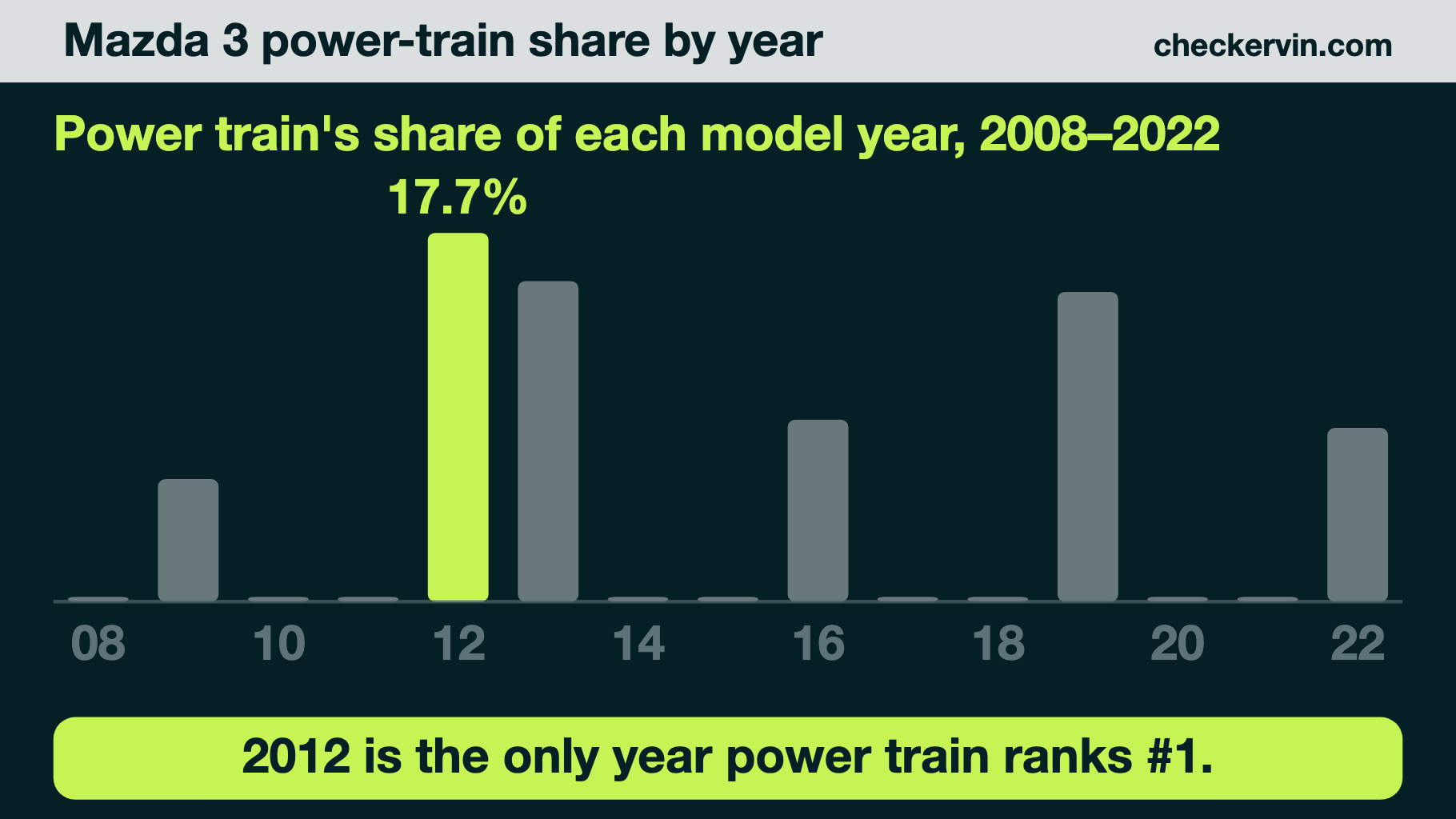
- 2012 alone reaches #1. POWER TRAIN cracks the model year's own top-5 in only 6 of 15 years and ranks third or lower in every one of them except 2012.
The numbers, and whose numbers they are
Kelley Blue Book’s model-year-specific fair-repair pages list a transmission fluid change at roughly $249 to $327 for a 2023 model (Michigan ZIP), $252 to $360 for a 2022 model (Iowa ZIP) and $276 to $378 for a 2014 model (Ohio ZIP) — KBB’s own 2025 page, by contrast, carried no pricing data at all. Every figure here is attributed to whoever published it; we sell VIN checks, not repairs, and price none of this ourselves.
A flat estimator price also will not tell you which production window a given car falls into, and on this nameplate that matters more than the sticker suggests — as the record below shows, one two-year stretch carries most of the transmission complaint history, and a named service bulletin covers almost exactly that window.
What 2,331 complaints say about one year
Our corpus of federal NHTSA complaints holds 2,331 reports against the 2008–2022 Mazda 3. POWER TRAIN names only 87of them across the whole span, and it is not spread evenly across the fifteen years. It cracks that year’s own top-5 complaint categories in only 6 of them: 2009 (#4, 5.9%), 2013 (#3, 15.4%), 2016 (#5, 8.7%), 2019 (#4, 14.9%), 2022 (#5, 8.3%) — and 2012.
2012 is different in kind, not just degree. In every other year that cracks the top 5, POWER TRAIN never ranks higher than third. In 2012 it ranks #1— the single best-ranking appearance POWER TRAIN makes anywhere in the 15-year record — at 40 of 226 complaints that year, 17.7%. That one year alone holds 46% of every POWER TRAIN complaint ever filed against the nameplate. 2013, the following model year, holds the next-largest share at 15.4%; together the two years account for 66.7% of the all-time total. The record also lists 1 recall campaign against the 2012 model year, worth checking by VIN before pricing anything.
The bulletin that names this exact window
2010 through 2013 is widely described, by generation-breakdown sources rather than NHTSA, as a single second-generation (BL) production run. That rules out a simple “this generation had a bad transmission” story on its own — 2010 and 2011, inside the same generation, show zero POWER TRAIN complaints in their own top 5. The spike sits specifically in 2012 and, to a lesser degree, 2013.
Secondary bulletin-tracking aggregation (recallcheck.net, summarizing the NHTSA-hosted filing) describes Mazda Technical Service Bulletin 05-002/14, internally tracked as 05-002-14-2894 and dated February 14, 2014. It covers 2012-2014 model-year CX-5, Mazda3 and Mazda6 vehicles built with the SkyActiv-G automatic transmission, addressing an “ATX fail-safe mode” — the transmission entering a protective limp state, with vehicle speed failing to rise in proportion to engine speed. The cause is attributed to iron particles in the automatic transmission fluid reaching the valve body and temporarily disrupting it or a sensor; the same aggregation describes the fail-safe condition as capable of clearing without a stored trouble code if it does not recur on the next drive cycle.
What is worth stating plainly: the bulletin’s 2012-2014 window covers three model years, and our own complaint record is not flat across all three. It is sharpest in 2012, still elevated in 2013, and back to zero POWER TRAIN complaints in its own top 5 by 2014— a narrower pattern than the bulletin’s own stated coverage, stated here rather than smoothed into a tidier three-year story.
A real lawsuit, about a different transmission type
Searching for a Mazda 3 transmission class action does turn up a real, active case — but it is not about the automatic or the fail-safe issue above. Gonzalez, et al. v. Mazda Motor Corp., et al., in the U.S. District Court for the Northern District of California (Case No. 3:16-cv-02087), alleges a defective clutch release assembly in 2010-2015 Mazda3 vehicles built with 5- or 6-speed MANUAL transmissions. A January 2017 ruling let part of the case proceed under California’s Song-Beverly Consumer Warranty Act while trimming other claims; no confirmed settlement for the case could be found via live search.
| Case or action | What it actually covers |
|---|---|
| Gonzalez v. Mazda Motor Corp. | Clutch release assembly, 2010-2015 Mazda3 MANUAL transmissions (5- or 6-speed) |
| TSB 05-002/14 (05-002-14-2894) | SkyActiv-G AUTOMATIC fail-safe mode, 2012-2014 CX-5/Mazda3/Mazda6 |
| This page's anchor (2012 complaint spike) | SkyActiv-G AUTOMATIC transmission only, not the manual clutch |
ATF FZ, and the CVT that isn't
Every US-spec Mazda 3 generation in this record pairs its SkyActiv-Drive 6-speed automatic with Mazda’s own ATF FZ specification, per multiple parts-retailer and technical-spec sources checked for this post. The 6-speed manual takes a separate gear oil, commonly listed as a 75W-80 GL-4 spec — not interchangeable with ATF FZ. Several retailer comparison pages list a continuously variable transmission (CVT) alongside Mazda 3 trims; the only confirmed CVT in this research belongs to a hybrid Mazda 3 variant, not the mainstream US gas lineup, and the mislabeling likely traces to confusion with the related CX-30 crossover. None of these specifications was independently confirmed here against a Mazda-published owner’s manual; each is attributed to the retailer or technical-spec source that published it.
What Mazda actually says about the interval
Multiple retailer maintenance summaries checked for this post report that Mazda does not set a routine mileage interval for changing the 6-speed automatic’s fluid under normal driving conditions, while still recommending periodic inspection. That echoes a pattern common across several nameplates in this series: an automatic transmission marketed as requiring little or no scheduled fluid service is not the same claim as one that can never develop a fault, and the 2012-2014 fail-safe bulletin above is itself evidence that a contamination-driven fault can occur regardless of mileage-based service schedules.
What a fail-safe event looks like before it costs anything
- Engine revs climbing without a matching rise in road speed — the symptom the fail-safe bulletin specifically describes
- The transmission holding one gear longer than expected, or hesitating between shifts
- A dash warning light that appears, then disappears on a later drive without a stored code
- Any of the above returning after a software update or fluid service has reportedly already been performed
The order matters because the cheap check comes first: confirm the exact model year by VIN, check whether the bulletin’s repair has already been performed on that specific car, and pull the vehicle’s open recalls — before anyone prices a transmission repair beyond a routine fluid service.
Before you authorize the service
- Confirm the exact model year by VIN — the 2012-2014 window carries nearly all of this nameplate's power-train complaint history
- Confirm the shop is using Mazda ATF FZ on the automatic, not a generic or CVT-branded fluid
- Ask whether TSB 05-002/14 (fail-safe mode) has already been addressed on this specific VIN
- Pull the VIN's open recalls before paying for anything that might already be covered under goodwill or warranty
- Get the quote itemized — fluid brand, quantity and labor — not a single flat-rate line
If you are buying the Mazda 3, not maintaining it
The same record reads as a shopping map. A 2012 or 2013 Mazda 3 carries both the sharpest power-train complaint share in the corpus and the open question of whether TSB 05-002/14 was ever performed — two separate things worth checking on the same car. A Mazda VIN decodeconfirms the exact model year before you price a service or believe a forum claim about “the Mazda 3 transmission lawsuit,” and the Mazda recall check confirms whether that specific VIN still shows an open campaign.
Before you decode anything, a free transmission fluid lookup by VIN returns the factory-spec fluid for the exact car, which settles the ATF-FZ-versus-manual-gear-oil question without guessing from the model year alone. And check which Mazda 3 model years show the most complaints overall rather than judging the nameplate by the power-train figure by itself — most of the 2008-2022 span outside 2012-2013 shows a materially lighter power-train record, and a documented fluid-contamination bulletin is cheaper to confirm than the negotiation it takes to discount around a year that predates it.
Where this information comes from
- NHTSA — Mazda 3 complaint databaseThe federal complaint record this page's figures are computed from, browsable by model year.
- NHTSA — technical service bulletin filings, 2014The NHTSA-hosted bulletin archive for the 2012-2014 model years cited above via secondary aggregation.
- NHTSA — recalls by VINThe official lookup that confirms whether a specific Mazda 3's open campaigns were completed.
- Justia — Gonzalez v. Mazda Motor Corp. docketBackground on the clutch-release-assembly case cited above, Case No. 3:16-cv-02087, N.D. Cal.
- Kelley Blue Book — 2023 Mazda 3 transmission fluid change estimateThe $249-$327 figure quoted above, retrieved via search November 2026.
Keep reading
Frequently asked questions
How much does it cost to change the transmission fluid in a Mazda 3?
Kelley Blue Book's model-year-specific fair-repair estimates range from about $249-$327 (2023 model, Michigan ZIP) to $252-$360 (2022 model, Iowa ZIP) and $276-$378 (2014 model, Ohio ZIP). KBB notes its 2025 page carried no pricing data at all. None of these figures is ours; we sell VIN checks, not repairs, and each is attributed to whoever published it rather than averaged together.
What transmission fluid does a Mazda 3 take?
Mazda's own SkyActiv-Drive 6-speed automatic (used across every US Mazda 3 generation in this record) calls for Mazda ATF FZ, per multiple parts-retailer and technical-spec sources. The 6-speed manual takes a GL-4 gear oil, commonly listed as 75W-80. Several retailer pages list a CVT for some Mazda 3 trims, but the only confirmed continuously-variable transmission found in this research belongs to a hybrid trim, not the mainstream US lineup — treat a CVT listing for a standard Mazda 3 as a likely mix-up with the CX-30 or another Mazda model until confirmed by VIN.
Which Mazda 3 model years show the most power-train complaints?
2012, by a wide margin — computed from src/data/models/mazda-3.json. Across the nameplate's 15 model years (2008-2022), POWER TRAIN complaints crack that year's own top-5 complaint categories in only 6 years, and in every one of them except 2012 it ranks third or lower. 2012 is the sole year it reaches #1 — 40 of 226 complaints (17.7%), and alone holding 46% of every POWER TRAIN complaint ever filed against the nameplate. 2013 is the next-largest share at 15.4% (#3); together the two years hold 66.7% of the all-time POWER TRAIN total.
Is there a recall or technical bulletin tied to the 2012 Mazda 3's transmission?
There is a documented Mazda technical service bulletin, not a recall. Secondary bulletin-tracking aggregation (recallcheck.net, summarizing the NHTSA-hosted filing) describes TSB 05-002/14 (internal number 05-002-14-2894), dated February 14, 2014, covering 2012-2014 model-year CX-5, Mazda3 and Mazda6 vehicles with the SkyActiv-G automatic transmission. It addresses an 'ATX fail-safe mode' — the transmission entering a protective limp state, with symptoms like vehicle speed not rising with engine speed — attributed to iron particles in the automatic transmission fluid reaching the valve body. This environment could not fetch the NHTSA-hosted PDF directly to verify it independently; the fetch failed identically to a positive-control request that succeeded in the same session, pointing to a network-allowlist gap rather than a fabricated bulletin.
Is there a class action lawsuit over Mazda 3 transmission problems?
Yes, but it covers a different transmission type than the one behind this page's complaint spike. Gonzalez, et al. v. Mazda Motor Corp., et al. (U.S. District Court, Northern District of California, Case No. 3:16-cv-02087) alleges a defective clutch release assembly in 2010-2015 Mazda3 vehicles equipped with 5- or 6-speed MANUAL transmissions. A 2017 ruling let part of the case proceed under California's Song-Beverly Act; no confirmed settlement could be found via live search. The 2012 complaint spike and fail-safe bulletin discussed on this page concern the SkyActiv-G AUTOMATIC transmission specifically — a different mechanism, named here to prevent the two from being confused.
Confirm the model year before you price the service
A free CheckerVIN report shows the factory build, specifications and open recalls for any VIN — confirm what you're actually pricing.
Run a free VIN check