The short answer
- What does it cost?
- RepairPal lists $806–$1,135 for a 2020 Compass starter. YourMechanic's Compass average is about $321.
- Is it really the starter?
- Often not on a 2017 or newer. FCA documents no-starts from the auxiliary battery, PCM software, a recalled PCM and a frozen muffler.
- What should I check first?
- Open recalls on the VIN, stored trouble codes, both batteries, and whether the engine cranks at all.
$806–$1,135
RepairPal, 2020 Compass starter
Retrieved Nov. 2026
953
Electrical reports counted
2008–2022, federal record
74%
Of them from 2017–2021
Years in FCA’s auxiliary-battery case
18V-524
2018 PCM recall
No-start or stall; check the VIN
The numbers, and whose numbers they are
We don’t repair cars and publish no price of our own, so every dollar figure here is someone else’s, dated. RepairPal’s page for the 2020 Compass lists a starter replacement at $806 to $1,135. YourMechanic puts its overall Compass starter estimate at about $321, made of $167 in parts and $154 in labor, so labor is roughly 48% of its figure. Advance Auto Parts lists starters for the 2018 Compass from $154.99 to $253.99. We read all three in November 2026 through their search listings, because each site refused direct requests from our tools.
A spread of more than three to one between two estimators is mostly a disagreement about labor. Third-party guides we read could not agree on whether the 2.4-liter Tigershark’s starter comes out from above or below, and we found no Stellantis labor time for the job on that engine, so we print none. The only factory starter labor figure we found for this generation is in an FCA bulletin for European diesel Compasses, a different engine sold in a different market, and it does not tell you what a US shop will bill.
What the spread does tell you: ask for the labor hours in writing, and ask whether the quote assumes a new or remanufactured part. Then make sure the starter is the problem, because a misdiagnosis is paid for in those same hours.
What 953 counted electrical complaints say
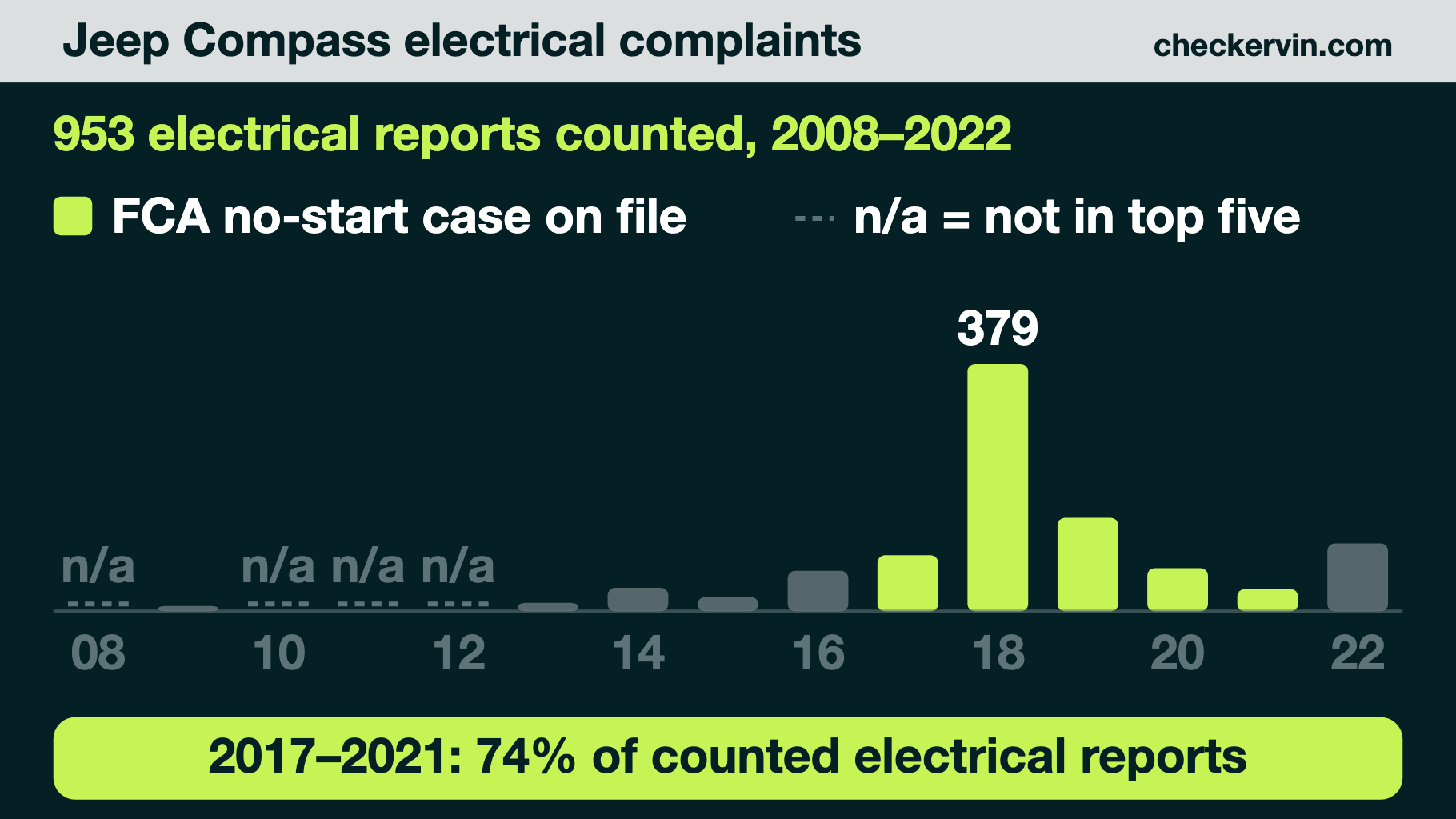
Our corpus of federal NHTSA complaints holds 3,436 reports against the 2008–2022 Compass. NHTSA has no starter category. The nearest is ELECTRICAL SYSTEM, which takes in both batteries, the wiring, lighting, body and powertrain modules, the radio and anything else an owner files as electrical. It reaches the five most-reported components in 11 of 15 model years and leads outright in 2017, 2021 and 2022. In 2008, 2010, 2011 and 2012it sits below that year’s fifth category, which is not the same as zero. Across the years it is counted, it adds up to 953 reports.
2018 carries the most, 379, about 40% of that year’s complaints, yet electrical still ranks second there behind ENGINE (474), the oil-consumption year covered in our Compass transmission fluid post. The second-generation years from 2017 through 2021 hold 708 counted electrical reports, 74% of the nameplate’s counted total. NHTSA files the 2017 first- and second-generation Compass under one model name, so that year pools both.
Reading the 2017–2020 electrical narratives, the starter is rarely the part owners name. Batteries and Stop-Start come up far more often, along with dash warnings that the vehicle will shut off soon. Where the starter does appear, it is often in a list of parts already replaced: batteries, a start-stop relay, a starter, and the fault still there. That pattern is the reason for the next five sections.
The second battery, and why it matters
A Compass with Engine Stop-Start carries two batteries: the main battery that cranks the engine and a smaller auxiliary battery. Mopar lists an auxiliary battery for the Stop-Start Compass, and FCA’s service case S2008000075, which NHTSA’s product list ties to the 2017–2021 Compass, describes what happens when it fails. The owner “may complain of a no start condition with a drained battery and the need to jump start the vehicle,” and the cluster may show a Service Start/Stop message. The technician finds code P00FD, auxiliary battery state of charge, or P2AF5, starter relay stuck.
FCA’s explanation is about voltage, not the starter motor. If the auxiliary battery is weak or disconnected, the powertrain module can reset during the crank and Stop-Start shuts itself off. The case tells technicians to disconnect the auxiliary battery’s ground before testing the main battery, because otherwise the test reads false, and to inspect every main and auxiliary connection for looseness or corrosion. A quick battery test at a parts store that only clamps the main battery can miss all of this.
A second FCA case, S1408000384, covers the battery sensor on the negative post and is blunt about two habits: a replacement sensor “is not required on a vehicle without DTCs,” and chargers should not be clamped straight to the battery post, which FCA calls blind charging because it bypasses the sensor. Stop-Start also switches itself off when charge drops below about 65% in mild weather, so “Stop-Start stopped working” is often a battery symptom rather than a starter one.
2019: a starter code that a reflash fixes
FCA bulletin 18-035-19, revised in November 2019, applies to the 2019 Compass with the 2.4-liter engine, with or without Stop-Start, sold in North America among other markets. Its code list reads like a starter diagnosis: P06E9, Engine Starter Performance, flagged as North America only, plus P141B and P141C for starter control circuit performance. One listed symptom is a “no crank condition while pushing the start button numerous times” that clears when the vehicle is switched fully off and restarted.
The repair is a powertrain control module software update, not a starter. The 2023 reissue of the bulletin states the cause plainly as PCM software. One 2019 owner in the federal complaint file describes exactly this sequence: repeated no-starts on a new car, and a dealer flash under 18-035-19. In 2019, electrical complaints rank secondamong the year’s categories with 143 counted. If a scan of a 2019 shows P06E9 or a starter-control code, ask whether the PCM software is current before anyone orders a starter.
2018: the powertrain module recall
Recall 18V-524, FCA’s campaign U87, includes the 2018 Compass. FCA’s safety report to NHTSA says some powertrain controllers were built with a suspect voltage regulator chip, and if it fails the controller stops working. The consequence FCA lists is “a no-start condition, a start-and-immediate engine stall condition, or an engine stall while driving.” The remedy is a new controller, free.
The recall is narrow. FCA estimated 12,779 vehicles across 16 vehicle families, built between November 28, 2017 and May 28, 2018, and said the VINs are not sequential, so two Compasses built the same week may differ. The only way to know is to check the VIN. The same report states FCA’s policy of reimbursing owners who paid for a repair that later became the subject of a recall, with a receipt. If you replaced a starter on a covered 2018 and the no-start came back until the controller was swapped, that receipt is worth keeping.
Cranks but won’t start below freezing
FCA bulletin 09-004-20 covers 2017 and 2018 second-generation Compasses built on or before March 4, 2018, in North America and Europe. The symptom is “a crank, no start condition, in freezing temperatures,” and the cause is condensation freezing inside the muffler. The fix is a 3 mm weep hole drilled at the bottom corner of the muffler, with a factory time allowance of 0.2 hours.
The diagnostic point is the word “crank.” A Compass that spins over normally on a frozen morning has a working starter. If the muffler on a qualifying 2017 or 2018 has no weep hole, that is a five-minute look on a lift, and it is worth having before anyone quotes a starter.
When nothing works at all: the D-pillar ground
FCA’s case S1908000108, which NHTSA links to the 2017–2019 Compass, describes a Jeep that intermittently will not crank or even switch on, where the key fob will not lock, unlock or remote start either, and a scan shows several lost-communication U-codes. The cause FCA names is a loose crimp at the Z942a ground eyelet on the passenger-side D-pillar, above the subwoofer. That ground also serves the fuel pump and the RF hub that listens for the key fob.
A dead starter does not stop the door locks from working. If the no-crank comes with a fob that does nothing and a scan full of communication codes, the cheaper suspect is a ground connection behind a trim panel, and the repair is soldering and re-crimping a wire.
The first-generation Compass is a different story
The 2008–2016 Compass predates all of the above: no Stop-Start, one battery, and none of the bulletins in the last four sections. Electrical reaches its top five in 5 of 9 of those years, adding 141 counted reports, and 2016 is the largest with 62.
Owners who know the Grand Cherokee’s fuel pump relay saga may expect the same trap here. We checked every Compass model year from 2008 to 2022 in NHTSA’s recall database and found no TIPM or fuel pump relay recall; the same lookup does return the Grand Cherokee relay recall, so the search works. That lesson, covered in our Grand Cherokee starter post, does not transfer. What the 2016 narratives describe instead is stalling and crank-no-start traced to crankshaft and camshaft sensors, and recall 16V-907 replaced the sensor connector on 2016 Compasses built from May 9 to July 15, 2016. A sensor fault cranks normally and does not need a starter.
Starter, battery or something else?
The symptom you hear narrows it more than any estimate. This table sorts the common Compass no-start sounds by what FCA’s own documents and basic starting-system logic point to. It is a guide for the conversation with the shop, not a diagnosis.
| What you hear or see | Where FCA's documents point |
|---|---|
| Engine cranks normally, never fires | Not the starter. Fuel, spark or sensors; on a 2017–2018 in freezing weather, the muffler weep-hole bulletin. |
| Single click or silence, dash lights bright | Starter or its relay are real suspects; test both batteries and read codes first. |
| Clicking, dim lights, Service Start/Stop message | Battery charge, most often the auxiliary battery on a Stop-Start car (FCA case S2008000075). |
| No crank after repeated button presses, fine after a full shutdown | 2019 PCM software (bulletin 18-035-19). |
| No crank, fob and locks dead, many U-codes | The D-pillar ground (FCA case S1908000108) on 2017–2019. |
| Starts, then dies at once, or stalls while driving | On a covered 2018, recall 18V-524; check the VIN. |
Before you authorize a starter
Most of these checks cost little next to the labor on a starter swap, and a recall repair costs nothing. Bring the list to the shop.
- Run the VIN for open recalls, especially 18V-524 on a 2018.
- Ask for the stored trouble codes, by number, in writing.
- Have the main and auxiliary batteries tested separately.
- Ask whether the PCM software is current (2019: bulletin 18-035-19).
- On a 2017–2018 that fails only in the cold, check the muffler weep hole.
- If the fob and locks die too, ask about the D-pillar ground.
- Get the starter part number and labor hours on the quote.
- Keep receipts; FCA states a reimbursement policy for recalled repairs.
If you are buying a Compass, not fixing one
A seller who mentions a recent starter on a 2017–2021 Compass has told you less than it sounds like. Ask what was replaced before the starter, whether both batteries were changed, and whether the no-start ever came back. A car that has had a starter, two batteries and a relay is more likely to have an unsolved electrical fault than a fixed one.
On a 2018, check that recall 18V-524 is closed or not applicable. On any Stop-Start Compass, watch whether the engine actually shuts off at a light on the test drive, since a disabled Stop-Start is an early sign of a weak battery. In the 2022 model year, electrical ranks first in the record with 104 counted complaints, so the newest examples are not exempt from the questions.
Where this information comes from
- NHTSA copy — FCA STAR case S2008000075, no start / Start-Stop inoperativeThe auxiliary-battery no-start, its codes, and FCA's battery test order.
- NHTSA copy — FCA bulletin 18-035-19 Rev. D, 2019 Compass PCM updateStarter-performance codes and a no-crank symptom fixed by software.
- NHTSA — FCA Part 573 report, recall 18V-524 (PCM voltage regulator)No-start and stall risk, build window, population and reimbursement policy.
- NHTSA copy — FCA bulletin 09-004-20, muffler weep holeCrank, no-start in freezing weather on 2017–2018 Compasses.
- NHTSA copy — FCA STAR case S1908000108, intermittent no crankThe loose D-pillar ground behind no-crank plus dead key fob.
- NHTSA copy — FCA STAR case S1408000384 Rev. J, battery sensorWhy the battery sensor rarely needs replacing, and how not to charge.
- NHTSA — recalls by VINThe official lookup for 18V-524, 17V-433 and 16V-907.
- RepairPal — 2020 Jeep Compass repair costsThe $806–$1,135 starter replacement range quoted above, retrieved November 2026.
- YourMechanic — Jeep Compass starter replacement estimateThe $321 average with its parts and labor split, retrieved November 2026.
Keep reading
Frequently asked questions
How much does it cost to replace a Jeep Compass starter?
RepairPal's page for the 2020 Compass lists $806 to $1,135 for a starter replacement, read in November 2026. YourMechanic's overall Compass estimate is much lower, about $321, with $167 for parts and $154 for labor. The gap is mostly labor time and parts source. Get a written quote that names the starter part number and the labor hours.
How do I know if my Jeep starter is bad?
A failing starter usually gives you a single click or nothing when you turn the key or press the button, with the dash lights still bright. If the engine cranks at normal speed but never fires, the starter is doing its job and the fault is elsewhere. On a Compass with Stop-Start, a drained auxiliary battery can look like a starter fault, so have both batteries tested and the trouble codes read first.
What is the most common problem with the Jeep Compass?
In the federal complaint record we hold for the 2008–2022 Compass, Engine is the most reported category, with 1,172 counted complaints across the years it reached the top five. Electrical comes second with 953. Complaints are unverified owner reports, not a measured failure rate, and the electrical category covers far more than the starter.
Does the Jeep Compass have two batteries?
Compasses with Engine Stop-Start do. FCA's service case S2008000075 describes a main battery and an auxiliary battery on these vehicles, and Mopar lists an auxiliary battery for the Stop-Start Compass. A weak or disconnected auxiliary battery can disable Stop-Start and, per FCA, contribute to a no-start with a drained battery. Compasses without Stop-Start have one battery.
Is there a recall for a Jeep Compass that won't start?
Yes, for some 2018 models. Recall 18V-524 replaces the powertrain control module on vehicles built with a suspect voltage regulator chip, which FCA said could cause a no-start, a start-and-stall, or a stall while driving. Production ran from November 2017 to May 2018 and VINs are not sequential, so check the specific VIN. FCA's report states a policy of reimbursing owners who already paid for the repair.
Check the VIN before the starter
A free CheckerVIN report shows the factory build, engine and open recalls for any VIN, so you know whether a no-start recall is still open before you pay for a starter.
Run a free VIN check