The short answer
- What does it cost?
- YourMechanic lists a 2016 Cherokee 2.4L at a $1,168 estimate and $1,401–$2,093 at a shop or dealer. A hose averages $240.
- Is the radiator the usual problem?
- No. NHTSA's cooling category never reached a KL Cherokee year's top five complaint categories; ENGINE did in 9 of 9 years.
- What to check first?
- Pressure-test it. Hoses, the 3.2L oil filter adapter and the 2.4L fan each have a cheaper fix or a Stellantis notice.
The numbers, and whose numbers they are
We sell VIN checks, not repairs, so every price here belongs to someone else. YourMechanic’s Jeep Cherokee radiator page, retrieved in November 2026, lists a 2016 Cherokee with the 2.4L four-cylinder at an estimate of $1,167.92, and puts the shop or dealer price for the same job at $1,400.98 to $2,093.12. The same page also prints a headline average of $457, split into $317 of parts and $140 of labor. That average is not attached to any model year, and the page serves every Cherokee back to the boxy 1980s models, whose radiators are simpler and cheaper. Use the year-specific row for a KL.
A useful cross-check on labor comes from TRQ, a parts seller whose radiator video for the 2014–2023 Cherokee states an estimated installation time of about 2 hours 36 minutes for a professional technician. At typical shop rates that is several hundred dollars of labor before coolant, which fits the gap between the generic average and the 2016 row. The radiator hose page from the same estimator puts the average hose job at $240, with $107 in parts and $133 in labor, and lists a 2017 Cherokee 2.4L hose estimate at $735.25. A hose is a cheaper repair than the radiator in every figure we found, which is the first reason to know which one is leaking.
| Figure (YourMechanic unless noted) | What it covers |
|---|---|
| $1,167.92 estimate | 2016 Cherokee 2.4L radiator replacement |
| $1,400.98–$2,093.12 | Shop or dealer price, same 2016 2.4L job |
| $457 ($317 parts, $140 labor) | Generic Cherokee average, any year or generation |
| $240 ($107 parts, $133 labor) | Generic Cherokee radiator hose average |
| About 2 h 36 min | TRQ's professional install estimate, 2.4L |
Make sure the quote is for a KL, not an XJ
Search results for this repair mix two vehicles that share a name and nothing else. The XJ Cherokee, sold through 2001, is a rear-drive-based SUV with a lengthwise engine, most often the 4.0L inline-six, and a far simpler front end. The KL Cherokee, sold from the 2014 to the 2023 model year, is a front-drive-based crossover with a transverse engine, a nine-speed automatic and an electric cooling fan bolted to the radiator. Most of the cost pages that rank for this search either price the old truck or average across both.
Our complaint data covers the KL from 2014 through 2022. The 2023 model year, the last, is not in our data; NHTSA held only a handful of complaints for it when we checked. A Jeep VIN decode confirms the model year and engine in a few seconds, which is the first thing to check before comparing any two quotes.
What 2,150 engine complaints say, and don't say, about radiators
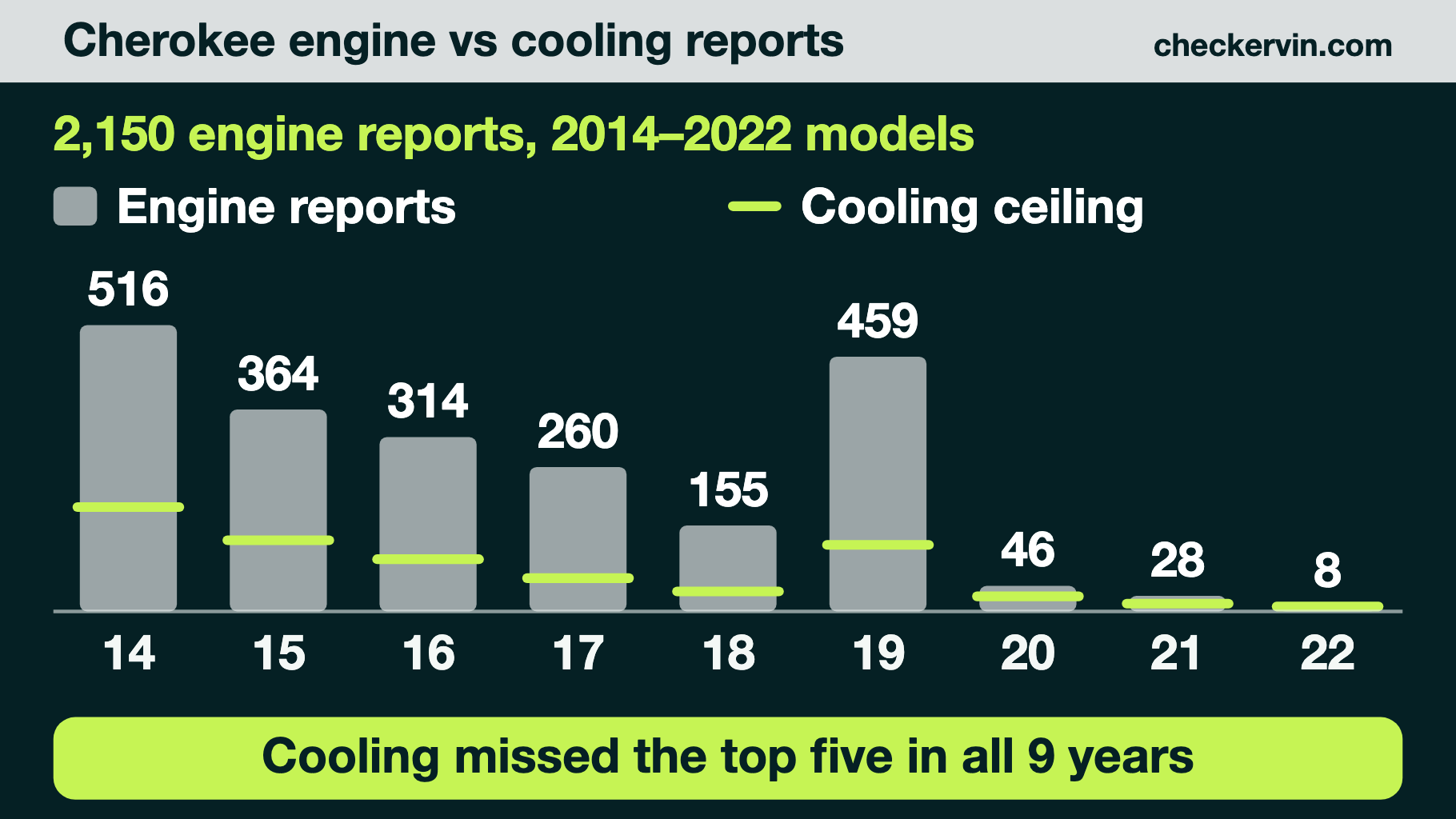
Our corpus of federal NHTSA complaints holds 10,108 reports against the 2014–2022 Cherokee. ENGINE is in the top five categories in 9 of 9 model years and accounts for 2,150 reports, about 21% of the total. The 2014 launch year carries the most at 516. The count falls each year to 155 for 2018, then jumps to 459 for 2019, the first year of the refreshed Cherokee and its new 2.0L turbo. The last three years in our data, 2020–2022, add only 82 between them.
We read the ENGINE narratives behind those counts. The common threads are not cooling. Owners most often describe stalling: at stops, in turns, or after refueling, with some 2.4L owners told by dealers that the engine shut itself off because it was low on oil. Oil consumption on the 2.4L four-cylinder is the second recurring theme. On 2019 models, 2.0L turbo owners describe power loss and, in some reports, low compression. Two recalls sit in the same territory: 18V739 re-flashed the transmission on certain 2019 2.4L Cherokees because the calibration could cause a stall, and 17V670 covered 2018 2.4L engines whose oil pump housing could crack. Radiator leaks do appear, in a scattering of reports from owners whose temperature warning came on, but they are a small strand.
The data says the same thing more precisely. NHTSA files cooling faults under a separate heading, ENGINE AND ENGINE COOLING. In our data it ranks below fifth in every one of the 9 model years. Our records store only each year’s top five, so for those years the fifth-ranked count is a ceiling. Added together, those ceilings come to 671, which is the most cooling complaints the record could hold across those years, against 2,150 engine reports. The true figure is lower. In 2014, the fifth-ranked category had 188 reports, so cooling had fewer than that.
Radiator, hose, or something else entirely
A coolant puddle under the front of a Cherokee has several possible sources, and only one of them costs four figures. The upper and lower radiator hoses and their quick-connect fittings are the cheapest. The radiator itself, with its plastic end tanks, is next. On the 3.2L V6 there is a third suspect higher up: the Pentastar oil filter adapter, which Stellantis lists for the 2014–2022 Cherokee in a February 2023 dealer notice. That notice tells technicians to replace the adapter outright on every 2014 model and to reseal it with new O-rings and gaskets on other years. Several 2014 Cherokee owners told NHTSA their cracked oil cooler housing came with a fluctuating temperature gauge and low coolant, which is how it gets mistaken for a radiator leak. We found no Stellantis document describing a coolant-side failure of that part, so treat the link as owner-reported.
The fourth possibility is not coolant at all. A separate Stellantis notice from April 2020 covers transmission oil cooler leaks on 2015–2020 Cherokees and tells dealers to mark the leak, then replace the cooler or, if the quick-connect fittings are leaking, the lines. Recall 21V310 covered 2021 Cherokees whose transmission oil cooler hose may have been incorrectly cured and could leak fluid. Red or brown fluid near the radiator is a transmission question, and the recall is free if it applies.
| Leak source | What points to it |
|---|---|
| Radiator hose or fitting | Wet hose ends or quick-connects; YourMechanic's hose average is $240 |
| Radiator | Seep at the plastic end tank or core seam under pressure test |
| Oil filter adapter (3.2L) | Fluid in the valley on top; Stellantis says replace on all 2014s |
| Transmission oil cooler | Red fluid, not coolant; Stellantis notice 9004244, recall 21V310 (2021) |
Three engines, three engine bays
The KL was sold with three gasoline engines in the US. The 2.4L Tigershark four-cylinder is the volume engine and is the one most cost estimates quote. The 3.2L Pentastar V6 was optional from the start and adds the oil filter adapter question above. The 2.0L turbocharged four-cylinder arrived with the 2019 refresh; a 2019 recall, 18V344, confirms it in that model year for missing valve stem keepers and a reversed camshaft cap.
The turbo adds plumbing around the radiator. Mopar parts catalogs list a charge air cooler for the 2.0L along with an inlet duct and a lower bracket, and a 2021 Stellantis parts notice indexed by NHTSA to the Cherokee covers a turbo water feed tube, so the turbo is plumbed into the cooling system. What we could not confirm from a Stellantis document is whether that charge air cooler is air-to-air or liquid-cooled, or whether the refresh changed the radiator module itself. A creator who filmed the job on a 2021 Cherokee 3.2L notes the repair will vary for the 2.0L turbo and the 2.4L, and that his vehicle had the standard-duty cooling system, which implies another option exists. Get the 2.0L quote by VIN rather than borrowing a 2.4L number. A VIN engine lookup settles which one you have.
The 2.4L cooling fan notice
The one cooling-specific Stellantis document we found for the KL concerns the fan, not the radiator. Dealer notice 9003826, dated November 29, 2017, covers 2015–2017 KL Cherokees with the 2.4L and the fan part number 68197298. Before replacing a cooling fan for fault code P0480, a cooling fan control circuit fault, or for an inoperative fan, it tells technicians to contact an FCA engineer, and asks them to return removed fans for analysis.
A notice like that means engineering wanted failed fans back to study, and wanted to hear about cases before parts were swapped. It does not say how often fans failed or offer free repair. For an owner, the practical point is that an overheating 2015–2017 2.4L with a P0480 code may have a fan or wiring fault rather than a clogged or leaking radiator. The fan is mounted to the radiator, so a shop may suggest replacing both at once. Ask for the code and a fan test before agreeing to the radiator.
What the job involves
On the KL the radiator sits at the front of a transverse engine bay, packaged with the air conditioning condenser and the electric fan. The job means draining the coolant, removing the trim and shields in the way, unbolting the fan and disconnecting the hoses, swapping the radiator, then refilling and bleeding the system. TRQ’s tool list for the 2.4L runs to a trim tool set, a drain pan, a floor jack and jack stands, which tells you the work happens from above and below, and its 2 hour 36 minute estimate is for that four-cylinder.
Two details push a quote up legitimately. The condenser is fragile and expensive if bent, so careful shops spend time keeping it intact. And the cooling system has to be bled properly, or air pockets can cause the overheating the repair was meant to fix. A quote that includes coolant, the bleed procedure and a recheck after the first drive is more complete, not padded.
The refill Stellantis asks for
Stellantis bulletin 07-007-23, dated May 18, 2023, applies to every gasoline and diesel Stellantis vehicle from 2013 on, which includes the KL. It says warranty analysis confirmed that filling the cooling system with anything other than distilled water can lead to leaks through the water pump’s mechanical seal, because minerals in tap or well water build up between the seal faces. Its recommendation is to refill with pre-diluted Mopar 50/50 coolant, or concentrate mixed with distilled water only.
That matters after a radiator replacement, because the whole system is drained and refilled. Ask what the shop will use. A coolant type lookup by VIN shows what the factory specified for that Cherokee, and pre-mixed coolant of the right type costs little more than concentrate.
What the recall record covers, and what it doesn't
We queried NHTSA’s recall database for every Cherokee model year from 2014 through 2023. The counts match our data; the 2014 model, for example, returned the same 13 campaigns our records hold. No campaign names the radiator, the cooling fan, the thermostat, the water pump or the coolant hoses.
A few campaigns filed under NHTSA’s engine and engine cooling heading turn out to be something else. Recall 15V676 covered 2015 Cherokees with an air conditioning hose that could be misrouted against the exhaust manifold. 17V670 and 18V344, described above, are oil pump and valvetrain faults. None of them pays for a radiator. The Jeep recall lookup by VIN shows whether 21V310 or any other campaign is still open on a specific vehicle.
The worst Cherokee years, by the record
People pricing a radiator often ask the bigger question: which KL years to avoid. On engine complaints, 2014 leads with 516 and 2019 follows with 459. The 2014–2018 models hold 75% of all engine reports, and the 2019–2022 models the rest. Engine is not the leading category in any year, though. Power train complaints, which cover the nine-speed transmission and the power transfer unit, lead every year in our data, and several power transfer unit recalls followed.
None of that is a radiator story, and a 2014 or 2019 Cherokee with a sound cooling system is still a 2014 or 2019 Cherokee. Our Jeep Compass starter post covers a related Jeep built with the same 2.4L engine family, if you are cross-shopping.
Before you authorize the repair
- Confirm the model year and engine by VIN: 2.4L, 3.2L V6 or 2.0L turbo
- Ask for a cooling system pressure test and a photo of the leak
- Rule out the radiator hoses and quick-connect fittings first
- On a 3.2L, have the oil filter adapter checked, especially on a 2014
- On a 2015–2017 2.4L with code P0480, test the fan before the radiator
- If the fluid is red, check the transmission cooler and recall 21V310
- Ask what coolant the shop will refill with: 50/50 premix or distilled water only
The pressure test is the step that saves money. It costs a fraction of the repair and tells you which of the four suspects is actually leaking. With a year-specific estimate in hand, a quote far above the YourMechanic shop range is worth a question about what else it includes.
Where this information comes from
- Stellantis notice 9003826 (NHTSA copy) — 2.4L KL cooling fan2015–2017 KL 2.4L: contact engineering before replacing a fan for P0480; return removed parts.
- Stellantis TSB 07-007-23 (NHTSA copy) — water quality in coolantAll 2013-and-later Stellantis vehicles: refill with 50/50 premix or distilled water only.
- Stellantis notice 9003357 Rev. A (NHTSA copy) — Pentastar oil filter adapterLists 2014–2022 KL; replace the adapter on all 2014 models, reseal on other years.
- Stellantis notice 9004244 (NHTSA copy) — transmission oil cooler leak2015–2020 KL: mark the leak, then replace the cooler or the quick-connect lines.
- NHTSA — recalls by VINOfficial lookup for 21V310, 18V739, 17V670 and the other campaigns named above.
- NHTSA complaints API — Jeep Cherokee (2014 shown)The federal complaint record behind our counts; we read the 2014–2023 ENGINE narratives here.
- YourMechanic — Jeep Cherokee radiator replacementThe 2016 2.4L estimate, shop range and generic average quoted above, retrieved November 2026.
- YourMechanic — Jeep Cherokee radiator hose replacementThe $240 hose average and 2017 2.4L hose estimate, retrieved November 2026.
Keep reading
Frequently asked questions
How much does it cost to replace a radiator on a Jeep Cherokee?
For the 2014–2023 Cherokee, YourMechanic's page lists a 2016 Cherokee with the 2.4L four-cylinder at an estimate of $1,167.92, against a shop or dealer price of $1,400.98 to $2,093.12, retrieved November 2026. The same page shows a $457 average with $317 in parts and $140 in labor, but that average is not tied to a model year and the page also covers older Cherokees, so treat the year-specific row as the better guide. Coolant is part of the job, and the engine changes the access.
What are the worst Jeep Cherokee years to avoid?
By engine complaints in the federal record, the 2014 Cherokee leads with 516, and 2019, the first year of the refreshed model and the 2.0L turbo, is next with 459. The 2014–2018 models together hold 75% of the KL's 2,150 engine reports. The narratives behind them are mostly stalling and oil consumption, not radiators. Power train complaints, a separate category, lead every year.
Is it the radiator or a hose?
A pressure test answers it. YourMechanic's Cherokee page puts the average radiator hose job at $240, against roughly a thousand dollars or more for a radiator on a 2.4L, so the difference is worth an hour of diagnosis. On a 2014–2022 Cherokee with the 3.2L V6, also rule out the oil filter adapter, which Stellantis tells dealers to replace outright on 2014 models. A red fluid leak at the front may be the transmission oil cooler, which has its own Stellantis notice.
Is there a recall or warranty extension for the Cherokee radiator?
Not that we found. We queried NHTSA's recall database for every Cherokee model year from 2014 through 2023 and no campaign names the radiator, cooling fan, thermostat, water pump or coolant hoses. The closest is 21V310, for 2021 Cherokees whose transmission oil cooler hose may leak fluid. Stellantis did issue a 2017 notice asking dealers to contact engineering before replacing a 2015–2017 2.4L cooling fan, but that is a diagnostic instruction, not a free repair.
Does the 2.0L turbo change the radiator job?
It adds parts around it. Mopar parts catalogs list a charge air cooler with an inlet duct and a lower bracket for the 2019-and-later 2.0L, and a Stellantis parts notice indexed to the 2021 Cherokee covers a turbo water feed tube, so the turbo is plumbed into the cooling system. We did not find a Stellantis document describing the charge air cooler's layout, so ask the shop to price the 2.0L by VIN rather than reuse a 2.4L quote.
Confirm the engine before you price the radiator
A free CheckerVIN report shows the factory build, engine, specifications and open recalls for any VIN, so the quote and any recall check match the Cherokee in front of you.
Run a free VIN check