The short answer
- What does it cost?
- About $159 to $246 at published averages (RepairPal, YourMechanic); one KBB ZIP-specific range for a 2020 CR-V runs $362 to $522.
- When is it due?
- When the Maintenance Minder shows sub-item 4, "Replace spark plugs." Honda schedules it by engine use, not one fixed mileage.
- What should a misfiring CR-V owner check first?
- On a 2017-2022 1.5T or 2020-2022 hybrid with coolant loss, Honda's head-gasket bulletin 26-016 or 26-018. Its inspection pulls the plugs anyway, and the repair may be Honda's bill.
$159-$246
Published averages
RepairPal low end to YourMechanic average, Nov. 22, 2026
2012-2018
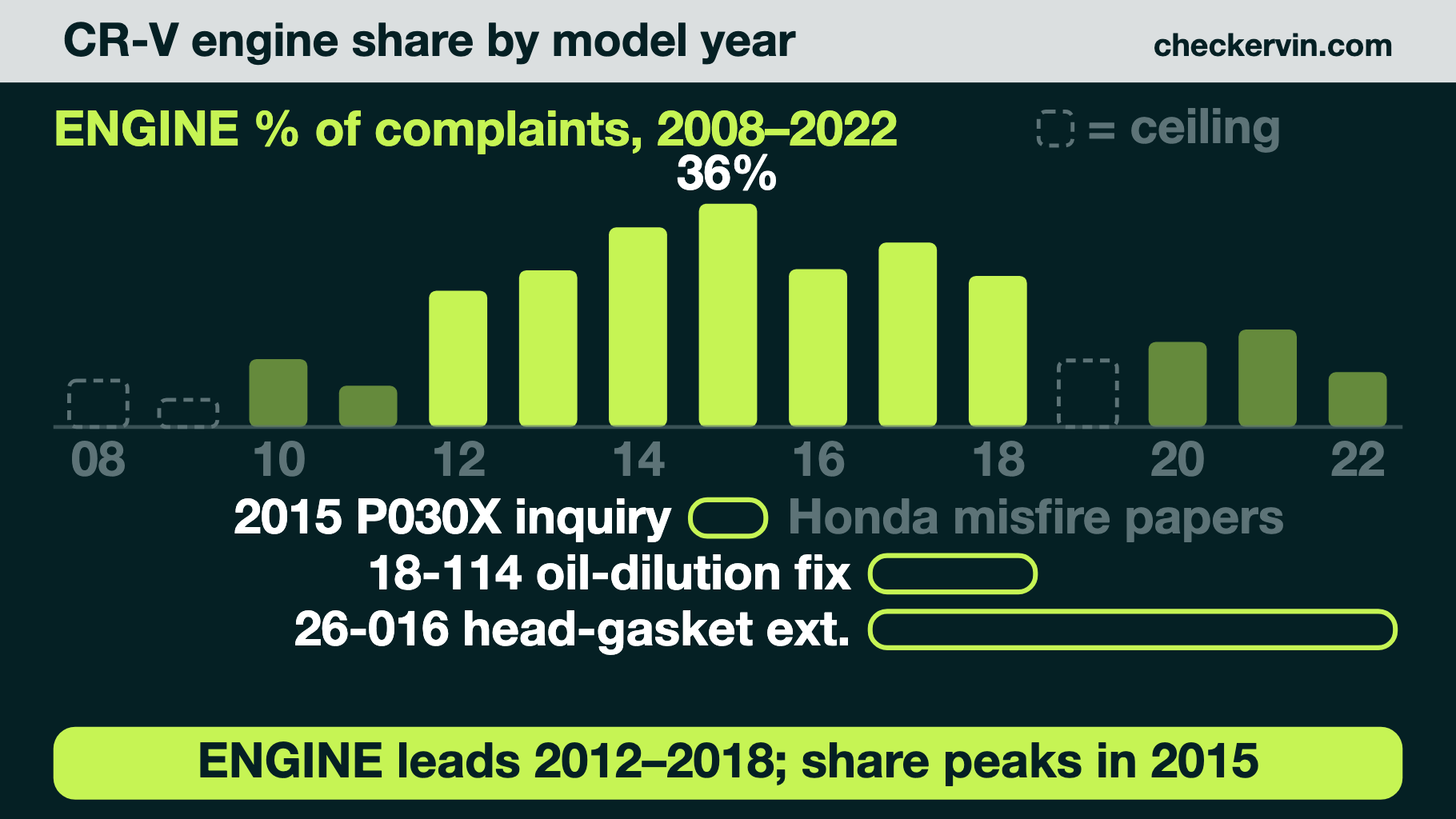
ENGINE ranks #1
Every model year in that run, of 15 on record
36%
ENGINE share peak, 2015
243 of 672 complaints that year
0
Honda misfire documents naming plugs as the fix
Of the six read for this page, 2015-2026
The published price, and whose numbers it is
Three estimators publish a figure for this job, and none of them is us. RepairPal puts the Honda CR-V spark plug replacement at $159 to $240, split into $76 to $111 of labor and $84 to $129 of parts. YourMechanic’s CR-V average is $246, with $106 in parts and $140 in labor, and the same page warns that ignition coils sometimes get added to the bill. Both were read from search-served copies of the pages on November 22, 2026, because direct requests to both sites were refused.
Kelley Blue Book prices by ZIP code. A search-served copy of its 2020 CR-V page showed $362 to $522 for ZIP 95354, in Modesto, California. That is one local market, not a national CR-V figure. Opened directly without a ZIP, KBB’s 2015 CR-V and 2022 CR-V Hybrid pages both said a fair repair range was not yet available, so we print no KBB number for those years.
The spread is narrow by repair standards. Parts are four plugs, labor is short, and the main variable is the shop’s hourly rate. Where CR-V owners actually lose money is earlier in the process: buying plugs for a misfire whose cause sits elsewhere, sometimes in a part Honda has agreed to pay for.
Which engine you are pricing
The CR-V covered by our data used three gasoline engines, and the plug job is similar on all of them: four cylinders in a row, one coil sitting on each plug, all reached from the top of the engine.
| Model years | Engine, per fueleconomy.gov |
|---|---|
| 2008-2016 | 2.4-liter four (direct injection from 2015) |
| 2017-2019 | 2.4-liter four on the LX, 1.5-liter turbo on other trims |
| 2020-2022 | 1.5-liter turbo only on gasoline models |
| 2020-2022 Hybrid | 2.0-liter four paired with Honda's two-motor system |
The engine matters less for the plug price than for the misfire diagnosis. Honda’s 2024 parts request on misfiring cars explicitly excluded the 2.4-liter CR-V and accepted only the 1.5 liter and the hybrid. If the quote does not say which engine is under the hood, an engine lookup by VIN settles it.
When the Maintenance Minder asks for it
Honda does not run the CR-V on a printed plug mileage the way older cars ran on a sticker. The Maintenance Minder works out service from how the engine has been driven and shows numbered sub-items when work is due. Honda owner’s manuals list sub-item 4 as “Replace spark plugs.” A CR-V whose display reads “4” is due; one that does not is not, whatever a shop flyer says.
We could not open a CR-V owner’s manual page directly (the Honda technical-information site failed a certificate check), so we print no Honda mileage figure. Kelley Blue Book’s generic text says conventional plugs wear out around 30,000 to 40,000 miles. That describes old-style copper plugs, not the long-life plugs these engines use, and it is the reason a CR-V owner can be sold two plug jobs where Honda planned one.
The Minder history is also a buyer’s tool. A used CR-V that has seen a 4 code should have a dated plug line on its service record. Our maintenance report guide covers how to read that record against the car’s age.
What the complaint record shows
Our corpus holds 11,098 federal NHTSA complaints against the 2008–2022 CR-V. NHTSA has no spark-plug category, so ENGINE is the closest honest proxy, and it is a wide one: it covers every engine fault from oil dilution to rattles to coolant in a cylinder. Read it as a ceiling on how much of the record could involve ignition, never as a count of bad plugs.
ENGINE appears in the CR-V’s top five complaint categories in 12 of 15 model years and is the single most reported category in every year from 2012 to 2018. Counted across the top-five lists, it carries at least 2,033 reports, a minimum because the years where it misses the top five are not counted. Those years are 2008, 2009, 2019: there ENGINE sat below that year’s fifth-place category, which in 2019 means no more than 120 reports. Below fifth, not zero.
Measured as a share of each year’s complaints, ENGINE peaks in 2015 at 36.2%. That is the first year of the direct-injection 2.4 liter and the same year Honda asked to inspect misfiring CR-Vs before dealers repaired them. It is also the year of two engine recalls and a vibration bulletin, so the share is not a misfire measurement. The raw counts peak later, in 2017 and 2018 (531 and 530 reports), the 1.5-liter turbo’s first two years. For 2020–2022, ENGINE’s share never passes 15.8%, below every year of the 2012–2016 run.
Honda’s misfire paper trail, document by document
NHTSA hosts the manufacturer communications Honda sends its dealers. Filtering the CR-V’s for misfire codes turns up a ten-year trail. We opened each of the following on static.nhtsa.gov.
| Document | What Honda said |
|---|---|
| Jan. 2015 dealer message | 2015 CR-V and Accord four-cylinder with P030X stored: Honda wants to inspect before any repair |
| Oct. 2018, bulletins 18-114 / 18-124 | 2017-18 CR-V, P0300-P0304 or P0172: new oil, software, and on some cars an A/C control unit |
| June 2021 parts request | 2018-21 1.5T Accord, Civic Si and CR-V misfires traced to the fuel injectors |
| July 2024 parts request | 2017-22 CR-V 1.5L and 2020-22 hybrid misfires with head-gasket coolant confirmed in a cylinder |
| Oct. 2024 parts request | Narrowed to hybrids under 100,000 miles, same head-gasket qualifier |
| Aug.-Sept. 2026, bulletins 26-016 / 26-018 | Head-gasket coverage extended to 10 years or 150,000 miles |
Read the corrective actions and one thing is missing: spark plugs. The 2018 bulletin’s parts list holds a drain-plug washer, oil and an A/C control unit. The 2021 request was about injectors. The 2024 requests required confirmed coolant in a cylinder, and every one of them asked dealers to send cars with no prior repair attempts, so Honda could see the parts as they failed.
None of this says CR-V plugs never wear out; they do, on the Minder’s schedule. It says that on the 1.5-liter turbo and the hybrid, a misfire code is a symptom Honda has tied to three different non-plug causes in its own documents. The oil-dilution chapter is told in full in our CR-V engine replacement post; for a plug quote, the point is that a 2017–2018 car with a misfire and a rising oil level needs the software history checked before it needs plugs.
The plugs come out anyway
Service Bulletin 26-016, Version 3, dated September 25, 2026, applies to every 2017–2022 CR-V whose VIN shows eligible. Its stated symptoms are overheating, coolant loss and misfire, and it adds that codes P0300 through P0304 may be stored but are not required. Coverage runs 10 years from the original purchase or 150,000 miles, and applies even to cars with a salvage or branded title.
The inspection is the useful part for anyone holding a plug quote. With the cooling system held at pressure after a warm-up, step 8 reads “Remove all 4 spark plugs,” and step 9 puts a borescope down each plug hole to look for coolant where the head meets the block. If coolant is there, the technician reinstalls the plugs and coils and moves on to the gasket and, if warpage is found, a head or short block. If not, the bulletin says it does not apply and diagnosis continues normally.
So on an eligible CR-V, the dealer’s first step lifts out the same four plugs an independent shop would replace. Asking for the inspection costs nothing if Honda finds coolant, and a no-coolant result clears the way for an honest plug job. Paying for plugs first leaves the cause in place and adds a prior repair to the history. The 2020–2022 CR-V Hybrid carries the same terms under bulletin 26-018, per Honda’s August 26, 2026 dealer message.
The 2.4-liter years: what is not a plug problem
The 2012–2016 run, when ENGINE led every year on the 2.4 liter, has its own set of Honda documents, and they rule out more than they rule in. The VTC actuator bulletins (A09-010 for 2010–2013, A16-012 for 2013–2014) describe a loud rattle for about two seconds at a cold start. That is a cam-phaser noise, not a misfire, and new plugs will not touch it. Bulletin 15-046 covers vibration felt through the driver’s seat on the 2015 CR-V; the fix was mounts and software, and a shaking idle on a 2015 is worth checking against it before blaming ignition.
The one ignition item on the 2.4 liter is a recall, not a bulletin. NHTSA campaign 11V004000 covers 2010 Accords and CR-Vs with an engine wiring harness connector that may cause “intermittent spark firing or the engine to stall.” The remedy was a free inspection and replacement of the ignition wiring harness connector. In 2010 ENGINE ranks #2 in the CR-V’s complaint record. On a 2010 that runs roughly, confirm the recall was done; the Honda recall check shows open campaigns by VIN.
Is replacing CR-V spark plugs a big job?
No. On all four engines it is a top-side job: remove the engine cover where fitted, unplug and lift out four coils, and swap four plugs with a long socket. The best evidence for how simple the access is comes from Honda: the 26-016 inspection lists pulling all four plugs as a single step, with nothing removed before it beyond the cooling-system pressure tester.
For a driveway attempt, work on a cold engine, thread each plug by hand before using a ratchet, torque to the figure in the service information rather than by feel, and keep each coil’s connector clean and seated. Aluminum heads punish a cross-threaded plug far more than they reward the labor saved. On the hybrid, the engine can start by itself whenever the system is on, so keep the vehicle fully off while working.
Signs of a worn plug, and what else causes them
A worn plug shows up as a check-engine light with a misfire code, a rough or shaking idle, hesitation when pulling away, slower starts and lower fuel economy. Every one of those signs is shared with the causes in Honda’s documents above, which is why the symptom alone cannot decide the repair.
| What you notice | What to check before plugs |
|---|---|
| Misfire plus coolant loss, 2017-22 1.5T or hybrid | Head-gasket inspection under 26-016 / 26-018 |
| Misfire plus rising or fuel-smelling oil, 2017-18 1.5T | 18-114 / 18-124 software history at a Honda dealer |
| Misfire with P0172 (running rich), 1.5T | Injector diagnosis, per Honda's 2021 request |
| Rough running on a 2010 | Recall 11V004000 completion |
| Single-cylinder code at high mileage, Minder showing 4 | Probably plugs; swap the coil to see if the code follows |
Before you authorize the service
- Ask which engine is being quoted: 2.4-liter, 1.5-liter turbo or hybrid
- Check whether the Maintenance Minder actually shows sub-item 4
- On a 2017-2022 1.5T or 2020-2022 hybrid with a misfire, ask a Honda dealer to run an iN VIN check for 26-016 or 26-018 first
- Read the stored codes, and do not let anyone clear them before a dealer sees the car if a bulletin may apply
- Ask for the plugs and coils as separate lines; a coil added without a test is a guess
- On a 2010, confirm recall 11V004000 shows complete
If you are buying the CR-V, not maintaining it
Plugs are cheap enough that they rarely decide a purchase. The misfire history behind them can. On a 2017–2022 1.5T or 2020–2022 hybrid, ask whether the car has had a head-gasket inspection or repair under the 2026 extension, and how long its 10-year clock has left from the original sale. On a 2017–2018, ask for proof of the oil-dilution software update. A CR-V that has had plugs replaced repeatedly in a short span is a car where someone treated the symptom.
Then read the year rather than the nameplate. Our CR-V years-to-avoid pagescores every model year against the CR-V’s own median from the same corpus this page uses. A Honda VIN decode confirms the trim and engine, and the warranty check by VIN shows what factory coverage is still attached.
Where this information comes from
- Honda Service Bulletin 26-016 v3, 2017-22 CR-V cylinder head gasket (NHTSA-hosted)The coverage terms, the misfire symptom list and the inspection that removes all four spark plugs.
- Honda dealer message, July 2024: 2017-22 CR-V 1.5L and FHEV misfire parts request (NHTSA-hosted)The head-gasket coolant qualifier on misfiring CR-Vs, two years before the extension; excludes the 2.4L.
- Honda Service Bulletin 18-114, 2017-18 CR-V misfire software update (NHTSA-hosted)Corrective action and parts list for the oil-dilution misfire codes; no spark plugs in it.
- Honda dealer message, June 2021: 1.5T misfire traced to fuel injectors (NHTSA-hosted)The injector chapter of the misfire trail.
- Honda dealer message, January 2015: 2015 CR-V P030X request for visit (NHTSA-hosted)Honda asked to inspect misfiring 2015 CR-Vs before any repair.
- NHTSA recalls API, 2010 Honda CR-VCampaign 11V004000, the ignition wiring harness connector recall.
- NHTSA complaint database, Honda CR-VThe federal complaint record the ENGINE shares on this page are computed from.
- fueleconomy.gov, Honda CR-V 2008-2022The engine offered in each model year.
- RepairPal, CR-V spark plug replacement estimateThe $159-$240 range quoted above, read from a search-served copy on Nov. 22, 2026.
- YourMechanic, CR-V spark plug replacement estimateThe $246 average quoted above, read from a search-served copy on Nov. 22, 2026.
- Kelley Blue Book, 2020 CR-V spark plug replacementThe ZIP-specific $362-$522 range for ZIP 95354; KBB prices change by location.
Keep reading
Frequently asked questions
How much does it cost to replace the spark plugs on a Honda CR-V?
Published averages sit between about $159 and $246. RepairPal puts the CR-V job at $159 to $240 ($76 to $111 labor, $84 to $129 parts), and YourMechanic's average is $246 ($106 parts, $140 labor), both read from search-served copies of those pages on November 22, 2026. Kelley Blue Book showed $362 to $522 for a 2020 CR-V at one California ZIP code, which reflects that area's shop rates. We sell VIN checks, not service, and none of these numbers is ours.
How often should a Honda CR-V get new spark plugs?
When the Maintenance Minder shows sub-item 4, which Honda's owner's manuals list as "Replace spark plugs." The Minder schedules work from how the engine has actually been used rather than from one fixed mileage, so the right answer for a given CR-V is on its dashboard and in its service record. We did not verify a Honda mileage figure for the CR-V and print none. Generic 30,000-to-40,000-mile advice describes conventional plugs, not the iridium-type long-life plugs these engines are serviced with.
Is replacing spark plugs on a CR-V a big job?
On every CR-V engine from 2008 to 2022 it is a four-plug, top-of-engine job with one ignition coil per plug. Honda's own 2026 head-gasket bulletin for the 2017-2022 CR-V lists removing all four spark plugs as a single inspection step, with no intake or manifold removal listed before it. Shop labor in the published estimates runs about $76 to $140. The bigger risk is paying for plugs to fix a misfire that has another cause.
What are the signs of a bad spark plug on a CR-V?
A flashing or steady check-engine light with a misfire code (P0300 random, P0301-P0304 for a single cylinder), rough idle, hesitation under load, harder starts and a fuel-economy drop. On a 2017-2022 1.5-liter turbo or 2020-2022 hybrid, those same codes appear in Honda's oil-dilution bulletins (2017-2018), its 2021 fuel-injector parts request and its 2024-2026 head-gasket documents. If the misfire comes with coolant loss or a sweet smell, ask a Honda dealer for the head-gasket inspection before buying plugs.
Does Honda's head gasket warranty extension cover a misfiring CR-V?
It can. Service Bulletin 26-016 covers 2017-2022 CR-Vs (check eligibility by VIN) for 10 years from original purchase or 150,000 miles, and names misfire and codes P0300-P0304 among the symptoms, though codes are not required. The dealer pulls all four spark plugs and looks into each cylinder with a borescope. If coolant is entering a cylinder, Honda pays for the gasket and, where warpage is found, a cylinder head or short block. If no coolant is found, the bulletin does not apply and the car goes back to normal diagnosis, which may well end in plugs.
Read the record before you buy the plugs
A free CheckerVIN report shows the factory build, engine, specifications and open recalls for any VIN, which is the starting point for telling a routine plug job from a covered repair.
Run a free VIN check