The short answer
- What does it cost?
- RepairPal lists $816–$1,183 for a 2015 200 starter. YourMechanic's Chrysler 200 average is about $371.
- Is it really the starter?
- Not always. FCA documents long-crank software, key detection, a stall recall on 2015 cars, and grounds on 2011–2014 cars.
- What should I check first?
- Open recalls on the VIN, the stored trouble codes, the battery, and whether the engine cranks at all.
$816–$1,183
RepairPal, 2015 200 starter
Retrieved Nov. 2026
1,223
Electrical reports counted
2011–2017, federal record
62%
Of them from 2015 alone
One model year of seven
15V-470
2015 stall recall
PDC connector; check the VIN
The prices, and whose prices they are
We don’t repair cars or publish prices of our own, so every dollar figure on this page belongs to someone else and carries a date. RepairPal’s estimator for the 2015 Chrysler 200 lists a starter replacement at $816 to $1,183, with labor at $427 to $627 and parts at $389 to $557, before tax and without a ZIP code. YourMechanic puts its Chrysler 200 average at $371: $189 in parts and $182 in labor. Both were read in November 2026 through search listings, because both sites refused direct requests from our tools.
The two estimators disagree by a factor of two to three, and the gap sits in both halves of the bill: RepairPal’s low parts figure is about double YourMechanic’s parts figure, and its low labor figure is more than double YourMechanic’s labor. Part source (dealer, new aftermarket or remanufactured) and shop rate explain most of a spread like that. We found no Stellantis labor time for the starter on either the 2.4-liter Tigershark four or the 3.6-liter Pentastar V6 in the 200, and the third-party hour estimates we saw were single-source, so we print none. RepairPal’s other 200 pages also returned inconsistent ranges in our searches, which is another reason to treat any online figure as a starting point.
A Mopar dealer notice from March 2025, titled simply “STARTER – ENGINE” and listed by NHTSA against the 2015–2017 200, told dealers to return stock of one remanufactured starter part number in favor of a newer revision. The notice does not say what changed or which engine it fits. It is a small reason to ask which part number a quote is built on.
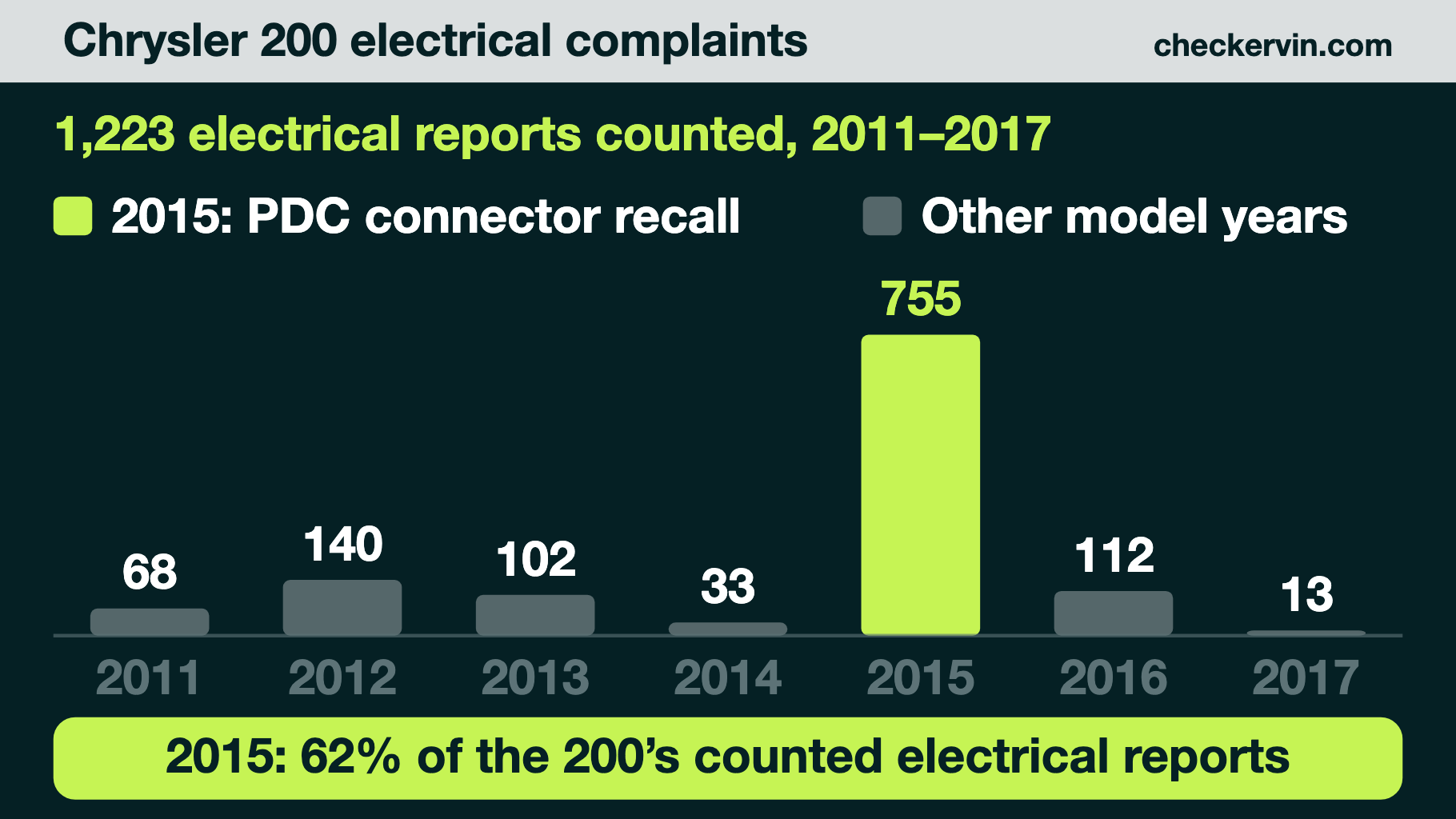
What 1,223 counted electrical complaints show
Our corpus of NHTSA complaints holds 4,174 reports against the 2011–2017 Chrysler 200, sedan and convertible pooled because NHTSA files both under one model name. NHTSA has no starter category. The nearest is ELECTRICAL SYSTEM, which also takes in the battery, wiring, lighting, the power distribution center, body and powertrain modules, and anything else an owner files as electrical. It makes the top five in 7 of 7 model years, ranks second in 2011, 2012, 2016 and 2017, and adds up to 1,223 counted reports.
One year carries most of that. The 2015 model, the first year of the redesigned 200 with the nine-speed automatic, has 755 electrical complaints, 62% of the nameplate’s counted electrical total and about 38% of everything filed against the 2015. It is the only year where electrical ranks first, ahead of POWER TRAIN (695). The 2016 has 112, roughly a 7-to-1 drop, and the short-run 2017 has 13. The four first-generation years together add 343.
That spike matches the search data: the 2015 is the model year people most often name when they look up a 200 starter. But reading the 2015 electrical narratives, the starter is not what owners describe. They describe the car shutting off while driving, dropping into neutral, and warning lights across the dash, and many cite recall 15V-470 by its campaign number. Where the starter comes up, it is usually a part already tested or already replaced, with the problem still there.
2015: the power distribution connector recall
Recall 15V-470, FCA’s campaign R24, covers 2015 Chrysler 200 sedans built from January 7 to September 23, 2014, with either engine. FCA’s safety report to NHTSA says some cars were built with “spread terminals” in the C4 connector at the Power Distribution Center, the under-hood box that feeds power to much of the car. A loose pin gives an intermittent connection, and the risk FCA names is “a stall or neutral event.”
FCA counted 77,834 cars potentially involved and said the VINs are not sequential. The free remedy differs by engine: a 12-wire splice kit on the 3.6-liter, a new transmission wiring harness on the 2.4-liter. The same report restates FCA’s policy of reimbursing owners who paid for a repair that later became the subject of a recall, with proof of payment.
Why this matters for a starter quote: an intermittent power fault does not sort itself neatly into “starts” and “won’t start.” Owners in the complaint file describe stalls followed by trouble restarting. If a covered 2015 has an open R24 campaign, close it before anyone condemns the starter. Two other 2015 recalls touch the same driveline. Recall 16V-529 reprograms the engine and transmission computers, and replaces a range-sensor harness if needed, because poor crimps can shift the nine-speed into neutral. Recall 15V-090 inspects transmissions on cars built March to December 2014 whose park mechanism might not engage.
2015 V6: a long crank that software fixes
Chrysler bulletin 18-056-14, revised November 2014, applies to 2015 200s with the 3.6-liter V6 built on or before November 1, 2014. It reprograms the powertrain control module with software written “to address customer’s concern of extended crank times” when starting the engine. In August 2015 FCA replaced it with bulletin 18-059-15, which covers every 2015 200 with the V6 and adds fixes for two engine codes. The factory time allowance is 0.2 hours.
An engine that cranks for too long before firing has a starter that is turning it. If a 2015 V6 takes a few extra seconds to catch, ask whether its engine software is current before anyone prices a starter. Bulletins are not recalls, so the update is not automatically free outside warranty, but it is a short job.
Push-button cars: when the key is not detected
Many 2015–2017 200s start with a button rather than a key. FCA’s service case S2008000113, which NHTSA’s product list ties to the 2015 and 2016 200 among many other models, describes an owner whose car “is not starting every time” at the button, sometimes with a Key Not Detected message, while remote start works normally.
FCA’s advice is to look for aftermarket equipment that jams the low-frequency signal between key fob and car, naming some LED replacement bulbs among the culprits. A starter cannot cause a Key Not Detected message. If the dash shows one, try the spare fob and think about any LED bulbs or accessories added recently, before paying for a starter.
2011–2014: a click and no crank
The first-generation 200 is an older design with a conventional automatic and a turn-to-start key. Here FCA’s own documents speak to the starter symptom directly. Service case S1121000006, revised August 2020 and listed against the 2011–2014 200, covers a car that will not crank, “Starter Will Not Engage,” with no trouble codes. The first test is to run a jumper from the battery negative cable to the engine block and try again.
If the engine then cranks, the starter was fine and the fault is a ground. FCA tells technicians to inspect the engine and powertrain computer grounds, check the transmission range sensor connector for moisture and corrosion, and add a redundant heavy ground from the battery to the transmission bell housing. Only if it still will not crank does the case move on, and even then the part it names is the transmission range sensor, which tells the computer the car is in Park or Neutral. A starter is not on FCA’s list in that case at all. Your shop should still test it, but this sequence is cheap to try first.
One more first-generation note. Bulletin 18-054-14 covers 2014 200s with the 3.6-liter V6 built between February 3 and July 18, 2014, where the engine may take “1 to 5” extra seconds of cranking with no codes. The fix is checking the serial number on a camshaft position sensor and replacing it if needed. Again, a long crank means the starter works.
The TIPM question on older 200s
Owners who know Chrysler’s Totally Integrated Power Module stories sometimes blame it for every no-start. The 2012 narratives in the complaint file mention the TIPM more than any other 200 year, and in 2012 electrical ranks second with 140counted complaints. We checked every 200 model year in NHTSA’s recall database. The only recall that names the TIPM is 13V-282, which flashes it or replaces an airbag controller so the active head restraints deploy. It has nothing to do with starting. No 200 recall covers a fuel pump relay, while the same lookup for the 2011 Grand Cherokee does return one, so the search works.
That does not make a TIPM fault impossible on a 200. It means there is no recall to lean on, and a power module is a much larger bill than a starter. Insist on a diagnosis that shows the module is at fault before replacing it.
Starter, battery or something else?
The sound the car makes narrows things more than any estimate does. This table sorts common 200 no-start symptoms by what FCA’s documents and basic starting-system logic point to. Use it to frame the conversation with the shop; it is not a diagnosis.
| What you hear or see | Where the documents point |
|---|---|
| Engine cranks normally, never fires | Not the starter. Fuel, spark or sensors. |
| Cranks a few seconds too long, then starts | Software on a 2015 V6 (18-056-14, 18-059-15); cam sensor on some 2014 V6 cars (18-054-14). |
| Single click, no crank, lights bright (2011–2014) | Grounds and the range sensor first (FCA case S1121000006), then the starter. |
| Nothing at the button, Key Not Detected | Key fob signal, not the starter (FCA case S2008000113). |
| Stalls or drops into neutral, then hard to restart (2015) | Recall 15V-470 or 16V-529 on a covered car; check the VIN. |
| Slow crank, dim lights | Battery charge or cables before the starter. |
Is a starter worth it on a Chrysler 200?
The newest 200 is a 2017, and the oldest are past fifteen years old. On many of these cars a dealer-priced starter is a real share of what the car is worth, which shifts the question from “what does it cost” to “is this the last repair it needs.” We don’t print a market value, because it depends on the trim, engine, mileage and condition; pull one from a VIN-based valuation tool before you decide.
A starter on its own is a bounded repair, and the lower estimates make it affordable. What changes the math is what else is open: an unfixed connector recall on a 2015, a transmission that has been shifting badly, or a no-start that has already survived a new battery. Paying for a starter on a car with an undiagnosed intermittent fault is how a modest repair becomes a series of them.
Before you authorize a starter
Most of these checks cost far less than a starter job, and a recall repair costs nothing. Take the list to the shop.
- Run the VIN for open recalls, especially 15V-470 and 16V-529 on a 2015.
- Ask for the stored trouble codes by number, in writing.
- Load-test the battery and check both battery cables and the engine ground.
- On a 2011–2014 that clicks, ask for the jumper-to-block ground test.
- On a 2015 V6 with a long crank, ask whether the engine software is current.
- If the dash says Key Not Detected, try the spare fob first.
- Get the starter part number, new or remanufactured, and labor hours on the quote.
- Keep receipts; FCA states a reimbursement policy for repairs later recalled.
If you are buying a 200, not fixing one
A seller who says a 2015 “just got a new starter” has told you less than it sounds like. Ask why it was replaced, what was tried first, and whether the car has stalled since. Then check that recall 15V-470 is closed or does not apply. POWER TRAIN complaints sit in the top five for both the 2015 and 2016, so the test drive should include several stops and a move from Park to Reverse to Drive.
The 2016 and 2017 cars carry far fewer electrical complaints, though electrical still ranks second for the 2016 and second for the 2017 in our record. On a first-generation car, a single click on a cold morning is worth a look at the battery ground before you treat it as a starter that needs replacing. Our Jeep Compass starter post covers the 2.4-liter Tigershark the 2015–2017 200 also uses, in a vehicle with a different set of no-start bulletins.
Where this information comes from
- NHTSA — FCA Part 573 report, recall 15V-470 (PDC C4 connector)Stall or neutral risk, build window, population, remedy by engine and reimbursement policy.
- NHTSA copy — FCA bulletin 18-059-15, extended crank time flashThe 2015 200 V6 long-crank software fix, superseding 18-056-14.
- NHTSA copy — FCA STAR case S1121000006, no start no crankThe ground and range-sensor test sequence for a 2011–2014 that clicks but will not crank.
- NHTSA copy — FCA STAR case S2008000113, intermittent no startKey Not Detected and multiple button presses, traced to key-signal interference.
- NHTSA copy — Chrysler bulletin 18-054-14, intermittent extended crankThe camshaft sensor fix for some 2014 V6 cars.
- NHTSA — recalls by VINThe official lookup for 15V-470, 16V-529, 15V-090 and 13V-282.
- RepairPal — 2015 Chrysler 200 starter replacement estimateThe $816–$1,183 range and its labor and parts split, retrieved November 2026.
- YourMechanic — Chrysler 200 starter replacement estimateThe $371 average with its parts and labor split, retrieved November 2026.
Keep reading
Frequently asked questions
How much is a starter for a Chrysler 200?
RepairPal's page for the 2015 Chrysler 200 lists a starter replacement at $816 to $1,183, with $427 to $627 of that in labor, read in November 2026. YourMechanic's Chrysler 200 average is much lower at $371, made of $189 in parts and $182 in labor. Ask any shop to put the starter part number and the labor hours on the quote.
What is the most common problem with the Chrysler 200?
In the federal complaint record we hold for the 2011–2017 200, Electrical System leads with 1,223 counted complaints, just ahead of Engine at 1,208. Most of the electrical total comes from the 2015 model year, the year of recall 15V-470 for a power distribution connector that could cause a stall or neutral event. Complaints are unverified owner reports, not a failure rate.
Why won't my 2015 Chrysler 200 start?
A dead battery and a failed starter are both possible, but FCA's own files for the 2015 list other causes: a long crank on 3.6-liter cars fixed by engine computer software (bulletins 18-056-14 and 18-059-15), and intermittent no-starts on push-button cars where the key is not detected. Recall 15V-470 covers a connector fault that can stall the car. Read the trouble codes and check the VIN for open recalls before buying a starter.
Is there a recall on the Chrysler 200 for stalling?
Yes. Recall 15V-470 covers certain 2015 Chrysler 200 sedans built from January 7 to September 23, 2014. A spread terminal in the power distribution center's C4 connector can cause an intermittent connection that may result in a stall or neutral event. The free remedy is a splice kit on the 3.6-liter or a new transmission wiring harness on the 2.4-liter. VINs are not sequential, so check the specific car.
Is it worth replacing the starter on a Chrysler 200?
Often yes if the starter is truly the fault and the rest of the car is sound, because a starter is a bounded repair. The risk is paying for one that does not fix the car. Confirm the diagnosis first, compare the quote with the car's current value from a VIN-based valuation, and weigh any open recalls or transmission complaints before you decide.
Check the VIN before the starter
A free CheckerVIN report shows the factory build, engine and open recalls for any VIN, so you know whether a stall recall is still open before you pay for a starter.
Run a free VIN check