The short answer
- How do you check a car's history in Missouri?
- Run the free national checks — VIN decode, NHTSA recalls, NICB theft and salvage — then the national NMVTIS title record through an approved provider. Then place the car against Missouri's inspection cliff: under ten years and 150,000 miles, nothing official has ever looked at it.
- What is the Missouri-specific pattern?
- The cliff. Exempt cars accumulate deferred issues invisibly; just-past-the-cliff cars needed a pass to change hands. A car listed just before it ages into inspection territory deserves the Pennsylvania expiring-sticker suspicion — selling now avoids the first-ever inspection.
- Can you look up a license plate in Missouri?
- No — the federal DPPA restricts plate-to-owner lookups to permitted uses in every state. The VIN is the number that answers purchase questions.
10 yr
The exemption boundary
Or 150,000 miles
2019
When the cliff was created
The exemption law
Rivers
Missouri's flood source
Two great valleys
DPPA
Plate lookups restricted
Federal, all states
The inspection cliff, and the market it creates
Since Missouri's 2019 exemption law, safety inspections apply only to vehicles more than ten model years old or past 150,000 miles. Inside the exemption, a car is bought, sold and registered without anyone official examining it; outside it, an inspection is required at sale and registration.
That draws a sharp line through the used market. The exempt fleet accumulates wear invisibly — a 2019 lesson Georgia and Tennessee buyers already know statewide. The inspected fleet carries a modest recent signal. And the boundary itself creates a seller incentive worth watching: a car about to age or mile its way into inspection territory is cheaper to sell now than to make pass later.
Buying on each side of the line
| The candidate | What its position implies |
|---|---|
| Well inside the exemption | No official look, ever. Your pre-purchase inspection is the first one — brakes, tires, steering and underbody all unexamined. |
| Approaching the cliff | Ask directly what the first inspection would need. The seller's answer, and its confidence, are both information. |
| Just past the cliff, recently sold or registered | A pass was required — a modest positive on the checklist items, silent on everything else. |
| Well past the cliff | Inspections at each transfer create a thin paper trail; ask for the last result and read what it flagged. |
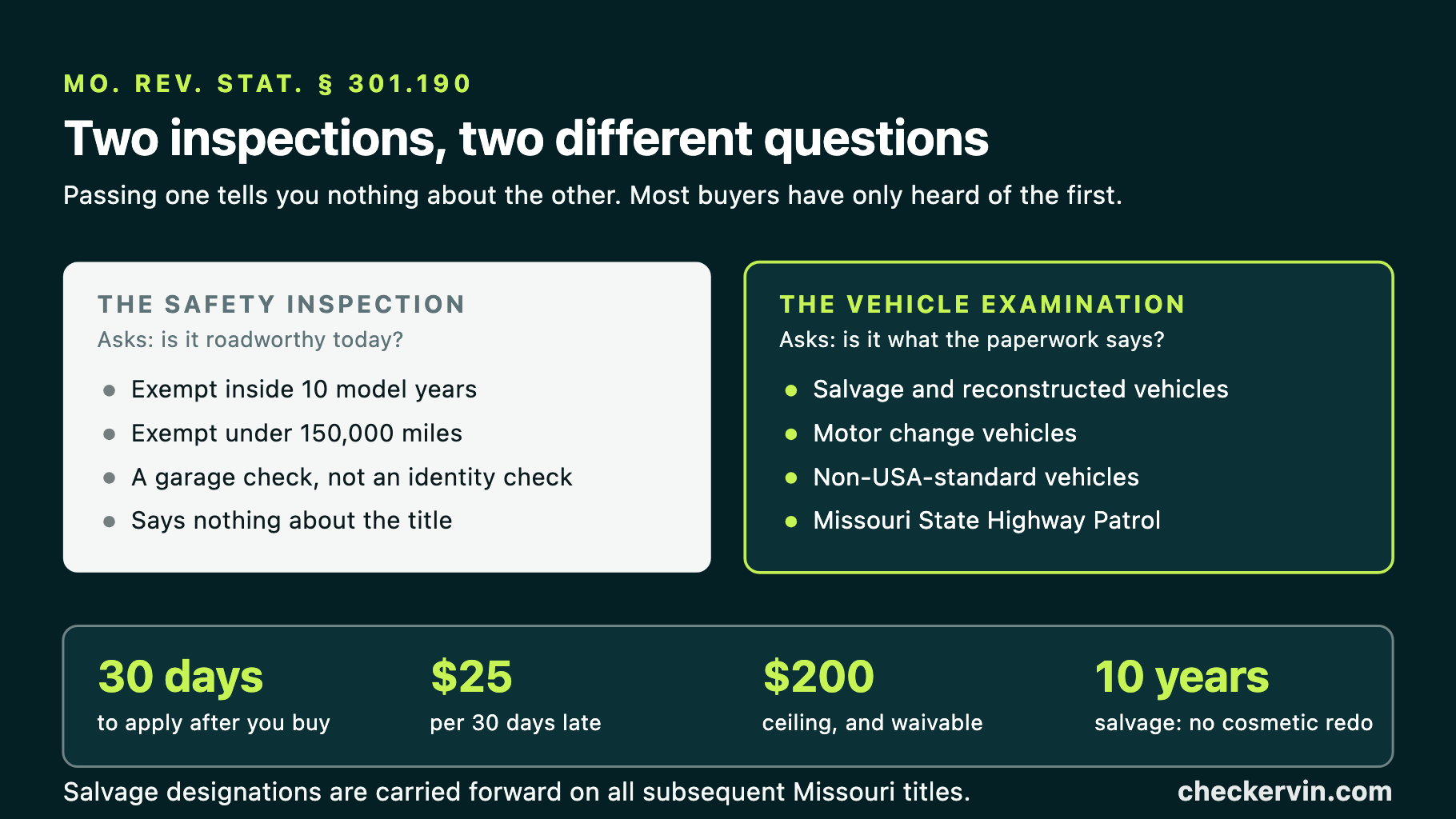
Missouri has two inspections, and they are not the same one
The exemption above is about the safety inspection. Missouri has a second, entirely separate examination that most buyers have never heard of, and confusing the two is how people end up believing a car was checked when nothing of the kind happened.
| The two examinations | What each one is |
|---|---|
| The safety inspection | Periodic, and exempt for vehicles inside the ten-model-year and 150,000-mile line. A roadworthiness check, not an identity check |
| The vehicle examination certificate | Required by statute before a title can issue on certain vehicles, and performed by the Missouri State Highway Patrol or another agency the director authorizes |
Section 301.190 is explicit about when the second one applies. An application covering a salvage vehicle, a reconstructed motor vehicle, a motor change vehicle, a non-USA-standard motor vehicle, or another vehicle the director requires “shall be accompanied by a vehicle examination certificate issued by the Missouri state highway patrol, or other law enforcement agency as authorized by the director of revenue.”
Read the list again, because it is doing more work than it looks. A motor change vehicle is one whose engine has been replaced with a different one. A non-USA-standard vehicle is an import not built to American specification. Both trigger a law-enforcement examination in Missouri, and both are the kind of thing a buyer discovers late — unless they read the title designation first.
The ten-year rule inside the salvage examination
Missouri issues titles carrying the designation prior salvage motor vehicle, and the statute contains a carve-out for older cars that changes what that designation is worth as evidence.
Section 301.190 provides that an owner presenting a motor vehicle which has been issued a salvage title and which is ten years of age or older to the vehicle examination, in order to obtain a certificate of ownership with the prior salvage designation, “shall not be required to repair or restore the vehicle to its original appearance in order to pass or complete the vehicle examination.”
So on a car of that age, passing the examination is not a statement that the vehicle looks or finishes like it did when new. The examination can be satisfied by a vehicle that is visibly a repair. That is a reasonable rule — requiring cosmetic restoration on a fifteen-year-old car would push usable vehicles into the crusher — but it means a prior salvage title on an older Missouri car tells you less about the standard of the work than buyers assume.
- A prior salvage designation on an older car is a record of examination, not of quality
- The appearance carve-out applies from ten years of age, which is the same number as the safety exemption and a completely different rule
- Nothing in the examination speaks to structural repair quality, which is what actually matters
- A physical inspection by someone you chose is still the only thing that answers that question
The second item is the trap. Missouri uses ten years in two unrelated provisions — the safety inspection exemption and this appearance carve-out — and hearing “ten years” in a Missouri conversation about a used car is not enough to know which rule someone means. Our rebuilt title guide covers what these designations mean nationally.
The provision that follows a car across state lines
Missouri's statute contains something most states leave to practice: an explicit instruction that a salvage designation travels forward, and a mechanism aimed squarely at vehicles arriving from elsewhere.
Subsection 11 deals with vehicles “brought into this state in a wrecked or damaged condition or after being towed as an abandoned vehicle pursuant to another state's abandoned motor vehicle procedures.” Those are inspected by the Missouri State Highway Patrol, and then comes the sentence that matters:
| What the statute directs | What it means for a buyer |
|---|---|
| If the inspection reveals the vehicle to be in a salvage or junk condition, the director shall so indicate on any Missouri certificate of ownership issued | The condition found at the border becomes part of the Missouri record, not a footnote lost in the transfer |
| Any salvage designation shall be carried forward on all subsequently issued certificates of title for the motor vehicle | Once applied, it follows the car through every later Missouri title. It is not shed by resale |
The second row is an anti-washing provision in plain words. Title washing works by moving a branded vehicle into a state whose paperwork does not carry the brand forward; Missouri's statute says its designations do carry forward. Our title jumping page covers the practice this is written against.
Subsection 8 closes a related gap, and it is the more surprising of the two. Before an original Missouri certificate of ownership is issued, the Highway Patrol must inspect the vehicle and verify its identification numbers where there is a current title issued by another state and a Missouri salvage certificate has already been issued for the same vehicle — unless it was comparably inspected by a law enforcement officer in another state.
Subsection 12 finishes the job for cars that arrive already branded. Where an out-of-state certificate has been designated a reconstructed motor vehicle, motor change vehicle, specially constructed motor vehicle or prior salvage vehicle, Missouri “shall appropriately designate on the current Missouri and all subsequent issues of the certificate of ownership the name of the issuing state and such prior designation.”
Both halves of that are unusual. Missouri carries the brand forward, and it carries where the brand came from forward with it — so a later Missouri title tells you not just that a vehicle was branded but which state said so. That is a more informative record than most states produce.
Then the sentence that puts a duty on the seller rather than the state: “The absence of any prior designation shall not relieve a transferor of the duty to exercise due diligence with regard to such certificate of ownership prior to the transfer.”A clean-looking out-of-state title does not discharge the seller's obligation to have looked. That is worth knowing on both sides of a private sale, and it is the statutory answer to “the title looked fine to me.”
Thirty days, twenty-five dollars, and a waiver most people never ask for
The clock on a Missouri purchase is statutory and the penalty is specific, which makes it one of the few state deadlines you can price exactly.
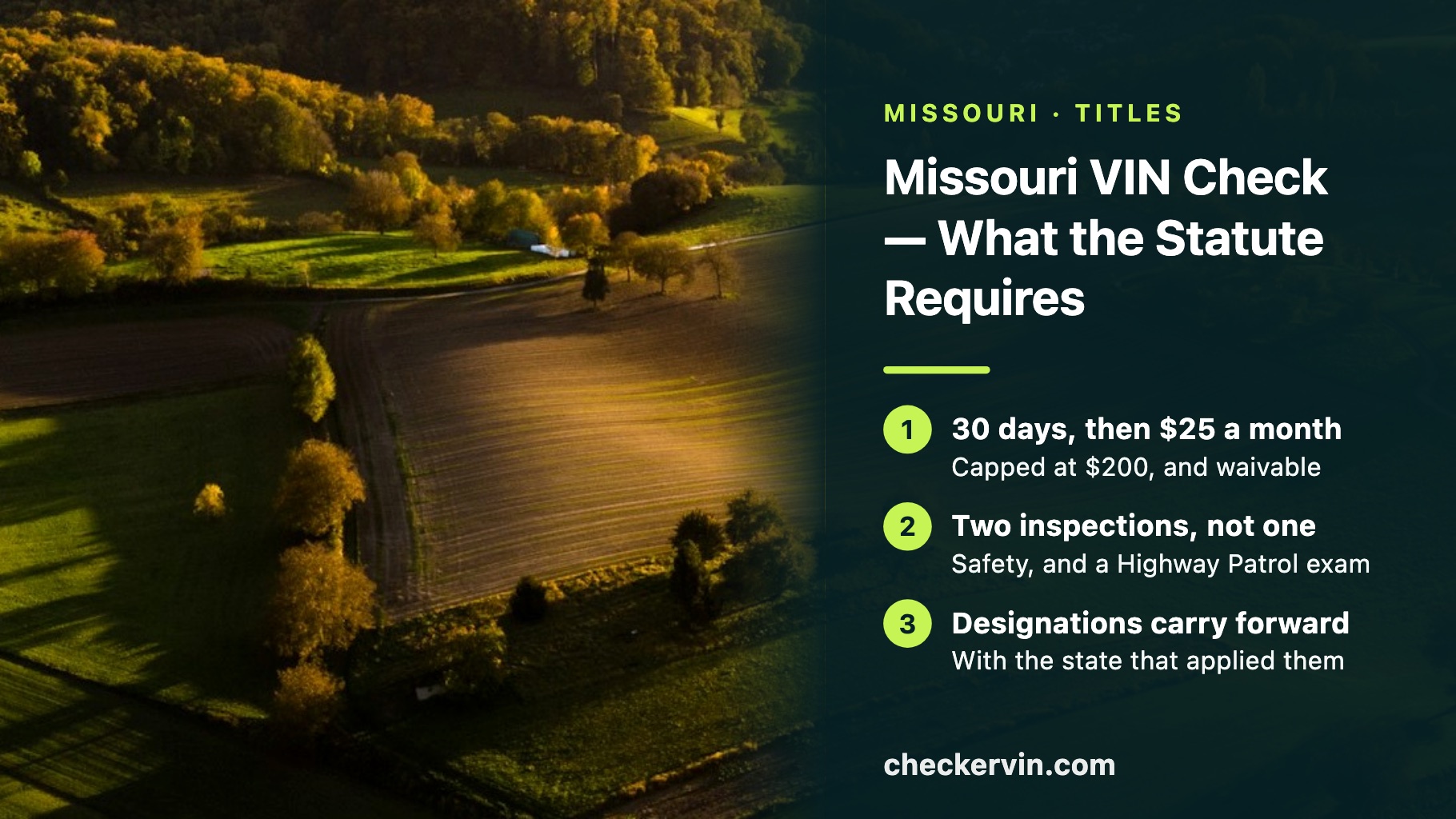
Under § 301.190 the application must be made within thirty days after the applicant acquires the vehicle. Miss it and the statute sets a delinquency penalty of twenty-five dollars for the first thirty days of delinquency, and twenty-five dollars for each thirty days thereafter, running up to a total of two hundred dollars.
| How late you are | What the statute sets |
|---|---|
| Within 30 days | No penalty — this is the window |
| First 30 days late | $25 |
| Each further 30 days | A further $25 |
| Ceiling | $200 total, and it stops there |
Two things follow that are worth knowing before you need them. The first is that the penalty is capped, so a long-delinquent title does not accumulate indefinitely — which is precisely why some sellers sit on paperwork rather than resolve it. The second is the part almost nobody mentions: the statute says the penalty “may be waived by the director for good cause shown”. It is not automatic and it is not a right, but it exists, and a buyer delayed by a seller who never handed over a signed title has a case worth making rather than a bill to pay silently.
The application itself must carry the vehicle identification number and the mileage registered on the odometer at the time of transfer — which is the statutory reason the VIN on the paperwork and the VIN on the car have to agree before you sign anything.
There is also a consequence that is not measured in dollars. The same section makes it “unlawful for any person to operate in this state a motor vehicle or trailer required to be registered under the provisions of the law unless a certificate of ownership has been applied for as provided in this section.” Note the wording: the test is whether ownership has been applied for, not whether the title has arrived. Processing time is not held against you; failing to start the process is.
Put those two together and the thirty-day window stops looking like an administrative nicety. Running past it is a fee that compounds to a ceiling, and driving on a vehicle you have not applied to title is a separate matter from the fee. Applying early costs nothing and settles both.
River-valley floods
Missouri's flood exposure is riverine, not coastal: the Missouri and Mississippi valleys flood somewhere in the state most wet springs, and record years put water into entire riverside towns. Cars drown in driveways and dealer lots miles from any hurricane coverage, and the dried-out uninsured share resurfaces clean-titled.
On anything with river-valley history — or a Gulf-state past, since Missouri sits on the northbound migration route — run the full water inspection. The Florida checklist applies unchanged: silt, connectors, light housings, intermittent electrics.
Salt winters
Missouri salts its roads, and its freeze-thaw winters put it firmly in the corrosion belt — milder than Michigan, harsher than its reputation. The underbody discipline from the Michigan guide applies, with extra attention on exempt-fleet cars: brake lines rust invisibly on a car no inspector has ever put on a lift.
Plates, briefly
Missouri plate lookups end at the same federal wall as every state's: the DPPA limits owner information to permitted uses, and private curiosity does not qualify. The full legal picture is on the license plate lookup guide — in a sale, ask for the VIN.
The Missouri check sequence
- 1Place the car against the cliffModel year and mileage against ten years and 150,000 miles. It tells you whether anything official has ever looked.
- 2Run the free national checksVIN decode, NHTSA recalls, NICB theft and salvage — all free, all before money moves.
- 3Pull the national title record — a few dollarsThrough an NMVTIS approved provider, for brands from every reporting state.
- 4Water-check river-valley and migrated carsRiverine floods brand fewer cars than hurricanes; the inspection finds what the record missed.
- 5Inspect underbody and brakes like the inspector who never cameSalt-state rules, weighted toward the exempt fleet.
- 6Complete the transfer at the license officeAnd confirm the seller's name matches the title exactly before money moves.
The Missouri order of operations
Pulling the statute together with the two inspections gives a sequence that is specific to this state, and each step is cheaper than the one after it.
- 1Read the title designation first, and the issuing state with itMissouri carries a prior brand forward and names the state that applied it. That single line tells you more than any amount of walking around the car, and it costs nothing to read.
- 2Ask whether a vehicle examination certificate existsSalvage, reconstructed, motor change and non-USA-standard vehicles require one from the Highway Patrol. Its presence tells you the identity was checked; its absence on a car that should have one is the question to ask.
- 3Separate the two inspections in your headThe safety exemption for newer, lower-mileage cars says nothing about identity, and the Highway Patrol examination says nothing about roadworthiness. Neither substitutes for the other.
- 4Run the VIN against the paperwork before money movesThe application itself must carry the VIN and the odometer reading at transfer, so a mismatch between metal and paper is a problem that will surface at the license office whether or not you spot it now.
- 5Start the thirty days on the day you buyThe penalty is $25 per thirty days to a $200 ceiling, and the clock runs from acquisition rather than from when the seller gets around to handing over a signed title.
- 6Then pay for an inspection of your own choosingStructure, corrosion and repair quality are exactly what neither state examination covers. That gap is what a physical inspection exists to fill.
The first step is the one people skip. A Missouri title that names another state and a prior designation is doing work no seller description will do for you.
Where this information comes from
- Mo. Rev. Stat. § 301.190 — certificate of ownershipThe thirty-day window, the delinquency penalty, the Highway Patrol examination and the carry-forward rules
- Missouri Department of Revenue — Motor VehicleMissouri's title and registration system, and the inspection rules
- NMVTIS — National Motor Vehicle Title Information SystemThe national title record, covering brands from every reporting state
- NICB VINCheckFree theft and salvage lookup from participating insurers
- NHTSA recall lookupFree open-recall check by VIN
Keep reading
Frequently asked questions
How do I check a VIN in Missouri?
Run the free national checks — a VIN decode, the NHTSA recall lookup and the NICB theft and salvage search — then pull the national NMVTIS title record through an approved provider. Missouri titles run through the Department of Revenue's license offices.
Does Missouri have a vehicle safety inspection?
Only past a threshold. Since a 2019 law change, vehicles ten model years old or newer with under 150,000 miles are exempt; older or higher-mileage vehicles need a safety inspection at sale and registration. The exemption boundary is where buyer attention belongs.
Why does the ten-year cliff matter to a buyer?
Because a nine-year-old Missouri car has likely never been inspected by anyone, while an eleven-year-old one needed a pass to change hands. Cars approaching the cliff from below carry accumulated deferred issues no system has surfaced — and your inspection is the first look.
Are there flood cars in Missouri?
Yes. Missouri sits at the junction of the Missouri and Mississippi river systems, and river flooding puts water into vehicles somewhere in the state most wet years. Run the water inspection on anything from the river valleys or with a Gulf-state past.
Can I look up a license plate owner in Missouri?
Not as a private individual — the federal Driver's Privacy Protection Act restricts owner information to permitted uses in every state. Ask the seller for the VIN instead.
Check a Missouri car before the deposit
Decode any VIN free for the factory build, specifications and open safety recalls. No account, no card.
Run a free VIN check