The short answer
- How long a window?
- About five seconds before impact on today's used cars, at two samples per second. The twenty-second version is a future requirement.
- Is it tracking me?
- No. The mandated manual statement says nothing is recorded under normal driving and no personal data is recorded at all.
- Can I check one when buying?
- Only physically, with a tool. No VIN lookup reads EDR data, ours included.
5 sec
Pre-crash window on today's cars
At 2 samples per second
100/sec
Crash-phase sampling of delta-V
49 CFR 563.7 Table I
30 sec
The manual's own phrase for the total
Typically or less
None
Personal data recorded
The regulation says so
There is a statement about this in the manual, and the government wrote it
49 CFR 563.11(a)does something regulations rarely do: it dictates the text. The owner’s manual in each covered vehicle must provide the following statement in English, and then supplies it. Most owners have never read it, and it answers the two questions people actually have.
The statement then lists, in plain language, what the recorder captures: how various systems in the vehicle were operating; whether the driver and passenger safety belts were buckled; how far, if at all, the driver was depressing the accelerator or brake pedal; and how fast the vehicle was traveling.
What the regulation requires it to record
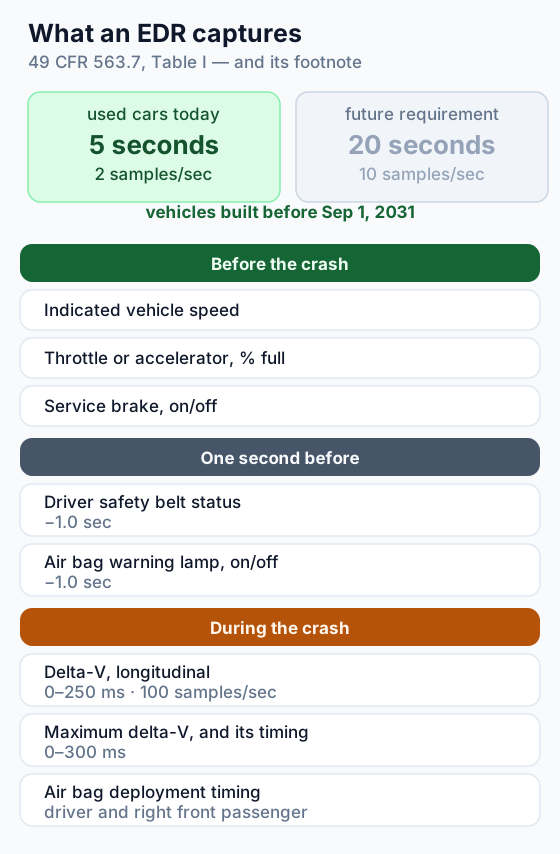
Table I to 563.7(a) is the list every EDR-equipped vehicle must satisfy. It splits neatly into what happens during the impact and what was happening in the seconds before it.
| Data element | When, and how often |
|---|---|
| Delta-V, longitudinal — the change in velocity | 0 to 250 ms from time zero, at 100 samples per second |
| Maximum delta-V, longitudinal, and the time it occurred | 0 to 300 ms from time zero |
| Indicated vehicle speed | Pre-crash — see the interval note below |
| Engine throttle, percent full, or accelerator pedal, percent full | Pre-crash, same interval |
| Service brake, on or off | Pre-crash, same interval |
| Safety belt status, driver | One second before time zero |
| Frontal air bag warning lamp, on or off | One second before time zero |
| Frontal air bag deployment timing, driver and right front passenger | At the event |
| Multi-event count, and time from event one to event two | At the event, and as needed |
| Complete file recorded — yes or no | Following the other data |
Two things are worth noticing. The crash-phase sampling is very fast and very short — a hundred readings a second across a quarter of a second, because that is the duration of the physics being measured. And the pre-crash elements are the ones a person would recognize: speed, pedal, brake, belt.
Five seconds, not twenty — and why the difference matters
This is the number most commonly reported wrongly, including by people summarising the regulation. Table I’s headline pre-crash interval reads −20 to 0 seconds at 10 samples per second. Footnote 4 to the same table makes that a phase-in.
| Vehicles equipped with an EDR | Required pre-crash recording |
|---|---|
| Manufactured before September 1, 2031 | −5.0 to 0 seconds relative to time zero, at 2 samples per second |
| Manufactured on or after September 1, 2028 but before August 31, 2029 | 25 percent of each manufacturer's EDR-equipped production must meet the longer interval and higher rate |
| The full −20 to 0 seconds at 10 samples per second | Phases in over the following years, reaching all EDR-equipped vehicles for the 2031 line |
Only on a crash, and no personal data
The privacy question is answered inside the same mandated statement, which is unusual and useful — it means the answer is not a manufacturer’s characterization but the regulator’s own words.
It is worth pausing on how unusual that paragraph is. A regulator has written, and required a manufacturer to reprint, both the reassurance and its limit — in the same note, in the owner’s own manual, without waiting to be asked. Most disclosures of this kind give you one half or the other.
Both halves of that matter. An EDR is not a tracker: it holds a rolling buffer that is only committed when something significant happens, and it has no idea who you are. But the data becomes identifying the moment somebody else joins it to a crash report, which is exactly what an investigation does. The regulation says so rather than leaving it to be discovered.
What “time zero” means, and why the record is so short
Every interval in the table is expressed relative to time zero, and the whole design follows from what that instant is. It is the moment the system decides a crash is happening — the point at which the algorithm watching the accelerometers commits, which is also the point at which deployment decisions get made.
That explains the two very different sampling regimes. The crash-phase elements run at a hundred readings a second across a quarter of a second, because the event being measured lasts about that long and the useful signal is the shape of the deceleration curve. The pre-crash elements run far slower over a much longer span, because the useful signal there is behavioral — was the driver braking, was the throttle open, how fast were they going.
The other consequence is the one owners find surprising. The recorder is not saving anything until time zero arrives. It is continuously overwriting a short buffer, which is what the regulation means by capture: buffering data in a temporary, volatile storage medium where it is continuously updated at regular intervals. Nothing is committed unless the event happens, which is the mechanical reason the privacy answer in the mandated statement is what it is.
Who can read it, and why that is deliberate
563.1 states the scope in terms of collection, storage, and retrievability, and adds a requirement aimed squarely at access: the part specifies requirements for vehicle manufacturers to make tools and/or methods commercially available so that crash investigators and researchers are able to retrieve data from EDRs.
It is a quietly consequential requirement. A manufacturer could otherwise satisfy every recording obligation in the part and still make the data practically unreachable by keeping the only reader in-house. The regulation closes that by making commercial availability a condition rather than a courtesy.
That is why EDR reads are not a manufacturer monopoly. Independent examiners, accident reconstructionists and researchers can obtain the equipment, which in practice means a used-car buyer with a real reason to know can commission a read rather than being told the data is unavailable. It still requires the tool and physical access to the vehicle.
Two crashes in one sequence, and the flag that admits it
Two entries in Table I exist because real collisions rarely stop at one impact, and they are worth understanding before anybody reads a printout at you.
| The element | What it is for |
|---|---|
| Multi-event, number of event | How many separate events the recorder treated the sequence as containing — a vehicle struck, then striking something else, is the ordinary case |
| Time from event 1 to 2 | The interval between them, recorded as needed. It is what distinguishes a single impact from a sequence |
| Complete file recorded — yes or no | Whether the recorder finished writing. A no means the data is partial, and that flag exists precisely so nobody reads a truncated file as a whole one |
That last flag deserves the attention. It is an admission built into the standard: the recorder can be interrupted — by loss of power in a severe crash, most obviously — and the regulation requires it to say so rather than present whatever it managed to save as a finished record. If a read ever becomes relevant to a car you are buying, whether that flag reads yes is among the first things to establish.
What it means when you are buying
There is a reasonable question underneath all of this: does any of it change what a buyer should do? For most purchases, no. The value of understanding the recorder is mainly that it tells you what is not knowable from records — and where a physical read could settle something that a report cannot.
The honest framing is narrow. An EDR read is not part of a normal pre-purchase process, and nobody should be commissioning one on a routine used car. What it is good for is a specific, contested question.
- A car with clear evidence of a deployment but no record of the event in any report is the case where this is worth raising
- A seller's account of a minor bump is testable against whether an event was recorded at all
- It is a physical read, so it belongs with an inspection rather than with a records check
- It is retrospective — it says what happened in one event, not whether the repair was done properly
- A recorder that was replaced with the module it lives in carries nothing from before the replacement
- For almost every purchase, the ordinary accident and title checks answer the question more cheaply
- And a read costs money and access, so it belongs in a dispute rather than in a routine viewing
The related records are covered elsewhere: accident records and why reports hold records rather than events, and what a deployment leaves behind, which is the physical side of the same question.
Not every car has one
Part 563 is written for vehicles equipped with an EDR. Its scope is uniform national requirements for those vehicles — the collection, storage and retrievability of the data. It is a specification for recorders that exist rather than a instruction that every vehicle carry one, and the page would be overstating things to imply otherwise.
The distinction is not academic. It means the correct answer to “does this car have a black box?” is not a year cut-off, and anybody offering one is approximating. Part 563 sets what a recorder must do if the vehicle has one, and leaves the decision to fit it where it already sat.
In practice the great majority of modern light vehicles sold in the United States have one, and the reliable way to find out about a specific car is the place the regulation put the answer: the owner’s manual statement. If the manual carries the text quoted at the top of this page, the vehicle has an EDR.
No VIN service reads this, including ours
Worth being blunt, because the topic attracts overselling. EDR data lives in a module in the car. It is not transmitted to a database, not attached to a VIN record, and not available to any consumer lookup service. Our decode returns the factory build, specifications and open safety recalls, and it does not touch this — nor will the full vehicle history reports that are launching soon.
Run the free decode and recall check
Decoded from official manufacturer and NHTSA records
What to actually do
- 1Check whether the manual carries the statementIt is the regulation's own designated place for telling an owner the car has a recorder. A missing manual is a small cost worth noting rather than a mystery.
- 2Run the free record checks firstAccident records, title brands and open recalls answer far more of the question far more cheaply than any physical read.
- 3Raise an EDR read only for a specific contested factIt is a tool for resolving a disagreement about one event, not a survey of the car's life.
- 4Ask whether the restraint module has ever been replacedA recorder lives in a module. If that module was replaced after a deployment, the data from before it went in is not there to read, which is worth knowing before anybody pays for an examination.
- 5Expect it to require access and equipmentThe tools are commercially available by design, but somebody still has to have one and be at the vehicle with it.
Where this information comes from
- 49 CFR Part 563 — event data recordersScope and retrievability at 563.1, the data element table at 563.7 including the pre-crash phase-in footnote, and the required owner's manual statement at 563.11
- 49 CFR 563.11 — information in owner's manualThe statement the regulation dictates verbatim, including the note on personal data
- NHTSA recall lookupOpen safety campaigns by VIN, free — including restraint-system campaigns
- NHTSA vPIC decoderThe federal build record, which carries no EDR data
Keep reading
Frequently asked questions
What does a car's event data recorder actually record?
Under 49 CFR 563.7 an EDR-equipped vehicle must record longitudinal change in velocity through the crash at 100 samples per second, plus pre-crash indicated vehicle speed, engine throttle or accelerator position and service brake on-off, driver safety belt status, air bag warning lamp state, and air bag deployment timing for the driver and right front passenger.
How many seconds does an EDR record before a crash?
For vehicles manufactured before September 1, 2031 the required pre-crash interval is five seconds at two samples per second. The longer twenty-second window at ten samples per second is a phase-in that begins with a share of production from September 2028, so it does not describe the used cars on sale today.
Does an EDR record everywhere I drive?
No. The statement the regulation requires in the owner's manual says EDR data are recorded only if a non-trivial crash situation occurs, that no data are recorded under normal driving conditions, and that no personal data such as name, gender, age or crash location are recorded.
Who can read the data from a car's black box?
Retrieval needs a tool and physical access to the vehicle. Part 563 requires manufacturers to make tools or methods commercially available so crash investigators and researchers can retrieve EDR data, which is why independent examiners can read them and not only the manufacturer.
Can I check a used car's EDR before buying it?
Not from a VIN lookup — no consumer service reads EDR data, and we do not hold any. It is a physical read performed with a tool on the car itself, which makes it a question for an inspection rather than a record check.
The check that is free and actually about your car
Decode any VIN free for the factory build, specifications and open safety recalls. No account, no card. Full vehicle history reports are launching soon.
Run a free VIN check