The short answer
- Is buying one illegal?
- Purchase is not among the prohibited acts. Removing, rendering inoperative, and selling or installing defeat parts are.
- Who does the rule cover?
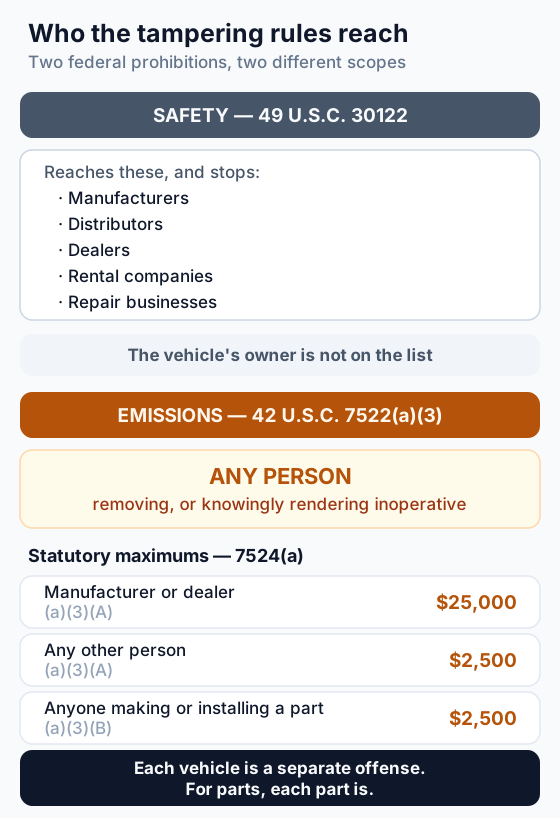
- Any person — unlike the safety-equipment rule, which reaches only manufacturers, dealers, rental companies and repair businesses.
- What is the real cost?
- Inspection. A deleted truck usually cannot pass, and often cannot even complete a test, which makes restoration your bill.
Any person
Who 7522(a)(3)(A) reaches
Not only businesses
$25,000
Statutory max, manufacturer or dealer
Before inflation adjustment
Each part
What counts as a separate offense
Under 7522(a)(3)(B)
Rejected
What an I/M test does with it
40 CFR 51.357
What “deleted” actually means on a listing
On a modern diesel, the emissions system is several distinct pieces of hardware plus the engine calibration that runs them — exhaust gas recirculation, a diesel particulate filter, selective catalytic reduction with its urea dosing, and sensors throughout. A “delete” removes or disables some combination of those, and it is necessarily accompanied by a tune, because the factory calibration will not run the engine without the parts it expects to find.
That matters for what follows, because federal law does not have a single concept called deleting. It has two prohibitions that between them cover both halves of the job — the removal, and the parts that make removal work.
The rule reaches any person, and that is unusual
42 U.S.C. 7522(a)(3)(A) makes it unlawful for any person to remove or render inoperative any device or element of design installed on or in a motor vehicle or motor vehicle engine in compliance with regulations under this subchapter before its sale and delivery to the ultimate purchaser, or for any person knowingly to remove or render inoperative any such device after that sale and delivery.
The phrase to notice is any person. Vehicle owners frequently assume the tampering rules apply to shops rather than to them, and for safety equipment that assumption is broadly right — 49 U.S.C. 30122 reaches manufacturers, distributors, dealers, rental companies and repair businesses, which is covered on our airbag check guide. The Clean Air Act provision is drafted the other way. It does not carve out the owner.
The separate rule for the parts themselves
7522(a)(3)(B) is the provision that reaches the supply chain, and it is broader than most people expect. It is unlawful for any person to manufacture, sell, offer to sell, or install any part or component intended for use with a motor vehicle where a principal effect of the part or component is to bypass, defeat, or render inoperative such a device — and where the person knows or should know that it is being offered or installed for that use.
Three things in that sentence do a lot of work. Install puts the fitting shop inside the rule, not just the seller. Principal effect means the question is what the part mainly does, not what the listing calls it — a block-off plate described as a race part is assessed on its effect. Knows or should know forecloses the common disclaimer, because a seller who advertises a part by the system it removes plainly should know.
What counts as rendering a device inoperative
The statute does not list parts. It prohibits removing or rendering inoperative any device or element of design installed on or in a motor vehicle or motor vehicle engine in compliance with regulations under this subchapter. Two phrases in that are broader than a buyer might assume, and both matter when you are assessing a specific truck.
“Element of design” is not confined to hardware you can unbolt. The calibration that governs how the engine meets the standard is part of how the vehicle was built to comply, which is why a tune can be within the prohibition even when every original component is still physically present. A truck that still has its filter and its urea tank is not automatically unmodified — it may simply have been modified in software.
“Render inoperative” reaches further than removal. Defeating a system while leaving it fitted is squarely inside the words, and it is also the harder version to detect on a walkaround, because there is nothing missing to notice. This is the practical reason the scan matters more than the visual inspection: the components can be present and reporting nothing.
- Hardware present is evidence, not proof — ask what calibration the engine is running
- A truck advertised as “tuned” rather than deleted still needs the same questions answered
- Read the readiness monitors yourself; a system that is defeated rather than removed shows up there
- Ask whether the original calibration can be restored, and by whom, before you treat software as reversible
The “off-road use only” label, and what it is worth
Almost every defeat part is sold with a disclaimer — for off-road use only, for competition vehicles, not legal for sale or use on pollution-controlled motor vehicles. Buyers reasonably assume those labels do legal work. It is worth understanding exactly what the statute asks, because the label does not answer the question it poses.
7522(a)(3)(B) turns on two things. First, a principal effect of the part — what the component mainly does, not what it is called. A plate whose function is to blank off a recirculation passage has one principal effect regardless of the name on the packaging. Second, whether the person knows or should know that it is being offered for sale or installed for that use. That is an objective standard as much as a subjective one, and a disclaimer attached to a part marketed by the system it defeats does not sit comfortably against it.
The same logic applies to a private seller telling you the work was done by a “reputable shop”. That may be true and is still not reassurance about restoration: the better the delete was executed, the more thoroughly the original calibration and hardware may be gone.
How the penalties are structured, and why the structure matters more than the number
42 U.S.C. 7524(a) sets the civil penalties, and it distinguishes by who committed the act:
| Who, and which provision | Statutory maximum |
|---|---|
| A manufacturer or dealer violating (a)(3)(A) — removing or rendering inoperative | Not more than $25,000 |
| Any other person violating (a)(3)(A) | Not more than $2,500 |
| Any person violating (a)(3)(B) — making, selling or installing a defeat part | Not more than $2,500 |
The structure is where the real exposure lives. The statute provides that a violation of (a)(3)(A) is a separate offense with respect to each motor vehicle, and a violation of (a)(3)(B) is a separate offense with respect to each part or component. A shop that fitted the same kit to two hundred trucks, or a seller who moved a thousand units of a block-off plate, is not looking at one penalty. That multiplication, not the headline figure, is why enforcement against delete-kit suppliers produces the numbers it does.
What buying one is, and what it is not
It is worth being exact here, because both the alarmist and the reassuring versions of this are wrong.
- Purchasing a vehicle somebody else deleted is not among the acts 7522(a)(3) prohibits
- Removing or rendering the equipment inoperative is prohibited, and after first sale it must be done knowingly
- Making, selling, offering to sell or installing a defeat part is prohibited separately, with its own per-part counting
- None of that makes an already-deleted truck lawful to operate where state law or an inspection program says otherwise
- And none of it transfers the seller's exposure to you — nor removes yours if you later commission more work
So the honest summary is that the federal risk in buying is not that the purchase is an offense. It is that you are buying a vehicle in a condition it cannot legally be restored to without cost, in a market where the next buyer will discover the same thing.
The inspection problem is the one that actually reaches you
In any area running an inspection and maintenance program, a deleted vehicle has a practical problem long before it has a legal one. The test is looking for equipment that is no longer fitted, and the on-board diagnostics that report on that equipment will either flag faults or sit unset.
That second outcome is the sharper one. As covered in detail here, 40 CFR 51.357 requires that a 1996-or-newer vehicle be rejected from testing when a scan of the OBD system reveals a not-ready code — so a deleted truck frequently cannot even complete an inspection, which is a different and worse outcome than failing one. Our smog check history guide covers what the resulting record does and does not preserve.
Whether that reaches you depends entirely on where the vehicle will be registered, which is why the same truck is an easy purchase in one county and an unusable one two hours away. Check your own program area before you agree a price, not after — the requirement follows where the vehicle is registered, not where it is sold, so a seller's local experience of the truck tells you nothing about yours.
Putting it back, and pricing that before you buy
- 1Establish exactly what was removedEGR, DPF, SCR and the urea system are separate items, and a truck may have had one, some or all of them addressed. The answer determines the parts list.
- 2Ask whether the original hardware came with the truckSome owners keep the removed components. That single question can change restoration from a parts-sourcing exercise into a labor one.
- 3Get the calibration answered separatelyReturning the hardware is not sufficient if the engine is running a tune written for its absence. Ask who can return it to a compliant calibration, and whether they will.
- 4Price it from a dealer for that engine and model yearWe do not publish a figure because it varies too much to be honest about. A parts quote against the VIN is the number that matters, and it is free to ask for.
Decode the VIN to confirm engine and model year
Decoded from official manufacturer and NHTSA records
What happens when you come to sell it
Every used vehicle has a resale story, and this one is unusual because the thing that makes the truck cheaper to buy is the same thing that makes it harder to sell. The saving is not free money — it is compensation for a narrower future market, handed to you by the person who is exiting it.
The discount that makes a deleted truck attractive is the same discount you will be offering later, and the pool of buyers narrows in one specific way: anyone in an inspection area is out, and increasingly so are dealers, who have their own exposure under the same provisions and generally will not retail a vehicle in that condition.
That leaves private sale into non-program areas, which is a real market and a smaller one. It is worth pricing that illiquidity into what you pay now, alongside the restoration quote, because those two numbers together are the actual cost of the saving being advertised to you.
Checking a specific truck before you commit
- Ask directly and in writing what was removed and what tune it is running
- Look for the physical evidence — the aftertreatment section of the exhaust, the urea tank and its filler, and the EGR plumbing
- Scan it yourself and read the readiness monitors, not just the dashboard, before you agree anything
- Confirm whether the original components come with the vehicle
- Check your registration area's inspection requirement before you agree a price
- Run the free recall and build check on the VIN, which is unaffected by any of the above and still worth doing
- Ask whether the truck has ever been presented for an emissions test, and what happened — a gap in that history around the modification date tells you something
Where this information comes from
- 42 U.S.C. 7522 — prohibited actsSubsection (a)(3)(A) reaching any person, and (a)(3)(B) covering parts whose principal effect is to defeat a device
- 42 U.S.C. 7524 — civil penaltiesThe statutory maximums, and the separate-offense rule for each vehicle and each part
- 40 CFR 51.357 — inspection and maintenance test proceduresRejection from testing when a scan reveals a not-ready code
- NHTSA recall lookupOpen safety campaigns by VIN, unaffected by emissions modifications
Keep reading
Frequently asked questions
Is it illegal to buy a deleted diesel?
Purchase is not among the acts federal law prohibits. 42 U.S.C. 7522(a)(3) prohibits removing or rendering inoperative an emissions device, and separately prohibits making, selling, offering to sell or installing a defeat part. Buying a truck someone else deleted is not on that list. The consequences that land on you are practical rather than criminal: inspection, restoration cost and resale.
Who does the emissions tampering law actually apply to?
Any person. That is the notable difference from the safety-equipment rule at 49 U.S.C. 30122, which reaches manufacturers, distributors, dealers, rental companies and repair businesses. The Clean Air Act provision reaches any person who removes or renders a device inoperative before sale, and any person who knowingly does so after sale to the ultimate purchaser.
How large are the penalties for emissions tampering?
The statute sets not more than $25,000 for a manufacturer or dealer who removes or renders a device inoperative, and not more than $2,500 for any other person, and for anyone who makes, sells or installs a defeat part. Those are the statutory figures and EPA adjusts civil penalties for inflation, so the operative maximums are higher. The structural point matters more: each vehicle is a separate offense, and for parts, each part is.
Will a deleted truck pass an emissions test?
Not in a program area. A delete removes or disables the equipment the test is looking for, and it usually leaves the OBD system reporting faults or unset readiness monitors. Under 40 CFR 51.357 a vehicle is rejected from testing outright when a scan shows a not-ready code, so the vehicle often cannot even complete the test.
How much does it cost to undo a delete?
Restoration means sourcing and fitting the original aftertreatment hardware and returning the engine calibration to a compliant state, and the parts alone are among the most expensive on the vehicle. We do not publish a figure because it varies by engine, model year and what was removed. Price it from a dealer for the specific truck before you buy, not after.
Confirm the build before you price the restoration
Decode any VIN free for the factory build, specifications and open safety recalls. No account, no card. Full vehicle history reports are launching soon.
Run a free VIN check