The short answer
- What does it cost?
- KBB's fair-repair ranges run from $257-$340 (2019) to $320-$422 (2017), varying by model year and ZIP code.
- Does the RAV4 have a transmission problem?
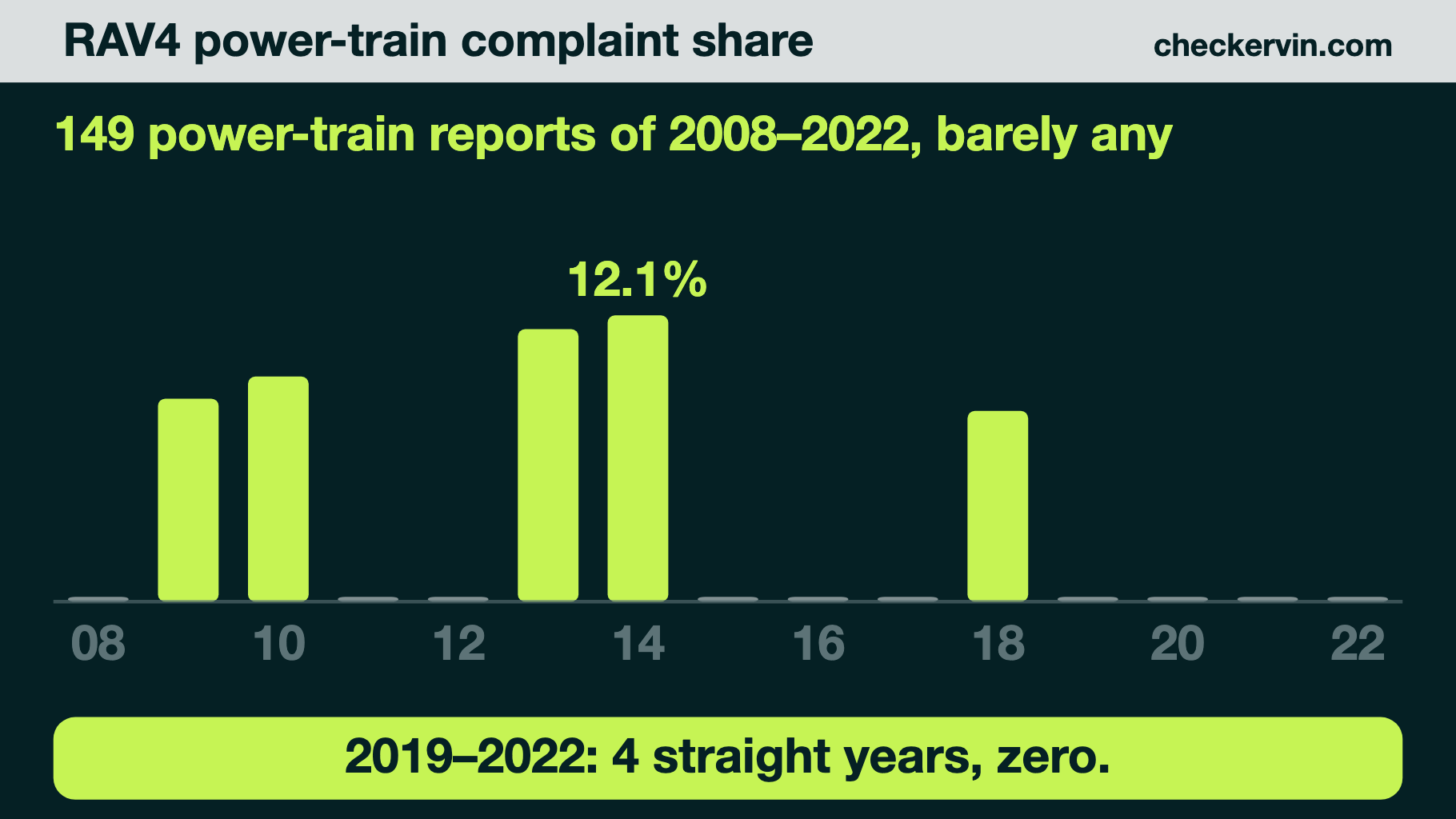
- No concentration shows up in the federal record: power train never exceeds 12.1% of any single model year's complaints.
- What fluid does it take?
- Toyota Genuine ATF WS (JWS 3324) only — it is not interchangeable with Dexron or the older T-IV fluid.
What the service actually costs
Kelley Blue Book publishes a fair-repair range for a RAV4 transmission fluid change on a per-year, per-ZIP-code basis. The figures move with the model year: $306 to $377 for a 2011 RAV4, $320 to $422 for a 2017, $257 to $340 for a 2019, and $304 to $402 for a 2021. None of these numbers is ours — we sell VIN checks, not repairs, and price nothing here ourselves — so treat every figure in this post as attributed to whoever published it, not as our quote.
A flat estimator price also does not tell you which automatic transmission is actually under the car. The RAV4 changed its transmission twice across the years this corpus covers, and as the next section shows, that is not where its complaint history concentrates — which matters because it is exactly the kind of fact a one-size estimator page cannot surface.
What 5,793 complaints say about the RAV4's transmission
Our corpus of federal NHTSA complaints holds 5,793 reports against the 2008–2022 Toyota RAV4. POWER TRAIN names only 149 of them — 2.6% of the entire record — and it cracks the model year’s own top-5 most-reported categories in just 5of the nameplate’s 15 years: 2009, 2010, 2013, 2014, 2018. In every one of those five years, power train never rises above third place among that year’s own complaint categories, and its single highest share of any model year’s total is 2014, at 12.1%.
That is a materially different shape from every other nameplate in this series. The Honda CR-V, Pilot and Civic, the Nissan Rogue and Altima, the Ford Fusion and the Jeep Grand Cherokee each show a sharp power-train concentration tied to a specific model-year window — a transmission switch, a documented defect, a settlement. The RAV4’s record shows the opposite: the longest unbroken run with zero power-train complaints in the top-5 is 2019–2022, 4straight model years with no power-train representation at all among that year’s most-reported problems.
Two new transmissions, two quiet launches
The RAV4 changed its automatic transmission twice inside the span this corpus covers. The fourth generation, which arrived for the 2013 model year, brought a 6-speed automatic (the U660E) in place of the outgoing car’s unit. The fifth generation, which arrived for 2019, replaced that 6-speed with an all-new 8-speed automatic for gasoline models — Aisin’s AWF8F35, marketed as Direct Shift-8AT — while the RAV4 Hybrid moved to an electronically controlled continuously variable transmission (eCVT) as part of its hybrid drive system, a different kind of unit from a conventional automatic or a belt-driven CVT.
What the outgoing third-generation RAV4 (2008–2012 in this corpus) actually ran is less settled: parts-seller listings checked for this post disagree across 4-, 5- and 6-speed units depending on the engine and drivetrain, and we could not confirm a single clean answer against a manufacturer document in this session. What is clear from our own record is that at least two real transmission launches sit inside this span, in 2013 and 2019 — and neither one produced the complaint spike that a new transmission has produced on other nameplates in this series. The fourth-generation 6-speed’s first two years, 2013 and 2014, do carry the RAV4’s two highest power-train shares (11.5% and 12.1% respectively) — a real, if modest, bump worth naming plainly. The fifth generation shows nothing of the kind: 2019–2022 covers its entire production run in this corpus with zero power-train representation in the top-5, in every single year — and those rows pool the 8-speed gas cars with the Hybrid and Prime, so the quiet record covers the whole lineup, not one transmission.
Toyota Genuine ATF WS, not a universal fluid
Toyota’s own owner’s-manual guidance — excerpted via third-party manual archives, since this environment could not fetch toyota.com directly — instructs that automatic transmission fluid other than “Toyota Genuine ATF WS” may cause deterioration in shift quality. ATF WS is built to the JWS 3324 specification, and a Toyota technical service bulletin states plainly that ATF-WS is not compatible with the older T-IV fluid or with generic Dexron automatic transmission fluid. The bulletin also notes that open containers of ATF WS can absorb moisture from the air, which can itself cause shift concerns — a reason to care which shop, and which sealed container, is doing the job.
| Fluid | Where it applies |
|---|---|
| Toyota Genuine ATF WS (JWS 3324) | The specification Toyota's own manual guidance calls for |
| T-IV / generic Dexron | Explicitly flagged as not compatible, per Toyota's technical bulletin |
| Aftermarket 'universal' ATF | Not confirmed against WS in sources checked for this post |
Is it really 'lifetime'?
Toyota has marketed ATF WS as effectively a lifetime fill on several RAV4 model years, and some owner guidance repeats that framing without qualification. That is not the only guidance in circulation. Multiple RAV4-specific maintenance references list a 60,000-mile change interval under Toyota’s own “severe” service schedule — trailer towing, sustained heavy city traffic, or off-road and dusty conditions — distinct from the “normal” schedule, where some model years show no scheduled change at all. Separately, independent, non-Toyota sources argue the lifetime label understates how transmission fluid actually breaks down under sustained heat, regardless of the specification.
The RAV4's worst complaint years weren't this
It would be easy to read a quiet transmission record as a quiet car overall, and the data does not support that either. 2019 is the RAV4’s single heaviest complaint year in the whole corpus, with 905complaints — more than double most other years on record — and its leading category is fuel/propulsion system, at 266 complaints. 2020 follows with 649 complaints, led by engine at 182. Power train is not among either year’s top categories at all.
The point of naming this plainly: this page is about the transmission-fluid question specifically, and the RAV4’s federal record genuinely does not show a power-train concentration problem anywhere in its 15 model years. It does show other, separate categories concentrating heavily in 2019 and 2020— a different question than this post set out to answer, and one worth checking on its own terms rather than assuming a quiet transmission means a quiet car.
What an actual transmission problem looks like, if it shows up
- A shudder, flare or harsh clunk between gears, especially at low speed
- Delayed or hesitant engagement when shifting from park into drive
- The transmission slipping or hunting between gears without a clear reason
- A burnt smell from the fluid, or fluid that has darkened well past its original color
None of these symptoms are specific to the RAV4 — they are the general signs any automatic transmission gives before a repair gets expensive. The order that matters is cheap first: confirm the exact model year and transmission by VIN, then get a fluid condition check, before anyone prices a repair beyond a routine service.
Before you authorize the service
- Confirm the exact model year by VIN — the fluid spec and the generation both change with it
- Confirm the shop is using Toyota Genuine ATF WS, not Dexron, T-IV or an unverified 'universal' substitute
- Ask which service schedule — normal or severe — your driving actually falls under, and get that interval in writing
- Pull the VIN's open recalls before paying for anything else
- Get the quote itemized — fluid brand, quantity and labor — not a single flat-rate line
If you're buying the RAV4, not maintaining it
The same record reads as a reassurance with one real caveat. A Toyota VIN decodeconfirms the exact model year and, by extension, which of the three automatic transmissions this corpus covers a given RAV4 actually has — worth knowing before you price a fluid service or assume interchangeable parts across generations. The complaint record itself gives you no reason to discount a RAV4 for transmission risk specifically, in any of its 15 model years, which is not something every nameplate in this series can say.
That is one category, not the whole car. Run the recall lookupon any candidate VIN before you negotiate — recalls run on their own schedule, independent of the complaint patterns above — and check why transmission fluid is the one fluid the VIN matters most for generally, since the same car can ship with different transmission and fluid combinations depending on trim and model year, exactly as this post found on the RAV4 itself.
Where this information comes from
- NHTSA — RAV4 complaint databaseThe federal complaint record this page's figures are computed from, browsable by model year.
- NHTSA — recalls by VINThe official lookup to confirm any open recall on a specific RAV4 VIN, independent of the complaint figures above.
- Kelley Blue Book — RAV4 transmission fluid change estimateThe per-model-year fair-repair-range figures quoted above, retrieved via search November 2026.
- Toyota technical service bulletin — ATF WS fluid specificationThe bulletin stating ATF-WS is not compatible with T-IV or Dexron fluid, hosted on NHTSA's TSB archive.
Keep reading
Frequently asked questions
How much does it cost to change the transmission fluid in a Toyota RAV4?
Kelley Blue Book's fair-repair-range figures vary by model year and ZIP code: $306-$377 for a 2011 RAV4, $320-$422 for a 2017, $257-$340 for a 2019, and $304-$402 for a 2021. None of these figures is ours — we sell VIN checks, not repairs — so treat them as attributed estimates, not a quote.
What transmission fluid does a Toyota RAV4 take?
Toyota Genuine ATF WS, built to the JWS 3324 specification. Toyota's own owner's-manual guidance, excerpted via third-party manual hosts, states that using a fluid other than ATF WS may cause deterioration in shift quality, and a Toyota technical bulletin states ATF-WS is not compatible with the older T-IV or generic Dexron automatic transmission fluids. This is not a universal fluid despite how some aftermarket bottles are marketed.
Is the RAV4's transmission fluid really a 'lifetime' fill?
That is how Toyota has marketed Genuine ATF WS, but it is not the only guidance in circulation. Several RAV4 maintenance references list a 60,000-mile change interval under Toyota's own 'severe' service schedule (towing, heavy city driving, dusty conditions), and multiple independent, non-Toyota sources argue 'lifetime' understates how fluid actually degrades under heat. We could not confirm either claim against a document opened directly in this session, so treat 'lifetime' as a marketing term, not a verified service-free guarantee.
Which Toyota RAV4 model years show the most power-train complaints?
Computed from src/data/models/toyota-rav4.json: POWER TRAIN cracks that year's own top-5 complaint categories in only 5 of the RAV4's 15 model years (2009, 2010, 2013, 2014, 2018) — never ranking higher than third — and accounts for just 149 of 5,793 total complaints across the whole span (2.6%). The single highest share is 2014, at 12.1% of that year's own complaints.
Does the Toyota RAV4 have transmission problems?
Not according to its own federal complaint record. POWER TRAIN complaints never reach double-digit percentage concentration in any single model year above 12.1%, and the longest unbroken run with zero power-train complaints in the top-5 is 2019-2022 (4 straight model years) — spanning the exact years the fifth-generation RAV4's brand-new 8-speed automatic was in production. The RAV4's two heaviest complaint years overall, 2019 and 2020, are driven by fuel/propulsion system and engine respectively, not the transmission. Complaints are unverified owner reports, not a measured failure rate, so this is evidence of an unusually quiet record, not a guarantee.
Confirm the generation before you price the service
A free CheckerVIN report shows the factory build, specifications and open recalls for any VIN — confirm what you're actually pricing.
Run a free VIN check