The short answer
- What does it cost?
- KBB's fair-repair ranges run roughly $303-$480 depending on model year, trim and ZIP code; YourMechanic averages $192.
- Does the Highlander have a transmission problem?
- POWER TRAIN has ranked as the #1 complaint category every single model year from 2017 through 2022, peaking at 41.6% in 2021.
- What fluid does it take?
- Toyota Genuine ATF-WS only — Toyota's own bulletin states it is not compatible with Dexron or the older T-IV fluid.
What the service actually costs
Kelley Blue Book publishes a fair-repair range for a Highlander transmission fluid change on a per-year, per-trim, per-ZIP-code basis. Sampled figures run from $361 to $444 for a 2016 Highlander, $329 to $397 for a 2019, and $303 to $392 for a 2023, with the Highlander Hybrid running somewhat higher across the years sampled. YourMechanic’s flat average lands lower, at $192 ($88 parts, $104 labor). None of these numbers is ours — we sell VIN checks, not repairs, and price nothing here ourselves — so treat every figure in this post as attributed to whoever published it, not as our quote.
A flat estimator price also does not tell you whether the car you’re pricing sits on the quiet side of this nameplate’s complaint record or the loud side. As the next section shows, that line falls at a specific model year — not gradually, and not evenly across the whole 15-year span.
What 4,258 complaints say about the Highlander's transmission
Our corpus of federal NHTSA complaints holds 4,258 reports against the 2008–2022 Toyota Highlander. POWER TRAIN names 775 of them — 18.2% of the entire record — but that share is not spread evenly across the span. It concentrates almost entirely on one side of a single model year.
Before 2017, POWER TRAIN barely registers. From 2017 onward, it is not merely present — it is the single most-reported complaint category, every year, through the last model year this corpus holds. That is a sharper, cleaner split than most nameplates in this series show.
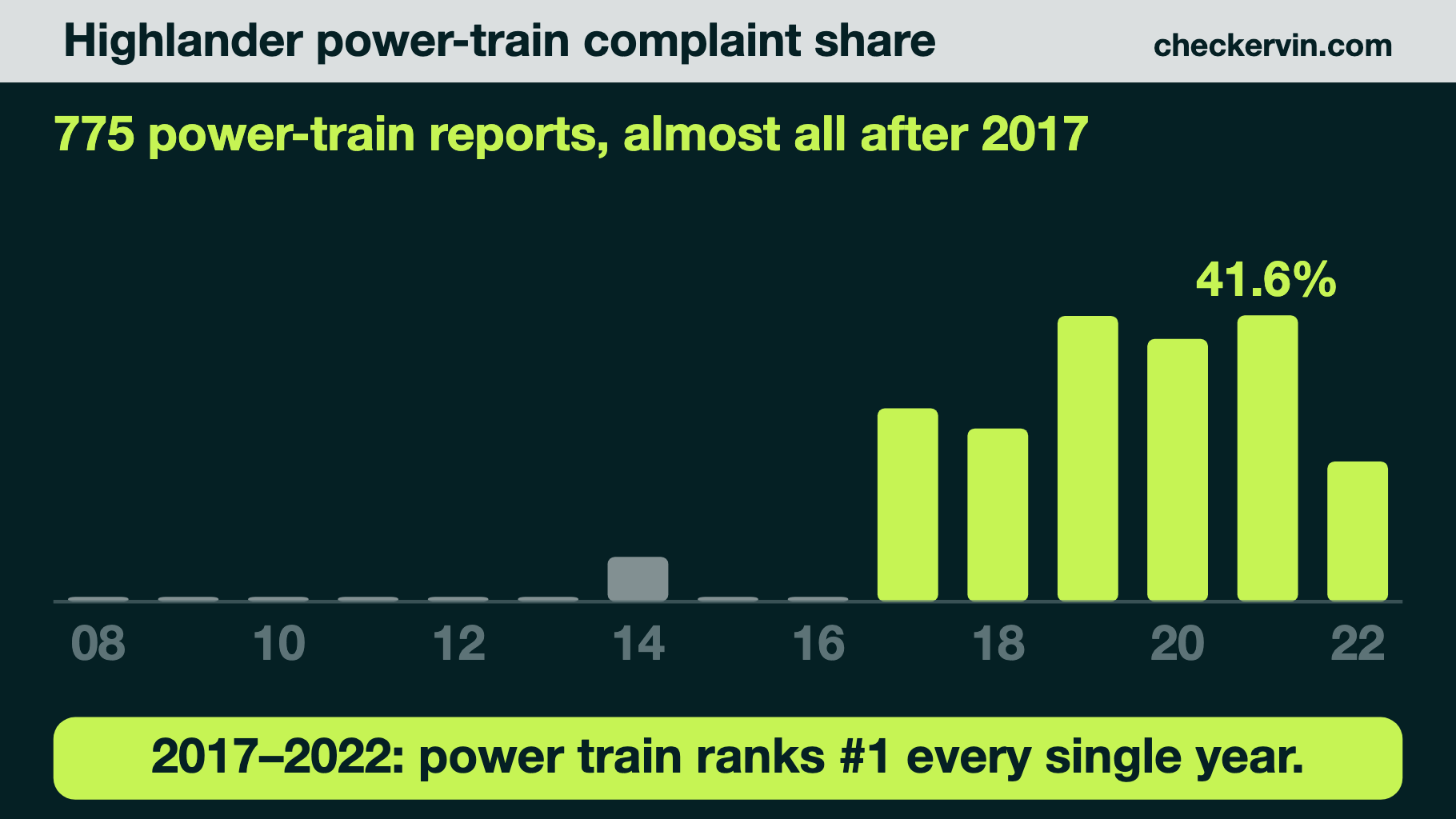
Before 2017: almost nothing
Across the 9 model years from 2008 through 2016, POWER TRAIN cracks that year’s own top-5 complaint categories just 1 time: 2014, at 6.5% of that year's complaints, ranked 4th. Every other year in that stretch shows zero power-train representation among its most-reported problems at all — not a low share, but entirely absent from the ranking.
That is nine model years, two full Highlander generations (third-generation 2008–2013, fourth-generation launching in 2014), where the record gives no reason to flag the automatic transmission specifically. Whatever changes starting in 2017 is not a continuation of a long-running pattern — it is a new one.
2017 onward: six straight years at #1
Starting with the 2017model year, POWER TRAIN becomes the single most-reported complaint category for the Highlander — not just present, but ranked first — in every one of the 6 model years this corpus holds from 2017 through 2022, with no exception. The share climbs from 28.1% of that year’s complaints in 2017 to a peak of 41.6% in 2021 — 228 of 548 total complaints that year alone.
| Model year | Power-train share of that year's complaints |
|---|---|
| 2017 | 28.1% (rank 1) |
| 2018 | 25.2% (rank 1) |
| 2019 | 41.5% (rank 1) |
| 2020 | 38.2% (rank 1) |
| 2021 | 41.6% (rank 1) |
| 2022 | 20.4% (rank 1) |
2017is also when Toyota introduced an all-new 8-speed automatic transmission to the Highlander lineup — a real generational change that lines up with the record’s own split, and the clearest candidate explanation for why the pattern starts exactly where it does rather than somewhere in the middle of a model-year run.
What two real service bulletins say
Two documented Toyota technical service bulletins corroborate this split independently of our own complaint corpus. T-SB-0194-17 — originally dated March 2017 and revised in December 2020, hosted on NHTSA’s own TSB archive — covers Highlanders with the 8-speed automatic showing low power, a high-RPM shift point on the 2-3 shift, and hesitation in low gears. T-SB-0008-21, per a secondary bulletin summary (we found no NHTSA-hosted PDF for this second bulletin in search, so it is attributed to that secondary source only), covers select 2021 Avalon, Highlander and Camry vehicles built on the UA80E/UA80F 8-speed, describing a whine or grind noise from the transmission.
A reported class-action investigation separately names Toyota and Lexus vehicles with the 8-speed automatic, including the Highlander from the 2017 model year forward, and alleges Toyota’s own analytics group flagged the transmission as a “high-priority powertrain concern” internally by February 2017 — the same model year our own corpus flags independently. That is a reported legal allegation, not a verified finding, and we did not independently open the underlying court filing in this session.
ATF-WS, and a disputed interval
Toyota’s own guidance calls for Toyota Genuine ATF-WS in the Highlander’s automatic transmission. A Toyota technical bulletin states plainly that ATF-WS is not compatible with the older T-IV fluid or with generic Dexron automatic transmission fluid, and separately warns that additives or unverified “universal” aftermarket substitutes can cause shift concerns and internal damage.
| Fluid | Where it applies |
|---|---|
| Toyota Genuine ATF-WS | The specification Toyota's own guidance calls for |
| T-IV / generic Dexron | Explicitly flagged as not compatible, per Toyota's technical bulletin |
| Aftermarket 'universal' ATF | Not confirmed against WS in sources checked for this post |
How often it should actually be changed is where sources disagree. One circulated bulletin describes ATF-WS under a 100,000-mile interval as inspection-only, with no scheduled change required absent a problem. Independent forum and dealer-service advice commonly recommends an initial drain-and-fill around 30,000 miles, then every 25,000 to 30,000 miles after that, especially for towing or sustained heavy city driving — closer to a conventional service interval than a lifetime fill.
The Highlander's worst year wasn't this
It would be easy to read the 2017-onward pattern as proof the Highlander simply got less reliable over time. The record does not support that either. The nameplate’s single heaviest complaint year across the entire 15-year span is actually 2008, with 602complaints — more than any power-train-era year, including 2021’s 548. 2008’s leading category is service brakes, at 196 complaints, not the transmission at all.
The point of naming this plainly: this page is about the transmission-fluid question specifically, and the record shows a real, dated, six-year pattern starting in 2017— not a claim that the Highlander’s overall complaint volume only ever rises. 2008 shows the opposite can also be true, for a completely different component, nearly a decade before the transmission pattern begins.
What an actual transmission problem looks like, if it shows up
- A shudder, flare or harsh clunk between gears, especially at low speed
- Hesitation or a delay in power delivery, particularly under acceleration
- A whining, grinding or humming noise from the transmission
- Delayed or hesitant engagement when shifting from park into drive
None of these symptoms are unique to the Highlander — they are the general signs any automatic transmission gives before a repair gets expensive. The order that matters is cheap first: confirm the exact model year by VIN, then get a fluid condition check, before anyone prices a repair beyond a routine service.
Before you authorize the service
- Confirm the exact model year by VIN — the complaint pattern above is specific to 2017 and later
- Confirm the shop is using Toyota Genuine ATF-WS, not Dexron, T-IV or an unverified 'universal' substitute
- Ask whether your dealer has applied T-SB-0194-17 or T-SB-0008-21 if your symptoms match either bulletin
- Pull the VIN's open recalls before paying for anything else
- Get the quote itemized — fluid brand, quantity and labor — not a single flat-rate line
If you're buying the Highlander, not maintaining it
The same record reads as a specific, dated caution rather than a blanket one. A Toyota VIN decodeconfirms the exact model year — worth knowing before you assume a used Highlander falls on either side of the 2017 split, since the two sides of this record look nothing alike. A Highlander from 2008–2016 carries almost no power-train complaint history in our corpus; one from 2017 on carries a documented, bulletin-corroborated pattern worth asking a seller or a pre-purchase inspector about directly.
That is one category, not the whole car. Run the recall lookupon any candidate VIN before you negotiate — recalls run on their own schedule, independent of the complaint pattern above — and see which Highlander model years the full record flags across every component, not just the transmission. More generally, the VIN, not the badge, decides which transmission fluid a car actually takes, exactly as this post found on the Highlander specifically.
Where this information comes from
- NHTSA — Highlander complaint databaseThe federal complaint record this page's figures are computed from, browsable by model year.
- NHTSA — recalls by VINThe official lookup to confirm any open recall on a specific Highlander VIN, independent of the complaint figures above.
- Toyota technical service bulletin T-SB-0194-17 — 8-speed automaticLow power, high-RPM 2-3 shift point and low-gear hesitation on the 8-speed automatic, hosted on NHTSA's TSB archive.
- Kelley Blue Book — Highlander transmission fluid change estimateThe per-model-year fair-repair-range figures quoted above, retrieved via search November 2026.
Keep reading
Frequently asked questions
How much does it cost to change the transmission fluid in a Toyota Highlander?
Kelley Blue Book's fair-repair-range figures vary by model year, trim and ZIP code: $361-$444 for a 2016 Highlander, $329-$397 for a 2019, and $303-$392 for a 2023, with the Hybrid running somewhat higher ($337-$462 across sampled years). YourMechanic quotes a lower flat average, $192 ($88 parts, $104 labor). None of these figures is ours — we sell VIN checks, not repairs — so treat them as attributed estimates, not a quote.
What transmission fluid does a Toyota Highlander take?
Toyota Genuine ATF-WS. A Toyota technical bulletin states plainly that ATF-WS is not compatible with the older T-IV fluid or with generic Dexron automatic transmission fluid, and that it should not be mixed with additives or 'universal' aftermarket substitutes, which Toyota warns can cause shift concerns and internal damage. Confirm the exact fluid for your model year and trim against your own owner's manual.
Is the Highlander's transmission fluid really a lifetime fill?
That is how Toyota has described ATF-WS on some model years and documents, with one circulated bulletin describing a 100,000-mile interval as inspection-only, with no scheduled change required. It is not the only guidance in circulation: independent forum and dealer-service advice commonly recommends an initial drain-and-fill around 30,000 miles and roughly every 25,000-30,000 miles after that, especially under towing or heavy city driving. We could not confirm either position against a document opened directly in this session, so this page states both and lets you weigh them rather than picking one.
Which Toyota Highlander model years show the most power-train complaints?
Computed from src/data/models/toyota-highlander.json: POWER TRAIN is the single most-reported complaint category in every one of the 6 model years from 2017 through 2022 (2017, 2018, 2019, 2020, 2021, 2022), with no exception — climbing from 28.1% of that year's complaints in 2017 to a peak of 41.6% in 2021 (228 of 548 complaints). Across the 9 model years before that (2008-2016), it appears in that year's own top-5 just 1 time.
Does the Toyota Highlander have transmission problems?
Its own federal complaint record shows a sharp, dated pattern: POWER TRAIN ranks as the single most-reported category every model year from 2017 onward, which two real Toyota technical service bulletins (T-SB-0194-17 and T-SB-0008-21) independently corroborate for the 8-speed automatic. The Highlander's single heaviest complaint year overall is actually 2008 (602 complaints), led by service brakes, not the transmission — a separate, older story. Complaints are unverified owner reports, not a measured failure rate, so this describes a documented pattern worth asking about, not a guaranteed defect in any individual vehicle.
Confirm the generation before you price the service
A free CheckerVIN report shows the factory build, specifications and open recalls for any VIN — confirm what you're actually pricing.
Run a free VIN check