The short answer
- What does it cost?
- YourMechanic averages $201; its own year-specific examples run $377 to $993. KBB's sampled fair-repair ranges run roughly $293-$487. All attributed, none ours.
- Does the Ram 1500 have a transmission problem?
- Power train's share of complaints ranges from 25.5% in 2011 to exactly zero in 2018 across the 2011-2022 span - a real recall explains only part of the spike.
- What fluid does it take?
- It depends on which of five transmissions your specific truck has - confirm by VIN or the fluid stamped on the pan before anyone adds anything.
What the service actually costs
YourMechanic publishes a $201 average for a Ram 1500 transmission fluid service — $106 in parts, $95 in labor — but its own year-and-engine-specific examples swing far wider than that headline number. A 2016 V6 estimate runs $377.40, against a dealer/shop range of $448.17 to $623.54. A 2019 Ram 1500 Classic V8 estimate runs $992.66, against a dealer/shop range of $1,181.07 to $1,732.53 — roughly 2.6 times the V6 figure for what is nominally the same service. Kelley Blue Book’s own fair-repair ranges, sampled across several model years, cab styles and ZIP codes, land closer to $293–$487. None of these numbers is ours; we sell VIN checks, not repairs.
KBB separately notes that some newer Ram transmissions are designed not to need a fluid change at all absent a leak or a problem, and that a high-pressure flush typically costs more than a straight drain-and-fill — and has fallen out of favor with some shops because it can dislodge debris inside an older unit. Confirm your exact engine and transmission before trusting any single quote.
What 12,457 complaints say about the Ram 1500's power train
Our corpus of federal NHTSA complaints holds 12,457 reports against the 2011–2022 Ram 1500. POWER TRAIN names 1,547 of them — 12.4% of the entire record. Spread evenly across twelve model years, that figure alone would say little. It is not spread evenly.
The category’s share of each model year’s own complaints runs from a high of 25.5% in 2011— the earliest model year in this corpus — down to exactly zero in 2018, the only one of the twelve years where POWER TRAIN does not place in that year’s own top five categories at all. It is worth stating plainly what this is not: POWER TRAIN never actually ranks as the single largest complaint category in any Ram 1500 model year on file. ELECTRICAL SYSTEM led 2011 itself, ahead of power train’s own 25.5%.
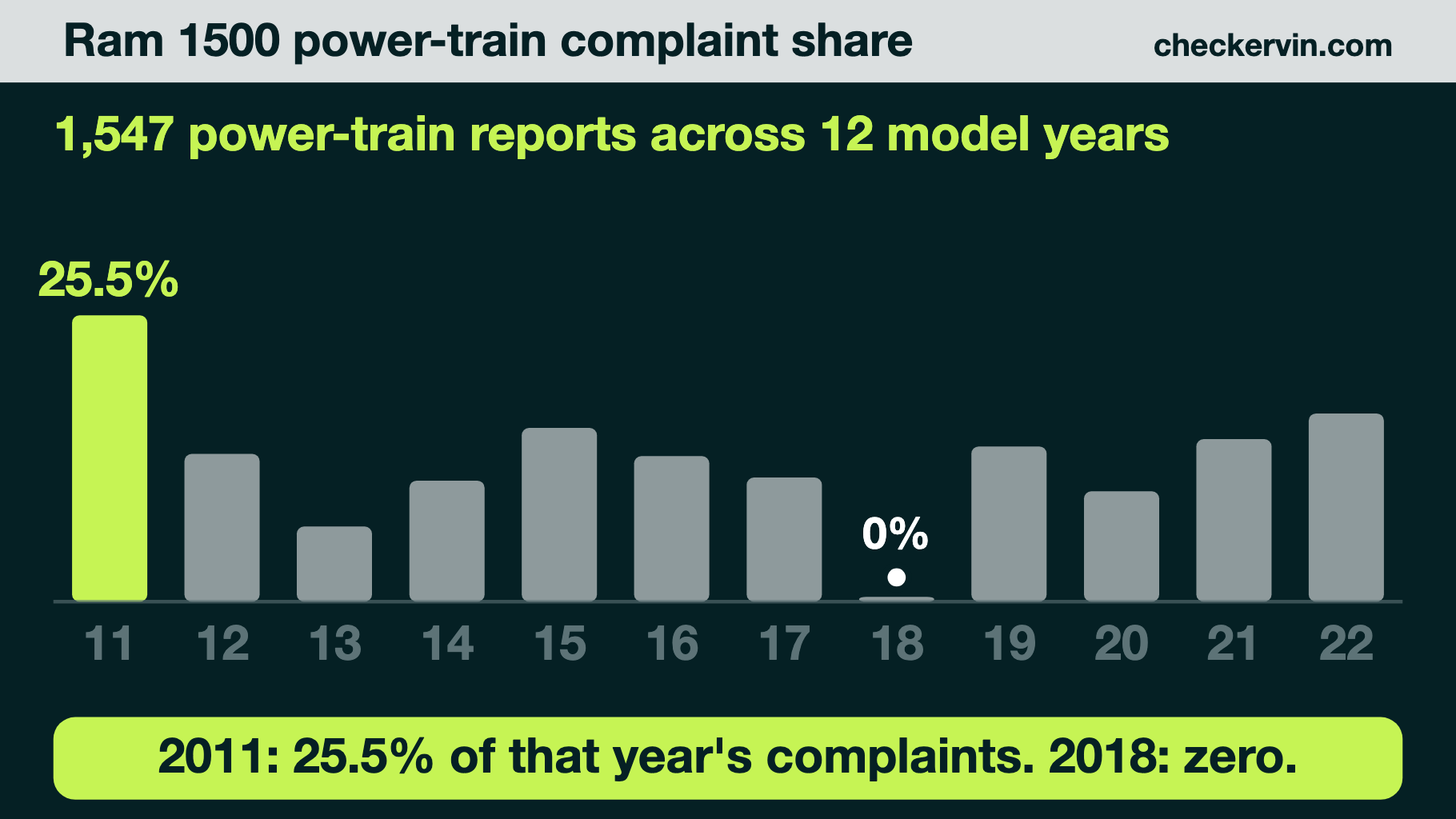
The two extremes: 2011 and 2018
| Model year | Power train's share of that year's complaints |
|---|---|
| 2011 | 25.5% (176 of 689, rank 2) |
| 2018 | 0% (0 of 667, outside the top 5) |
Both flagged years also sit below the nameplate’s own 791-complaint median model year — worth naming plainly, since a sharp share on a smaller base is a real pattern but not the same thing as a high absolute count. The next two sections take each end of the range in turn: what actually bounds the 2011 high, and what the platform change around 2018 and the following year has to do with it.
2011: an axle recall, not just a gearbox one
A real NHTSA safety recall, campaign 13V-038, covers 2009-2012 Ram 1500 trucks built in a specific production window for a rear-axle pinion nut that can loosen or fracture, which the recall’s own description ties to a risk of the rear axle locking up while driving. NHTSA files that defect under its own POWER TRAIN:DRIVELINE:DIFFERENTIAL category — the same broad category this page’s chart is built from, and one that covers axles and driveshafts as well as the transmission itself. Some of 2011’s elevated share is very plausibly axle-recall traffic, not gearbox trouble.
It does not explain all of it. Owner narratives located separately via WebSearch describe genuine automatic-transmission failures on 2011trucks with the 65RFE unit — one account describes a second failure in 20,000 miles, with third and fourth gear lost outright — which has nothing to do with a rear-axle pinion nut. The honest reading of 2011’s 25.5% is two separate stories landing in the same NHTSA category, not one clean explanation.
2018 to 2019: a platform change, not a pattern
2018was the final model year of the Ram 1500’s fourth-generation (DS) truck before the all-new fifth-generation (DT) redesign arrived for model year 2019. The change reached the transmission too: Ram’s own 2019 press materials describe the 5.7L Hemi moving from the 8HP70 eight-speed used from 2013 through 2018 to an upgraded 8HP75, while V6 trucks moved to an FCA-built TorqueFlite 850RE. Ram also continued selling the carryover DS-platform truck alongside the new one as the “Ram 1500 Classic,” which could still carry the older 8HP70 — so a 2019-badged truck is not automatically a DT.
That matters for reading this chart honestly. 2018’s zero and 2019’s rebound to a 13.9% share could reflect a genuinely different truck, a reporting lag as a new platform works through its first year on the road, or some mix of both running through the same Classic/DT split. This corpus’s 2019–2022rows do not separate the two: they count every complaint NHTSA files under the Ram 1500 name for that model year, the 1500 Classic’s included, so the platform change is named here as documented product history, not offered as proof of what drove either number.
The busiest year wasn't a power-train year
It would be easy to assume the two flagged years above are also the Ram 1500’s worst overall. The record does not support that. The nameplate’s single busiest complaint year across the full twelve-year span is actually 2014, with 1,777 total complaints — more than either 2011 or 2018. 2014’s leading category is steering, at 508 complaints, not power train at all.
The point of naming this plainly: this page is about the transmission-fluid question specifically, and the record shows two genuinely different years at the extremes of that one category — not a claim that the Ram 1500’s overall complaint volume traces back to the transmission in general.
Five transmissions, one VIN-specific answer
A single “what fluid does a Ram 1500 take” answer does not exist across a twelve-model-year span that has carried at least five distinct automatic transmissions: the 65RFE, the 8HP70, the upgraded 8HP75, and the Pentastar-paired 850RE and 845RE. Each has its own fluid specification, and using the wrong one is not a minor mismatch — an owner’s-manual mirror located via WebSearch names Mopar ATF+4 for older automatics, while sources describing the newer 8-speed units point to a separate ZF-licensed fluid instead of generic ATF.
| What we could confirm | Source |
|---|---|
| Older automatics (ATF+4 family) take Mopar ATF+4 | Owner's-manual mirror, via WebSearch |
| Newer 8-speed units commonly specify a ZF-licensed fluid, not generic ATF | Forum and parts-reference sources, via WebSearch |
| The exact unit in any individual truck depends on engine, trim and build date, not model year alone | Ram forum teardown comparing 845RE/850RE/8HP70/8HP75 |
Confirm the actual unit from your VIN or the fluid type stamped on the transmission pan before a shop adds anything. The interval is similarly unsettled: sources cite roughly 60,000 miles under towing or hot-climate use, stretching to 100,000–120,000 miles under normal duty, while some manual language suggests a factory fill for the life of the truck absent a leak — a claim a technical service bulletin summary pushes back on for several Ram models, recommending the fluid be checked on a schedule regardless.
What an actual transmission problem looks like, if it shows up
- A whirring, whining or clunking noise from the rear axle area on a 2009-2012 truck — check recall 13V-038 before assuming it's the transmission
- A shudder or vibration around 1,500 RPM that a shop cannot explain as normal Hemi behavior
- Losing a specific gear outright, or a delayed, harsh engagement from Park or Reverse into Drive
- Metal debris visible in fluid pulled during a routine service — a sign of internal wear, not something a fluid change alone fixes
None of these symptoms are unique to the Ram 1500 — several are the general signs any automatic transmission gives before a repair gets expensive. The order that matters is cheap first: confirm the exact model year, engine and build date by VIN, check for an open recall, then get a fluid condition check, before anyone prices a repair beyond a routine service.
Before you authorize the service
- Confirm the exact model year, engine and transmission unit by VIN — five different automatics have shared this nameplate
- On a 2009-2012 truck, check whether recall 13V-038 was completed before assuming a noise is transmission-related
- Confirm the correct fluid spec for your specific unit rather than assuming one generation's fluid applies to another
- Pull the VIN's open recalls while you are at it; the lookup is free
- Get the quote itemized — fluid brand, quantity and labor — not a single flat-rate line
If you're buying the Ram 1500, not maintaining it
The same record reads as a specific, dated question rather than a blanket one. A Ram VIN decode confirms the exact model year, engine and build date — worth knowing before you assume a used truck falls inside the 2011 window this page flags, or on the DS or DT side of the 2018-2019 platform change, since the two trucks do not share a transmission family.
That is one category, not the whole truck. Run the Ram recall checkon any candidate VIN before you negotiate — recall 13V-038 and any other open campaign run on their own schedule, independent of the complaint pattern above — and see which Ram 1500 model years the full record flags across every component, not just power train. More generally, the VIN, not the badge, decides which transmission fluid a truck actually takes, exactly as this post found on the Ram 1500 specifically.
Where this information comes from
- NHTSA — Ram 1500 complaint databaseThe federal complaint record this page's power-train figures are computed from, browsable by model year.
- NHTSA — recalls by VINThe official lookup to confirm recall 13V-038, or any other, on a specific Ram 1500 VIN.
- Kelley Blue Book — Ram 1500 transmission fluid changeOne of the year/location-sampled fair-repair ranges quoted above, retrieved via search November 2026.
- YourMechanic — Ram 1500 transmission fluid service estimateThe $201 average and the 2016/2019 year-specific examples quoted above, with their parts/labor split.
Keep reading
Frequently asked questions
How much does it cost to change the transmission fluid in a Ram 1500?
YourMechanic lists a $201 average ($106 parts, $95 labor), but its own year-and-engine-specific examples run far wider: $377.40 for a 2016 V6 (dealer range $448.17-$623.54) up to $992.66 for a 2019 Ram 1500 Classic V8 (dealer range $1,181.07-$1,732.53). Kelley Blue Book's sampled fair-repair ranges across several years and ZIP codes run roughly $293-$487. None of these numbers is ours - we sell VIN checks, not repairs - so treat every figure here as attributed to whoever published it, and confirm your exact engine and cab style before trusting any single number.
What transmission fluid does a Ram 1500 take?
There is no single answer, because the Ram 1500 has used at least five different automatic transmissions across the model years in our corpus - the 65RFE, the 8HP70, the upgraded 8HP75, and the Pentastar-paired 850RE and 845RE - each with its own fluid specification. Older trucks' owner's manuals name Mopar ATF+4; newer 8-speed units commonly call for a ZF-licensed fluid instead, and generic red ATF is not a safe substitute for either. Confirm the exact unit from your VIN or the fluid stamped on the transmission pan before anyone adds anything.
Which Ram 1500 model years show the most power-train complaints?
Computed from src/data/models/ram-1500.json: across the 2011-2022 span, POWER TRAIN's share of a model year's own complaints ranges from a high of 25.5% in 2011 (176 of 689) down to exactly zero in 2018 (667 total complaints, none of them POWER TRAIN) - the only model year where the category does not place in that year's own top five at all. POWER TRAIN never actually ranks as the single largest category in any model year; electrical system led 2011 itself.
Does the Ram 1500 have transmission problems?
A real NHTSA recall, campaign 13V-038, covers 2009-2012 Ram 1500 trucks built in a specific window for a rear-axle pinion nut that can loosen or fracture - filed under the same POWER TRAIN category NHTSA tracks for the transmission itself, which only partly explains 2011's spike. Owner narratives surfaced separately describe genuine 65RFE transmission failures on 2011 trucks unrelated to that axle recall. The nameplate's single busiest complaint year overall is actually 2014 (1,777 total complaints), led by steering, not power train. Complaints are unverified owner reports, not a measured failure rate.
How often should a Ram 1500's transmission fluid be changed?
Sources disagree. Several estimators cite roughly 60,000 miles under towing or hot-climate use, stretching to 100,000-120,000 miles under normal duty, while some owner's-manual language suggests certain transmissions are factory-filled for the life of the truck absent a leak. A technical service bulletin summary located via WebSearch pushes back on that lifetime-fill framing for several Ram models, recommending the fluid be checked on a regular schedule regardless. Confirm the figure in your own VIN's specific maintenance schedule rather than any flat number.
Confirm the recall before you price the service
A free CheckerVIN report shows the factory build, specifications and open recalls for any VIN — confirm what you're actually pricing.
Run a free VIN check