The short answer
- What does it cost?
- KBB's model-year pages list roughly $334-$435 (2021) and $333-$398 (2022) for the non-hybrid Sorento, reflecting local labor rates more than the job itself.
- Is there a recall on the transmission?
- Yes — NHTSA campaign 22V-760 covers 2021-2022 Sorentos with the 2.5L turbo/8-speed dual-clutch transmission for an electric oil-pump fault, a hardware defect a fluid change does not fix.
- Which years carry the power-train history?
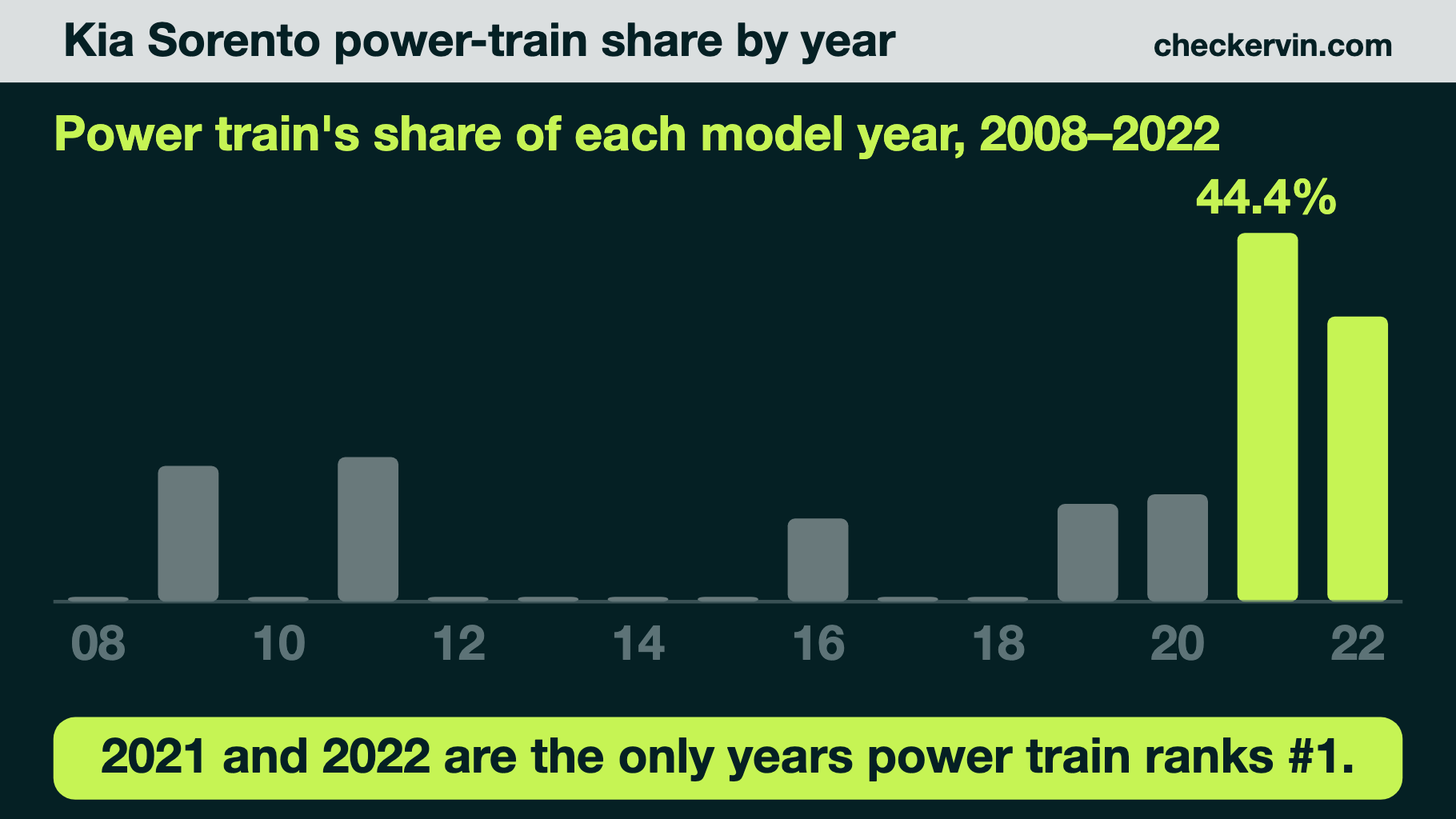
- 2021 and 2022, the two recall years, are the only ones where it reaches #1. POWER TRAIN cracks the model year's own top-5 in only 7 of 15 years and ranks 3rd or lower in every other one.
The numbers, and whose numbers they are
Kelley Blue Book’s model-year-specific fair-repair pages list a transmission fluid change at roughly $334 to $435 for a 2021 Sorento (Durham, NC ZIP) and $333 to $398 for a 2022 Sorento, depending on location. Those figures are for the non-hybrid lineup; a 2022 Sorento Hybrid page separately lists $299 to $369 and a 2023 Plug-in Hybrid lists $303 to $373 — different transmissions entirely, not a substitute number. One owner on ifixit.com reported a dealer quote near $800 including a filter change, well above every KBB range found for this research.
None of these figures is ours; we sell VIN checks, not repairs, and we price nothing here ourselves. A flat estimator also will not tell you which of at least four distinct Sorento generations, and which of at least two transmission types inside the most recent one, a given VIN actually carries — and as the record below shows, that distinction matters more on this nameplate than the sticker price suggests.
What 8,565 complaints say about two years
Our corpus of federal NHTSA complaints holds 8,565 reports against the 2008–2022 Kia Sorento. POWER TRAIN names only 567of them across the whole span (counting only the years it is large enough to crack that year’s own top-5 categories), and it cracks that top 5 in just 7 of the 15 model years: 2009 (#3, 16.4%), 2011 (#3, 17.4%), 2016 (#3, 10%), 2019 (#5, 11.8%), 2020 (#4, 12.9%) — and 2021 and 2022.
2021 and 2022 are different in kind, not just degree. In every other year that cracks the top 5, POWER TRAIN never outranks 2 other categories. In both recall years it ranks #1— the only #1 appearances POWER TRAIN makes anywhere in the 15-year record — at 20 of 45 complaints in 2021 (44.4%) and 78 of 227 in 2022 (34.4%). 2021’s 44.4% is the highest POWER TRAIN share of any model year on file, though it rests on a base of only 45 complaints. Neither year holds the highest raw count: 2011 holds that, with 265 POWER TRAIN complaints out of 1,520 total that year (17.4%, ranked #3) — and 2011is also the nameplate’s single worst overall year on record, 3.51x the 15-year median of 433 complaints. 2022, by contrast, sits at 0.52x the median and 2021 at 0.1x — two below-median years in volume where the mix of complaints shifted hard toward the power train, rather than years the whole nameplate was simply generating more complaints.
| Model year | What stands out |
|---|---|
| 2011 | Highest raw POWER TRAIN count (265), but ranked #3 that year and inside the nameplate's single worst overall year (3.51x median) |
| 2021-2022 | The only years it ranks #1 (44.4% and 34.4% of each year's complaints) — both on below-median overall totals (0.1x and 0.52x median) |
The recall that already covers 2021-2022, for a different reason
Per vehiclesafetyrecalls.com’s hosting of the manufacturer filing, corroborated by Consumer Reports’ and calemonlaw.com’s reporting, NHTSA campaign 22V-760 (Kia’s internal number SC250) is a real, named recall covering an estimated 69,038 vehicles: 2021-2022 Kia Sorento and 2021-2023 Kia K5, limited to vehicles built with the 2.5L turbocharged engine paired with an 8-speed wet dual-clutch transmission. The manufacturer’s report is dated October 11, 2022; owner notification letters went out December 9, 2022.
The defect is in the transmission’s electric oil pump. NHTSA’s filing, per the same secondary hosting, attributes it to a supplier-side quality deviation — a component detaching from the pump’s circuit board, described elsewhere as a soldering or contact fault — that can degrade the pump badly enough to trigger a fail-safe mode impaired enough to cause a complete loss of drive power while the vehicle is moving. The remedy is dealer inspection and, where needed, transmission replacement along with a transmission control unit reprogram — not a fluid service of any kind.
Why a fluid change does not touch this
Stated plainly, because it is easy to blur: the complaint pattern above and the recall above are the same story in two forms, and neither one is a reason to change transmission fluid. A seized or failing electric oil pump, or a fault on its control board, is a hardware failure inside the unit. Fresh fluid does not repair a failed pump, and a routine service interval would not have caught a supplier-side soldering defect before it manifested.
Worth stating the limits too, rather than smoothing them over: the recall’s own window spans two model years, 2021-2022, and our complaint record ranks POWER TRAIN #1 in both — but on small bases. 2021 shows 20 POWER TRAIN complaints out of only 45 total that year (#1, 44.4%), a sharp share on a thin sample. The record lines up with the recall’s window; it does not show that every one of those complaints is the recalled pump, and this corpus does not resolve which powertrain each complaint came from. And the recall itself only covers the 2.5L turbo/dual-clutch powertrain — it says nothing about a 2.5L non-turbo, conventional-automatic Sorento built the same model years, which is a mechanically different car wearing the same nameplate and model year.
Four generations, at least two fluid specs
The Sorento’s US run spans roughly four production generations across this record’s 2008-2022 window, per youcanic.com’s generation breakdown: the tail of the first generation (BL, through 2009), the second generation (XM, 2010-2015), the third generation (UM, 2016-2020) and the start of the fourth (MQ4, 2021 onward). Fluid specification tracks the generation, not a single nameplate-wide answer.
| Generation / years | Fluid and capacity (attributed) |
|---|---|
| XM, 2011-2015 | ATF SP-IV — 7.5 qt (2.4L I4) or 8.3 qt (3.3L V6), per Kia TSB application data |
| UM, 2016-2018 | ATF SP-IV — 7.5 qt (2.4L GDI) or 8.3 qt (2.0T / 3.3L), per the same TSB series |
| UM, 2019-2020 | ATF SP-IV — 7.4 qt (3.3L, 8-speed), per openlaborproject.com |
| MQ4, 2021+ | Kia ATF SP-IV UM013 CH059 — 6.9 qt per a 2024 Kia bulletin; a separate third-party spec site lists SP4M-1 at 6.5 qt for the same generation, a disagreement unresolved here |
None of this was independently confirmed against a Kia-published owner’s manual for every trim; each figure is attributed to the retailer, technical-spec aggregator or bulletin-hosting site that published it. Buying the wrong ATF spec on a Sorento is not a small mistake — SP-IV and SP4M-1 are not universal fluids and are not interchangeable with a generic ATF labeled “for most vehicles.”
What Kia's own manual says about the interval
Kia’s owner’s manual, per multiple retailer maintenance summaries checked for this post, lists the dual-clutch transmission’s fluid as an inspectionitem — every 40,000 miles or 48 months — rather than a fixed change interval, and that specific guidance applies to the DCT-equipped (2.5T) trim, not every Sorento built the same model year. For the conventional-automatic trims, Kelley Blue Book notes some modern automatic transmissions are designed to go without a scheduled fluid change absent a leak or fault, and a RepairPal owner thread about a 2016 Sorento with 70,000 miles found no maintenance-schedule entry for the transmission at all. A third-party guide lists roughly 50,000 kilometers as a European- market replacement interval, which is not Kia’s own US schedule and should not be substituted for it.
One cross-sourced detail worth keeping: a Kia bulletin cited by multiple sources states that a full fluid flush is required onlywhen the transmission itself is being replaced — meaning routine service, where it is called for at all, should be a drain-and-refill rather than a flush. That lines up with the inspection-first language above: Kia’s own guidance treats this as something to check periodically, not something to force on a fixed mileage schedule.
What the recalled fault looks like before it costs anything
- A sudden, unexplained loss of drive power while the vehicle is moving — the specific risk the recall names
- The transmission entering a protective fail-safe or limp mode without warning
- Hesitation or a delayed response when accelerating from a stop, particularly on a 2.5T/DCT-equipped Sorento
- Any dash warning returning after a dealer inspection or software update has reportedly already been performed
The order matters because the cheap check comes first: confirm the exact engine and transmission by VIN, check whether campaign 22V-760 has already been completed on that specific car, and pull the vehicle’s open recalls — before anyone prices a transmission repair, let alone a routine fluid service that would not have touched this fault anyway.
Before you authorize the service
- Confirm the exact engine and transmission by VIN — the 2.5T/8-speed dual-clutch is the only Sorento powertrain the 22V-760 recall covers
- Confirm the shop is using the fluid spec for your specific generation, not a universal ATF — SP-IV and SP4M-1 are not interchangeable with a generic fluid
- Ask whether campaign 22V-760 has already been completed on this specific VIN before paying for anything transmission-related
- Pull the VIN's open recalls before paying for anything that might already be covered under the recall at no cost
- Get the quote itemized — fluid brand, quantity and labor, and whether a filter change is included — not a single flat-rate line
If you are buying the Sorento, not maintaining it
The same record reads as a shopping map. A 2021 or 2022 Sorento with the 2.5T engine carries an open question worth checking before anything else: whether campaign 22V-760 was completed on that specific VIN. A Kia VIN decode confirms the exact engine and transmission before you price a service or assume a recall applies to a car that may actually carry the unrelated non-turbo powertrain, and a free transmission fluid lookup by VIN returns the factory-spec fluid for the exact car rather than guessing from the model year alone.
Before paying for anything, pull the VIN’s open recall history— campaign 22V-760’s remedy is dealer inspection and, where needed, a transmission replacement at no charge, which is a different conversation than negotiating a discount for a car you assume needs transmission work. And check which Sorento model years show the most complaints overall rather than judging the nameplate by the power-train figure alone — most of the 2008-2022 span outside 2011 and 2021-2022 shows a materially lighter power-train record, and a documented, VIN-checkable recall is cheaper to confirm than the negotiation it takes to discount around a year that may not even apply to the specific car in front of you.
Where this information comes from
- NHTSA — Kia Sorento complaint databaseThe federal complaint record this page's figures are computed from, browsable by model year.
- NHTSA — recall report, campaign 22V-760The manufacturer's own recall filing for the transmission oil-pump defect cited above, hosted by NHTSA.
- NHTSA — recalls by VINThe official lookup that confirms whether a specific Sorento's campaign 22V-760 was completed.
- Consumer Reports — Kia recalls K5 and Sorento for sudden power lossSecondary reporting on campaign 22V-760's scope and risk, used above since the primary NHTSA PDF could not be fetched directly in this environment.
- Kelley Blue Book — 2021 Kia Sorento transmission fluid change estimateThe $334-$435 figure quoted above, retrieved via search November 2026.
Keep reading
Frequently asked questions
How much does a transmission fluid change cost on a Kia Sorento?
Kelley Blue Book's model-year fair-repair estimates for the non-hybrid Sorento run roughly $334-$435 for a 2021 model (Durham, NC ZIP) and $333-$398 for a 2022 model, varying by ZIP code and trim. A 2022 Sorento Hybrid page separately lists $299-$369 and a 2023 Plug-in Hybrid lists $303-$373 — different trims with different transmissions, not interchangeable figures. One ifixit.com owner reported a dealer quote near $800 including a filter change, well above every KBB range found. None of these prices are ours; we sell VIN checks, not repairs.
Is the 2021-2022 Kia Sorento's transmission problem fixed by a fluid change?
No. Computed from src/data/models/kia-sorento.json: 2021 and 2022 are the only two of the Sorento's 15 model years where POWER TRAIN complaints rank #1 (2021: 20 of 45, 44.4%; 2022: 78 of 227, 34.4%) — in every other year it reaches that nameplate's top 5, it ranks 3rd or lower. Per NHTSA campaign 22V-760 (Kia internal number SC250), the covered defect is a fault in the electric oil pump of the 8-speed dual-clutch transmission paired with the 2.5L turbo engine, caused by a supplier-side soldering or contact deviation — a hardware fault inside the unit, not a fluid-degradation issue a drain-and-refill addresses. The recall remedy is dealer inspection and, if needed, transmission replacement with a control-module reprogram.
Which Kia Sorento model years does the transmission recall cover?
2021-2022 Kia Sorento and 2021-2023 Kia K5, per vehiclesafetyrecalls.com's hosting of the manufacturer filing (NHTSA campaign 22V-760), limited to vehicles built with the 2.5L turbocharged engine and 8-speed dual-clutch transmission — an estimated 69,038 vehicles across both nameplates. It does not cover Sorentos built with the 2.5L non-turbo engine and conventional 8-speed automatic, a separate powertrain sold under the same 2021-2022 model years.
What transmission fluid does a Kia Sorento take?
Kia's own technical service bulletins, per youcanic.com's and openlaborproject.com's generation-by-generation summaries, call for ATF SP-IV across the 2011-2020 Sorento (XM and UM generations) at fill capacities ranging 7.4-8.3 quarts depending on engine. A 2024 bulletin for the 2021+ (MQ4) generation lists Kia ATF SP-IV UM013 CH059 at 6.9 quarts, though a separate third-party spec site lists SP4M-1 at 6.5 quarts for the same generation — the two disagree, so confirm against the fluid-type label on the transmission itself or the owner's manual for the exact VIN before buying fluid.
Does the Kia Sorento need its transmission fluid changed on a schedule?
It depends which transmission. Kia's owner's manual lists the dual-clutch transmission's fluid as an inspection item — every 40,000 miles or 48 months — not a fixed change interval, and that applies to the DCT-equipped (2.5T) trim specifically, not every Sorento. For the conventional-automatic trims, Kelley Blue Book notes some modern transmissions are designed to go without a scheduled change absent a leak or fault, while a RepairPal owner thread on a 2016 model found no listed transmission interval at all. A Kia bulletin cited by multiple sources says a full flush is required only when the transmission itself is being replaced — routine service should be a drain-and-refill, not a flush.
Confirm the engine and transmission before you price the service
A free CheckerVIN report shows the factory build, specifications and open recalls for any VIN — confirm what you're actually pricing.
Run a free VIN check