The short answer
- What does it cost?
- RepairPal lists $1,080–$1,438 for the tensioner job — $765–$1,122 of it labor — and owner quotes for full chain work reach $3,250.
- Should I just pay it?
- Not first. Hyundai's powertrain warranty runs 10 years/100,000 miles for the original owner (5/60 subsequent), and the chain is an internal engine part.
- Which cars carry the risk?
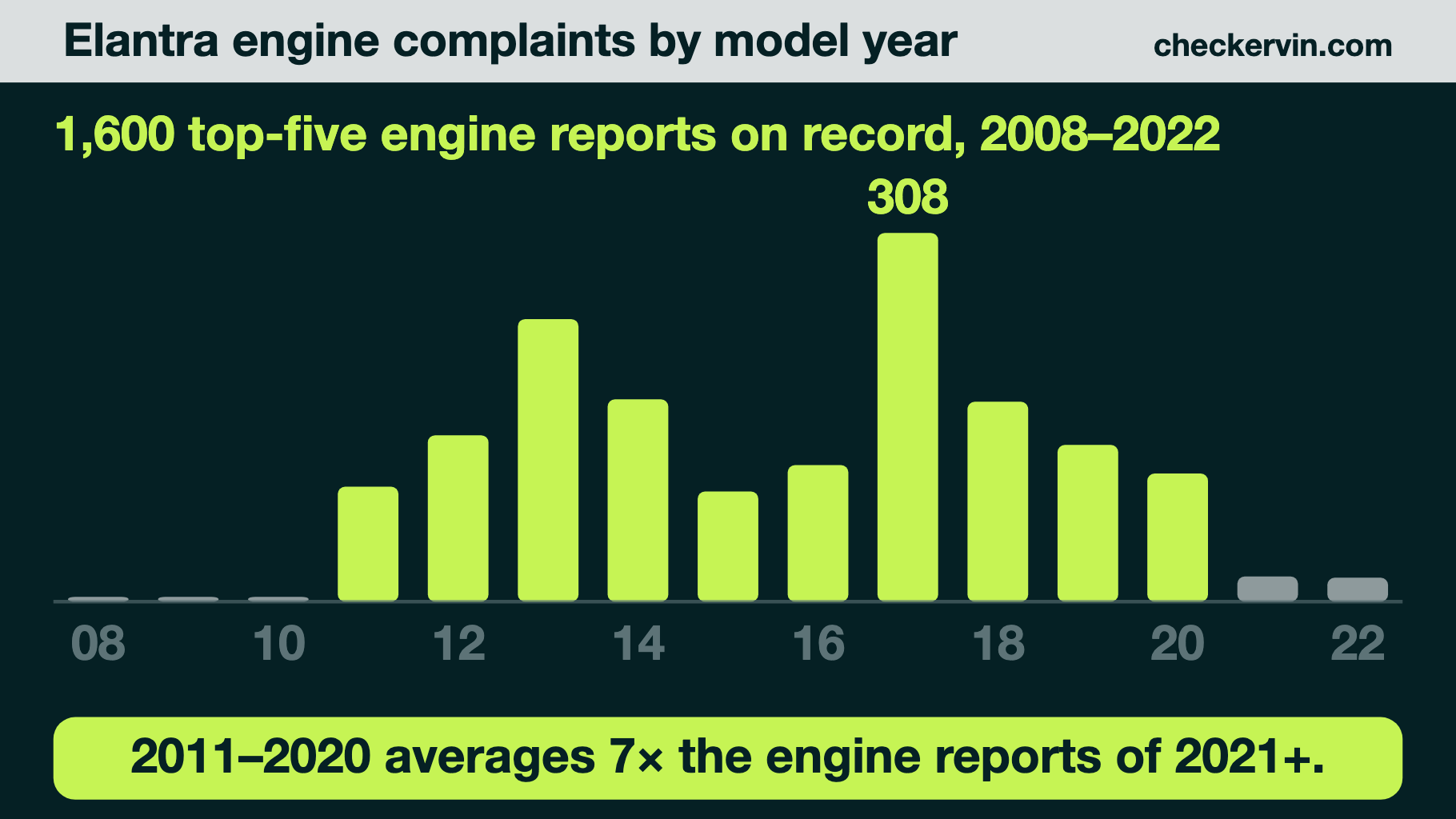
- The record concentrates in 2011–2020, which averages 7× the engine reports of the newest years.
The numbers, and whose numbers they are
RepairPal’s estimator prices a Hyundai Elantra timing chain tensioner replacement at $1,080 to $1,438 — with labor at $765 to $1,122 of it. The thread anchoring this query’s discussion results asks whether a $3,250 quote for chain work is reasonable. Both retrieved September 2026 and quoted with attribution; we sell VIN checks, not repairs, and publish no price of our own.
Hold those two numbers apart deliberately. The estimator prices one defined job; the owner quote prices whatever a particular engine needed once it was open — chain, guides, tensioner, sprockets, seals and the hours around them. On a repair this labor-heavy, the distance between those numbers is scope, and the section on anatomy below is about reading a quote for which one you are getting.
The question this SERP asks and never answers
One of the top results for this query is a Facebook thread asking whether the Elantra’s chain is covered under Hyundai’s warranty — and none of the pricing pages answers it. So: Hyundai’s powertrain limited warranty runs 10 years or 100,000 miles for the original owner, and 5 years or 60,000 miles for subsequent owners. A timing chain is an internal engine component, which is exactly the territory a powertrain warranty exists to cover when a part fails as a defect within the terms.
On top of the standard coverage, Hyundai has extended engine coverage on specific VIN populations through campaigns — the subject of our Hyundai engine warranty extension check. The order of operations on this repair is therefore unusual: establish the car’s warranty position first — original-owner status, in-service date, mileage, open campaigns — and only then collect quotes. A thousand-dollar repair that the manufacturer owes you is not a thousand-dollar repair.
Belt or chain: the 2011 line, and a SERP that blurs it
This query’s results include a Kelley Blue Book page pricing an Elantra timing beltat $409 to $919 — and unlike the equivalent confusion on other cars, here it is half right. Elantras before the 2011 redesign drive their valves with a rubber belt, a scheduled maintenance item with a printed replacement interval. The Nu-engine cars from 2011 on carry a chain, designed to last the engine’s life.
The model year therefore decides which repair — and which price class — this conversation is even about. A 2009 Elantra with a belt due is routine maintenance in the hundreds; a 2013 with a rattling chain is a repair in the four figures with a warranty question attached. Thirty seconds with a Hyundai VIN decode settles which car you have before any number means anything.
What 6,386 complaints say about the years
Our corpus of federal NHTSA complaints holds 6,386 reports against the 2008–2022 Elantra, 1,600 of them engine entries in the year-by-year top-component record — and they cluster hard. The 2011–2020 cars average 156 engine reports a year, peaking at 308 against the 2017 model year; after 2020, the same column drops to 21 a year — roughly a 7-to-one difference in pace.
Complaints are unverified owner reports rather than failure rates — the caveat this site attaches to every such figure. But the concentration maps onto the era a shopper is most likely to be quoted chain work for, and onto the engine generations whose campaigns and extensions exist in the first place. The record and the warranty programs are describing the same cars.
Why chains fail on an engine designed to keep them
A chain runs in oil and lives on oil pressure; its tensioner is hydraulic and its guides are sacrificial. Stretch the oil-change interval, run the level low, or feed it degraded oil, and the wear shows up as a loose chain long before the design life. That is the ordinary mechanism behind most chain rattle on these cars — less a mystery defect than accumulated oil history, which is why two Elantras of the same year can sit on opposite sides of this repair.
The practical readout: the car’s oil records are part of the diagnosis. A chain complaint on an engine with documented on-schedule changes reads differently — to a shop, to a warranty reviewer, and to you — than the same rattle on a car with a mystery service history.
What failure sounds like before it costs anything
- A rattle at cold start that fades with oil pressure — the classic early warning
- Check-engine light with camshaft/crankshaft correlation codes on a scan
- A history of stretched oil intervals — the risk factor that precedes the sound
- Rough running or hard starting — late signs that timing has already drifted
The economics of acting early are lopsided. At the rattle stage this is a chain-and-tensioner conversation; after timing slips it can be a valve conversation, and the warranty question gets harder at exactly the moment the bill gets bigger. A rattle plus a code scan plus a warranty check is one unhurried morning.
Where the money goes
Read RepairPal’s split again: $765 to $1,122 of a $1,080 to $1,438 job is labor. The chain kit is a few hundred dollars — Hyundai’s own parts catalog lists the chain itself cheaply — and everything else is hours spent reaching the front of an engine packed sideways into a compact car. Like the Equinox chain job, this is labor economics: hourly rate and book time swing the total far more than any parts markup.
Labor-heavy also explains the $3,250 class of quote. Once the front of the engine is open, marginal parts are cheap to add and expensive to revisit — so an honest thorough quote grows, and a bare-minimum quote invites a second teardown later. The comparison that matters between two quotes is the parts list, not the bottom line.
Before you authorize the repair
- Establish warranty position first — owner status, in-service date, mileage, open campaigns by VIN
- Scan the codes and keep the printout; correlation codes are the chain's signature
- Confirm belt or chain by model year before comparing any two numbers
- Ask what the quote includes — chain only, or guides, tensioner and seals
- Gather the oil records; they shape the diagnosis and any coverage conversation
If you are buying the Elantra, not repairing it
The purchase version of this page is three checks. Cold-start the car yourself and listen to the first ten seconds. Ask for oil records, which on this engine are the difference between design life and early wear. And run the VIN — build and recalls through a free CheckerVIN report, remaining coverage through the Hyundai warranty check, and the model year’s standing in our Elantra years-to-avoid breakdown, scored from the same corpus this page computes from.
The record’s shape is a negotiating fact, too: the elevated era is where chain conversations live, and the newest years are quiet in the file. A second-owner car still inside the 5-year, 60,000-mile powertrain window carries real coverage the asking price rarely reflects — and knowing that is worth more than any single quote on this page.
Where this information comes from
- NHTSA — Elantra complaint databaseThe federal complaint record this page's figures are computed from, browsable by model year.
- Hyundai — powertrain warranty termsThe 10-year/100,000-mile original-owner powertrain coverage, from the manufacturer's own page.
- RepairPal — Elantra tensioner estimateThe $1,080–$1,438 range and its labor-heavy split, retrieved September 2026.
- NHTSA — recalls by VINThe official lookup for open campaigns on the specific car — free, and first in line before any cash repair.
Keep reading
Frequently asked questions
How much does a Hyundai Elantra timing chain replacement cost?
RepairPal's estimator lists $1,080 to $1,438 for an Elantra timing chain tensioner replacement, and the split is the story: $765 to $1,122 of it is labor. Owner-reported quotes for full chain jobs run higher — a Reddit thread on this SERP asks whether $3,250 is reasonable. Their figures, quoted with attribution. The chain itself is cheap; reaching it is not, which is why warranty position matters more than shop choice.
Is the Elantra timing chain covered under Hyundai's warranty?
Often, and that is the first question, not the last. Hyundai's powertrain warranty runs 10 years or 100,000 miles for the original owner — 5 years or 60,000 miles for later owners — and the timing chain is an internal engine component. Separate from that, Hyundai has extended coverage on certain engines through campaigns tied to the VIN. Establish both before paying cash: a dealer can check the VIN's position in minutes.
How long does a Hyundai timing chain last?
It has no scheduled replacement — a chain is designed for the engine's life, and a healthy Elantra can retire with its original chain. What shortens the life is oil: stretched intervals and low levels wear the chain, guides and tensioner ahead of schedule. The maintenance schedule, not the chain, is the thing with an interval, and following it is what makes the design intent come true.
What are the signs of a timing chain going bad?
A rattle at cold start that fades as oil pressure rises, a check-engine light with camshaft or crankshaft correlation codes, and in later stages rough running or a no-start. On an Elantra the sound is the early warning worth acting on — investigated at the rattle stage this is a repair; ignored until timing jumps, it can become an engine. A code scan is the cheap first step.
Which Elantra years should get extra scrutiny?
The record concentrates: the 2011–2020 Elantras average 156 engine reports a year in our corpus — about 7 times the 21-a-year pace of the newest years — peaking at 308 against the 2017 car. Complaints are unverified reports, not failure rates — but on a used Elantra from the elevated era, a cold-start listen, an oil-history question and a VIN warranty check are the diligence that costs nothing.
Establish the coverage before you accept the quote
A free CheckerVIN report shows the factory build, specifications and open recalls for any VIN — the first step in finding out whether this repair is even yours to pay for.
Run a free VIN check