The short answer
- What does it cost?
- Owners report about $1,100-$1,900 on 2006-2014 cars and $4,400 to just under $5,000 at dealers on 2020 cars. The newer car's Honda flywheel alone lists at $1,681.34.
- Are the complaints about the clutch?
- Mostly not. POWER TRAIN is in the Civic's top five in 4 of 15 years, but only in 2020 do the reports center on the clutch. The 2014-2015 spike is mostly the CVT.
- Will Honda pay?
- Possibly, on a 2020-2021 1.5-liter turbo manual. Honda's bulletin 22-017 covers its clutch and flywheel, but under the car's normal warranty, not as a recall.
5.3 hr
Honda's flat rate, 2020-21 1.5T clutch + flywheel
$1,681
Honda flywheel, 2020-24 Civic, listed Nov. 24, 2026
4 of 15
Years with POWER TRAIN in the top five
0
Civic recalls naming the clutch, 2006-2022
What owners and parts lists show
Search for this job and you get clutch master and slave cylinder estimates, a forum thread about a 1997 Civic, and a fan-clutch page for a different part entirely. Nobody prices the full clutch kit by generation, so here is what we could open and verify, labeled by source.
Owners describe their own bills in federal complaint filings. On a 2006 Civic, a dealer replaced the clutch disc, pressure plate and throwout bearing at 26,232 miles for $1,098.68. A 2006 Si owner was quoted nearly $1,900 by a Honda dealer and paid $1,140 at an independent shop. A 2007 Si owner was quoted $1,400, and a 2014 Civic owner reported $1,700. Then the numbers jump. A 2020 Si owner says a dealer priced a failed clutch assembly at $4,400 at about 24,000 miles, and another 2020 owner reports a dealer estimate of just under $5,000. These are owners’ statements, not invoices we have seen, and we sell VIN checks, not repairs, so none of these prices are ours.
The jump has a parts explanation. For the 2020–2021 1.5-liter turbo, Honda’s own repair bulletin replaces four parts, not three: the friction disc, the pressure plate, the release bearing and the flywheel. HondaPartsNow listed that flywheel, part 22100-5CD-018, at $1,681.34 against a $2,458.10 MSRP on November 24, 2026. We could not open a current price for the matching disc and pressure plate, so we print none, but on the newer car the flywheel alone is a four-figure part before any labor.
What 365 power-train complaints are actually about
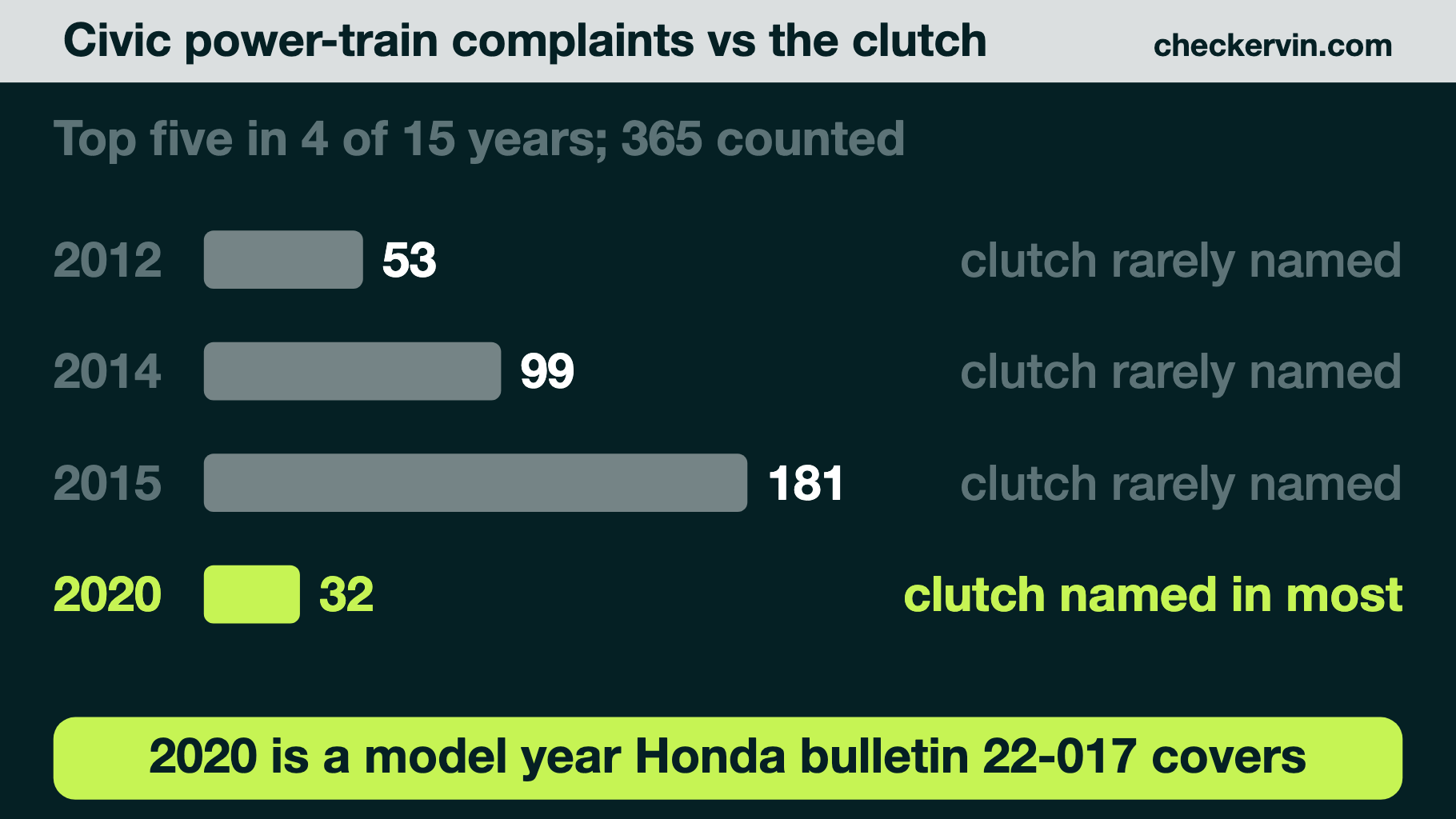
NHTSA has no clutch category. Owner complaints about a clutch land in POWER TRAIN, which also holds every automatic and CVT fault, driveshafts, hybrid drive problems and cars that roll away in Park. In our corpus of federal complaints against the 2008–2022Civic, POWER TRAIN makes a model year’s five most-reported categories in 4 of 15 years: 2012, 2014, 2015, 2020. Those years add up to 365counted reports. In every other year the category sits below that year’s fifth, so the true total is higher and unknown from our data.
We read the complaint narratives for those years rather than assuming. The biggest bar, 2015, holds 181 reports (45.9% of that year’s complaints), and together 2014 and 2015 make up 77% of the counted total. The word “clutch” barely appears in them. Those reports describe CVT failures, several citing Honda’s 2015 recall 15V574000 for CVT software that could damage the drive pulley shaft, along with Civic Hybrid drive faults and cars rolling after shutdown. The 2012 reports are a similar mix, with a few Si owners describing clutch noise from a stop.
2020 is different. Its 32 power-train reports are only 9% of the counted total and 13.5% of that year’s complaints, but most of them describe a manual clutch slipping, often on a highway on-ramp, and many name the Honda bulletin covered below. It is the one year where a power-train count and the clutch line up. For 2021, the other year that bulletin covers, POWER TRAIN does not reach the top five at all, which fits a model year when, per EPA listings, only the hatchback offered a manual.
Honda’s bulletin for the 2020–2021 manual
Honda Service Bulletin 22-017, Version 1, is dated September 5, 2022 and is filed with NHTSA. It covers 2020–2021 Civics with the 1.5-liter turbo engine in LX, EX, Sport and Si trims with a manual transmission, for all VINs. The symptom it lists is a manual transmission that will not shift, a slipping clutch, or a car that will not move in gear. Its stated cause is that, due to supplier production issues, the friction disc material may have prematurely worn.
The fix is not a disc alone. The bulletin replaces the flywheel, pressure plate, friction disc and release bearing, plus a list of single-use bolts, nuts, exhaust gaskets and three quarts of Honda manual transmission fluid. Honda pays its dealers 5.3 hours for the job under operation 2101J3, a figure that includes a wheel alignment and a steering relearn.
Two earlier Honda messages show the problem was on its radar before the bulletin. In January 2020, Honda asked dealers to call its technical group before repairing any 2020 Civic Si with clutch judder on take-off below 1,000 rpm, and only if the VIN began with 2HG, the prefix used on Canadian-built Hondas. One 2020 owner’s complaint notes a car assembled in Alliston, Ontario. Honda repeated that request twice more in early 2020.
“The normal warranty applies”
That sentence, from the bulletin’s warranty section, is the whole of Honda’s promise. 22-017 is a repair procedure, not a warranty extension and not a recall, so it does not lengthen coverage by a mile. Whether a slipping 2020 clutch is free depends on where the car stands against its original warranties and on how the dealer classifies the failure.
Honda’s warranty booklet sets the terms. The 2018 edition, the closest one we could open (the 2020 file returned an error), gives 3 years or 36,000 miles of new-vehicle coverage and excludes “normal wear or deterioration of any part.” Its 5-year or 60,000-mile powertrain warranty names the flywheel under the engine, and does not name the clutch disc or pressure plate, though it says other parts may be covered. A worn disc is normally a wear item. A disc that Honda’s own bulletin says wore early from a supplier problem is a different argument.
The complaints show how that argument goes at the service desk. Some 2020 owners report a free repair under the bulletin. Others say they were told the clutch is a wear item and charged in full, or were turned down because the car was past 3 years or 36,000 miles. Most 2020 cars are now past both the 3-year and 5-year marks from their original sale, so for many owners this is now a goodwill request rather than a claim.
Which Civics have a clutch at all
A clutch quote only applies to a car with a clutch pedal, and the Civic’s manual lineup changed almost every generation. EPA fuel economy listings, by model year, show these manual combinations:
| Civic model years | Manual versions EPA lists |
|---|---|
| 2006-2011 | 5-speed 1.8L; 6-speed 2.0L (Si) |
| 2012-2015 | 5-speed 1.8L; 6-speed 2.4L (Si) |
| 2016 | 6-speed 2.0L only (no Si that year) |
| 2017-2020 | 6-speed 2.0L and 1.5L turbo (incl. Si); Type R 2.0T |
| 2021 | Hatchback only: 6-speed 1.5L turbo or 2.0T |
| 2022-2024 | 6-speed 1.5L turbo; hatchback 2.0L; 2.0T from 2023 |
| 2025-2026 | Sedan 6-speed 1.5L turbo; hatchback 2.0T |
Two things follow. First, the generation decides the parts: a 2008 Civic’s 1.8-liter clutch and a 2020 Si’s turbo clutch share a job name and little else. Second, the Type R is its own market, with its own clutch and flywheel parts, and the prices above do not apply to it. Decoding the VIN tells you the engine and generation before anyone opens a parts catalog, and our transmission lookup by VIN shows what the car left the factory with.
The flywheel sets the bill
A clutch job always replaces the friction disc and almost always the pressure plate and release bearing. The flywheel is the line item that moves a quote by four figures. On many cars a shop can machine a worn flywheel flat and reuse it. Honda’s 22-017 procedure for the 1.5-liter turbo does not do that: it installs a new one, and its own cleaning step warns that spray cleaners may damage the “dual mass flywheel bearing.” A dual-mass flywheel is two plates joined by springs to soak up driveline vibration. It is heavier, cannot be resurfaced the way a solid one can, and costs far more; the HondaPartsNow listing for the 2020–2024 part gives its weight as 34.6 pounds.
Some owners avoid the factory part. One 2020 Si owner told NHTSA of skipping the dealer and fitting a Honda clutch made for the Type R and a different flywheel at home, reasoning that the dual-mass unit added wear. That is the owner’s view, not Honda’s. A single-mass conversion changes how the car idles and drives, and on a car still inside any warranty it gives the dealer a reason to say no to a later claim.
For the older 1.8-, 2.0- and 2.4-liter cars, we did not find a Honda document stating the flywheel type, so we will not guess. The owner bills from those years, around $1,100 to $1,900, are consistent with a clutch job that did not include a new four-figure flywheel. Ask the shop which flywheel your car has and whether the quote resurfaces or replaces it.
What the labor pays for
The clutch sits between the engine and the transmission, so the transmission comes out. Honda’s bulletin for the 2020–2021 car runs to 55 pages. Before the gearbox can drop, the technician removes the battery and its tray, the engine computer, the air cleaner, the shift cables and the slave cylinder, hangs the engine from a support bar, disconnects the steering shaft, both tie-rod ends, stabilizer links and lower ball joints, removes the driveshafts and the front subframe, then lowers the transmission on a jack. Reassembly ends with an alignment. That is why the job pays 5.3hours on Honda’s clock, and why a shop with a higher rate or a slower technician quotes well past it.
Older generations do not need every one of those steps, but the transmission still has to come out on all of them. A quote that seems low on labor is worth questioning: ask whether it includes the release bearing, new transmission fluid, the bolts the factory procedure calls single-use, and an alignment where the subframe is dropped.
Pedal faults that are not the clutch
A Civic clutch is hydraulic: a master cylinder at the pedal pushes fluid to a slave cylinder on the transmission, which moves the release fork. A pedal that sinks to the floor, a car that will not go into gear with the engine running, or a pedal that feels soft can be a leak in that circuit rather than a worn disc. Those parts are on the outside of the car, and on the 2020–2021 car Honda’s procedure simply unbolts the slave cylinder and moves it aside on its line, so replacing one does not mean pulling the gearbox.
The Civic has its own documented pedal quirks. NHTSA’s summary of Honda bulletin SB-11-005 for the 2006–2010 Civic describes a clutch pedal that pops or squeaks because of insufficient clearance at the master cylinder. One 2016 owner reported losing the clutch after finding the slave cylinder hanging loose with a sheared mounting bolt. Neither is a clutch replacement. A shop that diagnoses “clutch” from the pedal alone should show you why it is not the hydraulics.
The 2006–2015 Si: noise, shifts and slipping
The eighth-generation Si (2006–2011) draws a different kind of complaint. Many of its power-train reports are about the gearbox, not the clutch: grinding into third gear or popping out of it. NHTSA lists a Honda bulletin, 08-020, for exactly that symptom on the 2006 Civic, and another, SB-06-052, for 2006 Si engine speed that hangs between shifts. A slow rev drop is not a clutch fault, though several owners worry it adds wear. Several early 2006–2007 Si owners also describe clutches that burned out within months; they report dealers blaming driving habits, and one owner says Honda paid the labor while the owner paid about $300 in parts.
The ninth-generation Si (2012–2015) is known among owners for a grinding or groaning noise when the clutch engages in first. In September 2013 Honda asked dealers to send in 2012 manual Si cars with that noise, under the 3-year/36,000-mile warranty and with no previous clutch repair, so its engineers could inspect them. We found no follow-up bulletin with a fix. If a 2012–2015 Si makes that noise, a shop may hear it as a failing clutch; it may also be the condition Honda was studying, which owners report living with for years.
How long a Civic clutch should last
Honda does not publish a clutch interval. The disc is a friction part that wears with every engagement, so its life depends on traffic, hills, hard launches and the driver. Owners in the complaint record cite one clutch that lasted past 125,000 miles on an earlier car and others that failed in the first year. Neither is a benchmark.
The useful line is between wear and a defect. A clutch that slips after 150,000 miles of city driving has worn out. A 2020–2021 turbo clutch slipping at 20,000 to 40,000 miles matches the condition Honda’s bulletin describes, which is a stronger position at the service desk. Slip usually shows first in a high gear at low rpm with the throttle pressed hard: the engine speed climbs and the car does not.
Before you authorize a clutch job
- Decode the VIN to confirm the car is a manual and which engine it has, then match the quote to that generation.
- On a 2020-2021 1.5L turbo manual, ask whether Honda bulletin 22-017 applies and under which warranty, in writing.
- Ask whether the flywheel is being replaced, resurfaced or reused, and get the part number for each part on the quote.
- Ask whether the release bearing, transmission fluid, single-use bolts and an alignment are included.
- If the pedal is soft or sinks, ask the shop to rule out the master and slave cylinders first.
- Check open recalls on the VIN anyway; no Civic recall names the clutch, but other campaigns may be open.
If you are shopping for a used manual Civic rather than repairing one, a slipping clutch is a negotiating fact worth roughly the numbers above. Ask the seller for clutch receipts, and on a 2020 or 2021 turbo ask whether the bulletin repair was done. We offer free VIN decoding, specifications and open recalls; we do not have repair, accident or title history, so the service records have to come from the seller or the dealer. The Honda VIN decoder confirms the build, and Honda warranty check by VIN explains how to see what coverage is left.
Where this information comes from
- NHTSA-hosted Honda Service Bulletin 22-017 (2020-2021 Civic 1.5T manual clutch)Read in full: affected trims, the supplier-production cause, the four replaced parts, the 5.3-hour flat rate and the dual-mass flywheel note.
- NHTSA-hosted Honda dealer message, 2020 Civic Si clutch judder (January 2020)Honda's request to inspect 2020 Si cars with take-off judder, limited to VINs starting 2HG.
- NHTSA-hosted Honda dealer message, 2012 Civic Si clutch noise (September 2013)Honda's request to inspect 2012 manual Si cars with clutch noise in first gear.
- NHTSA — Civic complaints, recalls and manufacturer communicationsThe federal complaint record our counts are computed from, and the index of Honda bulletin summaries cited here.
- EPA fueleconomy.gov — Honda Civic listings by yearSource for which Civic model years and engines were sold with a manual transmission.
- Honda 2018 Warranty BasebookNew-vehicle and powertrain warranty terms, including the normal-wear exclusion and the flywheel listing.
- HondaPartsNow — Honda flywheel 22100-5CD-018Listed at $1,681.34 (MSRP $2,458.10) for the 2020-2024 Civic, retrieved November 24, 2026.
Keep reading
Frequently asked questions
How much does it cost to replace a clutch in a Honda Civic?
It splits by generation. Owners filing NHTSA complaints about 2006-2014 Civics report bills of roughly $1,100 to $1,900 for a disc, pressure plate and release bearing, while two owners of 2020 cars report dealer figures of $4,400 and just under $5,000. The gap is mostly the flywheel: the 2020-2024 Civic's Honda flywheel was listed at $1,681.34 on November 24, 2026, and Honda's bulletin replaces it with the clutch. Honda books 5.3 labor hours for that job on a 2020-2021 1.5-liter turbo manual.
How long should a Honda Civic clutch last?
Honda publishes no clutch replacement interval; the clutch is replaced when it wears or fails, and Honda's new-vehicle warranty excludes normal wear. How long that takes depends on driving, so no single mileage is honest. What the record does show is a failure that is not normal wear: Honda's Service Bulletin 22-017 says the friction disc on 2020-2021 1.5-liter turbo manual Civics may have worn prematurely because of supplier production issues, and owners often describe slipping between roughly 19,000 and 40,000 miles.
What Civic Si year should you avoid for clutch problems?
If the clutch is your worry, start with the 2020 Si. It is the only Si model year inside Honda Service Bulletin 22-017, which covers 2020-2021 1.5-liter turbo manual Civics, and 2020 is the one Civic model year where the clutch dominates the power-train complaints. Honda also asked dealers to send in 2012 Si cars with take-off clutch noise in 2013, and certain 2020 Si cars with clutch judder in 2020. Neither request was a recall. On any used Si, ask for clutch receipts and test-drive it in high gear at low rpm, where a worn disc slips first.
Does a Civic clutch cost the same as an Accord clutch?
Not necessarily, and we have not priced the Accord job. Some clutch parts may be shared between the 1.5-liter turbo Civic and the 2018-2019 Accord Sport, but the flywheel, labor time and access differ by car, and those are most of the bill. Get the part numbers for the actual VIN from a Honda parts counter before comparing quotes.
Is there a recall on the Honda Civic clutch?
No. We searched NHTSA's recall database for every Civic model year from 2006 through 2022 and found no campaign that names the clutch, after confirming the same search does find a manual-clutch recall on the 2016 Ford Focus. The closest Honda document is Service Bulletin 22-017, a repair procedure for 2020-2021 1.5-liter turbo manual Civics that says the normal warranty applies. A bulletin is not a recall, so coverage depends on the car's warranty status.
Confirm it is a manual before you price a clutch
A free CheckerVIN report shows the factory build, engine, specifications and open recalls for any VIN, so the quote matches the Civic in front of you.
Run a free VIN check