The short answer
- What services does CheckerVIN offer?
- Free VIN decoding, open safety-recall lookup, and a model-year problem record built from 423,551 complaints filed with NHTSA — plus a reference library of 355 guides covering state rules, title brands, marque-specific decoding and vehicles that are not cars.
- What do they cost?
- Nothing, and there is no account or card field to reach them. What the free tier holds and why it is free are argued on the pricing page rather than here.
- Where does the catalog stop?
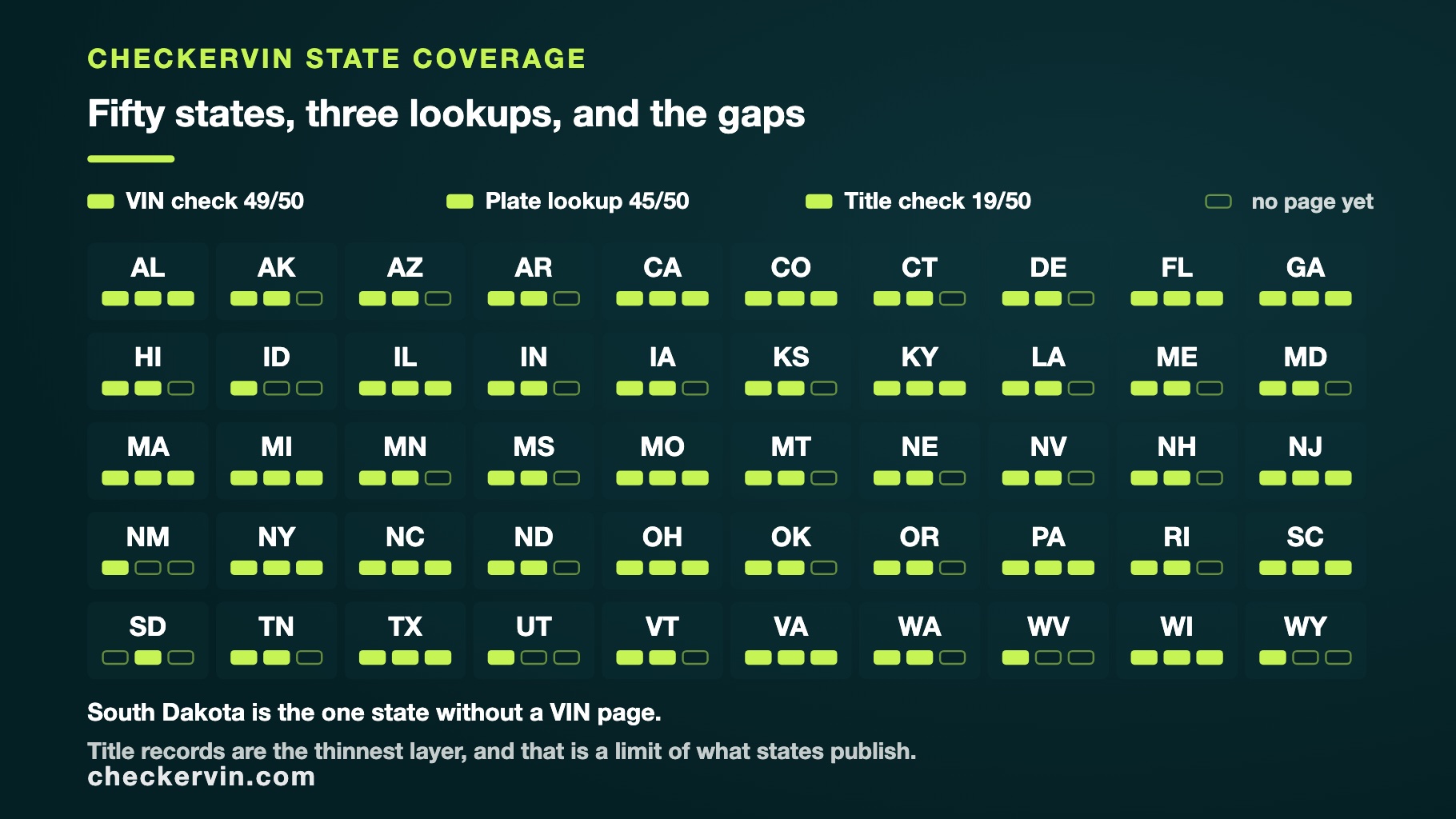
- South Dakota has no state VIN page. 5 states have no plate page and 31 have no title page. The model-year record runs 2008 to 2022 and covers 15 makes, not all of them.
423,551
Owner complaints aggregated
Across 835 model years
355
Reference guides published
In 8 subject groups
49/50
States with a VIN page
Missing: South Dakota
$0
Cost of every service listed
No account, no card field
How this catalog works
Nine services are described below, and they are not nine products. They are nine different questions people arrive with, each answered by a different record held by a different institution. The seventeen characters stamped on a car are the key to all of them, which is why one input serves the whole catalog.
Each entry states three things in the same order: what the service returns, how far it reaches, and where it stops. That third item is the one this page exists for. A service description that omits its own limits is not a description, it is an advertisement, and the reader who discovers the limit after trusting the tool is the reader who never comes back.
The counts are computed from the site’s own registry at build time rather than written by hand. If a state page ships tomorrow, the number in this paragraph’s neighbors changes by itself. That is deliberate: a coverage claim nobody can verify is worth about as much as no claim, and one that can go stale silently is worse than both.
1 · Decode a VIN
The entry service, and the one everything else is built on. Enter seventeen characters and the decode returns what the factory recorded when the vehicle was built: the manufacturer, the model line, the body style, the engine and drivetrain, the restraint system, the assembly plant and the model year.
This works because the number is not arbitrary. Under 49 CFR Part 565 the format is a federal standard, and every vehicle built for sale in the United States from model year 1981 onward carries a seventeen-character VIN laid out the same way. Positions one through three identify the manufacturer and the country. Positions four through eight are the descriptor section, where the manufacturer encodes the model, the body and the engine. Position nine is a check digit computed from the other sixteen. Position ten is the model year, eleven the plant, and the last six are the sequential serial.
Reach: any VIN issued under that standard, which in practice means almost anything on an American road. Stops at: vehicles built before the standard, where the number is shorter and the format is whatever that manufacturer chose — covered in the classic decoding guides rather than by the tool.
2 · Open recall check
The second service asks NHTSA whether the manufacturer has an unrepaired safety campaign against that specific VIN. A recall is a defect the manufacturer has admitted and agreed to fix, and the fix is free at a franchised dealer regardless of how many owners the car has had since or whether you were the one who bought it new.
This is the single highest-value free lookup in the catalog, and it is the one buyers most often skip. An open campaign is not a mark against the car in the way a title brand is; it is unclaimed money and an unfixed hazard sitting on a vehicle, and it costs a phone call to resolve.
Reach: every make sold in the United States, because the campaigns are filed with the federal regulator rather than with us. Stops at: defects nobody has recalled yet. A pattern of owner complaints with no campaign behind it is exactly what the next service is for.
3 · The model-year record
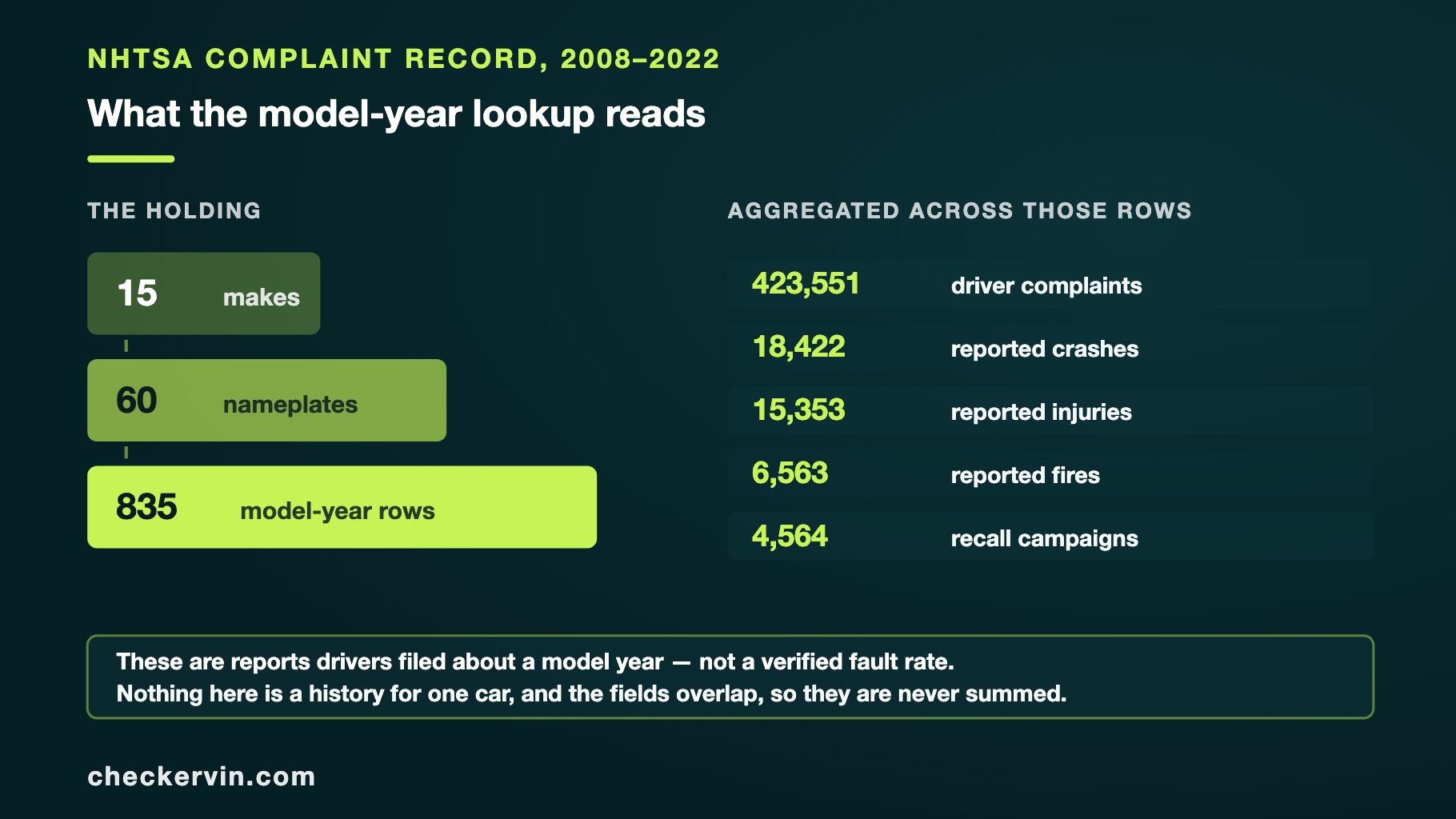
The third service answers a question the first two cannot: not what this car is, but what this kind of car has done to the people who own it. It is built from the complaints drivers file directly with NHTSA, aggregated by nameplate and by model year.
The aggregate currently holds 423,551 complaints spanning 835 model years across 60 nameplates from 15 manufacturers, 2008 through 2022. Inside those filings sit 18,422 reported crashes, 6,563 fires and 15,353 injuries, alongside 4,564 recall records attached to the same vehicles.
Those are not our numbers in any proprietary sense — anyone may download the same public files. What is ours is the arrangement: one nameplate’s model years lined up against each other so a bad year is visible as a bad year rather than as a large absolute count.
Reach: 60 nameplates, 2008 to 2022. Stops at: everything else. 15 makes is not every make, and the span excludes both the oldest vehicles and the newest, for opposite reasons — the oldest predate consistent electronic filing, and the newest have not been owned long enough for a pattern to exist.
Reading that record honestly
A complaint count on its own is close to meaningless, and publishing raw totals would make this service actively misleading. The reason is simple arithmetic: a nameplate that sold two million units will out-complain one that sold ninety thousand, in every year, without being any worse to own.
So each model year is scored against its own nameplate’s median rather than against the fleet. A year running well above the median for that specific vehicle is a real signal about that vehicle. A year running at the median is ordinary, however large the raw number looks next to a rarer car.
Two further cautions, both of which the service applies rather than merely mentioning. Recent model years are provisional, because complaints accumulate for years after a vehicle ships and a fresh year always looks clean. And complaint volume measures what owners chose to report to a federal agency, which correlates with how alarming a fault felt, not with how expensive it was.
4 · State paperwork
Titles, registration, inspection and plate law are state matters, and the variation between them is not cosmetic. Whether the plate stays with the seller or the car, how long you may drive on a temporary tag, what a state calls a rebuilt vehicle and how many days you have to retitle after a purchase all change at the state line.
49of the 50 states have a dedicated page covering that state’s rules and linking that state’s own official tools. These pages are documentation, not a database: no state gives a private site direct query access to its title system, and any service implying otherwise is describing something else.
Reach: 49 states for VIN and titling rules. Stops at: South Dakota, which has no page yet. It is named here rather than quietly omitted, because a coverage map with an unmarked hole in it is the thing this page is arguing against.
5 · Plate lookups
45states have a plate-lookup page, and every one of them exists mainly to explain a legal boundary rather than to perform a search. The Driver’s Privacy Protection Act makes the personal information behind a registration record closed to the public, with a defined list of permissible uses that does not include curiosity about a car parked outside.
What remains available differs by state and is genuinely useful: status checks, whether a plate is active, and in several states a public record of the vehicle attached to it minus the owner. The pages say which of those a given state offers and link the official tool.
Reach: 45 states. Stops at: the federal privacy statute, permanently. No amount of coverage work will change that, and a site promising owner details from a plate is either mistaken or selling something it should not.
6 · Title and brand checks
A title brand is a permanent mark a state applies to a vehicle’s title record — salvage, flood, hail, lemon, junk — and it follows the car across state lines when the system works as designed. 19states have a dedicated title-check page explaining that state’s brand vocabulary and the route to its own records.
The library carries 79 guides on titles and brands more broadly: what each brand means, what a rebuilt title does to insurability and resale, and how washing works when a car is retitled in a state that does not recognize the original brand.
Reach: 19 states with a dedicated page, plus 79 guides on brands as a subject. Stops at: returning a live title record for your VIN today. What the report will include, and when, is set out on the pricing page and in the sample report rather than promised here.
7 · Marque decoders
Positions four through eight of a VIN are the descriptor section, and the federal standard does not dictate what goes in them. Each manufacturer defines its own scheme, which is why a generic decode returns a trim level for one make and a blank for another.
63 pages document those manufacturer-specific schemes: which position holds the engine code for that marque, how the trim is encoded, what the plant letters mean, and which build details live on documents the VIN never carried — the window sticker, the build sheet, the option codes on a sticker in the trunk.
Reach: 63 marques and sub-marques. Stops at: manufacturers who never published their scheme, and at build details that were recorded on paper and thrown away. A decoder cannot recover a fact the factory did not encode.
8 · Not-a-car lookups
Motorcycles, ATVs, dirt bikes, trailers, RVs, boats, semi trucks and agricultural equipment all carry identifying numbers, and almost none of them behave like a car VIN. 20 pages cover them.
The differences are structural rather than incidental. Boats carry a Hull Identification Number, twelve characters, administered by the Coast Guard. Trailers may or may not carry a seventeen-character VIN depending on weight and state. Agricultural equipment uses manufacturer serial schemes with no federal standard behind them at all. Treating any of these as a car VIN produces a confident, wrong answer.
- Motorcycles: 17 characters, but the descriptor section is used differently
- Boats: a 12-character HIN, not a VIN, under Coast Guard rules
- Trailers: 17 characters or none, depending on weight and state
- ATVs and dirt bikes: often a VIN-format number, rarely road-registered
- Semi trucks: 17 characters with heavy-duty specific codes
- Tractors and equipment: manufacturer serials, no federal format
Reach: 20 vehicle types and manufacturers. Stops at: recall and specification coverage, which thins fast outside passenger cars. The federal databases were built around road vehicles, and equipment serials mostly resolve at the dealer.
9 · The reference library
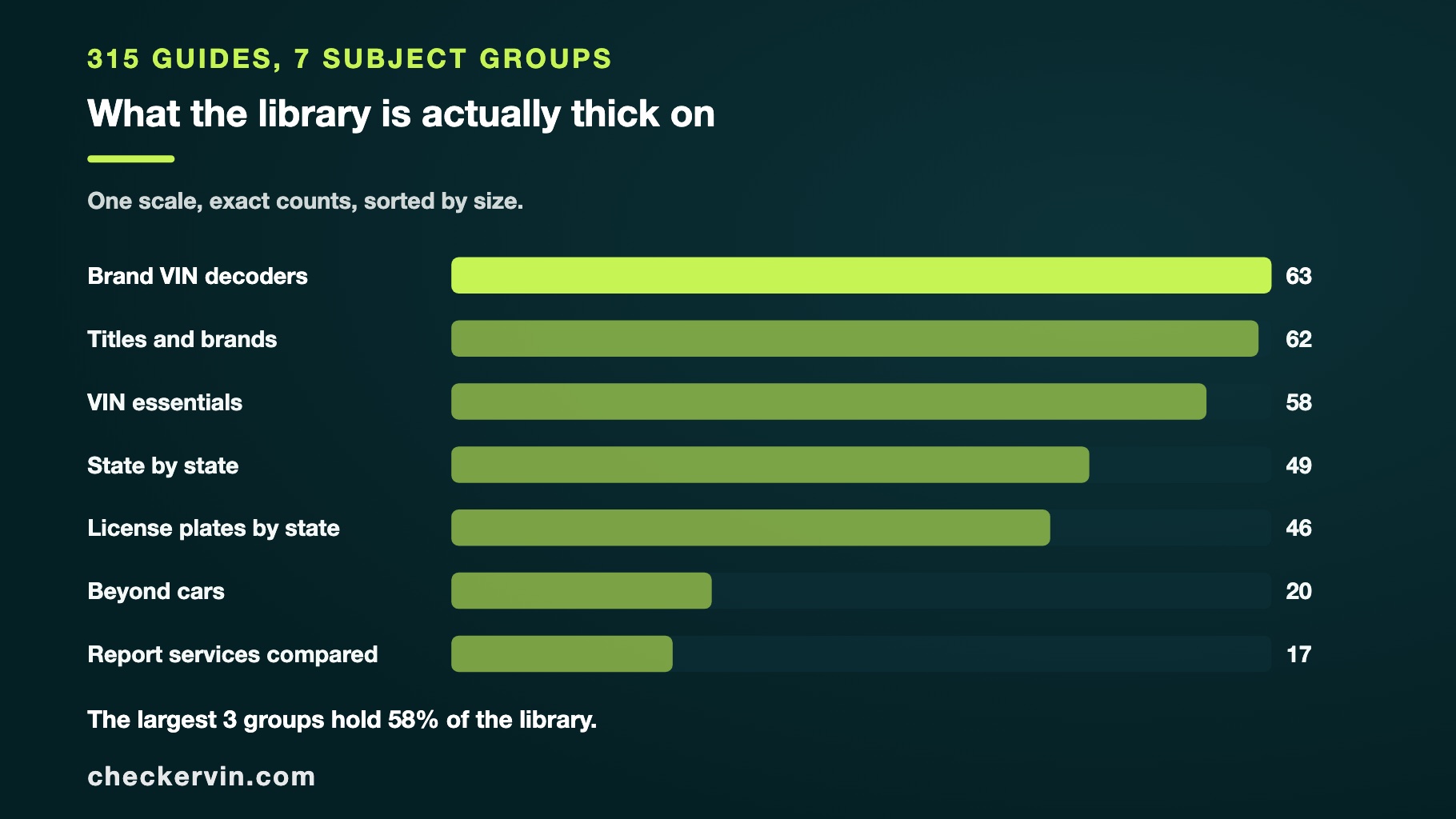
Behind the lookups sits the largest service in the catalog by volume: 355 guides organized into 8 groups. It exists because most questions that bring somebody to a VIN tool are not really VIN questions. They are questions about what a document means, what a state requires, or whether a specific fear is worth acting on.
| Group | What it covers |
|---|---|
| Essentials | 76 guides — reading the number, finding it, and the paperwork around it |
| Titles & brands | 79 guides — salvage, flood, lemon, rebuilt, and what each does to a car |
| Services compared | 17 guides — the paid report market, assessed one provider at a time |
| Marque decoders | 63 guides — manufacturer-specific position codes |
| Beyond cars | 20 guides — bikes, boats, trailers, trucks, equipment |
| By state | 49 VIN pages, 45 plate pages, 19 title pages |
The comparison group deserves a note, because it is the part readers least expect a free tool to publish. It assesses the paid services one at a time, including the ones that compete with this site, and it says plainly where a paid report is the right purchase. A catalog that could not name a case for buying elsewhere would not be a catalog.
Where the catalog stops
Collected in one place, so nobody has to assemble it from nine sections. These are the real edges of everything above.
| Service | How far it reaches |
|---|---|
| VIN decode | Every 17-character VIN issued under 49 CFR 565, so model year 1981 forward |
| Recall check | Open NHTSA campaigns, all makes sold in the United States |
| Model record | 60 nameplates, 15 makes, 2008–2022 |
| State pages | 49 of 50 states for VIN rules, 45 for plates, 19 for titles |
| Marque decoders | 63 pages on manufacturer-specific position codes |
| Beyond cars | 20 pages: bikes, ATVs, trailers, RVs, boats, trucks, tractors |
| Reference library | 355 guides in 8 groups |
None of that is a disclaimer in the legal sense. It is the working map, and it is printed because the alternative — letting a reader assume complete coverage and discover a hole at the moment they depend on it — costs more than admitting the hole up front.
Which service answers what
Nine services is more than anyone wants to read through when they have one question. The shortest route from a question to the thing that answers it:
| What you are asking | The service |
|---|---|
| What is this car, exactly? | VIN decode — engine, body, drivetrain, plant, year |
| Is anything unrepaired on it? | Open recall check, free at any franchised dealer |
| Is this model year a bad one? | The model-year record, scored against its own median |
| What does this paperwork mean? | The state page for the state that issued it |
| Can I look up who owns that plate? | No — the plate pages explain the federal statute |
| Is a paid report worth it here? | The services-compared group, provider by provider |
| It is not a car | The beyond-cars group, by vehicle type |
The order that saves money
The services are more useful in sequence than individually, and the sequence is deliberately front-loaded with the free work. Each step either ends the process or makes the next step cheaper.
- 1Decode before you drive anywhereConfirm the VIN matches the advertisement. A decode that returns a different engine, body style or model year than the listing claims ends the conversation before you have spent a Saturday on it.
- 2Run the recall check on the same screenIt costs nothing and takes seconds. An open campaign is a free repair you can raise with the seller, and occasionally a reason to walk.
- 3Read the model-year record before you negotiateA year running well above its own nameplate's median gives you something specific to inspect and something concrete to price against — far stronger ground than a general sense that the car is old.
- 4Check the state's rules before you hand over moneyWhether the plate transfers, how long the temporary tag lasts and how many days you have to retitle are all state questions with real deadlines behind them.
- 5Pay for the inspection, not for more recordsWhen the free work is done, the remaining unknown is physical condition, and no record service of any kind measures that.
What none of these are
Three things sit outside the catalog entirely, and being clear about them is worth more than another paragraph about what is inside it.
None of these is an inspection. Every service on this page reads records that somebody filed. Damage repaired in cash, a leak nobody claimed, deferred maintenance and ordinary wear generate no filing at all. A clean lookup means nothing was reported, which is not the same statement as nothing happened, and the gap between those two is where most expensive surprises live.
None of these is a valuation. The VIN encodes the build, not the worth. What a specific car is worth depends on condition, mileage, location and the month you are selling in — none of which is in the number.
None of these is legal or title advice. The state pages describe what a state publishes about its own process. When real money or a disputed title is involved, the state agency and, if needed, a lawyer are the correct authorities, and both are named on the pages rather than hidden behind a contact form.
Where this information comes from
- 49 CFR Part 565 — Vehicle Identification Number requirementsThe federal rule that fixes the VIN at 17 characters and makes every decode in this catalog possible
- NHTSA recall lookupThe agency's own free search — the same campaign data the recall service reads
- NHTSA vPIC — public VIN decoding APIFree and unlimited; the public decoder behind the factory-build fields
- NHTSA complaint and recall dataPublic-domain source of the 423,551 complaints behind the model-year record
- NMVTIS — approved provider list, U.S. Department of JusticeThe federal title system, and the official list of who may sell consumers access to it
Keep reading
Frequently asked questions
What does CheckerVIN actually do?
It runs free lookups against public and manufacturer records, and it publishes a reference library of 355 guides across 8 subject groups. The lookups decode the factory build from the seventeen characters, return open NHTSA recall campaigns, and surface what owners of a given model year reported to the federal complaint database.
Do I need an account to use any of these services?
No. There is no account, no card field and no checkout anywhere in the catalog. You type a VIN and the page returns what the records hold for it.
Which states are covered?
49 of the 50 states have a dedicated VIN-check page, 45 have a plate-lookup page and 19 have a title-check page. The state pages explain that state's own rules and link its official tools; they are not a separate database.
How far back does the model-year data go?
To 2008. The aggregate covers 60 nameplates from 15 makes across 835 model years through 2022, built from 423,551 complaints filed with NHTSA. A vehicle older than 2008 still decodes and still returns recalls; it has no model-year comparison.
Is a VIN check the same as a vehicle inspection?
No, and the difference matters more than any service on this page. A VIN check reads records that somebody filed. An inspection is a mechanic looking at the car. Damage repaired in cash, deferred maintenance and ordinary wear generate no record at all, so a clean lookup is not a clean car.
Every service here starts with the same seventeen characters
Decode the factory build, check open safety recalls and read the model-year record. Free, no account, no card field.
Run a free VIN check