The short answer
- What is there before a recall?
- Mandatory quarterly reporting, forwarded defect bulletins, and public investigations. A recall is the outcome, not the first signal.
- How far back does it reach?
- Ten model years — the current one plus the nine before it — for any manufacturer making 5,000 or more light vehicles a year.
- Is an investigation bad news?
- Not on its own. It is an inquiry. Many close with no action, and reading one as a verdict will cost you good cars.
Quarterly
How often the reports are filed
49 CFR 579.21
10
Model years each filing covers
Current plus nine prior
5 days
To report a foreign campaign
579.11, working days
Any defect
What bulletins must be forwarded for
Safety-related or not
A recall is the end of a process, not the start
There is a reason this stage is invisible to most buyers: nothing about it is marketed. No service sells investigation lookups, no listing mentions them, and the data behind them is filed with a federal agency rather than published as a product. It is genuinely free and genuinely obscure, which is an unusual combination.
By the time a recall is announced, a great deal has already happened: complaints have accumulated, claims have been filed, the manufacturer has reported data it was obliged to report, and in many cases the agency has opened and worked an investigation. A buyer who only checks recalls is reading the last page.
The earlier stages are not secret. They exist because 49 CFR Part 579 — titled Reporting of Information and Communications About Potential Defects — obliges manufacturers to hand the agency a continuous stream of information about problems long before anybody decides whether they amount to a defect.
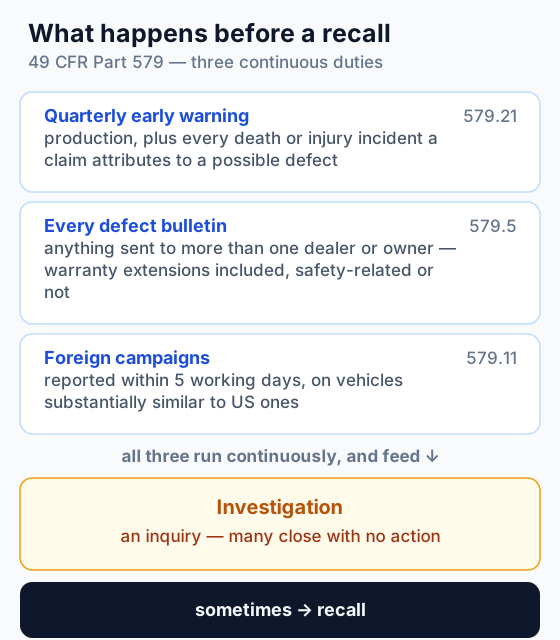
What manufacturers must file, every quarter
579.21 applies to any manufacturer whose annual output of light vehicles is 5,000 or more — which is every mainstream brand a used-car buyer is likely to consider. For each reporting period, that manufacturer must submit, separately for each make, model and model year:
| What is reported | The detail the regulation requires |
|---|---|
| Production information — 579.21(a) | Manufacturer, reporting period, make, model, model year, type, platform, the number produced, and the fuel or propulsion system coded — including EBP for battery electric, HEV for hybrid and PHV for plug-in hybrid |
| Incidents involving death or injury — 579.21(b) | A report on each incident involving one or more deaths or injuries in the United States identified in a claim against the manufacturer, or in a notice it receives, alleging or proving that the death or injury was caused by a possible defect |
Read the second row carefully, because its trigger is lower than most people assume. The duty attaches to a claim or notice alleging a possible defect. It does not require the manufacturer to agree, or a court to have found anything. The reporting happens while the question is still open, which is the entire point of calling it early warning.
Four more things counted every quarter, by component
Deaths and injuries are the headline of the early warning filing, and they are the rarest thing in it. 579.21(c) requires separate reports on the numbers of four further categories:
| Counted quarterly | What it captures |
|---|---|
| Property damage claims | Claims against the manufacturer where a possible defect damaged property rather than people |
| Consumer complaints | Complaints received by the manufacturer itself — distinct from the ones owners file with the agency |
| Warranty claims | Repairs the manufacturer paid for, which is the largest and earliest-moving of the four |
| Field reports | What the manufacturer's own people in the field wrote up about vehicles they saw |
The part that makes these useful rather than decorative is that they are not reported as a single lump. Each is broken down by the systems and components specified in codes 01 through 22, or 25 through 28, and separately for a fire, which has a code of its own. So the filing does not merely say a model generated a lot of warranty claims — it says which system they landed on.
Why warranty claims move first
Of the four, warranty claims are the earliest and least ambiguous signal, for a reason that has nothing to do with regulation: a warranty claim is a repair the manufacturer already paid for. It requires no owner to write to anybody, no agency to open anything, and no allegation of a defect. It just records that a part failed inside the period the manufacturer was standing behind it.
Put that alongside the bulletin duty at 579.5 and a sequence appears that a used-car buyer can actually use. Warranty claims accumulate on one component code. The manufacturer, watching its own money, issues a bulletin telling dealers how to fix it — or a warranty extension covering it for longer. Both are communications sent to more than one dealer about a defect, so both are forwarded to NHTSA. The public artifact of that whole chain is often a quiet extension letter rather than a recall.
Which is why a warranty extension on the model you are considering is worth more of your attention than its low profile suggests. It is the manufacturer telling you, in the most expensive language available to it, where that model breaks.
The ten-model-year window, and why it matters to a used buyer
The scope of each filing is the part that makes this useful to somebody buying an older car. A manufacturer reports for vehicles of the model year covered by the reporting period and the nine model years prior to the earliest model year in it, expressly including models no longer in production.
So a mainstream vehicle sits inside a mandatory reporting window for roughly a decade after it was built, whether or not the nameplate still exists. A discontinued model from eight years ago is not outside the system — its deaths, injuries and production numbers are still being filed.
Every defect bulletin reaches NHTSA, safety-related or not
579.5(a) is the provision with the widest reach, and its wording is worth reading closely. Each manufacturer must furnish NHTSA a copy of all notices, bulletins and other communications — including those transmitted electronically, and including warranty and policy extension communiqués and product improvement bulletins — sent to more than one distributor, dealer, lessor, lessee, owner or purchaser in the United States, regarding any defect in its vehicles.
The definition of defect there is broad on purpose: any failure or malfunction beyond normal deterioration in use, any failure of performance, or any flaw or unintended deviation from design specifications — whether or not such defect is safety-related. And 579.5(b) adds each communication relating to a customer satisfaction campaign.
- A technical service bulletin sent to dealers is a multi-recipient communication about a defect
- So is a warranty extension letter, which is named in the regulation explicitly
- So is a product improvement bulletin, also named explicitly
- None of it has to be safety-related to be forwarded
That is the mechanism behind something buyers notice but rarely explain: why bulletins and quiet warranty extensions become discoverable at all. Our TSB versus recall guide covers what a bulletin is and why one is usually not a free repair while a recall is.
Five working days, from anywhere in the world
579.11 closes a gap that used to matter a great deal. Two duties, both on the same short clock:
- 1The manufacturer's own decision abroadNot later than five working days after deciding to conduct a safety recall or other safety campaign in a foreign country covering a vehicle, item of equipment or tire identical or substantially similar to one sold or offered for sale in the United States, it must report that determination to NHTSA.
- 2A foreign government's determinationNot later than five working days after receiving written notification that a foreign government has determined a campaign must be conducted in its country on an identical or substantially similar vehicle, the manufacturer must report that too.
For an owner or a buyer, the practical reading is that a campaign announced in Europe, Japan or elsewhere on a car substantially similar to yours is not somebody else’s news. It is information the manufacturer owes the United States regulator within a working week, and it is frequently the earliest public signal that something is being taken seriously.
How to check a model, in the order that costs least
- 1Run the VIN for open recalls firstThis is the check with an answer that is specific to the car in front of you, and it is free. Everything else on this page is model-level rather than vehicle-level.
- 2Search NHTSA's investigations for the make, model and yearThe agency publishes its defect investigations and their status. Read what the investigation is about before reading anything into the fact that one exists.
- 3Look for bulletins and warranty extensions on the same modelThese are forwarded under 579.5 and are a reasonable proxy for where a model's known weaknesses are, even when nothing rises to a recall.
- 4Check the complaint record for the specific model yearOur per-model-year records show what owners reported and in which components, which is the closest thing to a pattern you can read yourself.
Start with the free recall check on this VIN
Decoded from official manufacturer and NHTSA records
An open investigation is not a verdict
This is the part to hold on to, because the temptation to over-read is strong and it will cost you good cars.
- An investigation is an inquiry into whether a defect exists — not a determination that one does
- Many investigations close with no action taken
- Some run for years while data accumulates, without anything being wrong with a particular vehicle
- A model with an investigation is not automatically worse than one without — high-volume models attract more complaints and therefore more scrutiny
- What an investigation gives you is a specific question to ask about a specific car, not a reason to dismiss a model
- And a closed investigation that found nothing is not the same as one closed because a recall was issued — read which it was
The useful version of this check is narrow: read what the investigation is about, then ask whether the vehicle in front of you shows that symptom, has had related work done, or carries a bulletin addressing it. That is a conversation with a seller and a mechanic, not a verdict from a database.
Using this when you are buying
The honest weight to give this is moderate. It is model-level information in a process where the vehicle-level checks matter more, and it is most valuable when it turns up something specific you can then look for on the actual car. Used that way it is a good question generator. Used as a filter on which models to consider, it will mostly tell you which models sell in volume.
- Do the VIN-level recall check first — it is free and it is about your car rather than your model
- Then read the investigation itself rather than its title, because the title rarely says what is actually being examined
- Treat an open investigation as a question to put to the seller and the inspector
- Ask whether any bulletin or warranty extension applies, and whether the work was done
- Remember that a warranty extension is a manufacturer paying for something quietly, which tells you where the weakness is
- Check whether the extension has already expired on the car you are looking at, because that changes who pays next time
- Weigh it against the rest of the picture rather than in isolation — an investigation on a well-maintained example is a smaller thing than a missing service history
- If nothing turns up, that is a mildly good sign and not a clean bill of health — the filings behind an investigation are not published in full
What we hold, and what we do not
Being direct, because this page describes records we do not supply. Our decode returns the factory build, specifications and open safety recalls for vehicles in the federal database, free. We do not hold investigation records, early warning filings or service bulletins, and no consumer VIN service does — the investigations are published by the agency and the early warning data is submitted to it rather than to anyone selling lookups.
Where this information comes from
- 49 CFR Part 579 — reporting information about potential defectsThe quarterly early warning duty at 579.21, the bulletin-forwarding duty at 579.5 and the five-working-day foreign campaign rule at 579.11
- NHTSA recall lookupThe free VIN-level check that should come before any model-level reading
- 49 CFR 579.21 — early warning reporting for light vehiclesThe quarterly duty, the ten-model-year scope, and the counts by component code
- NHTSA — datasets and APIsThe public complaint and campaign data behind the per-model-year records
Keep reading
Frequently asked questions
How do I check if a car model is under investigation?
NHTSA publishes its defect investigations by make, model and model year, and they are searchable free. An investigation is a stage that can precede a recall, so checking it tells you about problems that have been raised but not yet resolved into a campaign.
What is early warning reporting?
Under 49 CFR Part 579, manufacturers of 5,000 or more light vehicles a year must file quarterly reports covering the current model year and the nine model years before it, including production information and a report on each incident involving death or injury that a claim or notice attributes to a possible defect.
Do manufacturers have to send NHTSA their service bulletins?
Yes. 49 CFR 579.5 requires a copy of all notices, bulletins and other communications sent to more than one dealer or owner regarding any defect — expressly including warranty and policy extension communiqués and product improvement bulletins, and expressly whether or not the defect is safety-related.
Does a foreign recall have to be reported in the United States?
Within five working days. Under 49 CFR 579.11 a manufacturer must report to NHTSA once it decides to conduct a safety campaign in a foreign country on a vehicle identical or substantially similar to one sold here, and likewise within five working days of written notice that a foreign government has required one.
Does an open investigation mean the car is unsafe?
No. An investigation is an inquiry, not a finding. Many close without any action, some result in a recall, and some take years. Treat it as a question worth asking about a specific vehicle rather than as a verdict on the model.
Start with the check that is about your car
Decode any VIN free for the factory build, specifications and open safety recalls. No account, no card. Full vehicle history reports are launching soon.
Run a free VIN check