The short answer
- Can you run an Illinois plate lookup?
- Owner identity is gated by the federal Driver's Privacy Protection Act; SOS record releases require a permitted use. Buyers get the real history — decode, recalls, title brands — from the VIN.
- Why does this pickup have a different plate style?
- Illinois registers pickups as B-trucks — their own class, fees and plate series. It is normal, and it is also a reminder that Illinois encodes vehicle class on the plate.
- Does the plate come with the car?
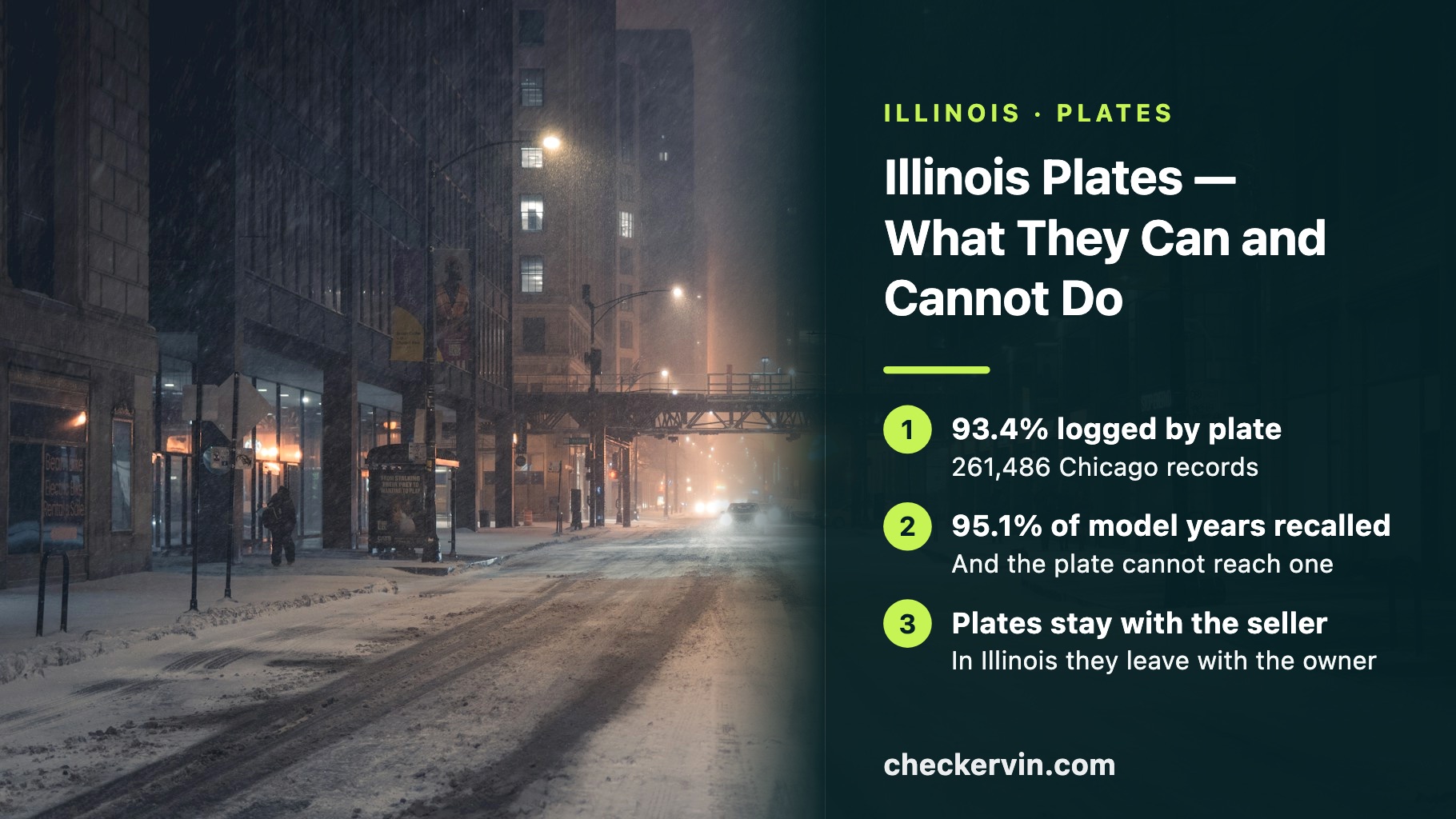
- No — Illinois plates leave with the seller, who can move the registration to their next vehicle. Buyers title and register fresh through the Secretary of State.
SOS
Who runs plates here
No DMV exists in Illinois
B
Pickup registration class
Trucks to 8,000 lbs
2
Plates required
Front and rear
Seller's
Whose plate it is
Removed and transferable at sale
The Secretary of State runs plates — Illinois's Michigan habit
Like Michigan, Illinois routes everything automotive through the Secretary of State: titles, registration, plates, renewal stickers, and the records behind them. The practical effect for out-of-staters is a naming problem — searching for an “Illinois DMV” finds SOS facilities — and for buyers it means one agency holds the whole paper trail, released only within the federal privacy rules covered below.
B-plates — why every Illinois pickup wears one
Illinois registers pickups up to 8,000 pounds as B-trucks: their own registration class, their own fee, their own plate series. A personal-use F-150 that would wear an ordinary passenger plate in Ohio wears a B-plate here. For a buyer the class is a small verification tool — a pickup offered with a passenger-class registration history has paperwork worth untangling — and a reminder that Illinois plates encode vehicle class, not just identity.
Two plates, by law
Illinois requires plates front and rear, and Chicago-area enforcement — including camera systems — leans on both being present and legible. Front-bracket hardware is universal on Illinois cars as a result, so its absence is the interesting case: a rear-only-state past, or front-end work that removed the mount. Either has a paper trail, and the national title record shows the state chain.
Plates stay with the seller
Illinois plates are the seller’s property. At sale they come off — the registration can follow the seller to a replacement vehicle — and the buyer applies for title and registration through the SOS, paying the state’s use tax scaled to the purchase price. The renewal sticker on the rear plate is the visible heartbeat of an Illinois registration: current sticker, current registration, current address on file.
Formats on Illinois roads
| Series | What it looks like |
|---|---|
| Standard passenger | The Lincoln-portrait blue-and-white base, letters and digits with a rear renewal sticker |
| B-truck | The pickup class — its own series and fee schedule up to 8,000 lbs |
| Specialty & collegiate | A long roster of cause and university designs with separate series |
| Personalized / vanity | Owner-chosen characters, SOS approval required, popular in Illinois |
| Antique vehicle | For qualifying older cars, with limited-use expectations |
What an Illinois plate lookup can legally find
The person behind an Illinois plate is protected by the federal Driver’s Privacy Protection Act, and the Secretary of State releases motor-vehicle records only for the statute’s permitted uses — insurance claims, litigation, commercial-driver verification, licensed investigation inside the law. Illinois adds its own record rules on top, and none of it leaves room for a public owner-by-plate search, whatever commercial sites imply.
The lawful private routes: police with a reason, an insurer with a claim, and the VIN in any purchase — the number that unlocks the decode, recalls, theft check and national title chain. The full framework lives in our license plate lookup guide.
Reading Illinois plates as a buyer
- Expired renewal sticker — lapsed registration with fees attached; ask why before it becomes your paperwork
- Missing front plate on an Illinois title — two are required; check for front-end repair or an out-of-state past
- B-plate history on a 'car-registered' pickup claim — the class mismatch is a paperwork question worth settling
- Auction-corridor chain — Illinois sits on the national salvage routes; the NMVTIS record shows rebuilt hops plainly
- Chicago winters — salt like Michigan's; put the car on a lift and read the subframes before the price
The Illinois order of operations
Illinois arranges a private sale differently from states where plates stay with the car, so the sequence has its own shape. Each step is cheaper than the one after it, which is the order you want when any of them can end the conversation.
- 1Before you travel, run the VINDecode it and check for open safety recalls. Both are free, both use federal data, and neither needs the seller's cooperation. This is the step that saves the wasted journey.
- 2At the car, read the VIN in two placesThe windshield plate and the driver's door jamb label. They must agree with each other and with the title. Do this before you look at the paint, because it is the only check that can end the visit outright.
- 3Expect the plates to leaveIn Illinois they belong to the seller and go with them. A seller offering to leave plates on the car is offering to leave their registration attached to your vehicle, which helps nobody.
- 4Confirm the title is signed and in the seller's nameA signed title is what transfers ownership. A bill of sale records the transaction and does not substitute for it, and a title in someone else's name is a different problem entirely.
- 5Register in your own name promptlyThe transfer is what puts the vehicle on the record as yours, and the delay is what creates exposure — tolls and citations follow the record rather than the reality until it catches up.
- 6Then spend money on inspectionStructure, corrosion and mechanical condition are the things no database on this page holds. That is the gap a physical inspection exists to fill, and it is worth paying for only once the free checks have passed.
Notice that a plate lookup appears nowhere in that list. It is not an oversight — the law limits what one can return to you, and none of what it returns is the car's history. The number that does the work here is the VIN, at every step.
What a plate is genuinely good for: a quarter of a million Chicago records
It would be easy to read this page as saying a plate is useless. It is not — it is precisely the right identifier for the job a city needs done, and Chicago publishes the evidence.
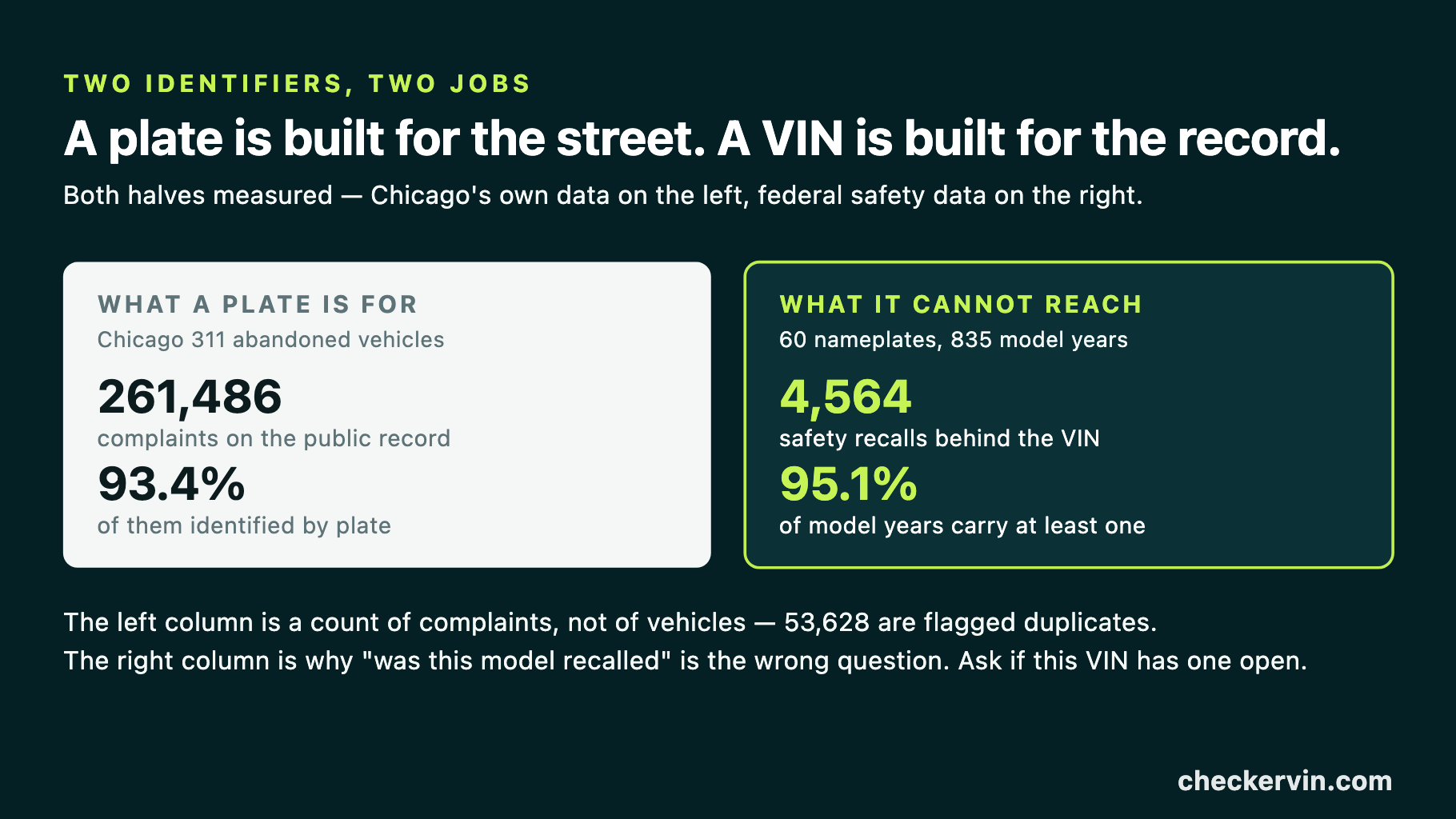
The city's open data portal carries its 311 abandoned-vehicle complaints as a public dataset. It holds 261,486 complaints from December 1999 to July 2020, and 244,322 of them — 93.4% — record a license plate. Not a VIN. A plate.
| Make recorded on the complaint | Complaints |
|---|---|
| Chevrolet | 38,321 |
| Ford | 34,049 |
| Honda | 15,895 |
| Toyota | 15,699 |
| Dodge | 14,866 |
That is the division of labor in one dataset. A city officer standing on a street needs to identify a vehicle from the outside, at a distance, without opening anything — and the plate is designed for exactly that. A buyer needs to identify a vehicle across time, through several owners and states, and the plate is designed to fail at that, because it is reassigned, surrendered and moved between cars by design.
The dataset records something else worth knowing: how long the vehicle had reportedly been sitting when somebody finally called it in.
| Days reported as parked | Complaints |
|---|---|
| 30 days | 39,332 |
| 14 days | 23,158 |
| 7 days | 19,283 |
| 21 days | 17,047 |
The clustering on round numbers is the tell — thirty, fourteen, twenty-one, seven. These are estimates by neighbors rather than measurements, and they bunch on the intervals people reach for when asked how long something has been there. It is a reminder that even a public record with a quarter of a million rows is made of human reports, and the precision of the field is not the precision of the answer.
The dataset also carries a lesson about reading any count of this kind. Of the 261,486 records, 53,628 — 20.5% — are flagged as duplicates, which is exactly what you would expect when four neighbors report the same car on the same street. So the total is a count of complaints, not of vehicles, and anyone quoting it as a number of abandoned cars in Chicago would be overstating it by about a fifth. We are quoting it as what it is.
One further caution worth stating: a 311 complaint is a report by a member of the public, not a finding. A vehicle appearing here has been reported as parked and apparently abandoned, which is a different thing from having been determined to be abandoned, and the dataset itself is historical rather than live.
What the plate cannot reach, in numbers
Everything above is about what an Illinois plate is and how it behaves. This section is about what it is not, because the gap is larger than most buyers assume and it is measurable.
A plate is an assignment. It is issued, transferred between vehicles, surrendered and reissued, and none of that touches the car's history. The VIN is the number those records hang from — and across the 60 nameplates and 835 model years of federal safety data we hold, here is what hangs from it.
| What the VIN reaches | Across the dataset |
|---|---|
| Safety recalls | 4,564 across 835 model years |
| Model years carrying at least one recall | 95.1% of them |
| Crash-involved complaints | 18,422 |
| Fire-involved complaints | 6,563 |
| Injury-involved complaints | 15,353 |
The second row is the one that reframes the question. Only 41 model years in the entire set carry no recall at all, which means 95.1% of them carry at least one. So “has this model been recalled?” is very nearly always yes, and it is the wrong question. The question that has a useful answer is whether this vehicle, by VIN, has a recall still open against it — and a plate will not get you there.
Recall repairs are performed at no cost by the manufacturer regardless of how many owners the vehicle has had, which makes this the cheapest check available on any used car and the one most often skipped. Our page on buying a car with an open recall covers what an unrepaired one means for a purchase.
When the plate and the paperwork disagree
Because Illinois plates move between vehicles and stay with sellers, a mismatch between the plate in front of you and the documents in your hand is not automatically sinister. It is, however, always worth resolving before money moves, and the order in which you resolve it matters.
- A plate that does not match the title is normal in a private sale — the plate belongs to the seller and is leaving
- A VIN on the title that does not match the VIN on the car is not normal, and ends the conversation
- A VIN plate at the windshield that disagrees with the door jamb label is the single clearest cloning signal there is
- A seller who offers to leave their plates on 'until yours arrive' is offering something that puts their registration on your car
- A title in a name that is not the seller's is a different problem entirely, and it has a name
The second and third items are the ones to take seriously. A plate is external, cheap and swappable; the VIN is stamped and recorded in several places on the vehicle, which is exactly why a cloned car has to reproduce it consistently and usually fails somewhere. Our VIN cloning page covers how that failure shows up, and title jumping covers the last item.
None of these checks requires a plate lookup, which is fortunate, because the law limits what a plate lookup can return to you and returns nothing about the car's history in any case.
Registering an Illinois purchase
- 1Take the signed titleSeller signature and odometer disclosure; verify the name against ID and the title face.
- 2Apply for title and registration at the SOSWithin the transfer window, with the use tax paid on the purchase price tier.
- 3Mount both platesFront and rear, with the renewal sticker on the rear plate.
- 4Note your classPickups register as B-trucks — the class drives the fee and the plate series you receive.
Decode an Illinois car's VIN free
Decoded from official manufacturer and NHTSA records
Where this information comes from
- City of Chicago open data — 311 abandoned vehicle complaintsThe dataset behind the plate figures above, queried through the Socrata API
- Illinois Secretary of State — vehicle servicesTitles, registration, plates and renewal stickers
- Driver's Privacy Protection Act, 18 U.S.C. § 2721The federal restriction on owner data in vehicle records
- NMVTIS — national title recordTitle brands from every reporting state, keyed to the VIN
- NICB VINCheckFree theft and salvage screen from participating insurers
Keep reading
Frequently asked questions
Can I look up the owner of an Illinois license plate?
Not from curiosity. The federal Driver's Privacy Protection Act limits owner information to permitted uses, and the Illinois Secretary of State releases vehicle records within those rules. In a purchase, the VIN — not the plate — carries the history you need.
Who issues license plates in Illinois?
The Secretary of State. Like Michigan, Illinois has no agency called a DMV — titles, registration, plates and renewal stickers all run through SOS facilities and its online services.
What is a B-truck plate in Illinois?
The registration class for pickups and other trucks up to 8,000 pounds. Illinois registers pickups as trucks, not passenger cars, so a personal F-150 or Silverado wears a B-plate with its own fee schedule — a distinction most states don't make visible on the plate.
Does an Illinois plate stay with the car when it is sold?
No — plates belong to the seller, who removes them and may transfer the registration to a replacement vehicle. The buyer applies for title and registration through the SOS and receives their own plates.
Does Illinois require a front license plate?
Yes — two plates, front and rear. Illinois is one of the remaining two-plate strongholds in the Midwest, so a clean undrilled nose on an Illinois-titled car deserves a question.
Class is on the plate — history is on the VIN
Decode any VIN free for the factory build, specifications and open safety recalls. No account, no card.
Run a free VIN check