The short answer
- What is the requirement?
- Two complete anchorage systems at rear forward-facing positions, plus a tether anchorage at a third. Not three complete systems.
- Which cars have it?
- Full compliance from vehicles built on or after September 1, 2002. Two earlier date lines apply before that, including a phase-in.
- Can a VIN tell me?
- No. There is no anchorage field in the federal decoder. The build date on the door jamb is what the standard's dates run on.
2 + 1
Full systems, plus a third tether
FMVSS 225 S4.4(a)
3 parts
What makes one system
Two lower anchors and a tether
Sep 2002
Full compliance date
By build date, not model year
1999
When installed anchors had to comply
Voluntarily fitted ones included
What actually counts as an anchorage system
49 CFR 571.225 — Federal Motor Vehicle Safety Standard 225 — exists, in its own words, to ensure the proper location and strength of child restraint anchorage systems, to reduce the likelihood of the anchorages failing, and to increase the likelihood that child restraints are properly secured.
The definition it uses is the thing to carry into a viewing. A child restraint anchorage system means:
| The two parts of one system | What it is |
|---|---|
| Two lower anchorages meeting S9 | The pair of bars in the seat bight that a car seat's connectors clip onto |
| A tether anchorage meeting S6 | The upper attachment point, behind or above the seat back, for the top tether strap |
All of it together is one system. A seating position with a tether anchor and no lower anchors is not a complete system under the standard, however it looks in a listing. That distinction is not pedantry — it is the exact thing a parent discovers when a car seat is already in the back seat and the lower connectors have nowhere to go.
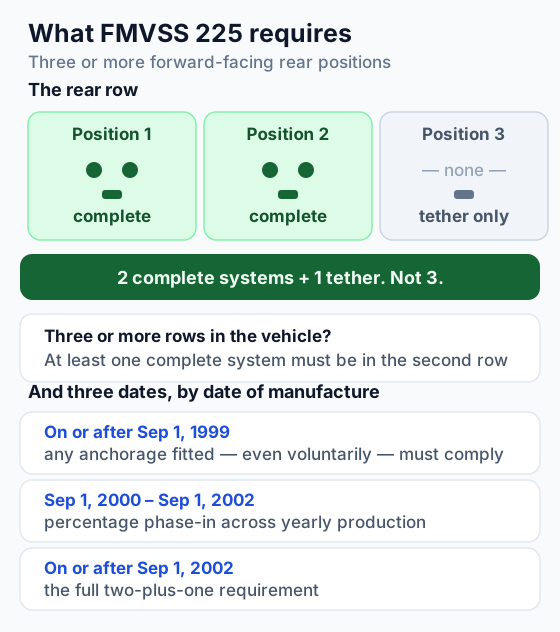
The standard requires two complete systems, not three
This is the part worth knowing before you go looking, because it explains a frustration that gets blamed on individual manufacturers and is actually the federal minimum.
S4.4(a) applies to vehicles manufactured on or after September 1, 2002 that have three or more forward-facing rear designated seating positions. Such a vehicle must be equipped with:
- A child restraint anchorage system conforming to S9 at not fewer than TWO forward-facing rear designated seating positions
- And a tether anchorage conforming to S6 at a THIRD forward-facing rear designated seating position
- The tether anchorage belonging to one of the complete systems may count toward that requirement
So the federal floor is two complete systems plus one tether. The familiar layout — lower anchors at the two outboard rear seats and a tether-only center — is not a manufacturer cutting corners. It is a manufacturer meeting the standard exactly.
The three-row rule, which matters for SUVs and minivans
There is a placement requirement layered on top of the counting one, and it is aimed squarely at larger family vehicles. Under S4.4(a)(1), where a vehicle has three or more rows, at least one of the required child restraint anchorage systems must be installed at a forward-facing seating position in the second row, if such a position is available in that row.
The practical reading for a used-SUV or minivan shopper: the standard prevents a manufacturer from satisfying its obligation entirely in the third row, where a parent would find the anchors technically present and practically useless for a young child. It does not promise you anchors in every row, and it does not promise a second-row center position.
Three date lines, not one
Most write-ups give September 1, 2002 as the LATCH date and stop. The standard has three distinct lines, and the earlier two matter when shopping older or cheaper stock.
| Vehicles manufactured | What the standard requires |
|---|---|
| On or after September 1, 1999 — S4.1 | Any tether anchorage or anchorage system installed, whether voluntarily or because the standard required it, must meet the configuration, location, marking and strength requirements. The vehicle must also be delivered with written information, in English, on how to use them |
| September 1, 1999 to September 1, 2000 — S4.2 | Not less than 80 percent of a manufacturer's average annual production, excluding convertibles, equipped with tether anchorages at no fewer than three forward-facing rear positions |
| September 1, 2000 to September 1, 2002 — S4.3 | A percentage phase-in of complete anchorage systems, set out in S14 of the standard |
| On or after September 1, 2002 — S4.4 | The full requirement: two complete systems plus a third tether anchorage, as described above |
The first row is the one people miss and the one that helps most. From September 1, 1999, a manufacturer that fitted anchorages voluntarily still had to fit them to the standard. So anchors found in a car from that era are not decorative or improvised — if they are there, they were required to comply.
Why the phase-in years are a production question, not a model-year one
Between September 1, 2000 and September 1, 2002 the requirement applied to a specified percentage of each manufacturer’s yearly production. That is a fleet-level obligation, not a per-vehicle one, which has an awkward consequence for a used-car buyer: two apparently identical cars from that window can legitimately differ, because the manufacturer was allowed to satisfy the requirement across its production rather than on every unit.
There is no way to resolve that from a listing, a model year or a trim level. The only reliable answer is to look at the specific car. It is also a reminder that the standard’s dates run on date of manufacture rather than model year — a distinction our safety features by VIN guide covers in detail for the same reason, since the two can differ by the better part of a year.
What a compliant lower anchor physically is
The standard describes the hardware precisely enough that you can tell a real anchorage from a bracket that happens to be there. Under S9.1.1, the lower anchorages must consist of two bars that:
| The specification | What it means when you are looking at one |
|---|---|
| 6 mm ± 0.1 mm in diameter | A specific, consistent thickness — car seat connectors are built to it, which is why they fit across brands |
| Straight, horizontal and transverse | Running across the vehicle, not fore and aft, and not curved |
| Not less than 25 mm in length | With not more than 60 mm between the supports that restrict a connector's lateral movement |
| Part of the vehicle, removable only with a tool | A screwdriver or wrench — anything that unclips by hand is not an anchorage |
| Not deforming more than 5 mm under a 100 N force in any direction | A rigidity requirement tested at certification, not something to test yourself |
One cross-reference is worth noting, because it shows how the two halves fit together. The standard defines a tether hook as the device illustrated in Figure 11 of Standard No. 213 (49 CFR 571.213), which is the separate standard governing child restraint systems themselves. The vehicle standard specifies the anchorage; the seat standard specifies the hardware that attaches to it. Neither alone determines whether your particular seat installs well in a particular car, which is why a test fit answers a question no regulation does.
The practical value of knowing this is recognition rather than measurement. You are not checking a car with calipers. You are confirming that what you found in the seat bight is a pair of dedicated transverse bars rather than a seat frame member or a trim bracket, which is a distinction that becomes obvious once you know what the standard asks for.
Two more dates hiding in the detail
Beyond the three compliance dates above, the hardware requirements carry two of their own — and both explain differences between cars that otherwise look contemporary.
| Vehicles manufactured | What changed |
|---|---|
| Sep 1, 1999 to Sep 1, 2004 — the S15 option | A manufacturer could, at its own irrevocable option selected at certification, meet the requirements of S15 instead of S9. Vehicles built on or after September 1, 2004 must meet S9 |
| On or after March 1, 2005 — S9.1.1(d) | The bars must not be capable of being stowable, whether folding or otherwise. Before that date, a stowable design could comply |
The second one is the more useful for a used-car shopper, because it describes something you can look for. On a vehicle built before March 2005, anchors that tuck away are not evidence of a problem — they were permitted. On a later vehicle, an anchorage that appears designed to fold out of sight is worth a closer look and a question, because the standard stopped allowing that.
Taken together with the compliance dates, the picture for anyone shopping early 2000s stock is that this was a moving target for roughly six years. That is not a reason to avoid those cars. It is a reason to check the specific vehicle rather than reasoning from its badge or its year.
Marking, and the booklet you probably did not get
S4.1 carries two obligations that are useful to a second owner. Installed anchorages must meet the standard’s marking requirements as well as its configuration, location and strength requirements — which is why lower anchor positions carry a symbol on the seat back or in the seat bight rather than being left for you to find by feel.
The second is the one that goes missing. The vehicle must be delivered with written information, in English, on how to appropriately use those anchorages and systems. On a new car that is the owner’s manual section. On a used car three owners later, the manual is often gone — and with it the guidance on which positions are approved for what, which the standard assumed you would have.
- Ask whether the owner's manual is with the car, and treat its absence as a small cost rather than nothing
- Look for the anchor symbols before feeling for bars — the marking requirement means they should be findable
- A manual for the exact model year is usually available free from the manufacturer, and it names the approved positions
Checking the actual car, in five minutes
- 1Read the build date on the door jamb labelMonth and year of manufacture. That is what the standard's dates run on, not the model year on the listing.
- 2Count complete systems, not anchorsFor each rear position, confirm both lower anchorages and a tether anchorage. Two lower bars without a tether point is not a complete system.
- 3Find the tether anchorages specificallyThey sit behind the seat back, on the parcel shelf, on the seat back itself, or in the cargo floor depending on the vehicle. If you cannot find one, ask.
- 4Check the second row on a three-row vehicleThe standard requires at least one complete system there where a forward-facing position exists, so its absence is worth questioning.
- 5Bring the actual car seat if you canAnchor spacing, seat contour and buckle position decide whether your seat installs well. No regulation answers that for your particular seat.
What a VIN cannot tell you here
It is worth being direct, because this is a case where our own tool does not answer the question. The federal decoder has no child restraint anchorage field. A decode returns the factory build, specifications and open safety recalls — none of which enumerates anchorages — and no commercial VIN service holds that data either, because it is not recorded per vehicle anywhere.
Decode the VIN free before you view
Decoded from official manufacturer and NHTSA records
Before you buy
None of this is a reason to be nervous about a used family car. The standard has been in full effect for more than two decades, and the great majority of what a parent will look at is covered by it. The value in knowing the detail is narrower and more practical: it tells you what the car is obliged to have, so the gap between that and what you actually need is a question you ask on the forecourt rather than discover in a parking lot with a child seat in your hands.
- Confirm the build date, not the model year, against the September 2002 line
- Count complete systems for the number of children you are actually seating
- Assume the center rear position is tether-only until you have seen otherwise
- On a three-row vehicle, verify the second row rather than the third
- Test-fit your own seat if the car is a serious candidate — it is the only check that answers your case
- Run the free recall check on the VIN, which matters more on a car carrying children than on any other
- Ask whether the rear seats have ever been replaced or retrimmed, since anchorage hardware lives in the seat structure
Where this information comes from
- 49 CFR 571.225 — FMVSS 225, child restraint anchorage systemsThe system definition, the two-plus-one requirement at S4.4, the second-row rule and all three compliance dates
- 49 CFR 571.213 — FMVSS 213, child restraint systemsThe standard covering child seats themselves, cross-referenced by FMVSS 225 for the tether hook
- NHTSA recall lookupOpen safety campaigns by VIN, free — including child restraint and seat-related campaigns
- NHTSA vPIC decoderThe federal build record, which carries no anchorage field
Keep reading
Frequently asked questions
How many LATCH positions does a car have to have?
Fewer than most parents expect. Under FMVSS 225 S4.4, a vehicle with three or more forward-facing rear seating positions must have a full child restraint anchorage system at not fewer than two of them, plus a tether anchorage at a third. Two complete systems and one tether-only position is the federal requirement, not three complete systems.
What actually counts as a LATCH system?
The standard defines a child restraint anchorage system as two lower anchorages meeting S9 and a tether anchorage meeting S6. All three parts together make one system. A seating position with a tether anchor but no lower anchors is not a complete system, which is the distinction most used-car shoppers run into.
Do all used cars have LATCH?
It depends on when the vehicle was built rather than on its model year. Full compliance applies to vehicles manufactured on or after September 1, 2002. Between September 1, 2000 and September 1, 2002 a percentage phase-in applied, so two identical-looking cars from that window can differ.
Can I fit three car seats across the back with LATCH?
Not by relying on the federal requirement. The standard obliges a manufacturer to provide two complete anchorage systems and a third tether anchorage, so the center position frequently has a tether but no lower anchors. Some vehicles provide more than the minimum, which is a per-model question rather than a rule.
Does a VIN decode show whether a car has LATCH anchors?
No. The federal decoder has no child restraint anchorage field, and no VIN service reports one. What a decode does give you is the model year and the build information, and the build date on the door jamb label is what the standard's dates actually run on.
Run the recall check before the test fit
Decode any VIN free for the factory build, specifications and open safety recalls. No account, no card. Full vehicle history reports are launching soon.
Run a free VIN check