The short answer
- What does it cost?
- Published estimates run $126 (RepairPal general) to $415 (KBB, 2022 Hybrid) — attributed figures, not ours.
- Why so wide a spread?
- Mostly trim and bundling. Hybrid and Prime variants run more labor; a 120k-mile visit invoiced as one line looks like an expensive plug job.
- Is the engine the risk here?
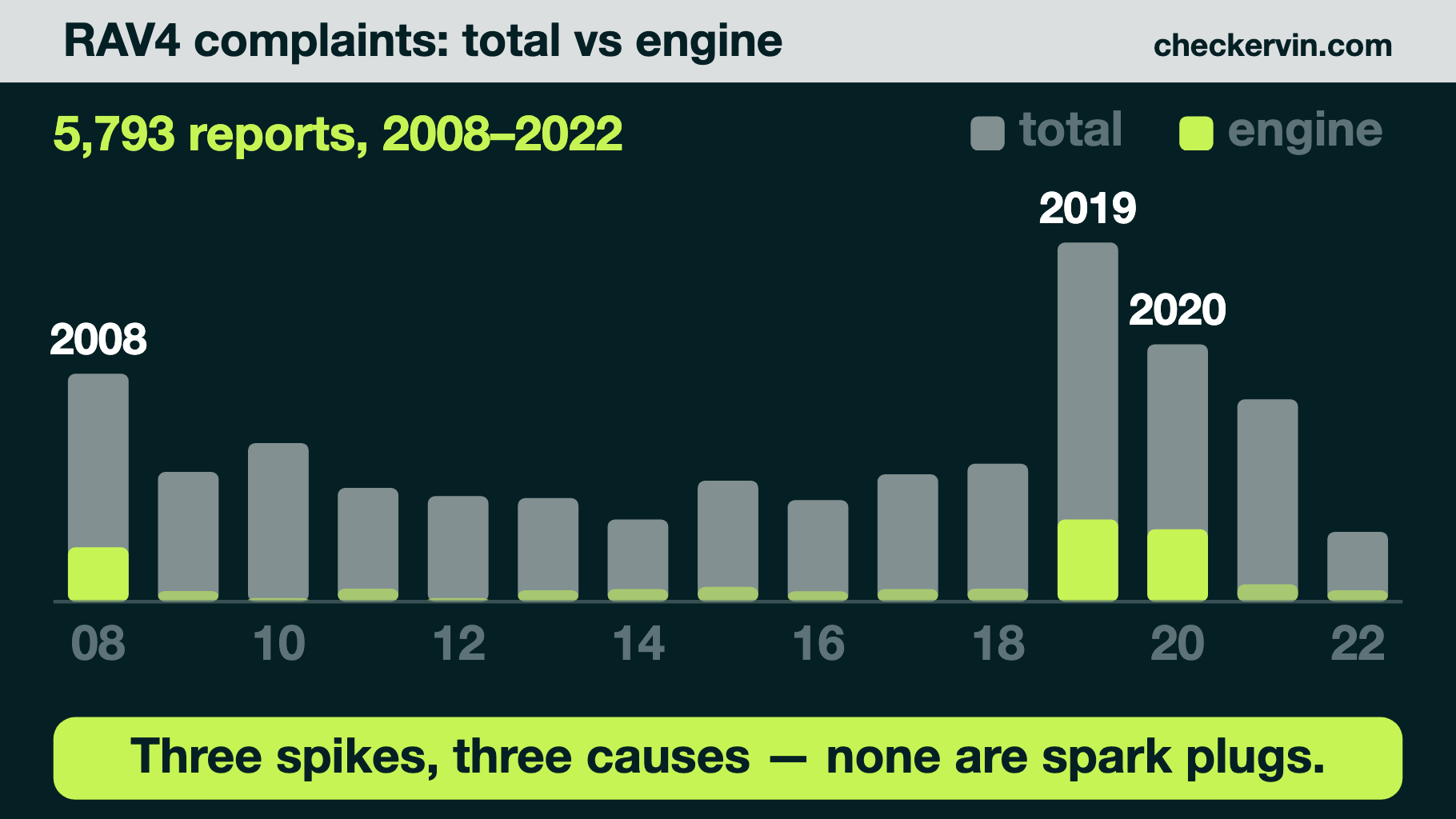
- For 12 of the RAV4's 15 model years, no — engine complaints stay under 16.5% of that year's total. The three exceptions (2008, 2019, 2020) each have a separately documented, named cause, and none of them is the plugs.
The spread, and whose numbers make it
Four published figures frame this repair, and none of them is ours. RepairPal’s general RAV4 page averages $126 to $162 — $53 to $70 in parts, $73 to $92 in labor. Its own 2024/Denver estimator runs higher, $227 to $300, though its listed parts-and- labor subtotals do not add up cleanly to that headline total, a discrepancy on RepairPal’s side rather than something we can resolve. YourMechanic lists a $140 average, shown on its page as $0 in parts and $140 in labor — almost certainly a display gap rather than a free-parts claim. Kelley Blue Book’s ZIP-based estimator runs from $251 to $314 on a 2017 RAV4 up to $333 to $415 on a 2022 Hybrid. All four were retrieved and quoted with attribution; we sell VIN checks, not service.
A spread past 3-to-1 on a routine maintenance item invites the same worry every time: is the car expensive because something is wrong with it? The rest of this page answers that with the record itself, not a guess.
What the record says, year by year
Our corpus of federal NHTSA complaints holds 5,793 reports against the 2008–2022RAV4. In 12 of its 15 model years, the engine’s share of that year’s own total complaints stays between 8.3% and 16.5% — and in two of those twelve, 2010 and 2012, the engine doesn’t even place in the model year’s top five complaint categories at all, meaning its true count is lower still than whatever fifth place held that year, not a literal zero we are claiming to have measured.
Three model years break that band: 2008 (23.8%), 2019 (22.9%) and 2020 (28.0%) — close enough to each other that no single one stands out by magnitude alone. What separates them from the other twelve years is not a single story. Each has its own named, documented, unrelated cause, covered next, and none of the three is spark plugs.
The three spikes, and why none of them is plugs
2008is an isolated single-year spike with no elevated neighbor — the following year drops to 8.3%. Live web search ties it to Toyota’s own Warranty Enhancement Program ZE7, covering excessive oil consumption on 2AZ-FE-engine vehicles including the 2006-2008 RAV4 (per carcomplaints.com’s bulletin summary and youcanic.com, with one source putting the program’s coverage window through October 2016 regardless of mileage). A related class action, April Lax v. Toyota Motor Corporation (case 14-cv-01490, U.S. District Court for the Northern District of California), was reported voluntarily dismissed in December 2015.
2019 and 2020, by contrast, are the corpus’s only back-to-back elevated pair. Live web search ties that specific pairing to a different, later, unrelated cause: a coolant bypass valve that can fail and trigger an “Engine Maintenance Required” warning, sometimes with overheating, across 2019-2023 RAV4 and Corolla models (per lemberglaw.com and carcomplaints.com secondary reporting). A 2024 class action, Barrientos et al. v. Toyota Motor Sales, U.S.A., Inc. (filed May 2024, case 3:24-cv-03282, U.S. District Court for the Northern District of California), alleged the defect across those model years; secondary reporting indicates the plaintiffs voluntarily dismissed it roughly five months later. Per the same lemon-law secondary source, Toyota has not issued a formal NHTSA recall for the valve, running a Customer Support Program instead (CSP 24TE04).
Two different engines, two different defects, two different legal outcomes, 11 years apart — kept as two distinct findings rather than one blended “RAV4 engine problems” story, because that is what the record actually shows. Neither is a spark-plug or ignition-system finding.
The interval, and the case for paying exactly once
Per a secondary source (autoreviewnest.com) relaying Toyota’s own printed U.S. maintenance guide for the current RAV4, spark plug replacement is scheduled at 120,000 miles — not independently fetched from Toyota’s own PDF here, so treated as attributed rather than verified first-hand. Long-life iridium electrodes are what buy that interval, and they cut both ways: no reason to replace healthy plugs early, and a real reason not to stretch far past 120,000 miles, since worn plugs push higher voltage demand into the ignition coils — and coils cost more than plugs.
| Outcome | How it happens |
|---|---|
| Pay once, on schedule | Plugs at the published 120,000-mile interval, itemized |
| Pay twice | Plugs replaced years early 'while we're in there,' then again on schedule |
| Pay more later | Interval stretched until a coil or misfire joins the bill |
| Pay for the wrong thing | A maintenance bundle remembered — and re-quoted — as 'spark plugs' |
Where the money goes
RepairPal’s own general split — $53 to $70 in parts against $73 to $92 in labor — is the clearest anatomy lesson available. The parts line is four ordinary iridium plugs; the labor line covers an inline four-cylinder’s job, which is not especially hard to reach on the RAV4’s standard gas engines compared to a boxer or a V6 tucked against a firewall. That is part of why the low end of the published range (RepairPal’s $126, YourMechanic’s $140) sits well under half of KBB’s upper range.
The gap between the low end and KBB’s $300-$415 figures is mostly where that KBB number comes from (ZIP-based dealer and independent-shop ranges skew higher than a flat-rate online estimate) and which trim is being quoted — which the next section covers directly.
The do-it-yourself question, answered honestly
It is a common driveway job on the RAV4’s standard four-cylinder engines, with the usual cautions: work when the engine is cold, follow the plug maker’s torque spec rather than guessing, and use anti-seize and dielectric grease only where specified. Hybrid and Prime models add a reason for caution beyond mechanical skill — their high-voltage systems are not a place to improvise around, and a shop that already handles that system routinely is a reasonable premium to pay for.
The honest arithmetic on a standard gas RAV4: parts alone run well under a hundred dollars, so an afternoon with the right socket saves most of the quoted labor. That math changes on a Hybrid or Prime, where the labor is buying expertise around a system most driveway mechanics are right to leave alone.
Before you authorize the service
- Ask for line items — separate plug labor from any bundled 60k/120k service before comparing quotes
- Confirm which trim is being quoted — gas, Hybrid and Prime RAV4s price differently
- If symptoms (rough idle, misfire code, overheating warning) triggered the visit, scan codes first — an overheating warning on a 2019-2020 points at the coolant valve, and heavy oil use on a 2008 points at the 2AZ-FE program, neither of which is the plugs
- Pull the VIN's open recalls while you are at it; the lookup is free
- Check remaining factory coverage, including any customer support program, by VIN before paying out of pocket
If you are buying the RAV4, not maintaining it
The 120,000-mile interval turns into a one-question service-history test: on a RAV4 past that mileage, ask when the plugs were done and expect a line item. A seller who cannot answer is not hiding a catastrophe — it is a plug job, not a timing chain — but a missing interval is a real number to subtract from your offer. On a 2019 or 2020 specifically, ask one more question: has the coolant bypass valve been addressed, since that is the documented issue for those years, not the plugs. On a 2008, ask about the oil-consumption warranty program (ZE7) instead — a different engine, a different fix, and also not the plugs.
Then read the year, not the brand story. Our RAV4 years-to-avoid breakdown scores every model year against the nameplate’s own median, from the same corpus this page computes from. A Toyota VIN decode confirms the build and trim, and the warranty check by VIN settles what factory coverage — including any customer support program — is still attached before you price any of it into the deal.
Where this information comes from
- NHTSA — RAV4 complaint databaseThe federal complaint record this page's engine-share figures are computed from.
- KBB — RAV4 spark plug estimateThe ZIP-based $251-$415 ranges quoted above, by model year and trim.
- YourMechanic — RAV4 spark plug estimateThe $140 average quoted with attribution.
- RepairPal — RAV4 spark plug estimateThe $126-$162 general range and its parts/labor split.
Keep reading
Frequently asked questions
How much does a Toyota RAV4 spark plug replacement cost?
The published estimates disagree by more than 3x. RepairPal's general figure averages $126 to $162 ($53-$70 parts, $73-$92 labor); its 2024 Denver estimator runs $227 to $300. YourMechanic lists $140. KBB's ZIP-based ranges run roughly $251 to $415 depending on model year and trim, with the Hybrid and Prime running toward the top of that. Each figure is quoted with attribution; we sell VIN checks, not service.
How often should spark plugs be changed on a RAV4?
Per a secondary source relaying Toyota's own printed maintenance guide for the current RAV4, the interval is 120,000 miles — long-life iridium plugs are what buy that number. There is no case for replacing healthy plugs early, and a real case for not stretching past the interval, since worn plugs push more voltage demand into the ignition coils, and coils cost more than plugs.
Did my RAV4's engine problems get recalled?
Probably not under that name. The 2019-2020 RAV4's elevated engine complaints trace to a coolant bypass valve that can trigger overheating and an "Engine Maintenance Required" warning. A 2024 class action (Barrientos et al. v. Toyota Motor Sales, U.S.A., filed in the Northern District of California) covered 2019-2023 RAV4 and Corolla models and was reported voluntarily dismissed about five months later. Per a lemon-law site, Toyota has not issued a formal recall for it, running a Customer Support Program (CSP 24TE04) instead — neither of which is a spark-plug or ignition-system issue.
Why does my RAV4 spark plug quote vary so much between shops?
Three things stack: trim (Hybrid and Prime variants run more underhood components and higher-voltage caution, pushing labor up), bundling (a 120k-mile visit invoiced as one "spark plugs" line is really plugs plus fluids, filters and inspection), and plain shop labor-rate differences. Ask for an itemized quote before comparing any two numbers.
Does the complaint record show the RAV4 has an engine problem?
Mostly no. Across 5,793 federal complaints against the 2008-2022 RAV4, the engine's share of each model year runs 8.3% to 16.5% in 12 of the 15 model years. The three exceptions — 2008 (23.8%), 2019 (22.9%) and 2020 (28.0%) — each trace to a separately documented, named cause (a 2AZ-FE oil-consumption warranty program for 2008; a coolant bypass valve for 2019-2020), attributed above, and none of them is the plugs.
Read the record before you pay for the reputation
A free CheckerVIN report shows the factory build, specifications and open recalls for any VIN — five minutes that separates genuine engine issues from a routine service bill.
Run a free VIN check