The short answer
- What does it cost?
- Published estimates run $216 (YourMechanic general average) to $750 (RepairPal’s top end) — attributed figures, not ours.
- Is the engine a known weak point?
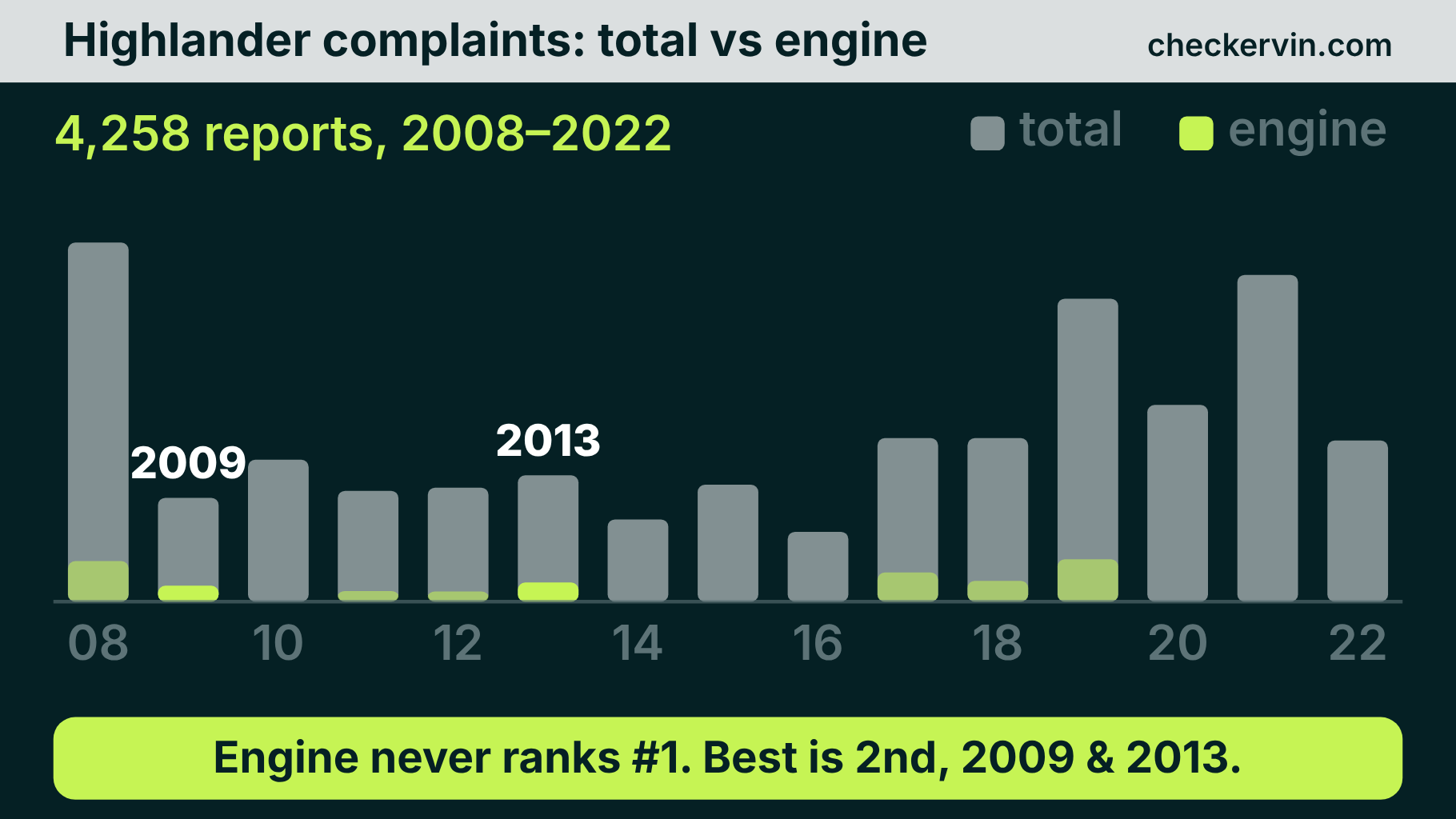
- No. ENGINE never ranks #1 in any of the Highlander’s 15 model years, and reaches the top five at all in only 8 of them.
- What about the $1,000 quote some owners report?
- It traces to a direct-injection V6 and a disputed service interval — two sources put that engine at 60,000 miles, not the 120,000 the owner expected, not a defect.
4,258
Federal complaints, 2008-2022
Full NHTSA corpus for this nameplate
8 of 15
Years engine reaches the top five
7 years it is not even close enough to count
0
Years engine ranks #1
Best is a tie for 2nd: 2009 and 2013
$216-$750
Published quote spread
YourMechanic general average to RepairPal's top end
The spread, and whose numbers make it
Four published figures frame this job, and none is ours. YourMechanic’s general Highlander page averages $216 total — $76 in parts, $140 in labor, no model year named. RepairPal’s estimator runs higher and wider: $502 to $750, with labor alone quoted at $435 to $638 against $68 to $112 in parts — also with no model year or engine specified, which matters more on this nameplate than most. Kelley Blue Book’s ZIP-based figures are the only ones tied to a specific car: $402 to $473 on a 2018 Highlander, $371 to $465 on a 2023 Highlander Hybrid.
That is close to a 3.5-to-1 spread on one routine maintenance item, and it is not explained by location alone. The rest of this page checks that spread against the federal complaint record, the published service interval, and the fact that this nameplate has shipped at least three meaningfully different engines since 2008.
What the record says, year by year
Our corpus of federal NHTSA complaints holds 4,258 reports against the 2008–2022Highlander. NHTSA keeps no SPARK PLUGS or IGNITION category of its own, so ENGINE is the closest honest proxy — the same convention every spark-plug post in this series uses, since it is an upper bound on plug trouble, never a count of it.
ENGINE is not a persistent category here. It reaches that year’s own top-five complaint categories in only 8 of the Highlander’s 15 model years — 2008, 2009, 2011, 2012, 2013, 2017, 2018, 2019. In the other 7 years — 2010, 2014, 2015, 2016, 2020, 2021, 2022— it is not simply small, it falls outside the top five entirely, meaning the record is silent on it rather than reporting a low number.
The year that looks worst, and the two that rank closest
In the 8years ENGINE is present, it never ranks #1 — not once, in fifteen years of this nameplate’s record. Its only two 2nd-place finishes are 2009 (27 of 174 complaints, 15.5%) and 2013 (32 of 212, 15.1%) — close enough in share to call a tie, and a tie in rank regardless.
The year with the single highest ENGINE share on record is actually 2017, at 17.9% (49 of 274complaints) — higher than either 2009 or 2013. But 2017is only ENGINE’s 3rd-rank year, because another category grew even faster that same model year. The year with the biggest engine number is not the year engine stands out most against everything else reported that year — a distinction a flat price-only estimator page has no reason to draw and therefore never does.
No NHTSA recall campaign naming spark plugs, ignition coils or a misfire condition turned up for this nameplate in this research. Stated plainly: across fifteen model years, the Highlander’s own federal complaint record does not support a “feared engine problem” framing, which is exactly the framing a price-only estimator implies just by publishing a number for the job at all.
The interval two sources can't agree on
Secondary reproductions of Toyota’s own printed Warranty & Maintenance Guide for the pre-2017 Highlander’s 2GR-FE V6 list spark-plug replacement at 120,000 miles (144 months), specifying a DENSO FK20HR11 plug or equivalent. That figure also shows up, attributed to Toyota, in a Torque News article about a 2017 Highlander owner’s dealer quote.
But the 2017 model-year facelift switched that V6 to direct injection — the 2GR-FKS — and two independent secondary sources describe a shorter interval for that specific engine: a Firestone Complete Auto Care maintenance guide covering 2014-2019 Highlanders gives 60,000 miles for the 2GR-FKS specifically, and a Go-Parts fitment guide for 2019-2022 Highlanders states the same 60,000-mile figure for the 3.5L V6 sold in those years. Neither source is Toyota’s own document, and this research could not independently confirm either figure against one — this environment’s network restrictions block a direct read of Toyota’s own hosted PDF the same way they block several estimator sites cited above.
| Engine | Spark-plug interval, per source |
|---|---|
| 2GR-FE V6 (pre-2017) | 120,000 mi / 144 mo — secondary reproduction of Toyota's W&M Guide; DENSO FK20HR11 |
| 2GR-FKS V6, direct injection (2017+) | 60,000 mi — Firestone and Go-Parts guides, independently; conflicts with the 120,000-mile figure some sources still apply to this engine |
| Hybrid four-cylinder | Not separately confirmed in this research — check the Hybrid's own maintenance schedule rather than assuming the V6 figure |
This is not a small gap. If 60,000 miles is the right number for a 2017-or-newer V6, a quote at 64,500 miles is about 4,500 miles pastdue, not early — the opposite of how at least one owner’s complaint about a dealer quote was framed online. Check the number printed in your own VIN’s maintenance schedule or door-jamb sticker before arguing with a quote on the strength of a secondhand figure.
Where the money goes
YourMechanic’s own split — $76 in parts against $140 in labor — puts roughly two-thirds of its $216 average into labor for a six-cylinder engine with six plugs to reach, not four. That ratio alone explains a meaningful share of why this job runs higher than the same job on a four-cylinder nameplate in this series. RepairPal’s wider $435-$638 labor range, quoted without a model year, likely spans easier and harder generations of the same V6 rather than describing one job.
Three spark-plug jobs under one nameplate
Owner and shop forum threads describe meaningfully different labor for this job depending on generation. On the pre-2017 2GR-FE V6, multiple owners describe removing the intake plenum and, on some cars, the wiper cowl to reach the rear bank of plugs — one forum post puts a shop at 3.5 hours, another owner at about four, largely because of awkward bolts behind the plenum. On the 2017-and-newer direct-injection 2GR-FKS, at least one owner describes the plenum coming off in about 15 minutes with the whole job done in under an hour — a very different labor picture for what is still, on paper, “a Highlander V6 spark-plug job.” The Hybrid runs a smaller four-cylinder alongside the electric motors, with its own access and its own schedule, not covered by either V6 figure above.
None of that spread is in our complaint corpus, which tracks reported problems, not labor time. It is attributed context, kept separate from the computed figures above it: if your Highlander is a specific model year, price the job against owners describing that generation, not a flat average that blends all three.
The do-it-yourself question, answered honestly
Forum accounts for the pre-2017 V6 describe a genuinely more involved job than a four-cylinder plug change — intake plenum off, sometimes the wiper cowl, awkward rear-bank access — which is consistent with the longer labor times owners report for that generation. The post-2017 direct-injection V6 appears to be considerably easier by the same forum accounts, though individual results vary with tools and experience. Either way, use the plug and coil maker’s torque spec rather than guessing, and confirm which interval actually applies to your engine before buying parts.
Before you authorize the service
- Confirm which V6 your Highlander has — pre-2017 2GR-FE or 2017-and-newer direct-injection 2GR-FKS — the published intervals differ
- Ask which interval the quote assumes, and whether it matches the figure printed on your own VIN's maintenance schedule or door-jamb sticker
- Ask for line items — separate plug labor from any bundled major service before comparing two quotes
- If a misfire code or rough idle triggered the visit, scan codes first — a worn plug can push failure into the ignition coil, which costs more than the plug
- Check remaining factory coverage by VIN before paying out of pocket
If you are buying the Highlander, not maintaining it
The interval conflict above turns into a simple service-history question on a used Highlander: ask which engine it has, ask when the plugs were done, and expect an answer tied to a specific mileage rather than a shrug. A seller who cites “120,000 miles” on a 2017-or-newer V6 may be repeating the same outdated figure this page questions above — worth a follow-up question, not an argument.
Then read the year, not the brand story. Our Highlander years-to-avoid breakdown scores every model year against the nameplate’s own median, from the same corpus this page computes from. A Toyota VIN decodeconfirms the build and engine — essential here, since the 2GR-FE and 2GR-FKS V6s share a nameplate but not a service interval — and the warranty check by VIN settles what factory coverage is still attached before you price any of it into the deal.
Where this information comes from
- NHTSA — Highlander complaint databaseThe federal complaint record this page's engine-share figures are computed from.
- NHTSA — recalls lookup by VINConfirm whether a specific Highlander VIN has any open recall before paying for a repair.
- KBB — Highlander spark plug estimateThe ZIP-based $402-$473 (2018) and $371-$465 (2023 Hybrid) ranges quoted above.
- YourMechanic — Highlander spark plug estimateThe $216 general average ($76 parts, $140 labor) quoted above.
Keep reading
Frequently asked questions
How much does a Toyota Highlander spark plug replacement cost?
Published estimates vary by source and engine. YourMechanic's general average is $216 ($76 parts, $140 labor). RepairPal's estimator runs $502-$750 ($68-$112 parts, $435-$638 labor) without specifying a model year or engine. Kelley Blue Book's ZIP-based ranges run from about $402-$473 on a 2018 Highlander to $371-$465 on a 2023 Highlander Hybrid. A Torque News article reports one owner quoted over $1,000 by a dealer. Each figure is quoted with attribution; we sell VIN checks, not service.
How often should spark plugs be changed on a Toyota Highlander?
Sources disagree, and we are stating the disagreement rather than picking a side. Secondary reproductions of Toyota's own Warranty & Maintenance Guide for the pre-2017 2GR-FE V6 list 120,000 miles (144 months). A Firestone Complete Auto Care guide for 2014-2019 Highlanders and a Go-Parts fitment guide for 2019-2022 models both give 60,000 miles specifically for the direct-injection 2GR-FKS V6 that replaced the 2GR-FE at the 2017 facelift. Neither figure was independently confirmed against Toyota's own document in this research. Check your specific VIN's maintenance schedule, printed in the owner's manual or on the driver's-door jamb sticker, rather than trusting either secondary figure alone.
Does the complaint record show the Highlander has an engine problem?
No, not by this measure. Across 4,258 federal complaints against the 2008-2022 Highlander, ENGINE reaches that year's own top-five categories in only 8 of 15 model years, and never ranks #1 in any of them. Its only two 2nd-place finishes are 2009 and 2013 (15.5% and 15.1% respectively). 2017 carries the single highest one-year share on record, 17.9%, but even that year ENGINE only ranks 3rd — something else grew faster the same year. No recall tied to spark plugs or ignition was found for this nameplate in this research.
Why did one Highlander owner get quoted over $1,000 for this job?
A Torque News article describes a 2017 Highlander V6 owner quoted that much at 64,500 miles, framed in the piece as premature against a stated 120,000-mile Toyota schedule. But the 2017 facelift switched that V6 to direct injection (2GR-FKS), and two independent secondary sources — a Firestone maintenance guide and a Go-Parts fitment guide — give 60,000 miles for that specific engine, not 120,000. If the 60,000-mile figure is the one that actually applies to a 2017-and-newer V6, the quote landed about 4,500 miles past due, not early. We could not confirm either figure against Toyota's own document in this research, so both are stated with attribution rather than one being declared correct.
Why does my Highlander spark plug quote vary so much between sources?
Three things stack: engine (the pre-2017 2GR-FE, the 2017-and-newer direct-injection 2GR-FKS V6, and the Hybrid's smaller four-cylinder all have different access and different published intervals), bundling (a scheduled major service invoiced as one line is really plugs plus fluids, filters and inspection), and the fact that RepairPal's and YourMechanic's general averages do not name a model year or engine at all, while KBB's do. Ask which engine and which interval a quote assumes before comparing any two numbers.
Read the record before you pay for the reputation
A free CheckerVIN report shows the factory build, specifications and open recalls for any VIN — five minutes that separates a confirmed defect from a routine service bill.
Run a free VIN check