The short answer
- What does it cost?
- YourMechanic averages $168. KBB's ZIP-specific ranges run $279-$394 depending on model year and location. Some Kia dealers quote under $150 for a plain change versus a full flush.
- Does it even need one?
- Check the owner's manual for that exact year and engine — Kia's own normal-conditions schedule marks ATF as requiring no service on several recent engines.
- What does the record actually flag?
- ENGINE, not the transmission: it has ranked #1 every year since 2011 (10 of 10) and is 48.8% of every complaint the Optima has ever drawn.
The numbers, and whose numbers they are
YourMechanic’s average estimate for a Kia Optima transmission fluid service is $168, split roughly $73 in parts and $95 in labor. Kelley Blue Book’s “fair repair range” pages run higher and vary by ZIP code: $279 to $369 for a 2019 Optima near Columbus, Ohio, and $312 to $394 for a 2015 Optima near Homewood, Illinois — each tied to one specific location, not a national average. One Kia dealer’s own service page, Courtesy Kia of Brandon, notes that a plain fluid change is ordinarily about half the price of a full flush, since it uses less fluid and less shop time, and that some shops price the change itself under $150. We sell VIN checks, not repairs, so none of these figures are ours.
KBB’s own advice, printed on the same pages that quote those ranges, is to check the owner’s manual before paying for anything: some newer Kia transmissions are built not to need a fluid change at all unless there is a leak or a diagnosed problem. That advice matters more on this nameplate than the price spread does, because the Optima’s own complaint record raises a different question entirely — whether the transmission is the part worth worrying about on this car at all.
What 6,756 complaints say about this car
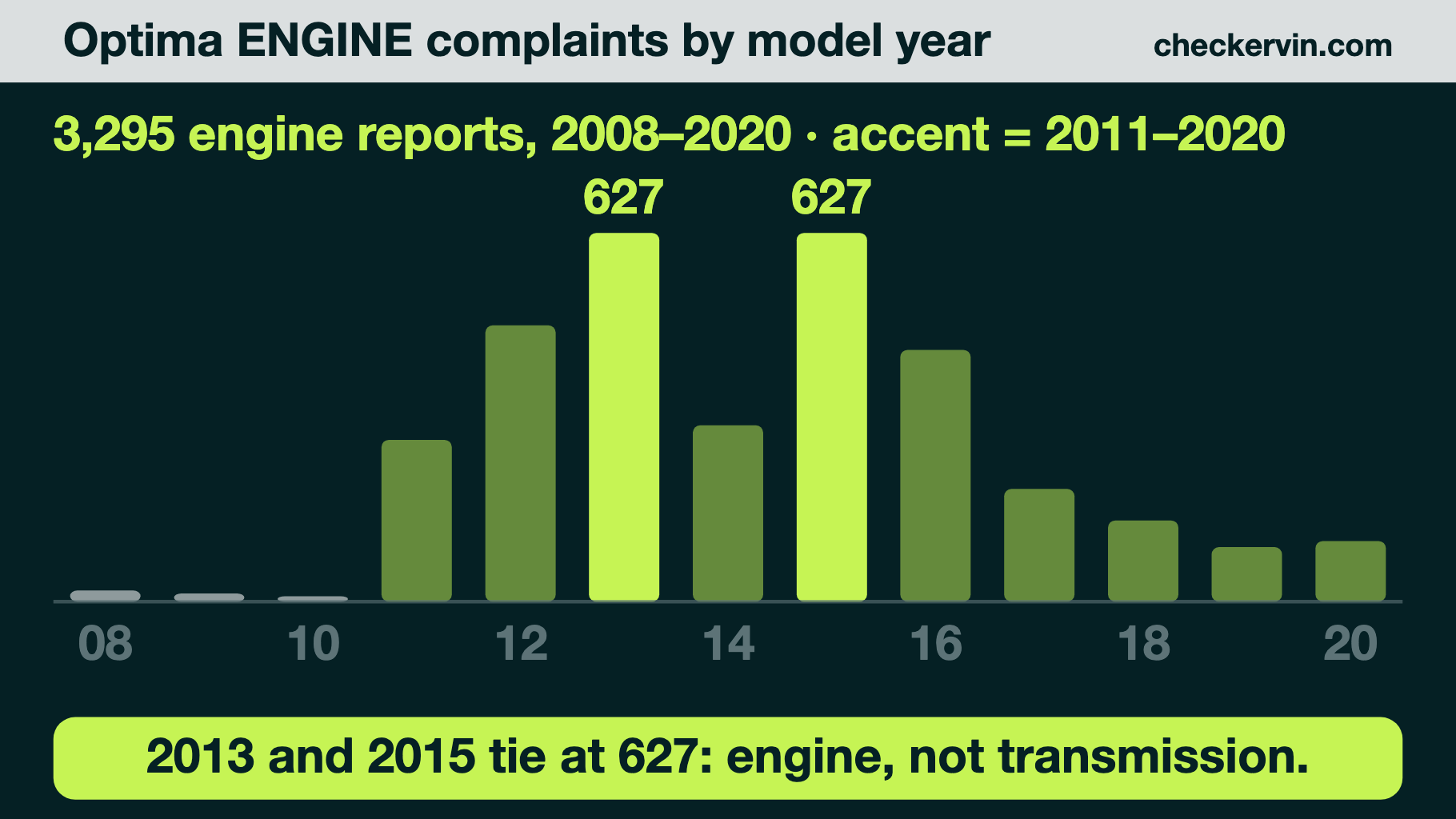
Our corpus of federal NHTSA complaints holds 6,756 reports against the 2008–2020Optima. POWER TRAIN, the category that covers the transmission, cracks the model year’s own top-five complaint categories in only 7 of those 13 years. ENGINE cracks the top five in every single one of them, and ranks as the single most-reported category of any kind in 10 of 13 years, concentrated almost entirely after 2010.
That is not a subtle tilt. ENGINE accounts for 48.8% of every complaint the nameplate has ever drawn — 3,295 of 6,756— while POWER TRAIN’s total across the 7 years it even appears in the top five comes to 226 reports, combined. Someone pricing a transmission fluid change on this nameplate is pricing the quieter of the two categories by a wide margin.
The category that actually dominates
The break lines up with a specific engine change. Kia introduced the Theta II 2.4-liter GDI four-cylinder into the Optima around the 2011 model year. From 2011 through 2020, ENGINE ranks #1 in 10 of those 10model years — every one of them, with no exception. The busiest years, 2013 and 2015, tied at 627 engine complaints each; in 2013 that was 43.5% of the year’s 1,442 total complaints.
Before that engine arrived, the pattern was different. POWER TRAIN was actually the Optima’s #1 complaint category in 2009 and 2010— a clean reversal the record shows plainly rather than one we are smoothing over. Complaints are unverified owner reports, not a measured defect rate, and a car that sold more units in some years will naturally draw more reports in those years. The concentration is still the figure worth knowing before paying for a transmission service on this specific nameplate.
What's left when the engine is set aside
Our underlying data records each model year’s top five complaint categories, not a full category-by-category count for every year. That means for the 6 years where POWER TRAIN does not appear at all, we can say it fell outside that year’s top five — not the exact number behind it. We are stating that limit plainly rather than guessing a figure to fill the gap.
What the record does show cleanly: since 2011, POWER TRAIN cracks the top five in only 4 of 10 years, sitting in 4th place in three of them. Its single best showing in that span is 2nd place, in 2020— and ENGINE still outranks it that same year. Across every year POWER TRAIN does crack the top five at all, its combined total — 226reports — is less than half of what ENGINE drew in 2013alone. A transmission fluid change is still a reasonable maintenance item on its own merits. It is just not the repair this nameplate’s complaint history is actually about.
Recall 17V-224: the connecting-rod bearing
Kia’s recall 17V-224 covers 2011–2014 model year Optima vehicles for a defect in the Theta II engine’s connecting-rod bearings: manufacturing debris can restrict oil flow to the bearing, leading to premature wear, eventual bearing failure, and a stalled or seized engine — with some reports describing a fire risk. One secondary source cites a recall population of 443,825 MY2011–2014 Optimas. This page attributes that figure to that source rather than independently confirming it: direct fetch to NHTSA’s own recall systems failed from this environment with a connection error, verified against a positive-control fetch that succeeded in the same session, so the absence is an environment limitation, not a finding about the recall itself.
| What | What's reported about it |
|---|---|
| Recall 17V-224 | 2011-2014 Optima; connecting-rod bearing debris restricts oil flow |
| Risk described | Premature bearing wear, failure, engine stall or seizure; fire risk in some reports |
| How to check | Enter the VIN at nhtsa.gov/recalls — the only way to confirm a specific car |
The settlement, and why its status is disputed
A separate class-action settlement covers Theta II 2.0-liter and 2.4-liter GDI engines more broadly. The sources checked for this post do not agree on the exact scope: one summary lists 2011–2018 (and some 2019) Optima vehicles as eligible under the gas-engine settlement, while a separate list names the Optima Hybrid specifically for 2011–2016 — a different powertrain, not assumed interchangeable with the gas Theta II here. Reported benefits include a lifetime warranty on the engine’s short-block assembly for connecting-rod bearing failure once a free Knock Sensor Detection System software update is installed.
Does this transmission even get a scheduled change
Kia’s own maintenance-schedule language, as summarized in search results for this post (not opened directly, per the environment limitation noted above), marks automatic transmission fluid as requiring no scheduled service under the normal-use table for several recent Kia engines, with a separate severe-duty table listing a mileage figure instead. One third-party shop-data site lists Kia SP-IV-M fluid (Hyundai part 04500-00F00) for the 2011–2015 Optima’s 2.4-liter four-cylinder on a 60,000-mile interval — but that same site flags its own figure as estimated, not verified against a factory document. A RepairPal forum reply describes the same pattern in different words: no normal-schedule interval, severe duty suggests 60,000 miles.
The honest answer is that there is no single number to quote for every Optima. The exact year, engine and transmission determine whether a fluid change is due at all, and the owner’s manual for that specific car, not a search result, is the document that settles it.
What actually needs a same-day stop
- Knocking, rattling or a check-engine light from a 2011-2014 Optima with the 2.4L engine — the pattern the connecting-rod bearing recall describes, not a transmission symptom
- A sudden loss of power, stalling or an unusual smell while driving — stop and have it checked rather than continuing to a scheduled fluid-change appointment
- Harsh, delayed or slipping shifts with no engine warning present — the case where the transmission itself is the more likely cause
- A fluid leak or visibly low, discolored transmission fluid — a reason to check sooner than any mileage interval, regardless of what the manual's normal table says
The first two symptoms point at the engine, which this nameplate’s own record says is the more common and more serious category by a wide margin. Treating every warning light as a transmission problem risks paying for the wrong repair.
Before you authorize the service
- Confirm the exact model year and engine by VIN before assuming a flat estimator price applies
- Check whether recall 17V-224 or a Theta II settlement benefit has ever applied to this specific vehicle
- Pull the VIN's open recalls before paying for anything a recall might already cover
- Ask the shop whether this is a change or a flush — dealers describe them as meaningfully different prices
- Get the quote itemized: fluid type and spec, quantity, and labor, not one flat-rate line
If you are buying the Optima, not maintaining it
The same record works as a shopping map. A 2011–2014 Optima sits inside recall 17V-224’s own window and may carry a disputed settlement benefit — worth checking by VIN before you negotiate, not after. A Kia VIN decode confirms the exact model year and engine, and checking whether an engine warranty extension applies to that VIN settles whether a knocking or stalling complaint might already be someone else’s responsibility to fix.
On any candidate car, run a recall lookup by VIN before you price anything, and look at which Optima model years draw the most complaints overall rather than judging the nameplate by the transmission-fluid question alone — on this car, that is not where the record says the risk actually sits.
Where this information comes from
- NHTSA — Kia Optima complaints and recallsThe federal complaint and recall record this page's figures are computed from, browsable by model year.
- NHTSA — recalls by VINThe official lookup that confirms whether a specific Optima has recall 17V-224, or any other campaign, still open.
- YourMechanic — Kia Optima transmission fluid service estimateThe $168 average quoted above ($73 parts, $95 labor), as summarized in search results retrieved November 13, 2026.
- Kelley Blue Book — Optima transmission fluid change, by model yearThe ZIP-specific fair-repair ranges quoted above; KBB publishes a separate page per model year, each tied to one location.
- SafetyResearch.net — Hyundai-Kia Theta II engine problem historyIndependent safety-research summary of the Theta II connecting-rod bearing defect and NHTSA's civil penalty against Hyundai-Kia, as served in search.
- Top Class Actions — Kia engine failure class-action settlementThe disputed eligibility window and settlement-benefit summary quoted above; verify current terms with the administrator directly.
Keep reading
Frequently asked questions
How much does it cost to change the transmission fluid in a Kia Optima?
YourMechanic's average is $168 ($73 parts, $95 labor). KBB's ZIP-specific fair-repair ranges run from $279-$369 for a 2019 Optima near Columbus, Ohio to $312-$394 for a 2015 Optima near Homewood, Illinois — each tied to one location, not a national figure. One Kia dealer's own service page notes a plain fluid change ordinarily costs about half what a full flush does, since it uses less fluid and less time. KBB's own advice is to check the owner's manual first, since some newer Kia transmissions are designed not to need a fluid change at all absent a leak or a problem.
Does the Kia Optima's transmission actually need a scheduled fluid change?
Not always, and not on a fixed mileage you can quote from memory. Kia's own owner's-manual language (as summarized in search results, not opened directly in this session) marks automatic transmission fluid as requiring no scheduled service under the normal-conditions table on several recent engines, while a severe-duty table lists a mileage mark instead. A third-party shop-data site lists Kia SP-IV-M fluid on a 60,000-mile interval for the 2011-2015 Optima's 2.4-liter four-cylinder — but flags that figure itself as estimated, not verified. The honest answer is to check the specific year and engine's own manual table, not a flat number from a search result.
Which Kia Optima model years show the most transmission complaints?
Not many years, and not large numbers. Computed from src/data/models/kia-optima.json, POWER TRAIN — the category covering the transmission — cracks the model year's own top-five complaint categories in only 7 of the Optima's 13 model years, totaling 226 reports across those years combined. It was actually the single most-reported category twice, in 2009 and 2010 — before the Theta II engine arrived. From 2011 onward its best showing is 2nd place, in 2020 — and ENGINE still outranks it that same year.
Is the Kia Optima's engine more of a risk than its transmission?
By a wide margin, in the federal complaint record. ENGINE ranks as the single most-reported complaint category in every one of the 10 model years from 2011 through 2020 — 10 of 10, no exceptions — and accounts for 48.8% of the Optima's entire 6,756-complaint record going back to 2008. The 2013 model year alone drew 627 engine complaints, 43.5% of that year's total. That timing lines up with the Theta II 2.4-liter GDI engine entering the Optima lineup and the connecting-rod bearing defect behind Kia's recall 17V-224.
Is my Kia Optima covered by the Kia engine recall or class-action settlement?
Possibly, but check by VIN rather than assuming. Kia's recall 17V-224 covers 2011-2014 model year Optimas for a Theta II connecting-rod bearing defect. A related class-action settlement over Theta II engines is reported with inconsistent eligibility windows across sources — one lists 2011-2018 (and some 2019) Optima vehicles, a separate list covers the Optima Hybrid for 2011-2016 specifically, which is a different powertrain. Reported final-approval dates also disagree by source. Check the VIN at nhtsa.gov/recalls and verify current terms with the settlement administrator before assuming either applies — or doesn't.
Check the recalls before you price the fluid change
A free CheckerVIN report shows the factory build, specifications and open recalls for any VIN — confirm what you're actually dealing with first.
Run a free VIN check