The short answer
- What does it cost?
- KBB's regional fair-repair ranges run roughly $275-$449 across sampled model years and ZIP codes.
- Does the Santa Fe have a transmission problem?
- Power train ranks as the single largest complaint category in exactly three model years — 2010, 2021 and 2022 — each tied to a separate, real NHTSA recall.
- What fluid does it take?
- Hyundai SP-IV for the 2010-era 2.4L automatic, per an owner's-manual mirror. The 2021-2022 8-speed DCT's exact spec is unconfirmed here.
What the service actually costs
Kelley Blue Book publishes a fair-repair range by Santa Fe model year, trim and ZIP code rather than one flat number. Sampled figures run roughly $275 to $449 across several older Santa Fe and Santa Fe Sport model years, and $306 to $444 for recent Santa Fe Hybrid years. KBB’s own general guidance separately notes that a high-pressure flush typically costs more than a straight drain-and-fill, and has fallen out of favor with some shops because it can dislodge debris in an older transmission. None of these numbers is ours — we sell VIN checks, not repairs, and price nothing here ourselves — so treat every figure in this post as attributed to whoever published it.
A flat estimator price also doesn’t say whether the specific Santa Fe you’re pricing sits on the quiet side of this nameplate’s complaint record or the loud side. As the next section shows, that is not spread evenly across the fifteen model years on file — it concentrates in exactly three of them.
What 6,460 complaints say about the Santa Fe's transmission
Our corpus of federal NHTSA complaints holds 6,460 reports against the 2008–2022 Hyundai Santa Fe. POWER TRAIN names 612 of them — 9.5% of the entire record. Spread across fifteen model years, that would be unremarkable. It isn’t spread that way.
In exactly three model years, power train is not merely elevated — it is the single largest complaint category NHTSA tracks for that year, ahead of engine, electrical, steering, everything. Every other model year either leaves power train out of the year’s own top five entirely or never ranks it better thansecond place. Those three years hold 39.5% of every power-train complaint this corpus has ever recorded for the nameplate, averaging a 34% share of their own year’s complaints against 6.4% across the other twelve years combined — roughly 5.3x the rate.
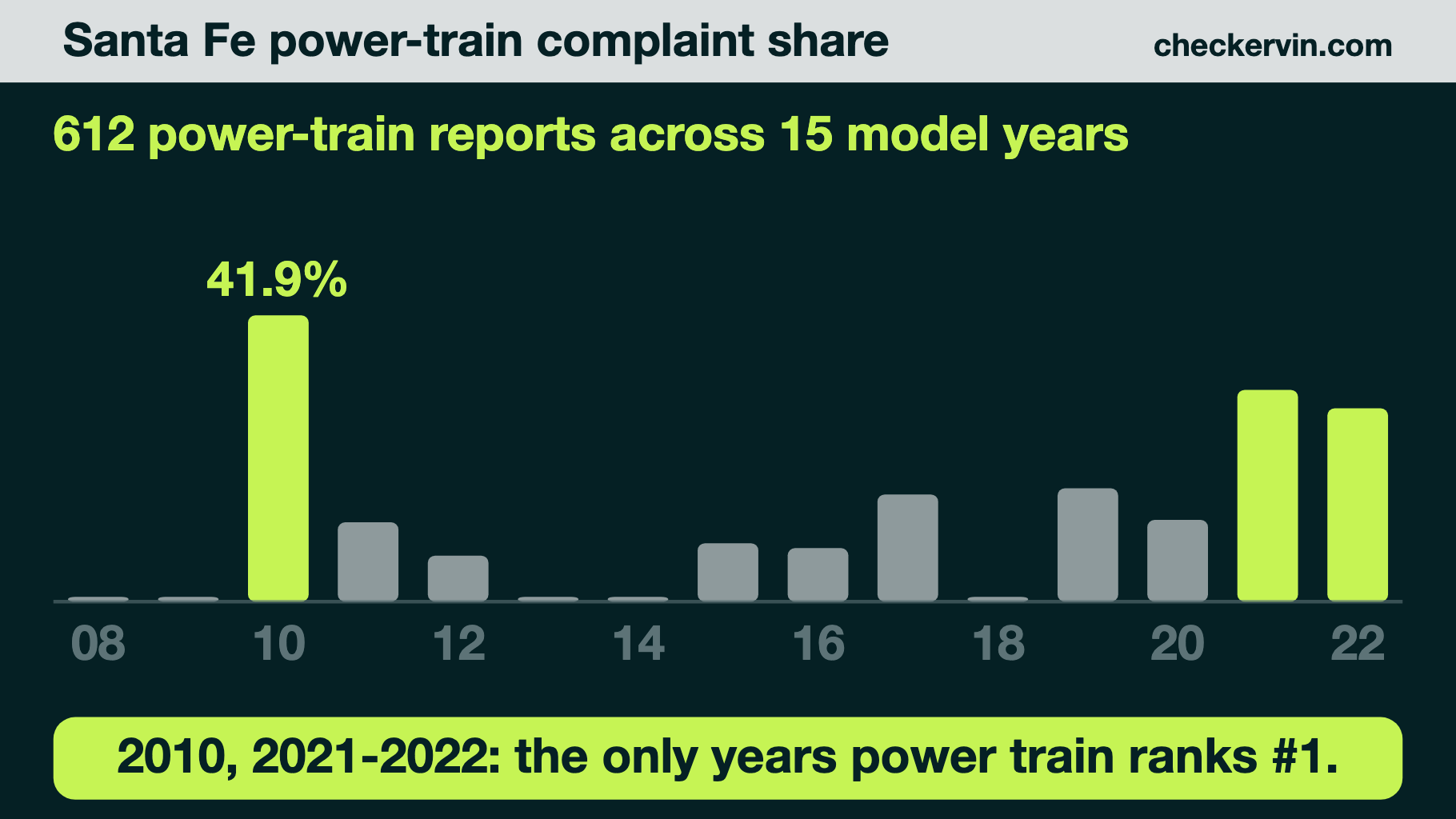
The three years power train leads
| Model year | Power-train share of that year's complaints |
|---|---|
| 2010 | 41.9% (109 of 260, rank 1) |
| 2021 | 31% (58 of 187, rank 1) |
| 2022 | 28.3% (75 of 265, rank 1) |
These are not three consecutive years — 2010 sits alone, a full decade before 2021 and 2022 arrive back to back. That separation matters: it means two different, unrelated transmission stories happen to show up as the same pattern in our data, not one long-running defect. The next two sections take them one at a time.
All three flagged years also carry total complaint counts below the nameplate’s own 339-complaint median model year — worth naming plainly, since a sharp share on a smaller base is a real pattern but not the same thing as a high absolute count.
2010: a driveshaft recall, not a gearbox one
A real NHTSA safety recall, campaign 11V261000, covers 2010 Santa Fe 2WD models with the 2.4-liter engine and an automatic transmission, built between October 15, 2009 and March 5, 2010. The defect named in the filing is the intermediate driveshaft, and the filing’s own stated consequence of driving on it is specific: it can produce a whirring or whining noise, and continuing to drive “can eventually damage the automatic transmission.” That is a recall that starts outside the transmission and can end up costing one, which lines up with owner complaints describing harsh or loud shifting and, in some reports, a transmission that failed outright.
The recall’s own build window is narrow — 2WD, 2.4L, five and a half months of production — and it does not cover 2010 Santa Fe models built with all-wheel drive or the V6 engine. An owner with a transmission complaint on one of those configurations is describing something this specific campaign doesn’t reach.
2021-2022: a real 8-speed DCT recall
A separate, unrelated real NHTSA recall, campaign 22V746, covers 2021-2022 Santa Fe (the TMa generation) with the 2.5-liter turbo engine and 8-speed dual-clutch transmission. The defect: a transmission oil-pump malfunction can trigger an improper fail-safe response, which one recall filing describes as a total loss of propulsion. Hyundai’s remedy is a TCU software update, with a full transmission replacement required only if the malfunction indicator light is on with a specific stored diagnostic trouble code.
Two further Santa Fe-specific technical service bulletins from the same window, located via WebSearch, describe a related family of symptoms on the same 8-speed DCT: an intermittent shift bump, hesitation during low-speed acceleration, and judder with the idle-stop system engaged. Each bulletin’s remedy is the same kind of fix — an ECU/TCU software update — rather than hardware. None of these bulletins or the recall itself were opened as primary PDFs in this session; both are attributed to the WebSearch results that located and described them, not asserted as independently re-verified.
The ten quiet years in between
Outside the three flagged years, power train is a minor character in the Santa Fe’s complaint record. FUEL/PROPULSION SYSTEM leads the 2008 and 2009 model years, and ENGINE leads every one of the other ten— a separate, already well-documented Hyundai story tied to the Theta engine family, not this post’s subject and not repeated here. The point for a transmission-fluid question specifically: across the other 12model years on either side of this post’s three flagged ones, power train is rarely what owners are reporting at all.
SP-IV, and an unconfirmed newer spec
For the 2010-era Santa Fe’s 2.4-liter automatic, an owner’s-manual mirror lists Hyundai SP-IV automatic transaxle fluid, roughly 7.5 US quarts, with Michang- and SK-branded SP-IV named as approved equivalents alongside Hyundai’s own genuine fluid. The same specification appears to carry into the 2012 manual as well, based on the same mirror.
| Generation | What we could confirm |
|---|---|
| 2010-era 2.4L automatic | Hyundai SP-IV ATF, ~7.5 US qt, per an owner's-manual mirror |
| 2021-2022 2.5T 8-speed DCT | Not confirmed in this session — a dual-clutch unit typically takes its own specific fluid, not standard ATF |
How often the fluid should be changed under normal use is a separate, disputed question we could not settle against a document opened directly in this session. Hyundai’s own current online manual pages instruct owners to use only the fluid and interval named in that specific VIN’s own “Recommended lubricants and capacities” section, which is the better authority than any third-party estimate here. Confirm both the fluid and the interval against your own VIN’s documentation before paying for anything.
The busiest year wasn't a transmission year
It would be easy to read the three flagged years as the Santa Fe’s worst model years overall. The record doesn’t support that. The nameplate’s single busiest complaint year across the full fifteen-year span is actually 2017, with 1,326total complaints — more than any of 2010, 2021 or 2022. 2017’s leading category is engine, at 857 complaints, not power train.
The point of naming this plainly: this page is about the transmission-fluid question specifically, and the record shows three real, dated years each independently corroborated by a separate federal recall — not a claim that the Santa Fe’s overall complaint volume always traces back to the transmission.
What an actual transmission problem looks like, if it shows up
- A whirring or whining noise that gets louder over time, especially on a 2010 model — the symptom named in recall 11V261000
- A sudden drop into a limited-power or fail-safe mode on a 2021-2022 model with the 2.5T and 8-speed DCT — the symptom named in recall 22V746
- An intermittent bump, hesitation on light throttle, or judder with the engine idle-stop system engaged
- Harsh or delayed engagement shifting from Park or Reverse into Drive
None of these symptoms are unique to the Santa Fe — several are the general signs any automatic transmission gives before a repair gets expensive. The order that matters is cheap first: confirm the exact model year and build date by VIN, check for an open recall, then get a fluid condition check, before anyone prices a repair beyond a routine service.
Before you authorize the service
- Confirm the exact model year, engine and transmission by VIN — the two flagged recalls are each scoped to a specific build window
- On a 2010 model, check whether recall 11V261000 was completed before assuming the noise is unrelated
- On a 2021-2022 2.5T model, check whether recall 22V746 was completed before paying for fail-safe-mode diagnosis
- Confirm the correct fluid spec for your exact VIN rather than assuming the 2010-era SP-IV applies to a newer 8-speed DCT
- Get the quote itemized — fluid brand, quantity and labor — not a single flat-rate line
If you're buying the Santa Fe, not maintaining it
The same record reads as a specific, dated caution rather than a blanket one. A Hyundai VIN decodeconfirms the exact model year, engine and build date — worth knowing before you assume a used Santa Fe falls inside or outside either flagged window, since the complaint record on either side looks nothing alike. A Santa Fe from outside 2010 and 2021-2022 carries a far lower power-train complaint share in our corpus.
That is one category, not the whole SUV. Run the Hyundai recall lookupon any candidate VIN before you negotiate — recalls run on their own schedule, independent of the complaint pattern above — and see which Santa Fe model years the full record flags across every component, not just the transmission. More generally, the VIN, not the badge, decides which transmission fluid an SUV actually takes, exactly as this post found on the Santa Fe specifically.
Where this information comes from
- NHTSA — Santa Fe complaint databaseThe federal complaint record this page's figures are computed from, browsable by model year.
- NHTSA — recalls by VINThe official lookup to confirm either real campaign named above, or any other, on a specific Santa Fe VIN.
- NHTSA recall 22V746 — manufacturer's reportThe 2021-2022 Santa Fe 8-speed DCT oil-pump fail-safe defect and TCU software remedy named above.
- Kelley Blue Book — Santa Fe transmission fluid changeThe regional fair-repair ranges quoted above, retrieved via search November 2026.
Keep reading
Frequently asked questions
How much does it cost to change the transmission fluid in a Hyundai Santa Fe?
Kelley Blue Book's fair-repair ranges, sampled across several model years and ZIP codes, run roughly $275-$449 for older Santa Fe and Santa Fe Sport model years and $306-$444 for recent Santa Fe Hybrid model years. KBB itself notes these figures vary by location and that a flush typically costs more than a straight drain-and-fill. None of these numbers is ours — we sell VIN checks, not repairs — so treat every figure here as attributed to whoever published it.
What transmission fluid does a Hyundai Santa Fe take?
For the 2010-era 2.4L automatic, an owner's manual mirror names Hyundai SP-IV automatic transaxle fluid (about 7.5 US quarts), with Michang and SK-branded SP-IV listed as approved equivalents alongside Hyundai's own genuine fluid. We could not confirm the exact fluid specification for the 2021-2022 8-speed dual-clutch transmission in this session — a dual-clutch unit commonly uses its own specific fluid rather than standard torque-converter ATF, so confirm the correct spec against your own VIN's documentation before a shop adds anything.
Which Hyundai Santa Fe model years show the most power-train complaints?
Computed from src/data/models/hyundai-santa-fe.json: across the 2008-2022 span, POWER TRAIN ranks as the single largest complaint category of any kind — ahead of engine, electrical, everything — in exactly three model years: 2010 (41.9% of that year's complaints), 2021 (31%) and 2022 (28.3%). Every other model year either leaves power train out of the top five entirely or never ranks it better than second. Those three years alone hold 39.5% of every power-train complaint this corpus has ever recorded for the nameplate.
Does the Hyundai Santa Fe have transmission problems?
Its own federal complaint record flags three specific, non-consecutive model years, and two separate real NHTSA recalls independently corroborate them: 11V261000 for a 2010 intermediate-driveshaft defect that NHTSA's own filing says can eventually damage the automatic transmission, and 22V746 for a 2021-2022 8-speed DCT oil-pump malfunction that can trigger an improper fail-safe reaction. The nameplate's single busiest complaint year overall is actually 2017 (1,326 complaints), led by engine, not power train — a separate story. Complaints are unverified owner reports, not a measured failure rate, so this describes a documented, dated pattern worth asking about, not a guaranteed defect in any individual SUV.
How often should a Santa Fe's transmission fluid actually be changed?
Sources disagree and we could not confirm Hyundai's current factory-stated interval against a document opened directly in this session. One secondary source cites roughly 90,000 miles as typical of many owner's manuals generally, which is not Hyundai-specific. Hyundai's own current online manual pages instruct owners to use only the fluid and interval in that specific VIN's 'Recommended lubricants and capacities' section and to have the fluid changed by a dealer on the maintenance schedule — which is the better authority than any third-party estimate here.
Confirm the recalls before you price the service
A free CheckerVIN report shows the factory build, specifications and open recalls for any VIN — confirm what you're actually pricing.
Run a free VIN check