The short answer
- What does it cost?
- RepairPal's 2017 page lists $171-$202; its 2021 page lists a close $170-$200. KBB's localized ranges for nearby years run higher, $281-$389.
- Is there a recall on the transmission?
- Hyundai opened Service Campaign 963 / TSB 20-01-047H for 2020-model-year Elantras — an ECU/TCU software update with IVT replacement where needed, not a lawsuit.
- Which year carries the power-train history?
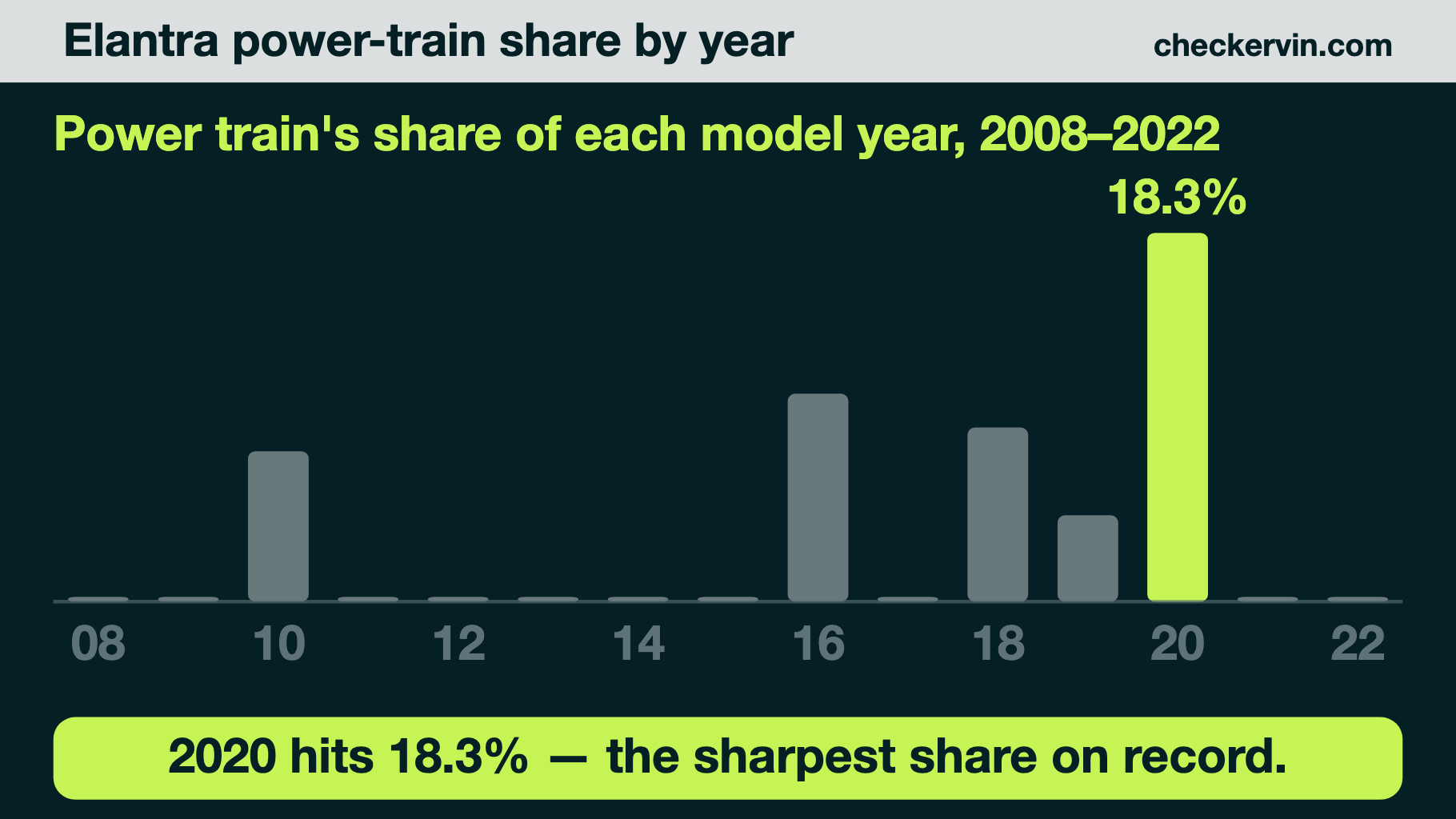
- 2020 alone. POWER TRAIN cracks the model year's own top-5 in only 5 of 15 years and never ranks above third in four of them — 2020 is the single year it reaches #2.
The numbers, and whose numbers they are
RepairPal’s 2017 Elantra page lists a transmission fluid change at $171 to $202; its 2021 page lists a close $170 to $200 — a figure that holds roughly steady whichever model year you look up. KBB’s zip-code-specific fair-repair ranges for nearby years run meaningfully higher, from about $281–$351 for a 2018 to $325–$389 for a 2019, which reflects local labor rates rather than a different job. Every figure here is attributed to whoever published it; we sell VIN checks, not repairs, and price none of this ourselves.
A flat estimator price also does not tell you which transmission is actually under the hood, and on this nameplate that is not a small distinction — the fluid spec, the service philosophy and, as the record below shows, the complaint history all break at one specific model year.
What 6,455 complaints say about one year
Our corpus of federal NHTSA complaints holds 6,455 reports against the 2008–2022 Elantra. POWER TRAIN names 153of them across the whole span — a small share of the total — and it is not spread evenly across the fifteen years. It cracks that year’s own top-5 complaint categories in only 5 of them: 2010 (#5, 7.5%), 2016 (#3, 10.3%), 2018 (#4, 8.7%), 2019 (#5, 4.3%) — and 2020.
2020 is different in kind, not just degree. In the four other years that crack the top 5, POWER TRAIN never ranks higher than third. In 2020 it ranks #2— the single best-ranking appearance POWER TRAIN makes anywhere in the 15-year record — at 48 of 262 complaints that year, 18.3%. The next-best share anywhere in the other fourteen years is 2016’s 10.3%, meaning 2020 runs nearly double the rate of every year outside it that managed to crack the top 5 at all. The record also lists 3 recall campaigns against the 2020 model year, worth checking by VIN before pricing anything.
The campaign Hyundai itself opened on this exact year
2020 is also the model year Hyundai replaced the Elantra’s conventional 6-speed automatic with the IVT, its name for a continuously variable transmission. Secondary aggregation of NHTSA’s technical-service-bulletin filings (carcomplaints.com, vehicleflaws.com and au7o.io each describe it independently) reports Hyundai’s Service Campaign 963, formalized as Technical Service Bulletin 20-01-047H, hosted on NHTSA’s site as bulletin MC-10185430-0001 and dated December 2020. It covers 2020 model-year 2.0L Elantra (AD/ADa) vehicles that may trigger an illuminated check-engine light, with a remedy of an ECU/TCU software update and, where the fault persists, replacement of the IVT unit. The aggregated sources list specific trigger codes: TCU codes P0730, P0731, P0741, P0867 and P1603, alongside ECU codes P0106, P0068 and P0101.
What makes this worth stating plainly: the bulletin’s stated model year and the complaint record’s actual spike year are the same single year, 2020. That is not always true in this series — a comparable service bulletin covered elsewhere has named a multi-year window that did not line up with where the underlying complaint record actually concentrated. Here, the two agree.
The lawsuit this isn't
Searching for an Elantra class action does turn up a real, settled case — but it is not about the transmission. Brown, et al., v. Hyundai Motor America, in the U.S. District Court for the District of New Jersey, covers 2011–2016 Hyundai Elantra, 2013 Elantra GT and 2013 Elantra Coupe vehicles factory equipped with the 1.8-liter Nu engine, over piston and engine problems. No search result checked for this post identifies a class action litigating the Elantra’s IVT or 6-speed transmission specifically.
| Case or action | What it actually covers |
|---|---|
| Brown v. Hyundai Motor America | 1.8L Nu engine piston defect, 2011-2016 Elantra/Elantra GT/Coupe |
| Service Campaign 963 / TSB 20-01-047H | 2020-model-year IVT: ECU/TCU software update, IVT replacement if needed |
| Elantra IVT/6-speed hardware | No verified class action found |
SP4-M, then SP-CVT1 — the fluid changed too
The fluid split follows the same 2020 line as the complaint pattern. Pre-2020 Elantras, running the 6-speed automatic, are documented to Hyundai’s SP4-M specification in parts and forum sourcing, with SP-IV-compliant fluid widely reported as a working substitute for the same transmission family. The 2020 and later IVT calls for a different specification, SP-CVT1 — not interchangeable with SP4-M, and exactly the kind of mix-up a flat “Elantra transmission fluid change” search result does not warn against. Neither figure was confirmed here against a Hyundai-published owner’s manual; both are attributed to parts-retailer and forum sourcing retrieved via live search.
'No service required' is Hyundai's position, not the only one
Hyundai’s owner’s-manual maintenance tables checked for this post list the IVT fluid under “no check, no service required,” with one stated exception: a change is called for if the transmission has been submerged in water. No source checked for this post identifies an official Hyundai-published mileage interval contradicting that for the IVT specifically. One pricing website claims independent mechanics disagree and treats the IVT as more service-sensitive than Hyundai states, but it offers no supporting evidence and its specific figures did not match the other sources checked, so it is named here rather than quietly relied on.
The 2021-2022 redesign: too new to call
The Elantra was redesigned onto a new platform for the 2021 model year, and that redesign also uses a CVT Hyundai again brands as an IVT. In our own record, 2021 and 2022 show no POWER TRAIN complaints inside either year’s own top-5 categories, across both years combined. That is not evidence the redesign fixed anything: 2021 and 2022 are the two newest model years in the corpus, with far less time on the road to accumulate a complaint history than 2020 has had, and this page does not treat an absence of data as a finding the way it treats the 2020 spike as one.
What an IVT fault looks like before it costs anything
- An illuminated check-engine light, the symptom Service Campaign 963 specifically targets
- Hesitation, slipping or a delayed response between acceleration and the engine actually revving up
- A shudder or droning sound under light throttle, common to CVT-style transmissions generally
- Any dash message about the transmission even after a software update has reportedly already been performed
The order matters because the cheap check comes first: confirm the exact model year by VIN, verify whether Service Campaign 963 has already been performed, and pull the vehicle’s open recalls — before anyone prices an IVT replacement beyond a routine fluid service.
Before you authorize the service
- Confirm the exact model year by VIN — the transmission, the fluid spec and the complaint history all break at the 2020 model year
- Confirm the shop is using SP-CVT1 on a 2020-or-later IVT, not SP4-M — the two are not interchangeable
- Ask whether Service Campaign 963 / TSB 20-01-047H has already been performed on this specific VIN
- Pull the VIN's open recalls before paying for anything that might already be covered
- Get the quote itemized — fluid brand, quantity and labor — not a single flat-rate line
If you are buying the Elantra, not maintaining it
The same record reads as a shopping map. A 2020 Elantra carries both the sharpest power-train complaint share in the corpus and the open question of whether Service Campaign 963 was ever performed — two separate things worth checking on the same car. A Hyundai VIN decode confirms the exact model year before you price a service or believe a forum claim about “the IVT lawsuit,” and the Hyundai recall check confirms whether that specific VIN still shows an open campaign.
Before you decode anything, a free transmission fluid lookup by VIN returns the factory-spec fluid for the exact car, which settles the SP4-M-versus-SP-CVT1 question without guessing from the model year alone. And check which Elantra model years show the most complaints overall rather than judging the nameplate by the power-train figure by itself — the 2010-2019 years outside 2020 show a materially lighter power-train record, and a documented software campaign is cheaper than the negotiation it takes to discount around a year that predates it.
Where this information comes from
- NHTSA — Elantra complaint databaseThe federal complaint record this page's figures are computed from, browsable by model year.
- NHTSA — Technical Service Bulletin MC-10185430-0001The NHTSA-hosted filing of Hyundai's Service Campaign 963 / TSB 20-01-047H, cited above via secondary aggregation.
- NHTSA — recalls by VINThe official lookup that confirms whether a specific Elantra's Service Campaign 963 was completed.
- Class action tracker — Brown v. Hyundai Motor AmericaBackground on the Elantra's one verified class settlement, over the 1.8L Nu engine's piston defect, cited above.
- RepairPal — 2017 Hyundai Elantra transmission fluid change estimateThe $171-$202 figure quoted above, retrieved via search November 2026.
Keep reading
Frequently asked questions
How much does it cost to change the transmission fluid in a Hyundai Elantra?
RepairPal's 2017 model-year page lists $171 to $202, and its 2021 page lists a close $170 to $200 — the figure holds steady across generations by its account. KBB's zip-code-specific fair-repair ranges for nearby years run noticeably higher, from roughly $281-$351 (2018) to $325-$389 (2019), reflecting local labor rates rather than a different part of the car. None of these figures is ours; we sell VIN checks, not repairs, and each is attributed to whoever published it rather than averaged together.
What transmission fluid does a Hyundai Elantra take?
It depends on which transmission is under the car, and that split falls at the same 2020 model year as the complaint pattern below. The pre-2020 Elantra's 6-speed automatic is documented to Hyundai's SP4-M specification (with SP-IV-compliant fluid widely reported as compatible by forum and parts-retailer sourcing). The 2020-and-later IVT (continuously variable transmission) calls for a different fluid, SP-CVT1, which is not interchangeable with the 6-speed's spec. None of this was independently confirmed against a Hyundai-published owner's manual in this session; both specs are attributed to secondary retailer and forum sourcing.
Which Hyundai Elantra model years show the most power-train complaints?
2020 — computed from src/data/models/hyundai-elantra.json. Across the nameplate's 15 model years (2008-2022), POWER TRAIN complaints crack that year's own top-5 complaint categories in only 5 years, and in four of those five it never ranks above third. 2020 is the sole exception: POWER TRAIN ranks #2 that year, 48 of 262 complaints (18.3%) — the sharpest share and the highest rank POWER TRAIN reaches anywhere in the record. 2020 is also the first model year the IVT (CVT) replaced the Elantra's conventional 6-speed automatic.
Is there a recall or lawsuit tied to the 2020 Elantra's transmission?
There is a documented Hyundai service action, not a lawsuit. Secondary aggregation (carcomplaints.com, vehicleflaws.com, au7o.io) describes Service Campaign 963 and Technical Service Bulletin 20-01-047H, hosted on NHTSA's site as bulletin MC-10185430-0001 and dated December 2020, covering 2020 model-year 2.0L Elantra (AD/ADa) vehicles for an ECU/TCU software update with IVT replacement where the fault persists. This environment could not fetch the NHTSA-hosted PDF directly to verify it independently — the fetch failed identically to a positive-control request that succeeded, pointing to a network-allowlist gap rather than a dead or fabricated bulletin. Separately, no class action specifically litigating the Elantra's transmission could be found; the one verified Elantra class settlement, Brown v. Hyundai Motor America, covers 2011-2016 models with the 1.8L Nu engine's piston defect, an unrelated system.
Is the Hyundai IVT really 'no service required'?
That is Hyundai's own documented position in the owner's-manual maintenance tables checked for this post, which list the IVT fluid as requiring no scheduled check or service outside of exceptional conditions (the manual does call for a change if the transmission has been submerged in water). We could not find a Hyundai-published source contradicting that for the IVT specifically. A pricing website claims the IVT is more service-sensitive than Hyundai states, but it cites no evidence and its specifics didn't match other sources checked, so it is not relied on here — stated plainly rather than silently dropped.
Confirm the campaign before you price the service
A free CheckerVIN report shows the factory build, specifications and open recalls for any VIN — confirm what you're actually pricing.
Run a free VIN check