The short answer
- What does it cost?
- YourMechanic averages $160; KBB's fair-repair ranges run roughly $223-$358 depending on model year and ZIP code.
- Does the Odyssey have a transmission problem?
- Power train ranks in the top three of that year's complaints for four straight model years, 2014-2017, peaking at 23.5%.
- What fluid does it take?
- Honda ATF DW-1 for both the 2014-2017 six-speed and the 2018-and-later nine-speed, per the owner's manual.
What the service actually costs
YourMechanic averages a Honda Odyssey transmission fluid service at around $160, split roughly $65 for parts and $95 for labor. Kelley Blue Book instead publishes a fair-repair range by model year and ZIP code — sampled figures run from about $223 to $358 for a 2022 Odyssey and $263 to $334 for a 2023. Nalley Honda, a Honda dealer, says a straight change or flush can run under $150 in some cases, and separately notes that a full flush uses roughly 10 quarts of fluid against a standard drain-and-fill’s smaller volume — the reason a flush typically costs more. None of these numbers is ours — we sell VIN checks, not repairs, and price nothing here ourselves — so treat every figure in this post as attributed to whoever published it, not as our quote.
A flat estimator price also does not tell you whether the van you’re pricing sits on the quiet side of this nameplate’s complaint record or the loud side. As the next section shows, that is not spread evenly — it concentrates almost entirely in four specific, consecutive model years.
What 5,243 complaints say about the Odyssey's transmission
Our corpus of federal NHTSA complaints holds 5,243 reports against the 2008–2022 Honda Odyssey. POWER TRAIN names 440 of them — 8.4% of the entire record. In five of the fifteenmodel years on file, power train does not appear among that year’s own top five complaint categories at all, and in every year outside the window below, it never ranks higher than 4th or 5th.
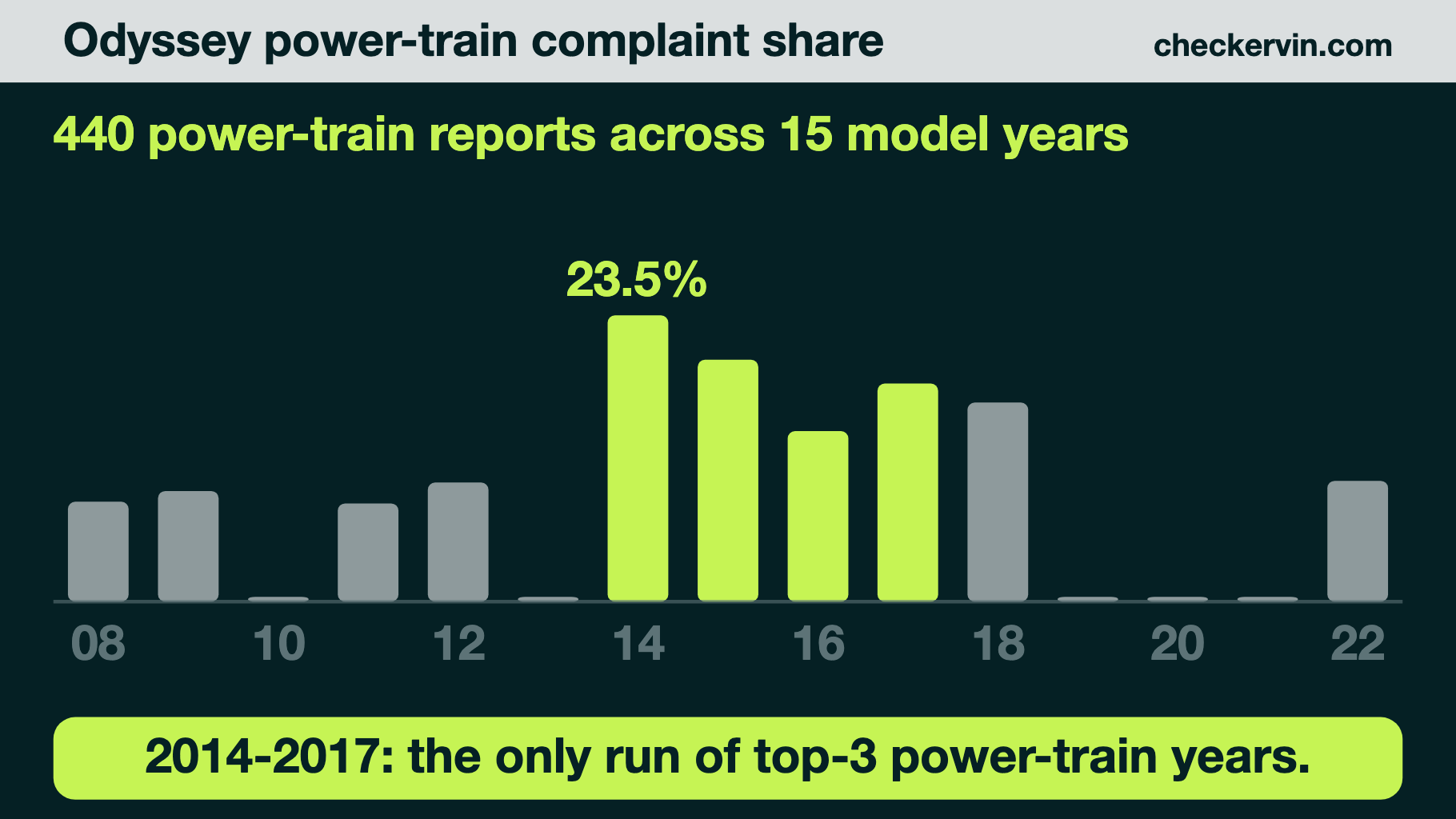
What breaks that pattern is a specific, consecutive run. In exactly four model years — 2014 through 2017 — power train ranks 1st, 2nd, 3rd and 2nd. No other run of consecutive years anywhere in the 15-year span comes close to that length or that consistency.
The four years that spike: 2014-2017
In 2014, power train names 73 of 310 total complaints — 23.5% of the entire model year, the single highest share in the corpus. The other three years in the run stay elevated too, never dropping below 14%. Together, these four consecutive model years hold 36.1% of every power-train complaint this corpus has ever recorded against the Odyssey — concentrated in just 4 of the 15 model years on file.
| Model year | Power-train share of that year's complaints |
|---|---|
| 2014 | 23.5% (73 of 310, rank 1) |
| 2015 | 19.9% (41 of 206, rank 2) |
| 2016 | 14% (38 of 271, rank 3) |
| 2017 | 17.9% (7 of 39, rank 2) |
2017carries the smallest total complaint count of the four — only 39complaints filed that model year, the smallest sample of any year in this corpus — so its 17.9% share rests on a thinner base than the others and is worth reading with that caveat attached.
What changed in 2014, and again in 2018
The run starts and ends at real transmission changes, not an arbitrary date range. The third-generation Odyssey (2011-2017) launched with a mixed lineup: a 5-speed automatic on the LX, EX and EX-L trims, and a 6-speed automatic reserved for the Touring trim only. Honda’s 2014 mid-cycle refresh made the 6-speed standard across every trim — 2014 is the first model year every Odyssey on the road shared the same automatic transmission, not just the top trim.
The run also ends where the 6-speed itself ends. The 2018 redesign replaced it with an all-new 9-speed automatic. Both boundaries of the 2014-2017window line up with a documented hardware change, which is a specific, falsifiable explanation for why the complaint concentration starts and stops precisely where it does — not proof by itself, but the clearest candidate this record offers.
What two real Honda bulletins say
Two documented Honda technical service bulletins corroborate part of this window independently of our own complaint corpus. TSB 17-043, dated June 20, 2017, is scoped explicitly to 2014–2017Odysseys and describes judder from the torque converter lock-up clutch, typically felt between 20 and 60 mph. Honda’s stated root cause is not a failed torque converter — it is transmission fluid that breaks down faster than expected under repeated high-heat driving. The interim remedy, before a software update was available, is a fluid flush: draining and refilling the transmission across three drive cycles. The bulletin separately warns against non-Honda ATF, since it can affect shift quality.
A predecessor bulletin, TSB 16-060, describes the identical judder symptom and the same deteriorated-fluid cause. Honda later revised 16-060 to apply to 2012-2013 Odysseys instead, after moving 2014-2015 vehicles into 17-043. Named plainly rather than stretched to fit: our own corpus does not show an elevated power-train share in 2012 (9.8%, rank 5) or 2013 (absent from the top five), so this page treats 16-060 as a real, documented bulletin on the same defect family, without claiming our complaint data corroborates it the way it corroborates 17-043.
A real 2018-2019 recall, a different story
A separate, genuine NHTSA safety recall, campaign 19V299000, filed April 2019, covers 2018-2019 Odyssey Touring and Touring Elite minivans. The defect: a loose battery-terminal connection or a degraded battery can cause the transmission control unit to unexpectedly reboot, which can shift the transmission into Park even though the vehicle is still moving — and repeated cycling can damage the parking rod. Honda’s remedy is to tighten the battery terminal connections and update the transmission control unit’s software for free, with a full transmission assembly replacement if the parking gear can no longer secure the vehicle on its own.
This is a different defect on a different generation — worth naming here only because it is easy to confuse with the 2014-2017 fluid story above. It is not that story. Our own corpus’s worst single complaint year, 2018 (1,007 complaints), is led by electrical system, not power train, which lines up with a battery/electrical defect rather than a transmission-fluid one.
DW-1, and a disputed interval
Honda’s own owner’s manuals for both the 2014-2017 six-speed and the 2018-and-later nine-speed name Honda ATF DW-1 as the specified fluid. A third-party parts listing separately names Honda ATF-Z1 for part of the 2011-2017 span, conflicting with the owner’s manual on the exact cutoff year — the manual is the better authority, and the exact spec for any individual VIN should be confirmed against its own documentation.
| Fluid | Where it stands |
|---|---|
| Honda ATF DW-1 | Named in the owner's manual for both the 2014-2017 and 2018+ generations |
| Honda ATF-Z1 | Named by one third-party listing for part of the 2011-2017 span; conflicts with the manual |
| Non-Honda ATF | Explicitly warned against in TSB 17-043 as a risk to shift quality |
How often it should be changed under normal use is where sources disagree, and we could not confirm Honda’s current factory-stated interval against a document opened directly in this session. Independent shop and owner advice commonly lands around 30,000 to 60,000 miles for severe service — short trips, towing, heavy stop-and-go driving — with longer intervals cited for normal use. That is a routine-maintenance question, separate from the three-cycle flush TSB 17-043 recommends as a repair for judder symptoms specifically.
The Odyssey's worst year wasn't this
It would be easy to read the 2014–2017run as proof those are simply the Odyssey’s worst model years, period. The record does not support that. The nameplate’s single heaviest complaint year across the entire 15-year span is actually 2018, with 1,007 total complaints — more than any year in the 2014-2017 run. 2018’s leading category is electrical system, at 263 complaints, not the transmission — and ties to the separate, real 2019 recall above, not to this page’s fluid story.
The point of naming this plainly: this page is about the transmission-fluid question specifically, and the record shows a real, dated, four-year concentration bounded by a documented transmission change — not a claim that the Odyssey’s overall complaint volume only ever traces back to the transmission.
What an actual transmission problem looks like, if it shows up
- A shudder or judder felt between roughly 20 and 60 mph, especially under light throttle
- A harsh or delayed engagement when shifting from Park or Reverse into Drive
- Gear hunting or flaring between gears, especially on a slight grade
- Dark or burnt-smelling fluid rather than the bright red or pink of healthy fluid
None of these symptoms are unique to the Odyssey — they are the general signs any automatic transmission gives before a repair gets expensive. The order that matters is cheap first: confirm the exact model year by VIN, then get a fluid condition check, before anyone prices a repair beyond a routine service.
Before you authorize the service
- Confirm the exact model year by VIN — the complaint run above is specific to 2014-2017
- Confirm the shop is using Honda ATF DW-1 or a confirmed equivalent, not a generic ATF
- Ask whether your dealer has applied TSB 17-043 if your symptoms match its description
- Pull the VIN's open recalls before paying for anything else, including the separate 2018-2019 campaign
- Get the quote itemized — fluid brand, quantity and labor — not a single flat-rate line
If you're buying the Odyssey, not maintaining it
The same record reads as a specific, dated caution rather than a blanket one. A Honda VIN decodeconfirms the exact model year — worth knowing before you assume a used Odyssey falls on either side of the 2014–2017 window, since the complaint record on either side of it looks nothing alike. An Odyssey from outside that window carries a far lower power-train complaint share in our corpus; one from inside it carries a documented, bulletin-corroborated pattern worth asking a seller or a pre-purchase inspector about directly.
That is one category, not the whole van. Run the recall lookupon any candidate VIN before you negotiate — recalls run on their own schedule, independent of the complaint pattern above, including the separate 2018-2019 campaign named above — and see which Odyssey model years the full record flags across every component, not just the transmission. More generally, the VIN, not the badge, decides which transmission fluid a minivan actually takes, exactly as this post found on the Odyssey specifically.
Where this information comes from
- NHTSA — Odyssey complaint databaseThe federal complaint record this page's figures are computed from, browsable by model year.
- NHTSA — recalls by VINThe official lookup to confirm either real campaign named above, or any other, on a specific Odyssey VIN.
- Honda technical service bulletin TSB 17-043 — torque converter judderScoped to 2014-2017 Odysseys, naming deteriorated transmission fluid as the stated cause, hosted on NHTSA's own TSB archive.
- YourMechanic — Odyssey transmission fluid service estimateThe $160 average figure quoted above, retrieved via search November 2026.
Keep reading
Frequently asked questions
How much does it cost to change the transmission fluid in a Honda Odyssey?
YourMechanic puts the average around $160, split roughly $65 for parts and $95 for labor. Kelley Blue Book's fair-repair ranges vary by model year and ZIP code — sampled figures run about $223-$358 for a 2022 Odyssey and $263-$334 for a 2023. Nalley Honda, a dealer source, says a straight fluid change or flush can run under $150 in some cases, and separately notes a flush uses roughly 10 quarts of fluid versus a standard drain-and-fill, which is why a flush typically costs more. None of these figures is ours — we sell VIN checks, not repairs — so treat every number here as attributed to whoever published it, not as our quote.
What transmission fluid does a Honda Odyssey take?
Honda ATF DW-1, according to the Odyssey's own owner's manuals for both the 2014-2017 six-speed generation and the 2018-and-later nine-speed generation. A third-party parts listing separately names Honda ATF-Z1 for part of the 2011-2017 span, which conflicts with the owner's manual on the exact cutoff year — treat the manual as the better authority and confirm the spec against your own VIN's documentation. Honda's own bulletin on this transmission explicitly warns that fluid not equivalent to the correct ATF specification is not a warranty-covered substitute.
Which Honda Odyssey model years show the most power-train complaints?
Computed from src/data/models/honda-odyssey.json: across the 2008-2022 span, power train ranks in that model year's own top three complaint categories in exactly four consecutive model years, 2014-2017 (ranks 1st, 2nd, 3rd and 2nd) — every other year in the corpus either ranks it 4th, 5th, or leaves it out of the top five entirely. Those four years alone hold 36.1% of every power-train complaint this corpus has ever recorded for the nameplate, peaking at 23.5% in 2014.
Does the Honda Odyssey have transmission problems?
Its own federal complaint record shows a specific, dated, four-year concentration — 2014 through 2017 — which two real Honda technical service bulletins independently corroborate for the overlapping or adjacent window, describing judder caused by transmission fluid that deteriorates faster than expected. The Odyssey's single heaviest complaint year overall is actually 2018 (1,007 complaints), led by electrical system, not the transmission — a separate, newer story tied to a real 2019 recall, not this one. Complaints are unverified owner reports, not a measured failure rate, so this describes a documented pattern worth asking about, not a guaranteed defect in any individual minivan.
How often should an Odyssey's transmission fluid actually be changed?
Sources disagree on the routine interval, and we could not confirm Honda's current factory-stated number against a document opened directly in this session. Independent shop and owner advice commonly suggests roughly every 30,000-60,000 miles for severe service (short trips, towing, heavy stop-and-go driving), with some sources describing longer intervals for normal use. Separately, Honda's own bulletin on the 2014-2017 judder issue recommends a specific interim fix — draining and refilling the fluid across three drive cycles — which is a repair procedure for that symptom, not a substitute for the routine maintenance interval. We state both rather than picking a side.
Confirm the generation before you price the service
A free CheckerVIN report shows the factory build, specifications and open recalls for any VIN — confirm what you're actually pricing.
Run a free VIN check