The short answer
- What does it cost?
- Published estimates run $162 (YourMechanic general average) to $639 (KBB, 2022 Hybrid) — attributed figures, not ours.
- Is the engine a known weak point?
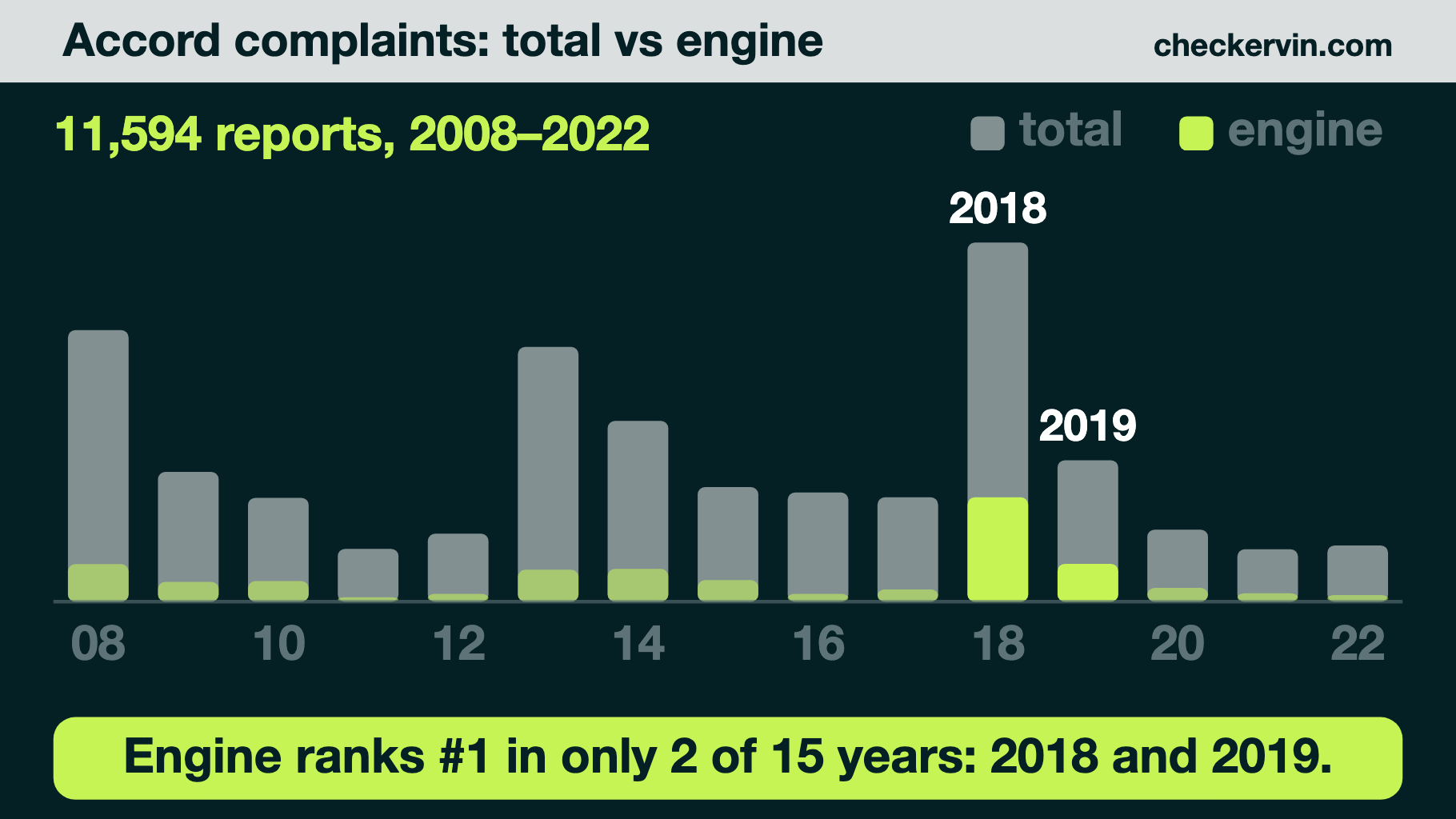
- Mostly no. ENGINE ranks #1 in that year's own top-5 in just 2 of the Accord's 15 model years: 2018 and 2019, the first two turbo years.
- Does either year have a confirmed cause?
- Neither is tied to a recall here. The one engine peak with a named cause is earlier: 2010, the pre-turbo high point, and NHTSA recall 11V004000, an ignition-circuit connector fault.
11,594
Federal complaints, 2008-2022
Full NHTSA corpus for this nameplate
17.8%
Engine's all-time share
2,059 of 11,594 complaints
2 of 15
Years engine ranks #1
2018 and 2019 — every other year ranks 2nd-4th
$162-$639
Published quote spread
YourMechanic general average to KBB's 2022 Hybrid range
The spread, and whose numbers make it
Two published figures frame this repair, and neither is ours. YourMechanic’s general Accord page averages $162 total — $22 in parts, $140 in labor. Its own worked example for a 2021 Accord with the 1.5L turbo four-cylinder runs far higher: $358.39, with a quoted shop-or-dealer range of $413.35 to $574.04. Kelley Blue Book’s ZIP-based estimator spans from $307-$394 on a 2000 Accord up to $474-$639 on a 2022 Accord Hybrid, with a 2010 Accord at $413-$485 and a 2021 at $428-$502. No RepairPal page exists for the base Accord’s spark-plug job specifically — checked directly, not assumed — so it is not cited here the way it is on this series’ RAV4 and Outback posts.
That is close to a 4-to-1 spread on a routine maintenance item, and the YourMechanic page’s own general-average-versus- worked-example gap alone is more than 2-to-1. The rest of this page checks that spread against the federal complaint record itself, not a guess about which number to trust.
What the record says, year by year
Our corpus of federal NHTSA complaints holds 11,594 reports against the 2008–2022Accord. ENGINE is a persistent category — present in the top five every single model year, never absent the way it is for some other nameplates in this series — and its all-time share is 17.8% (2,059 of 11,594 complaints).
But presence is not the same as prominence. In 13 of the Accord’s 15 model years, ENGINE ranks somewhere from 2nd to 4th among that year’s own top five categories, topping out at 20.0% of that year’s total. Only twice does it rank #1, in back-to-back years: 2018 (29.0%, the single highest share on record) and 2019 (26.8%). Those two years, plus one earlier year with a named recall, are what the rest of this page is about.
The two years that stand out, and the one with a recall
2018 and 2019are the first two model years of the 10th generation’s switch to turbocharged 1.5L and 2.0L engines, replacing the prior naturally aspirated four-cylinder. 2018carries the Accord’s highest single-year ENGINE share on record (29.0%, 584 of 2,011 complaints), and 2019 the next highest (26.8%) — new engine architectures commonly draw more complaints in their early years regardless of defect status. No recall matching the 2019 spike was found in this research, and this page ties none to 2018 either. Stated plainly: this is a bare computed fact about where complaints concentrated, not a confirmed defect finding, and it is not a spark-plug issue.
2010 is the one engine peak with a named cause. It is not a #1 year, but at 20.0% it is the highest ENGINE share of any pre-turbo model year (2008–2017), and it is corroborated by a real NHTSA campaign. Recall 11V004000, filed by American Honda and reported in January 2011, covers 2010Accord and CR-V vehicles — 2,277 of them in the U.S. — for, per secondary reporting of the notice, “a potential failure with the engine wiring harness connector which may cause intermittent spark firing or the engine to stall.” The remedy was a dealer inspection and replacement of the ignition wiring harness connector at no charge. That is an ignition-circuit fault, not the spark plugs — but it is close enough to the same system, and lands in the exact year the pre-turbo record’s ENGINE share peaks, that a 2010 Accord owner pricing a plug job should also confirm this specific campaign was completed on their VIN.
Two turbo-launch years without a named cause and one earlier year with one, kept as separate findings rather than blended into one “Accord engine problems” story — because that is what the record actually shows.
The interval, and the case for paying exactly once
Honda ships iridium-tipped plugs specifically to buy a long interval, and a Honda owner’s-manual excerpt surfaced via search is explicit that the plugs should be changed on the mileage printed in the maintenance schedule rather than any generic rule. Multiple secondary sources converge on roughly 100,000 miles for the Accord’s standard four-cylinder engines, with one source specifically citing 90,000 miles for the 1.5L turbo (with a check at 80,000 if the car tows). A “30,000 miles” figure shows up on some repair-shop marketing pages, but it is not sourced to Honda and most likely describes older copper-plug advice, not the iridium plugs Honda actually installs — worth knowing before anyone recommends changing healthy plugs early.
| Outcome | How it happens |
|---|---|
| Pay once, on schedule | Iridium plugs changed at the published ~90k-100k interval, itemized |
| Pay twice | Plugs replaced years early on generic '30k' advice, then again on schedule |
| Pay more later | Interval stretched well past spec until a misfire or coil joins the bill |
| Pay for the wrong thing | A maintenance bundle remembered — and re-quoted — as 'spark plugs' |
Where the money goes
YourMechanic’s own general split — $22 in parts against $140 in labor — is the clearest anatomy lesson available for the naturally aspirated four-cylinder: four ordinary iridium plugs against straightforward access. That is roughly a 6-to-1 labor-to- parts ratio, which is most of why the low end of the published range sits so far under KBB’s ZIP-based figures — those lean toward dealer and independent-shop labor rates rather than a flat-rate online estimate.
The 2021 1.5L-turbo worked example closes most of that gap by itself: $358.39, inside the same page that quotes $162 as the general average. The difference is the engine, covered next.
The turbo trims' different math
Every model year from 2018 forward (10th generation) runs a turbocharged 1.5L or 2.0L four-cylinder instead of the larger naturally aspirated engines used through 2017. YourMechanic’s own 2021 1.5T example — $358.39, more than double its $162 general average — is the clearest published evidence that turbo trims cost more to service, consistent with tighter underhood packaging and, on some turbo layouts, more disassembly to reach the plugs. Our complaint corpus does not separate engine variants within a model year, so this section is attributed pricing context, not a computed finding: if your Accord is a 2018 or newer turbo model, price the job against that example rather than the general average above it.
The do-it-yourself question, answered honestly
On the older naturally aspirated four-cylinders, this is a common driveway job: work when the engine is cold, follow the plug maker’s torque spec rather than guessing, and use anti-seize and dielectric grease only where the plug or coil maker specifies it. The parts-only cost is well under a hundred dollars on most years, so an afternoon with the right socket and extension saves most of the quoted labor.
On the 2018-and-newer turbo engines, factor in tighter access before assuming the same afternoon applies — the published $358.39 worked example reflects real added labor, not just a higher quote for the same job.
Before you authorize the service
- Ask for line items — separate plug labor from any bundled 90k/100k service before comparing quotes
- Confirm which engine is being quoted — naturally aspirated vs. 1.5L/2.0L turbo price differently
- On a 2010 Accord specifically, confirm NHTSA recall 11V004000 (ignition wiring harness connector) was completed before paying for a separate ignition diagnosis
- If a misfire code or rough idle triggered the visit, scan codes first — a worn plug can push failure into the ignition coil, which costs more than the plug
- Check remaining factory coverage by VIN before paying out of pocket
If you are buying the Accord, not maintaining it
The published ~90,000-100,000-mile interval turns into a simple service-history question: on an Accord past that mileage, ask when the plugs were done and expect a line item, not a shrug. On a 2010 specifically, also ask whether recall 11V004000 was completed — it is a separate repair from the plugs, but it is free, and a seller who does not know about it has not been thorough. On a 2018 or 2019, the two #1 engine years, there is no recall tied to that spike to check; weigh either the same way you would any new-engine-architecture year, on its own service history rather than on a defect campaign this research did not find.
Then read the year, not the brand story. Our Accord years-to-avoid breakdown scores every model year against the nameplate’s own median, from the same corpus this page computes from. A Honda VIN decode confirms the build and engine, and the warranty check by VIN settles what factory coverage is still attached before you price any of it into the deal.
Where this information comes from
- NHTSA — Accord complaint databaseThe federal complaint record this page's engine-share figures are computed from.
- KBB — Accord spark plug estimateThe ZIP-based $307-$639 ranges quoted above, by model year and trim.
- YourMechanic — Accord spark plug estimateThe $162 general average and the $358.39 2021 turbo example, both quoted with attribution.
- NHTSA — recalls lookup by VINConfirm whether a specific 2010 Accord VIN still shows recall 11V004000 open.
Keep reading
Frequently asked questions
How much does a Honda Accord spark plug replacement cost?
Published estimates vary widely by year and trim. YourMechanic's general average is $162 ($22 parts, $140 labor), though its own worked 2021 1.5L-turbo example runs $358.39, with a shop/dealer range of $413.35-$574.04. Kelley Blue Book's ZIP-based ranges run from about $307 (2000 model) to $639 (2022 Hybrid). Each figure is quoted with attribution; we sell VIN checks, not service.
How often should spark plugs be changed on a Honda Accord?
Honda installs iridium-tipped plugs specifically for a long interval, and a Honda owner's-manual excerpt found via search states plugs should be replaced on the mileage printed in the maintenance schedule rather than on a calendar. Multiple secondary sources put that figure near 100,000 miles for the standard four-cylinder, with one citing 90,000 miles for the 1.5L turbo. A generic '30,000 miles' figure circulating on some repair-shop sites is not sourced to Honda and likely reflects older copper-plug advice, not the iridium plugs Honda actually ships.
Does the 2010 Accord's engine complaint spike mean a recall?
Partly. 2010 is not one of the 2 model years where ENGINE complaints rank #1 (those are 2018 and 2019), but it is the high point of ENGINE's share across the Accord's pre-turbo years, 2008-2017, at 20.0% of that year's complaints. It is independently corroborated by NHTSA campaign 11V004000 (American Honda, reported January 2011): 2,277 model year 2010 Accord and CR-V vehicles recalled for a potential engine wiring harness connector failure that "may cause intermittent spark firing or the engine to stall," per secondary reporting of the notice. That is an ignition-circuit connector issue, not the spark plugs themselves, but it sits close enough to the same system that a 2010 Accord owner pricing a plug job should also confirm this recall was completed.
What about the 2018 and 2019 Accords — is that a known issue too?
They are the Accord's only #1-ranked engine years: 2018 at 29.0% (584 of 2,011 complaints, the highest share on record) and 2019 at 26.8% (212 of 792) — the first two years of the 10th generation's new 1.5L and 2.0L turbocharged engines replacing the prior naturally aspirated four-cylinder. No NHTSA recall campaign matching the 2019 spike was found in this research, and this page ties none to 2018 either. Stated plainly: it is a computed fact about where complaints concentrated in those years, not a confirmed defect finding, and it is not a spark-plug issue either.
Why does my Accord spark plug quote vary so much between shops?
Three things stack: engine (the 1.5L and 2.0L turbo fours run different access and labor than the older naturally aspirated engines, and some turbo layouts require more disassembly), bundling (a 100k-mile visit invoiced as one line is really plugs plus fluids, filters and inspection), and ordinary shop labor-rate differences. Ask for an itemized quote before comparing any two numbers.
Read the record before you pay for the reputation
A free CheckerVIN report shows the factory build, specifications and open recalls for any VIN — five minutes that separates a confirmed recall from a routine service bill.
Run a free VIN check