The short answer
- What does it cost?
- RepairPal's general estimate runs $189-$237; YourMechanic lists service starting from $178; KBB publishes year-specific dealer estimate pages. Published estimates, not ours.
- Which years carry the power-train spikes?
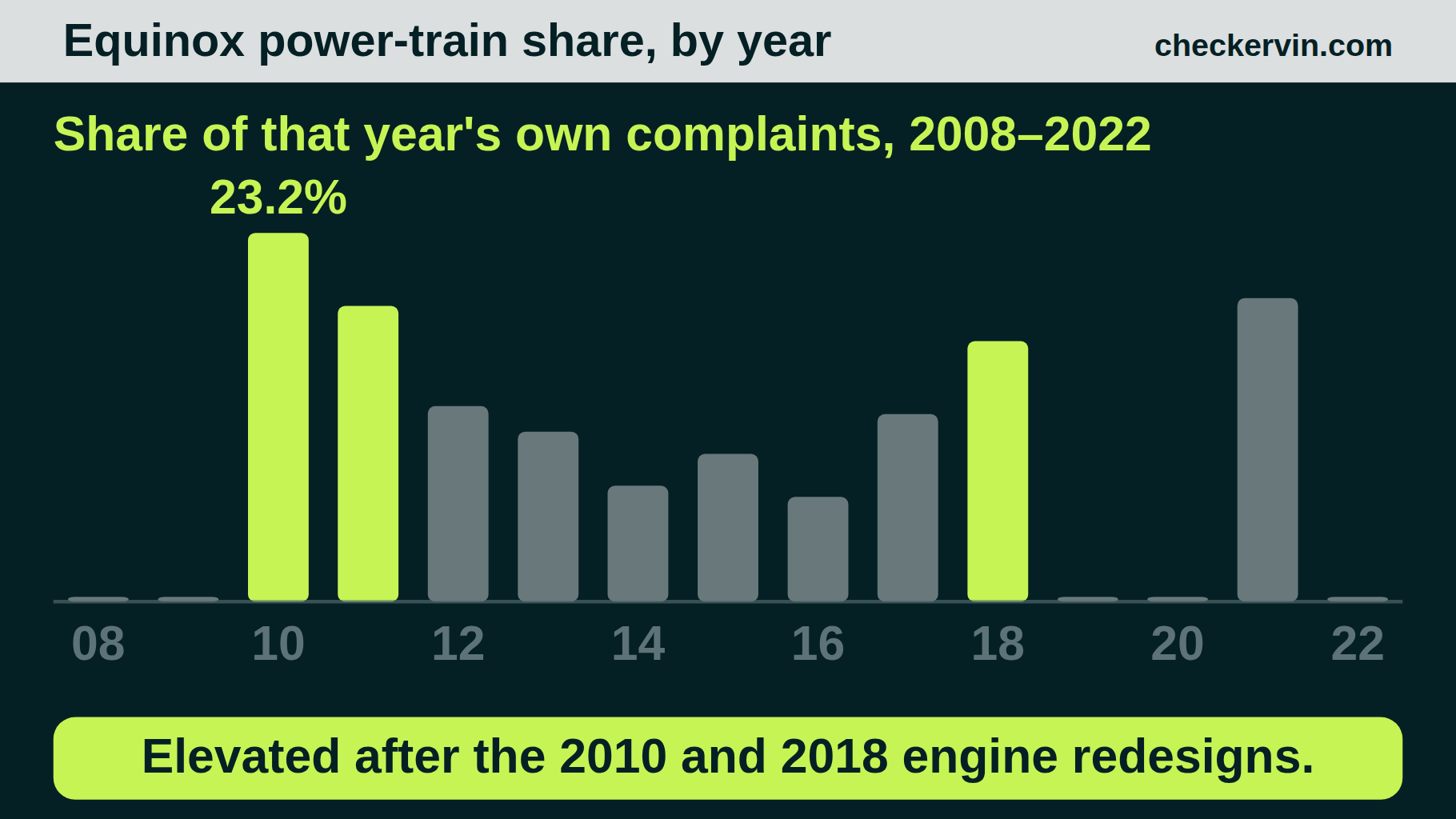
- 2010-2011 (23.2% and 18.6% of that year's own complaints) and 2018 (16.4%) — the two model years right after each of the Equinox's engine-lineup redesigns.
- Is 2021's spike the same pattern?
- No. 2021 has this corpus's lowest complaint volume by far, so its elevated share is treated as small-sample noise, not a third redesign-linked bump.
The numbers, and whose numbers they are
RepairPal’s general estimate for a Chevrolet Equinox transmission fluid change runs $189 to $237, with its own per-year pages spreading wider than that single range suggests — down around $153 to $198 on some newer model years, up toward $221 to $278 on a 2016. YourMechanic lists its transmission fluid service starting from $178. KBB does not publish one blended Equinox figure at all; instead it runs year-specific dealer estimate pages, one per model year.
None of that spread is a mistake in any one estimator. It is three different pricing methods (a national average, a per-visit quote start, a dealer-labor-rate lookup) answering three different questions. What none of them asks is which Equinox engine and transmission is actually under the hood — and across fifteen model years, that question has two different answers with two specific model-year boundaries.
Two engines, two transmissions, one nameplate
GM replaced the first-generation Equinox’s V6-only lineup with a new 2.4L four-cylinder (standard) and 3.0L V6 (optional) for the 2010 model year, per autoevolution’s report of GM’s own announced specifications. Then, for the 2018 model year, GM replaced that lineup entirely — dropping the V6 outright and moving to two turbocharged four-cylinders, a 1.5L and a 2.0L — per GM Authority’s and Automotive Fleet’s reporting of GM’s press materials. Neither report is a GM press release itself; both are automotive-trade outlets citing GM’s materials, and they are cited here as exactly that.
The transmission changed at both boundaries too. Per Powertrain Products’ own transmission-specific parts listings, the first generation paired with a 5-speed Aisin AF33 automatic; the second generation (2010-2017) moved to GM’s 6T40/6T45 Hydra-Matic for four-cylinder models and the heavier-duty 6T70 for V6 models; the third generation (2018-2022) paired the 1.5L with a 6-speed (6T45) and, new for this nameplate, the 2.0L with a 9-speed (9T45). Three different transmission families across fifteen model years, all searched under one “transmission fluid” query.
| Model years | Engine / transmission pairing |
|---|---|
| 2008-2009 | 3.4L/3.6L V6 — 5-speed Aisin AF33 automatic |
| 2010-2017 | 2.4L I4 or 3.0L/3.6L V6 — 6T40/6T45 (I4) or 6T70 (V6), 6-speed |
| 2018-2022 | 1.5L or 2.0L turbo I4 — 6T45 (1.5L, 6-speed) or 9T45 (2.0L, 9-speed) |
What 6,587 complaints say about two model-year boundaries
Our corpus of federal NHTSA complaints holds 6,587 reports against the 2008–2022Equinox. POWER TRAIN’s share of that year’s own complaint total runs 23.2% in 2010 (182 of 784) and 18.6% in 2011 (145 of 781) — against 2008 and 2009, where POWER TRAIN does not crack the nameplate’s own top 5 at all — bounded below that year’s fifth-ranked component count (39 in 2008, 11 in 2009), never asserted as exactly zero. Combined, those first two redesign years hold 327 power-train complaints out of 1,565 filed against them, a 20.9% share. That share falls to a range of 6.6%–12.3% across 2012-2016, the interior of the same generation.
The pattern repeats, smaller, at the second boundary. POWER TRAIN’s share rises to 16.4% in 2018 (65 of 396) from 11.8% in 2017, then falls to 0% in both 2019 and 2020 — POWER TRAIN absent from the top 5 in both of those years, bounded below whatever that year’s fifth-ranked component count happened to be (36 in 2019, 39 in 2020), never asserted as exactly zero.
Complaints are unverified owner reports, not a measured failure rate. But a category rising in the exact year a new engine and transmission pairing arrives, twice, independently, across two unrelated redesigns fifteen model years apart, is a pattern worth naming — distinct from a single spike, and distinct from the flat, no-clean-break shape this series has also found on nameplates whose fluid and transmission never changed.
The one year that doesn't fit the pattern
Read the full record rather than the two years that support the argument: 2021 also shows an elevated POWER TRAIN share, 19.1% (17 of 89) — higher than 2018’s 16.4%. It does not sit next to a redesign; 2018-2022 is a single generation with no engine change in between.
The honest explanation is sample size, not a third pattern. 2021’s 89total complaints are the lowest of any model year in this corpus — a small fraction of 2010’s 784— so a swing of a handful of reports moves the percentage by several points. Treating that swing as equivalent evidence to a 784-complaint year would be exactly the kind of invented specificity this series tries not to produce. This page counts 2010-2011 and 2018 as the redesign-linked pattern and 2021 as noise, and says so rather than picking whichever reading fits the headline.
How often GM actually says to change it
The Equinox’s automatic transmissions specify Dexron VI-family fluid, per forum and parts-fitment discussion of the second- and third-generation Hydra-Matic units (Chevy Equinox Forum, Terrain Forum). Owner’s-manual maintenance schedules, cited in the same forum threads, put the severe-service interval around 45,000 to 50,000 miles — shorter than the “fill for life” framing some owners assume applies to a modern automatic. None of this removes the need to confirm the exact fluid and interval for a specific VIN and generation before paying for a service; owner’s manuals themselves are the authority, and this page cites forum discussion of them, not the manuals directly.
What a transmission problem sounds like before it costs anything
- A harsh or delayed shift, especially worth checking on a 2010, 2011 or 2018 model given where the complaint record concentrates
- Fluid that looks dark or smells burnt at a routine dipstick or fill-plug check
- A whine or shudder under load that a forum thread would call converter shudder
- Any warning light tied to the transmission, checked before it becomes a shift-quality complaint
The order matters because the cheap check comes first: confirm which engine and transmission the Equinox actually carries, pull its open recalls by VIN, and get the fluid checked — before anyone prices a repair beyond a routine service.
Where the money goes
On a routine fluid service, RepairPal’s own breakdown for a recent Equinox splits labor at roughly $103 to $150 against parts around $86 to $99 — fluid volume, filter (where the transmission uses one) and labor rate driving the total far more than any single defect would. On a repair beyond routine service, get the shop to state plainly which engine and transmission generation they are quoting before accepting a number.
Two practical consequences follow. First, confirm the engine and transmission by VIN before accepting any quote, since the same nameplate spans three distinct transmission families across fifteen model years, all under one “transmission fluid” search term. Second, get the quote itemized by fluid quantity and labor rather than one blended “transmission service” line.
Before you authorize the service
- Confirm the engine and transmission by VIN — the Equinox has used three distinct transmission families (5-speed, 6-speed, 6/9-speed) across fifteen model years
- Pull the VIN's open recalls before paying for anything that might already be covered
- Ask which fluid the shop is pouring and confirm it against the specific transmission generation, not just the nameplate
- Don't treat a long-service fluid label as a reason to skip the service indefinitely — the owner's manual's own severe-service schedule still applies to many drivers
- Get the quote itemized — fluid quantity and labor — not a single flat-rate line
If you are buying the Equinox, not maintaining it
The same record reads as a shopping map. A 2010, 2011 or 2018 Equinox should show either a documented transmission service history or a clean test drive with no harsh shifts or shudder under load, given where the complaint record concentrates. A Chevrolet VIN decode confirms the exact engine and transmission before you price a service specific to any of the three eras.
On any candidate Equinox, run the recall lookup before you negotiate, confirm the warranty status in case a covered repair is still available, and check which Equinox model years show the most complaints overall rather than judging the nameplate by the power-train figure alone — engine and visibility/wiper complaints each outrank it in most years. A documented fluid history and a clean recall check on 2010, 2011 or 2018 are usually cheaper than the negotiation it takes to discount around ones that are missing.
Where this information comes from
- NHTSA — Equinox complaint databaseThe federal complaint record this page's figures are computed from, browsable by model year.
- NHTSA — recalls by VINThe official lookup that settles whether a specific Equinox has open safety campaigns.
- RepairPal — Equinox transmission fluid change estimateThe $189-$237 general range quoted above, attributed to its estimator as retrieved September 2026.
- KBB — Equinox transmission fluid change cost (by year)One of KBB's year-specific dealer estimate pages rather than a single blended figure.
Keep reading
Frequently asked questions
How much does it cost to change the transmission fluid in a Chevy Equinox?
RepairPal's general estimate runs $189 to $237, with per-year pages spreading from about $153-$198 on newer model years up to $221-$278 on some older ones. YourMechanic lists its transmission fluid service starting from $178. KBB publishes year-specific dealer estimate pages instead of one blended number. None of these figures is ours; we sell VIN checks, not repairs, and price none of this ourselves.
Does the Equinox take a different transmission fluid across model years?
The nameplate has used Dexron VI-specification automatic transmission fluid across its lineup, per forum and parts-fitment discussion of the second- and third-generation Hydra-Matic units. What changed at each redesign was the transmission unit and the engine it pairs with, not the fluid family — though always confirm the exact fluid by VIN and generation before a service, since GM's own severe-service schedule and fill procedure differ by transmission.
Which Equinox model years show a power-train complaint spike?
Two separate periods, not one. Computed from src/data/models/chevrolet-equinox.json, POWER TRAIN's share of that year's own total complaints runs 23.2% in 2010 and 18.6% in 2011 — versus 2008-2009, before the first redesign, when POWER TRAIN does not crack the nameplate's own top 5 at all — then falls to 6.6%-12.3% through 2012-2016. It rises again to 16.4% in 2018, versus 11.8% in 2017, before dropping out of the top 5 again in 2019-2020.
What changed in the Equinox for the 2010 and 2018 model years?
Both were full engine-lineup redesigns. MY2010 replaced the first generation's V6-only lineup with a new 2.4L four-cylinder (standard) and 3.0L V6 (optional), per autoevolution's report of GM's announced specs. MY2018 replaced that lineup entirely with two turbocharged four-cylinders — a 1.5L paired with a 6-speed automatic and a 2.0L paired with a new 9-speed automatic — and dropped the V6 outright, per GM Authority's and Automotive Fleet's reporting of GM's press materials.
Why does 2021 also show an elevated power-train share?
2021 is the Equinox's lowest-volume year in this corpus — 89 total complaints, against 6,587 across all fifteen years — so a swing of a few reports moves the percentage sharply. Its 19.1% power-train share (17 of 89) does not sit next to either engine redesign, unlike 2010-2011 and 2018, and this page treats it as small-sample noise rather than a third pattern.
Confirm the transmission before you price the service
A free CheckerVIN report shows the factory build, specifications and open recalls for any VIN — confirm what you're actually pricing.
Run a free VIN check