The short answer
- Can you run a Montana plate lookup?
- Owner identity is restricted by the federal Driver's Privacy Protection Act; Montana's DOJ-run Motor Vehicle Division releases records only for permitted uses. Buyers should work from the VIN, which carries the title and brand history.
- What does the plate's first number mean?
- The registration county — 1 is Silver Bow, 2 is Cascade, and the sequence continues through Montana's counties. It is geography stamped on the metal.
- Why is a Ferrari wearing Montana plates?
- Probably an out-of-state owner using a Montana LLC to avoid home-state sales tax. Legal in Montana, pursued as evasion elsewhere — and a title in an LLC's name changes the questions a buyer should ask.
1–56
County codes on standard plates
Silver Bow is 1, Cascade is 2
$0
Montana general sales tax
The engine of the LLC scheme
11 yr
Permanent registration threshold
One fee, no renewals after
DOJ
Who runs the MVD
Justice, not transportation

The county number — geography stamped on the metal
Standard Montana plates open with a county code assigned in the 1930s and never reshuffled: 1 for Silver Bow, 2 for Cascade, 3 for Yellowstone, on through the small counties. Montanans read them reflexively — a 6 is Gallatin, a 4 is Missoula — and a buyer can borrow the habit. The code says where the car is registered today, which is a first, checkable claim about where it has lived: a mountain-county code suggests winters and forest-service roads; a Yellowstone or Gallatin code suggests town miles.
Like Georgia’s county decal, the code is a prompt rather than proof. Owners move, and registrations follow. But when the plate’s geography and the seller’s story disagree, the national title record is how you find out which one is telling the truth.
Why exotics nationwide wear Montana plates
Montana has no general sales tax, no vehicle inspections, and it allows a Montana LLC to register vehicles it owns. Assemble those three facts and you get the famous scheme: an owner in a high-tax state forms a Montana LLC for a few hundred dollars, titles the Lamborghini or the half-million-dollar motorhome to it, and registers in a Montana county — usually through a registered-agent firm that handles thousands of such LLCs. The home state loses the sales tax, and several now audit, fine, and criminally pursue residents doing it.
For a used-car buyer the scheme has a practical edge: if the title names an LLC, you are not buying from the person in front of you — you are buying from a company they claim to control. Verify the LLC exists in Montana’s business registry, that the seller has authority to sign for it, and that the title chain is clean in the national record. And know that your own state may treat the car’s tax history with interest when you register it at home.
Permanent registration at 11 years — no renewals, no paper trail
Montana lets vehicles 11 years and older register permanently: one fee, one plate, no annual renewals ever again. It is a genuine convenience for ranch trucks and winter beaters — and a small evidence problem for buyers, because the annual-renewal heartbeat that helps date a car’s life in other states simply stops. An old Montana vehicle’s recent history lives almost entirely in its title record, service receipts and odometer statements, so lean on those harder here.
Two plates, run by the Department of Justice
Montana requires plates front and rear on passenger vehicles, and its Motor Vehicle Division sits — unusually — inside the Department of Justice rather than a transportation agency. Titles, registration and records all flow through MVD offices and the county treasurers who process registrations locally. Plates belong to the owner: at sale they come off, transferable to the seller’s next vehicle, and the buyer registers fresh through their county treasurer.
What the law actually protects, defined precisely
Every honest answer about plate lookups runs through one federal statute, and most pages gesture at it without quoting it. The Driver’s Privacy Protection Act defines its own terms at 18 U.S.C. 2725, and the definitions decide everything.
| Term | What 18 U.S.C. 2725 says |
|---|---|
| Motor vehicle record | Any record pertaining to a driver's permit, motor vehicle title, motor vehicle registration, or identification card issued by a department of motor vehicles |
| Personal information | Information that identifies an individual — photograph, social security number, driver identification number, name, address, telephone number, medical or disability information |
| Highly restricted personal information | An individual's photograph or image, social security number, and medical or disability information |
| Express consent | Consent in writing, including consent conveyed electronically bearing an electronic signature |
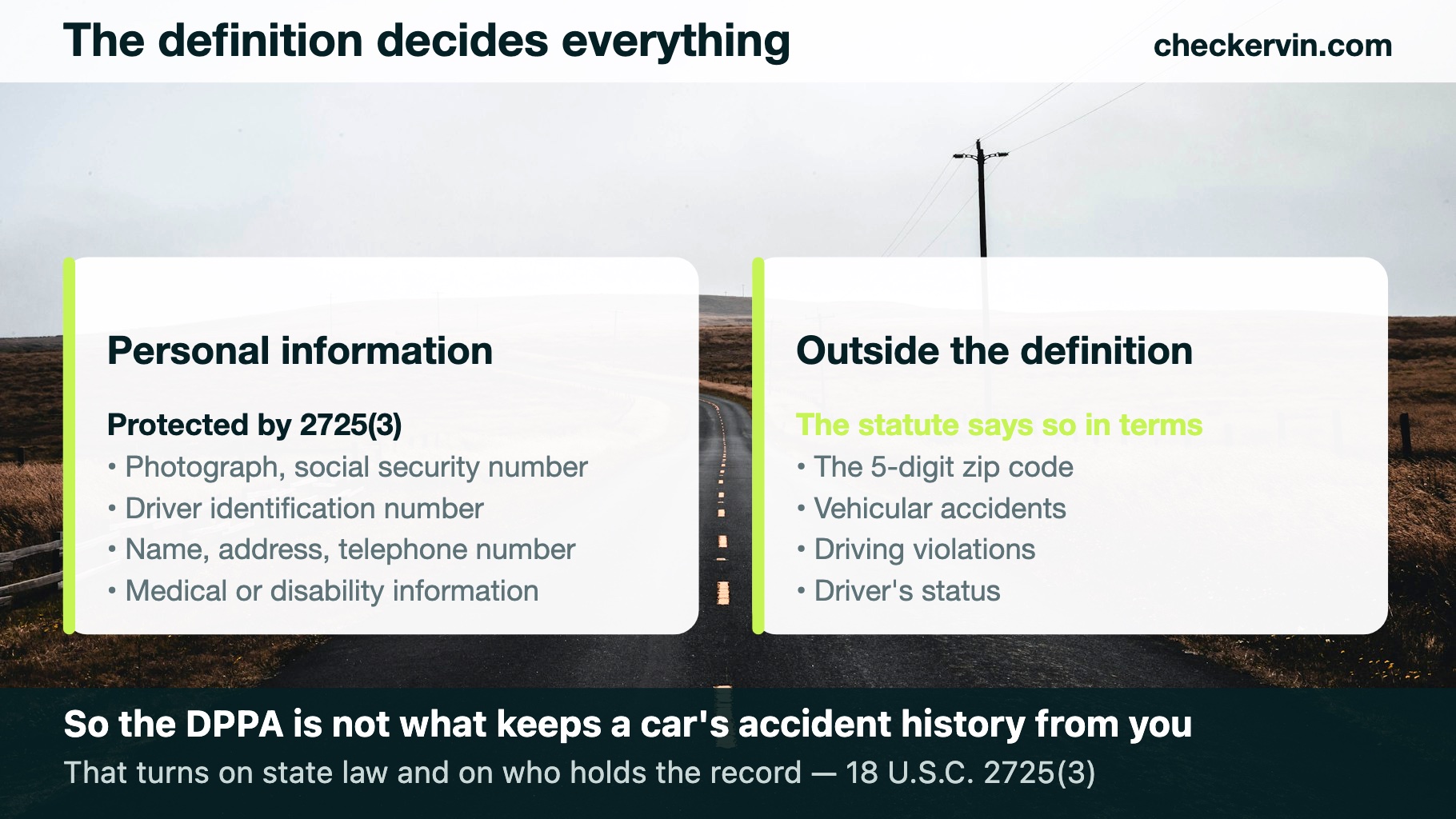
Two carve-outs inside the definition of personal information do more work than the whole rest of the section, and almost nobody mentions them.
- Address is protected — but the definition says “(but not the 5-digit zip code)”, so the zip is not personal information under the Act
- Personal information “does not include information on vehicular accidents, driving violations, and driver's status”
The default is no, and the exceptions are a closed list
The structure of the Act is worth understanding because it explains why every legitimate service asks what you want the information for.
Under 18 U.S.C. 2721(a), a state department of motor vehicles, and any officer, employee or contractor of one, shall not knowingly disclose or otherwise make available to any person or entitypersonal information about an individual obtained in connection with a motor vehicle record — except as provided in subsection (b).
Highly restricted personal information is fenced tighter still. It may not be released without the express consent of the person to whom it applies, except under four of the fourteen permitted uses.
The fourteen permitted uses, and where an ordinary buyer sits
Subsection (b) lists fourteen uses. Reading them as a group is more useful than memorizing them, because the pattern is clear: they are institutional roles, not curiosity.
| Grouped | Uses in 18 U.S.C. 2721(b) |
|---|---|
| Government and legal process | Government agencies including courts and law enforcement (1); civil, criminal, administrative or arbitral proceedings, service of process, investigation in anticipation of litigation (4) |
| Vehicle safety and the industry | Motor vehicle or driver safety and theft, emissions, product alterations, recalls or advisories, performance monitoring, market research (2) |
| Verifying what someone told you | A legitimate business, but only to verify the accuracy of information the individual submitted, and if wrong to obtain the correct information — only to prevent fraud, pursue legal remedies, or recover on a debt or security interest (3) |
| Insurance | Insurers and insurance support organizations for claims investigation, antifraud, rating or underwriting (6) |
| Licensed intermediaries | Licensed private investigative agencies and licensed security services, for any purpose otherwise permitted (8) |
| Consent routes | Express consent (11); bulk distribution for surveys or marketing with express consent (12); written consent of the individual (13) |
| Other | Towed or impounded vehicle notices (7); commercial driver's license verification (9); private toll facilities (10); other uses specifically authorized by the law of the state that holds the record, if related to vehicle operation or public safety (14) |
Notice what is not there. “I am thinking of buying this car and want to know who owns it” is not among the fourteen. A private individual doing pre-purchase research is generally not exercising a permitted use for personal information, and that is the statute working as designed rather than a gap.
Two ways a person, not a state, breaks this
Most of the Act constrains the department that holds the record. One short section constrains everybody else, and it is the one that governs lookup services and the people who use them.
Under 18 U.S.C. 2722, it is unlawful for any person knowingly to obtain or disclose personal information from a motor vehicle record for any use not permitted under the permitted-use list. And separately, it is unlawful for any person to make a false representationto obtain personal information from an individual’s motor vehicle record.
| The act | What it covers |
|---|---|
| Procurement for an unlawful purpose | Obtaining or disclosing the information for a use outside the fourteen |
| False representation | Claiming a purpose you do not have in order to get the information |
What happens when it is broken
The Act carries consequences on three separate tracks, which is unusual and tells you how seriously it was meant.
| Track | What 18 U.S.C. 2723 and 2724 provide |
|---|---|
| Criminal | A person who knowingly violates the chapter shall be fined under title 18 |
| Against a state DMV | A department with a policy or practice of substantial noncompliance is subject to a civil penalty imposed by the Attorney General of not more than $5,000 a day for each day of substantial noncompliance |
| Private civil action | The individual the information pertains to may sue in a United States district court |
The private action is the one with real force. Under 18 U.S.C. 2724 a court may award actual damages, but not less than liquidated damages in the amount of $2,500; punitive damages on proof of willful or reckless disregard of the law; reasonable attorneys’ fees and litigation costs; and other equitable relief.
A statutory floor on damages plus fee-shifting is what makes a privacy statute enforceable in practice, because it means a person whose information was misused does not have to prove a large loss to bring a case worth bringing.
And the restriction follows the data downstream
One provision closes the obvious loophole. Under 18 U.S.C. 2721(c), an authorized recipient of personal information may resell or redisclose it only for a use permitted under subsection (b).
So a permitted use does not convert protected information into a general asset. A company that lawfully obtained data for one of the fourteen purposes cannot pass it on for a purpose outside them, and the two consent-based routes are carved out of the general resale permission separately.
The practical consequence for anyone shopping for a lookup service is that the chain matters, not just the first request. Where a service is vague about its permitted use, it is being vague about the part of the statute that governs it.
What a Montana plate lookup can legally find
The county code is public by design; the person behind the plate is not. The federal Driver’s Privacy Protection Act restricts owner identity to enumerated permitted uses — insurance claims, litigation, employment verification for commercial drivers, licensed investigation within the statute — and Montana’s MVD releases records inside that frame. Commercial sites offering Montana owner lookups by plate are selling scrape-jobs, often stale ones pointed at LLC registered agents rather than humans anyway.
The lawful private routes are the standard three: police with a reason, your insurer with a claim, and — in a purchase — the VIN. The national rules, permitted-use list and scam patterns live in our license plate lookup guide.
Reading Montana plates as a buyer
- County code vs the seller's story — a Missoula-coded plate on a car 'always garaged in Billings' is a question, and the title record is the answer
- Exotic or motorhome on MT plates outside Montana — assume an LLC title; verify the company and the seller's authority before anything else
- Permanent registration on an 11+ year vehicle — no renewal trail; put extra weight on odometer statements and service records
- Front plate missing on a passenger car — Montana requires two; harmless by itself, but check for out-of-state history
- Winter-county codes — mountain winters mean gravel, chains and salt-brine on passes; look underneath like you would in the Midwest
Reading a Montana plate as a signal, not a verdict
Pulling the threads together, a Montana plate on a car you are looking at somewhere else is information — it is just not the kind people assume. It tells you something about how the vehicle is registered, and nothing at all about the vehicle.
| What you can read off it | What it does not tell you |
|---|---|
| The county of registration, from the number | Where the car has actually lived or been driven |
| That the registration may be permanent rather than annual | That anybody has looked at the car recently |
| That an entity rather than a person may hold it | Who that entity is, or who is behind it |
| That the registering state is not the state you are standing in | Whether that arrangement is a problem for you as the buyer |
The permanent-registration point is the one worth dwelling on as a buyer, because it quietly removes a signal you rely on elsewhere. On an annually registered car, a lapsed or nearly expired sticker is a small piece of evidence about how the vehicle has been kept. Where registration does not expire, that evidence is simply absent — not negative, absent.
And if the registration arrangement itself matters to your purchase — because of where you intend to register the car, or what your own state will ask for — that is a question for your state’s motor vehicle agency before you buy, not a question a plate lookup answers.
Registering a Montana purchase
- 1Take the signed title — and check who the owner isIf an LLC holds title, get proof the signer has authority. Montana's business registry is searchable and free.
- 2Register through the county treasurerMontana registrations run through the county — that is where the plate with your county's code is issued.
- 3Consider permanent registration if the vehicle qualifiesAt 11 years or older, the one-time permanent option ends renewals for as long as you own it.
- 4Mount both platesFront and rear are the law on passenger vehicles, whatever the car's nose looks like.
Decode a Montana car's VIN free
Decoded from official manufacturer and NHTSA records
Where this information comes from
- 18 U.S.C. 2721–2725 — Driver's Privacy Protection Act2721(a) the prohibition and (b) the fourteen permitted uses; 2722 procurement for an unlawful purpose and false representation; 2723 penalties; 2724 the private civil action and its $2,500 liquidated-damages floor; 2725 the definitions
- Montana MVD — license platesStandard plate design, county codes and issuance
- Montana Department of Justice — Motor Vehicle DivisionTitles, registration and vehicle records
- Driver's Privacy Protection Act, 18 U.S.C. § 2721The federal limits on identifying owners from records
- NMVTIS — national title recordTitle chains and brands across states, keyed to the VIN
Keep reading
Frequently asked questions
Can I look up who owns a car from its license plate?
Generally not as a private individual. Under 18 U.S.C. 2721 a state DMV may not knowingly disclose personal information from a motor vehicle record except for one of fourteen permitted uses, and pre-purchase curiosity is not among them. What is not restricted is the vehicle itself — decoding a VIN for the factory build and checking open safety recalls involves no personal information about anybody.
Does the Driver's Privacy Protection Act hide a car's accident history?
No, and this is widely misunderstood. The Act's own definition at 18 U.S.C. 2725 says personal information does not include information on vehicular accidents, driving violations, and driver's status. That category sits outside the definition entirely, so whether you can obtain it turns on state law and on who holds the record rather than on this statute.
Is a zip code protected under the DPPA?
The definition of personal information includes an address but says in terms “(but not the 5-digit zip code)”. So the zip is carved out of the definition. It is a small detail that shows how precisely the statute was drawn, and it is the kind of thing worth knowing before assuming a whole record is off limits.
What can happen to a service that misuses plate data?
Three things, on separate tracks. A knowing violation is criminally fineable under 18 U.S.C. 2723. A state DMV with a policy or practice of substantial noncompliance faces a civil penalty of up to $5,000 a day. And under 18 U.S.C. 2724 the individual concerned may sue in federal court for actual damages with a floor of $2,500 in liquidated damages, plus punitive damages, attorneys' fees and costs.
What does the number at the start of a Montana plate mean?
The county. Standard Montana plates open with a numeric county code — 1 for Silver Bow, 2 for Cascade, and so on through the list fixed decades ago — so the plate announces where in Montana the vehicle is registered before you read anything else.
Why do so many expensive cars have Montana plates?
Montana charges no general sales tax and lets an LLC registered in the state own and register a vehicle. Owners elsewhere form a Montana LLC, register the car to it, and skip their home state's sales tax — a scheme that several states now actively pursue as tax evasion. For a buyer, an LLC on the title means extra diligence on who actually has authority to sell.
Can I look up who owns a Montana plate?
Not from curiosity. The federal Driver's Privacy Protection Act limits owner information to permitted uses, and Montana's Motor Vehicle Division — run by the Department of Justice — releases records on that basis. In a purchase, the VIN is the number that opens the doors that matter.
What is Montana permanent registration?
Vehicles 11 years old and older can be registered once, permanently, with no further annual renewals. It is popular and legal — but it also means an old Montana car carries no registration-renewal paper trail, so the odometer and title record have to do more of the talking.
Does Montana require a front license plate?
Yes — two plates, front and rear, on passenger vehicles. A Montana car with a clean, undrilled nose has probably been wearing its front plate on a bracket, or has an exemption-class body.
County codes tell you where — the VIN tells you what
Decode any VIN free for the factory build, specifications and open safety recalls. No account, no card.
Run a free VIN check