The short answer
- What does it cost?
- RepairPal's general estimate is $189-$229; its own per-year figures for 2015, 2016, 2017 and 2019 all come back flat at $160-$188 regardless of generation.
- Is my Rogue covered by the CVT settlement?
- Only 2014-2018 models, under the $277M Stringer v. Nissan settlement — and the claim deadline has already passed. Earlier and later Rogues are not covered.
- Which years carry the power-train history?
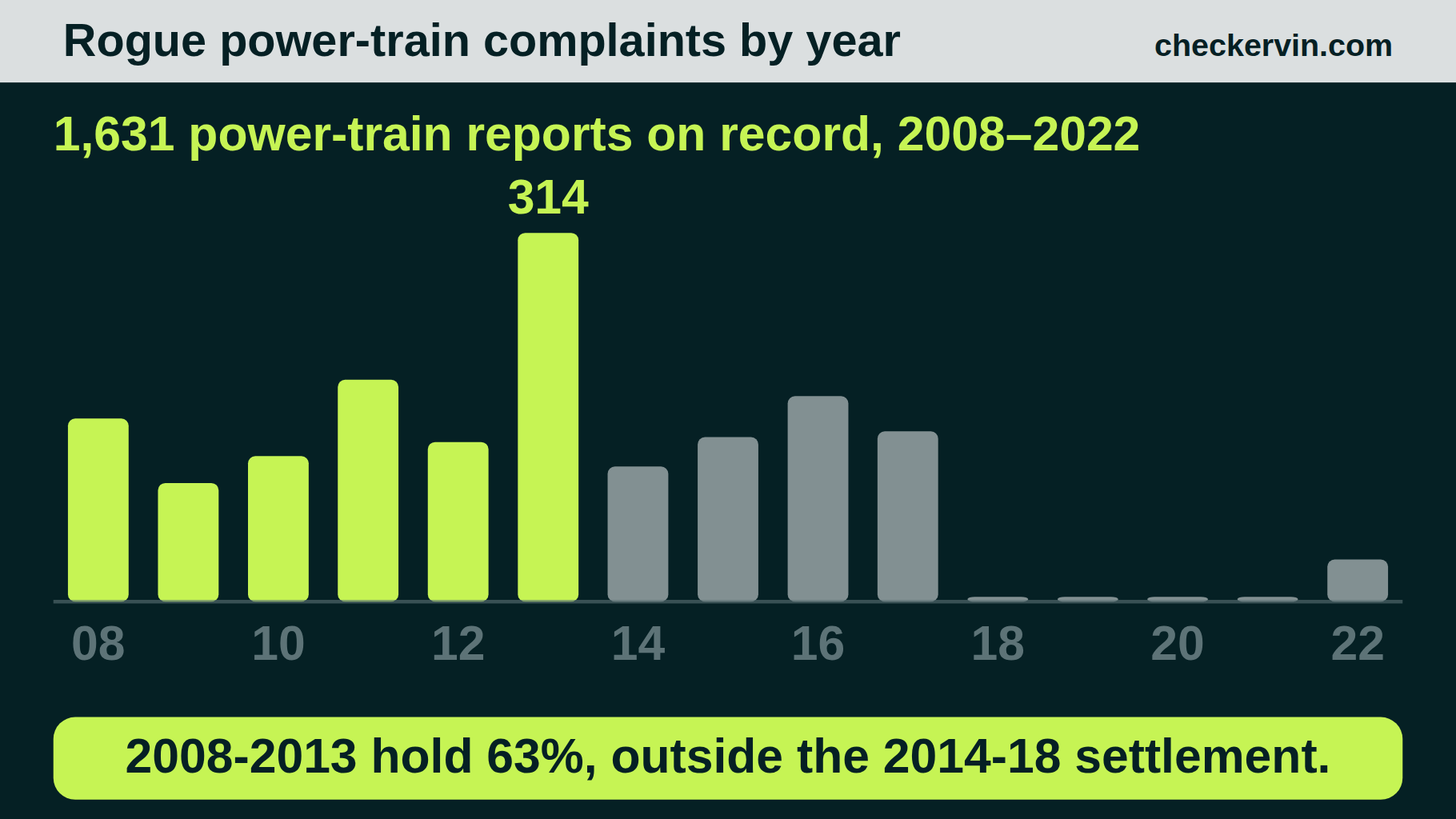
- 62.5% of every POWER TRAIN complaint the Rogue has ever recorded sits in 2008-2013 — before the settlement's own window even starts.
The numbers, and whose numbers they are
RepairPal’s general estimate for a Nissan Rogue transmission fluid change is $189 to $229. Checking its own per-year estimator pages for 2015, 2016, 2017 and 2019 model years returns the same $160 to $188 range on every one of them — a flat number that does not move whether the car is a second-generation Rogue inside a $277 million class-action settlement window or a third-generation redesign outside it entirely. Every figure here is attributed to whoever published it; we sell VIN checks, not repairs, and price none of this ourselves.
A flat estimator price is a reasonable starting point for a routine fluid service. It is not a reasonable stand-in for knowing which generation of Rogue is actually parked in the driveway — and on this nameplate, that distinction already has $277 million attached to it.
What 6,408 complaints say about three generations
Our corpus of federal NHTSA complaints holds 6,408 reports against the 2008–2022 Rogue. POWER TRAIN names 1,631 of them — 25.5% of the whole record — and it is not a minor category here: it ranks in the model year’s own top-5 complaint types in 11 of the nameplate’s 15 years. What matters is not that share alone, but exactly which years carry it, because the Rogue has been through three distinct generations since 2008 and the record treats them very differently.
The first generation (2008–2013) holds 62.5% of every POWER TRAIN complaint the nameplate has ever recorded — 1,020 of 1,631 — peaking at 52.2% of 2011’s own total complaints. The second generation, 2014–2018, holds 35.3% (575complaints) — less than the first generation, even though it is the generation a national class-action settlement was actually built around.
The $277M settlement, and its exact window
Stringer v. Nissan North America, Inc. settled for $277 million over allegations that certain Nissan and Infiniti CVTs were defective. The settlement covers 2014–2018 model year Rogue, 2015–2018 Pathfinder, and 2015–2018 Infiniti QX60 vehicles, offering an extended warranty, reimbursement of repair and replacement costs up to $5,000, or a $1,000 voucher toward a new Nissan or Infiniti. The court entered its final approval order in March 2022, and the claim deadline named on the settlement’s own administrator site has already passed.
| Rogue generation | Covered by the 2014-2018 settlement? |
|---|---|
| First generation (2008-2013) | No — outside the settlement window entirely |
| Second generation (2014-2018) | Yes — the settlement's exact target |
| Third generation (2018 onward) | Only the 2018 model-year overlap; 2019+ is not covered |
This is a different, and separate, settlement from the earlier CVT class actions covering 2013–2016 Altima, 2013–2017 Sentra, 2012–2017 Versa, 2014–2017 Versa Note and 2013–2017 Juke — those cases named different nameplates and do not extend to the Rogue.
The generation the settlement doesn't cover
Nothing in the Stringer settlement reaches a 2008–2013 Rogue. That is also the six-year span our own corpus shows carrying 62.5% of the nameplate’s entire power-train complaint history — a larger share than the settlement’s own 2014–2018 window holds. POWER TRAIN ranks as the single most-reported category in five of those six years, and 2011 alone accounts for 52.2% of that year’s own total complaints, the highest single-year share this nameplate has recorded.
None of this means a first-generation Rogue owner has a legal claim the settlement missed — complaints are unverified owner reports, not a certified defect finding, and a settlement's scope is a legal negotiation, not a direct readout of a complaint database. It does mean that “the Rogue had a CVT lawsuit, so check if yours is covered” is the wrong first question for roughly two out of every three Rogues built before 2014 — the settlement was never going to reach them regardless of what the record shows.
What changed in the redesign
The clearest break in the whole record sits at the third-generation redesign. POWER TRAIN does not crack the model year’s own top-5 complaint categories at all in 2018, 2019, 2020 or 2021 — 0 complaints in that category across four consecutive years, after ranking in the top five in 11 of the previous 14 years without a break longer than one year. It reappears in a small way in 2022: 36 complaints, fifth place, 13.6% of that year’s total — present again, but nowhere near the first generation’s peak.
Read plainly, that is a real shift in what owners report, timed to a body-and-platform redesign rather than to the settlement’s legal calendar. It is not proof the underlying CVT design changed, and it is not a claim that 2018-and-newer Rogues are defect-free — only that the specific pattern driving this nameplate's power-train complaints for a decade largely stops showing up in the record after the redesign.
How Nissan actually schedules this
Nissan does not publish one fixed transmission-fluid mileage for every Rogue either. Its own maintenance-schedule pages list CVT transmission fluid as a severity-based item, checked at intervals and specified for replacement under Nissan’s own listed service conditions, using Nissan CVT Fluid NS-3 — the page states NS-3 only should be used in this transmission — and directs owners to their vehicle’s specific Owner’s Manual or a Nissan dealer for the exact figure on their car.
That is one more reason a single number from a search result should be treated as a starting estimate, not a spec: NS-3 is not interchangeable with other CVT fluids or with conventional automatic transmission fluid, and the interval Nissan actually schedules depends on a severity condition specific to how the car has been driven.
What a CVT problem sounds like before it costs anything
- A shudder, jerk or hesitation under light acceleration — the symptom most reported in the class-action complaints against 2014-2018 Rogue CVTs
- A whining or humming noise that changes with engine speed rather than road speed
- Delayed or inconsistent engagement when shifting from park into drive
- The transmission running noticeably hotter than usual, or an overheating warning — the underlying allegation in the Stringer complaint was an undersized transmission cooler
The order matters because the cheap check comes first: confirm the generation and the exact model year by VIN, check whether a warranty extension or settlement benefit ever applied to that specific vehicle, and pull its open recalls — before anyone prices a repair beyond a routine fluid service.
Before you authorize the service
- Confirm the exact model year and generation by VIN before assuming a flat estimator price applies
- Ask whether the CVT has ever had a warranty claim, extension or class-action reimbursement on this specific vehicle's history
- Confirm the shop is using Nissan CVT Fluid NS-3, not a generic or universal CVT fluid
- Pull the VIN's open recalls before paying for anything that might already be covered
- Get the quote itemized — fluid brand, quantity and labor — not a single flat-rate line
If you are buying the Rogue, not maintaining it
The same record reads as a shopping map. A first-generation Rogue (2008–2013) carries the heaviest power-train complaint history in the corpus and no settlement coverage at all — a documented CVT service history matters more here, not less, than on a newer car. A second-generation Rogue (2014–2018) sits inside the Stringer settlement’s own window, though the claim deadline has passed, so any benefit would already have been used or missed by the current owner. A Nissan VIN decode confirms the exact model year and build before you price a service or ask a seller about settlement history, and checking what factory or extended coverage remains by VIN settles whether anything on the transmission is still someone else’s responsibility to fix.
On any candidate car, run the recall lookup before you negotiate, and check which Rogue model years show the most complaints overall rather than judging the nameplate by the power-train figure alone. The redesign years (2018–2021) show a materially lighter power-train record than either generation before them — a documented fluid service is usually cheaper than the negotiation it takes to discount around a generation that predates it.
Where this information comes from
- NHTSA — Rogue complaint databaseThe federal complaint record this page's figures are computed from, browsable by model year.
- NHTSA — recalls by VINThe official lookup that settles whether a specific Rogue has open safety campaigns.
- Stringer v. Nissan North America — official settlement siteThe $277M CVT settlement's own terms, covered model years (2014-2018 Rogue/Pathfinder, 2015-2018 QX60) and claim deadline.
- RepairPal — Rogue transmission fluid change estimateThe $189-$229 general range and the flat $160-$188 per-year figures quoted above, retrieved September 2026.
- Nissan — official Rogue maintenance schedule, CVT fluid componentNissan's own service page naming NS-3 as the required fluid and describing the severity-based check interval.
Keep reading
Frequently asked questions
How much does it cost to change the transmission fluid in a Nissan Rogue?
RepairPal's general estimate is $189 to $229. Its own per-year figures, checked for 2015, 2016, 2017 and 2019, all come back identical at $160 to $188 — a flat number that doesn't distinguish the first-generation Rogue (2008-2013), the second generation targeted by a $277M CVT class-action settlement (2014-2018), or the redesigned third generation (2018 onward). None of these figures is ours — we sell VIN checks, not repairs.
Is the Nissan Rogue covered by the CVT class-action settlement?
Only some of them. Stringer v. Nissan North America settled for $277 million and covers 2014-2018 model year Rogue, Pathfinder and Infiniti QX60 vehicles with a defective CVT, offering a warranty extension, repair reimbursement up to $5,000, or a $1,000 voucher. The claim deadline has already passed. First-generation Rogues (2008-2013) are not part of this settlement at all, despite our corpus showing a larger share of the nameplate's all-time power-train complaints sitting in those six years than in the settlement's own 2014-2018 window.
Which Nissan Rogue model years show the most power-train complaints?
2008-2013 — the first generation, six years out of fifteen. Computed from src/data/models/nissan-rogue.json, POWER TRAIN accounts for 1,631 of the Rogue's 6,408 total complaints (25.5%), and 62.5% of that power-train total sits in the six pre-settlement years alone — more than the 35.3% that falls inside the settlement's own 2014-2018 window. 2011 carries the largest single-year share, at 52.2% of that year's own complaints.
Did Nissan fix the Rogue's transmission problem in later models?
The complaint record is consistent with that, though it isn't a defect-free guarantee. POWER TRAIN does not crack the model year's own top-5 complaint categories at all in 2018, 2019, 2020 or 2021 — the third-generation redesign — after ranking in the top five in 11 of the previous 14 years. It reappears in a small way in 2022 (36 complaints, 5th place, 13.6% of that year's total). Complaints are unverified owner reports, not a measured failure rate, so this reads as a real shift in what owners are reporting, not a certified fix.
How often should a Nissan Rogue's CVT fluid actually be changed?
Nissan doesn't publish one flat mileage across every Rogue either. Its own maintenance-schedule pages list the CVT transmission fluid as a severity-based item — checked periodically and specified for replacement under normal conditions, using Nissan CVT Fluid NS-3 only, with the page directing owners to their specific Owner's Manual or a Nissan dealer for the exact interval on their car. NS-3 is not interchangeable with other CVT fluids or with conventional automatic transmission fluid, which is one more reason a flat number from a search result is a guess a VIN decode and a service history both settle for free.
Confirm the generation before you price the service
A free CheckerVIN report shows the factory build, specifications and open recalls for any VIN — confirm what you're actually pricing.
Run a free VIN check