The short answer
- What does it cost?
- Sources disagree: YourMechanic averages $160, KBB’s regional ranges run roughly $184-$326 by model year and ZIP code, and a 2014-specific YourMechanic estimate reaches $342.89-$490.18 at a shop — get a local, itemized quote.
- Which years carry the power-train history?
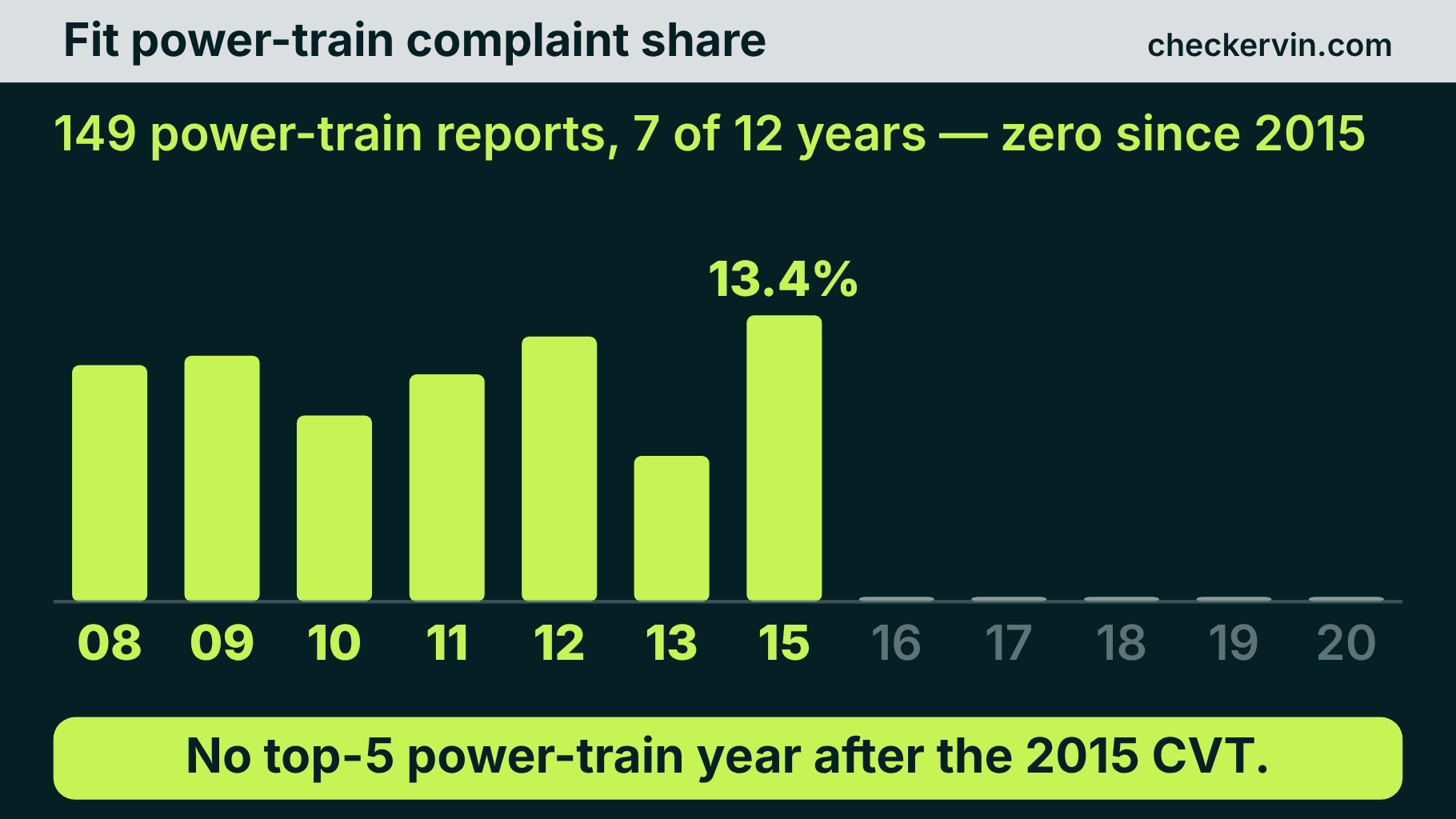
- Seven: 2008 through 2013 (every year of the 5-speed automatic) and 2015, the CVT’s debut year and the single highest power-train share on record (13.4%). Zero years from 2016 through 2020 carry it.
- Is there a real recall tied to 2015?
- Yes — NHTSA recall 15V-574 covers roughly 143,000 2014-2015 Civic and 2015 Fit vehicles for a CVT control-module software update, a free dealer reprogram.
The numbers, and whose numbers they are
YourMechanic puts its own average Honda Fit transmission fluid service at $160 ($65 in parts, $95 in labor) — though its own estimate for a 2014 Fit specifically runs to $286.11, with a shop or dealer price range of $342.89–$490.18. Kelley Blue Book’s regional fair-repair ranges vary by model year and ZIP code: roughly $184–$237 for a 2010 model near Highland, IN, $185–$265 for a 2015 model near Columbus, OH, and $278–$326 for a 2017 model near Wilmington, DE. None of these figures is ours — we sell VIN checks, not repairs, and price nothing on this page ourselves.
KBB’s own guidance adds a wrinkle worth repeating before anyone pays for this service at all: some newer transmissions are designed to never need a fluid change absent a leak or a problem, and the Owner’s Manual for the specific car is the only reliable source for whether that applies. On this nameplate, that question lines up with a real gearbox change and a sharply uneven complaint record.
What 1,827 complaints say about one nameplate
Our corpus of federal NHTSA complaints holds 1,827 reports against the 2008–2020Fit (2014 carries no rows in this dataset and is skipped, not interpolated). POWER TRAIN is not a constant presence in this record, but where it appears, it appears with a clean boundary: it places in that year’s own top five complaint categories in 7 of the 12 years this corpus covers — every single year of the second-generation 5-speed automatic, 2008 through 2013, and again in 2015, the year the CVT arrives.
Then it stops. From 2016 through 2020 — five consecutive model years, the entire remainder of the corpus — POWER TRAIN does not place in that year’s own top five at all. 2015, the CVT’s debut year, also carries the single highest power-train share of any year on record: 13.4% — and it is still the smallest of that year’s own five categories, behind ENGINE.
The year Honda swapped the gearbox
The corpus’s boundary has a plausible mechanical starting point. Per Honda’s own 2015 Fit overview and independent spec coverage located via WebSearch, the redesigned third-generation Fit introduced for model year 2015 paired its new Earth Dreams 1.5-liter engine with either a six-speed manual or a new Continuously Variable Transmission — described at the time as essentially the same CVT fitted to the 2014 Civic, itself a more compact version of the CVT used in the Accord. The second-generation Fit it replaced, 2008 through 2013, used a conventional 5-speed automatic instead.
| Fit era | What the corpus shows |
|---|---|
| 2008-2013 (5-speed automatic) | POWER TRAIN in that year’s own top five, all 6 years |
| 2015 (CVT’s debut year) | POWER TRAIN in the top five, at its highest-ever share |
| 2016-2020 (CVT, later years) | POWER TRAIN absent from the top five, all 5 years |
This is ordinary product history, stated as context rather than as a conclusion the complaint counts alone can establish — a new transmission family is one plausible explanation for a sharp pattern change, not something this corpus proves on its own.
The one real recall inside 2015
Independently of our own corpus, one federal filing sits inside the CVT’s debut year, located via WebSearch and not independently re-opened as a primary PDF in this environment (see Sourcing): NHTSA recall 15V-574, covering roughly 143,000 2014–2015 Civic and 2015 Fit (EX, EX-L and LX trim) vehicles for a CVT control-module software update. Honda’s own description, per sources quoting the filing, attributes the action to stress on the CVT’s input-shaft pulley under certain driving conditions; the remedy is a free dealer reprogram, issued under Service Bulletin 15-065 (October 2015, revised August 2017).
The recall covers only the 2015 model year of this nameplate, not the four years of absence that follow it — which reads less like a single ongoing defect and more like an early correction that prevented the new CVT’s debut-year issue from compounding into later model years.
What the forums say, against what the record says
Secondary sources quoting carcomplaints.com’s own tally describe 2015 as the Fit’s single worst model year for total owner-submitted reports (518, per that site) — and frame that volume as substantially a transmission-shudder story for the CVT’s first year. That is a reasonable read of aggregate complaint counts, and it is not what NHTSA’s own category breakdown for that year shows.
In the federal top-five breakdown this corpus is built from, POWER TRAIN is the smallest of 2015’s five categories at 13.4%, behind ENGINE at 14.1% and far behind ELECTRICAL SYSTEM at 41.2% of that year’s complaints. Reading 2015’s overall complaint volume as primarily a transmission story is not what this corpus’s own category split supports — a correction worth stating plainly rather than repeating the more common framing uncontested.
The fluid changed when the gearbox did
The 2009 and 2010 Fit owner’s manuals specify Honda ATF-Z1 for the 5-speed automatic, per manual excerpts located via WebSearch. Honda’s current Genuine ATF DW-1 (part 08200-9008) supersedes ATF-Z1 and is sold as fully backward compatible, per an automotive parts retailer’s product listing — not a claim this page independently verifies against a Honda service bulletin.
The CVT in the 2015-and-later Fit is a different transmission family and does not use ATF at all. Honda’s own manual for the mechanically related Jazz — a CVT-equipped sibling sold outside the US — specifies Honda HCF-2 CVT fluid; no source located in this research confirms that part number against a Fit-specific US owner’s manual directly, so it is stated here as the fluid family rather than a confirmed Fit specification. A shop that quotes a flat ATF price without first confirming which transmission is actually in the car is quoting the wrong job on roughly half the model years this nameplate has on sale.
How often Honda actually says
No source located here states a single Honda-published mileage figure specific to the Fit. Firestone’s own Fit maintenance pages describe Honda recommending a transmission and differential fluid exchange at certain intervals using Honda-approved fluid, without stating the mileage in the excerpt located. A secondary auto-advice source puts the common figure for CVT-equipped Hondas at roughly 60,000 miles under normal driving, sooner in severe conditions such as heavy stop-and-go traffic or frequent towing; another source disagrees, citing a dealer quote of 60,000 miles followed by 30,000-mile intervals after. None of these is a confirmed Honda-published figure for the Fit specifically — the honest answer is to check the Owner’s Manual for the exact model year and ask a Honda dealer directly.
What a power-train problem looks like before it costs anything
- A software-related shift concern on a 2014-2015 Civic or 2015 Fit — the exact condition recall 15V-574’s reprogram addresses
- A burnt-fluid smell, dark fluid, or a visible leak — the general warning signs any transmission fluid specialist checks before anything else
- Hesitation, shudder or an RPM flare on acceleration, particularly from a CVT-equipped 2015-or-later Fit
- A grinding or clunking noise shifting gears on a 5-speed-automatic 2008-2013 Fit, which owner reports describe independently of any recall
The order matters because the cheap check comes first: confirm the exact model year and transmission by VIN, pull the car’s open recalls, and check whether 15V-574’s software update was ever performed on a 2015 Fit — before anyone prices a repair beyond a routine fluid service.
Before you authorize the service
- Confirm the exact model year and transmission by VIN before assuming a flat estimator price applies
- Pull the VIN’s open recalls and check specifically for 15V-574 on a 2015 Fit
- Confirm the shop is using the correct fluid — ATF DW-1 (or Z1) for the 5-speed automatic, CVT-specific fluid for 2015-and-later cars, never one for the other
- Ask whether a software update has already been applied before paying to diagnose a shift concern on a 2014-2015 Civic or 2015 Fit
- Get the quote itemized — fluid type, quantity and labor — not a single flat-rate line
If you are buying the Fit, not maintaining it
The same record reads as a shopping map. A 2008–2013 Fit carries a persistent, if modest, power-train complaint presence in every model year of this corpus — worth a transmission fluid check on general principle at this age regardless of the estimator price. A 2015 Fit sits inside recall 15V-574’s window — worth confirming the software update was performed before assuming the CVT needs anything else. A 2016–2020 Fit shows no power-train presence in this corpus’s top five at all, which is a quieter record than the nameplate’s own earlier years, not a guarantee.
A Honda VIN decode confirms the exact model year and transmission before you price a service or ask a seller about recall history, and checking what factory coverage remains by VIN settles whether anything on the transmission is still someone else’s responsibility to fix. Run the Honda recall lookup before you negotiate, and check which Fit model years show the most complaints overall rather than judging the nameplate by the power-train figure alone.
Where this information comes from
- NHTSA — Fit complaint databaseThe federal complaint record this page’s figures are computed from, browsable by model year.
- NHTSA — recalls by VINThe official lookup that confirms whether recall 15V-574’s software update was performed on a specific 2015 Fit.
- Kelley Blue Book — Fit transmission fluid change fair-repair rangeOne of the KBB regional estimator pages the cost figures above are drawn from.
- YourMechanic — Fit transmission fluid service estimateThe mobile-mechanic estimate this page’s average and 2014-specific figures are drawn from.
Keep reading
Frequently asked questions
How much does it cost to change the transmission fluid in a Honda Fit?
Estimates vary by source, model year and ZIP code. YourMechanic puts its own average at $160 ($65 in parts, $95 in labor), though its own estimate for a 2014 Fit runs to $286.11, with a shop or dealer range of $342.89-$490.18. Kelley Blue Book’s regional fair-repair ranges run from about $184-$237 for a 2010 model near Highland, IN, to $185-$265 for a 2015 model near Columbus, OH, and $278-$326 for a 2017 model near Wilmington, DE. None of these is ours — we sell VIN checks, not repairs — and KBB itself notes that some newer transmissions are designed to never need a fluid change absent a leak or a problem, which is worth checking against the specific car’s Owner’s Manual before paying for the service at all.
Which Honda Fit model years show the most power-train complaints?
Every model year of the second-generation 5-speed automatic carries a power-train complaint pattern worth knowing: 2008, 2009, 2010, 2011, 2012 and 2013 all place POWER TRAIN in that year’s own top-five complaint categories (111 reports combined, computed from src/data/models/honda-fit.json), and 2015 — the CVT’s debut year — does too, at the highest share of any year on record (13.4%, 38 reports). No year from 2016 through 2020 does, in five straight years.
Is there a real recall behind the 2015 CVT’s debut-year numbers?
Yes, though it predates most of the complaints that followed it rather than explaining all of them. Per NHTSA recall 15V-574, located via WebSearch (the primary filing could not be fetched directly in this environment), Honda recalled roughly 143,000 2014-2015 Civic and 2015 Fit (EX, EX-L, LX trim) vehicles to update the CVT’s control-module software, addressing input-shaft-pulley stress that could occur under certain driving conditions — a free dealer reprogram under Service Bulletin 15-065. It is a real, documented CVT-specific action tied to exactly the model year our corpus flags as the power-train share’s peak.
Was 2015 really the Fit’s worst year for transmission problems?
Not by the federal complaint record’s own breakdown, though that is a reasonable thing to assume from other sites. Secondary sources quote carcomplaints.com’s own count that 2015 drew more total owner-submitted reports than any other Fit model year — framed there as largely a transmission story for the CVT’s first year. NHTSA’s own top-five categories for 2015 tell a narrower story: POWER TRAIN is the SMALLEST of the five categories present that year (13.4%, behind ENGINE’s 14.1%), while ELECTRICAL SYSTEM accounts for 41.2% of that year’s complaints. The record does not support reading 2015’s overall volume as primarily a transmission complaint, and that volume is a different measure from the power-train share this page tracks.
What transmission fluid does a Honda Fit actually need?
It depends entirely on which generation. The 2009 and 2010 Fit owner’s manuals specify Honda ATF-Z1 for the 5-speed automatic; Honda’s current Genuine ATF DW-1 supersedes it and is sold as fully backward compatible. The CVT in the 2015-and-later Fit is a different transmission family entirely and does not take ATF at all — Honda’s manual for the mechanically related Jazz (a CVT-equipped sibling) specifies Honda HCF-2 CVT fluid, though no source located here confirms that part number against a Fit-specific manual directly. Confirm the correct fluid against the Owner’s Manual for the specific model year before any shop fills the pan.
Confirm the exact model year and transmission before you price the service
A free CheckerVIN report shows the factory build, specifications and open recalls for any VIN — confirm what you’re actually pricing.
Run a free VIN check