The short answer
- Is there one mileage chart for the Civic?
- No. Since the mid-2000s Honda's Maintenance Minder sets the interval per car based on driving pattern, not a fixed table — though reference sites publish estimates (7,500 miles for the first service; 37 service types over 150,000 miles per RepairPal).
- What does our own record add?
- FUEL SYSTEM, GASOLINE and FUEL/PROPULSION SYSTEM complaints each miss the Civic's year-level top-5 in 13 of 15 model years, then all three appear together only in 2018-2019 — the exact window of a recalled low-pressure fuel pump, not a maintenance item.
- Does the Civic need a timing belt?
- No — every model year in our corpus falls inside the chain-only era for the US-market Civic, so there is no belt-replacement line item on this nameplate's schedule at all.
Why there is no single schedule to quote
Searching “Honda Civic maintenance schedule” turns up dealer blogs, parts-store mileage tables and Honda’s own owner’s manuals, and they do not all say the same thing — because, for most of the Civic’s recent history, there is no single mileage table to disagree about. Honda replaced the fixed schedule with the Maintenance Minder, a system that reads the car’s own driving pattern and displays a dashboard code only when a specific service is actually due. Two identical Civics driven differently can see their first transmission-fluid reminder thousands of miles apart.
That makes a typed mileage chart a guess dressed up as an answer. What this page does instead: explain how the Minder actually decides, show the published reference figures that do exist and who published them, and add the one thing a schedule can’t tell you — which model years in the federal complaint record carry a pattern that no amount of on-time maintenance would have changed.
How the Maintenance Minder actually works
The system combines one letter and, usually, one or more numbers. The letter is the main item: A means an oil-only change, and B means oil, filter and a broader inspection round. The numbers are sub-items that ride alongside it, per Honda-focused mechanic references (YourMechanic, RepairSmith, Jalopnik):
| Code | What it adds |
|---|---|
| 1 | Rotate the tires, check pressure and tread |
| 2 | Replace the air cleaner element; inspect the drive belt |
| 3 | Replace the transmission fluid |
| 4-7 | Spark plugs, brake fluid and other items — varies by model year; check the owner's manual for the specific car |
A display of “B123” therefore means oil, filter and inspection, plus tire rotation, the air cleaner and the transmission fluid, all due at once — not a fixed mileage, a combination the algorithm decided was due on that specific car, that day.
The mileage figures that do exist, and who published them
Reference sites still publish approximate figures, and this page attributes every one of them rather than repeating them as if Honda issued a single number. Middletown Honda’s own service guide lists a first scheduled visit at 7,500 miles, covering an oil and filter change plus a tire rotation. RepairPal’s Civic estimator describes 37 distinct service types spread across 150,000 miles of ownership, without resolving them to one table either. Cars.com, writing specifically about 2016–2021 Civics, states plainly that those model years have no traditional mileage-or-time-interval schedule at all — the Minder is the schedule.
Honda’s manuals also split every generation into Normal and Severe service schedules, and which one applies depends on driving conditions — short trips, extreme temperatures or dusty roads typically push a car onto the Severe side, with shorter intervals than the Normal table most published estimates quote by default.
One job that never shows up: the timing belt
Every Civic model year in our corpus, 2008–2022, falls inside the generation Honda moved the US-market Civic to a timing chain instead of a belt. Independent repair references (Motorbiscuit, AHG Auto Service, carscounsel.com) place that switch at the 2006 model year, carrying through the 8th (2006–2011), 9th (2012–2015), 10th (2016–2021) and 11th (2022–) generations — with the caveat that the earlier, mixed 7th generation (2001–2005) sold belt and chain engines side by side, and sits entirely before this page’s data window. A chain is lubricated by engine oil and is not a scheduled replacement item the way a belt is, so for every year this page covers, “timing belt replacement” is not a line item that belongs on the Civic’s own schedule at all — despite how often the search term pairs with this nameplate.
What 7,598 complaints say about which years need extra attention
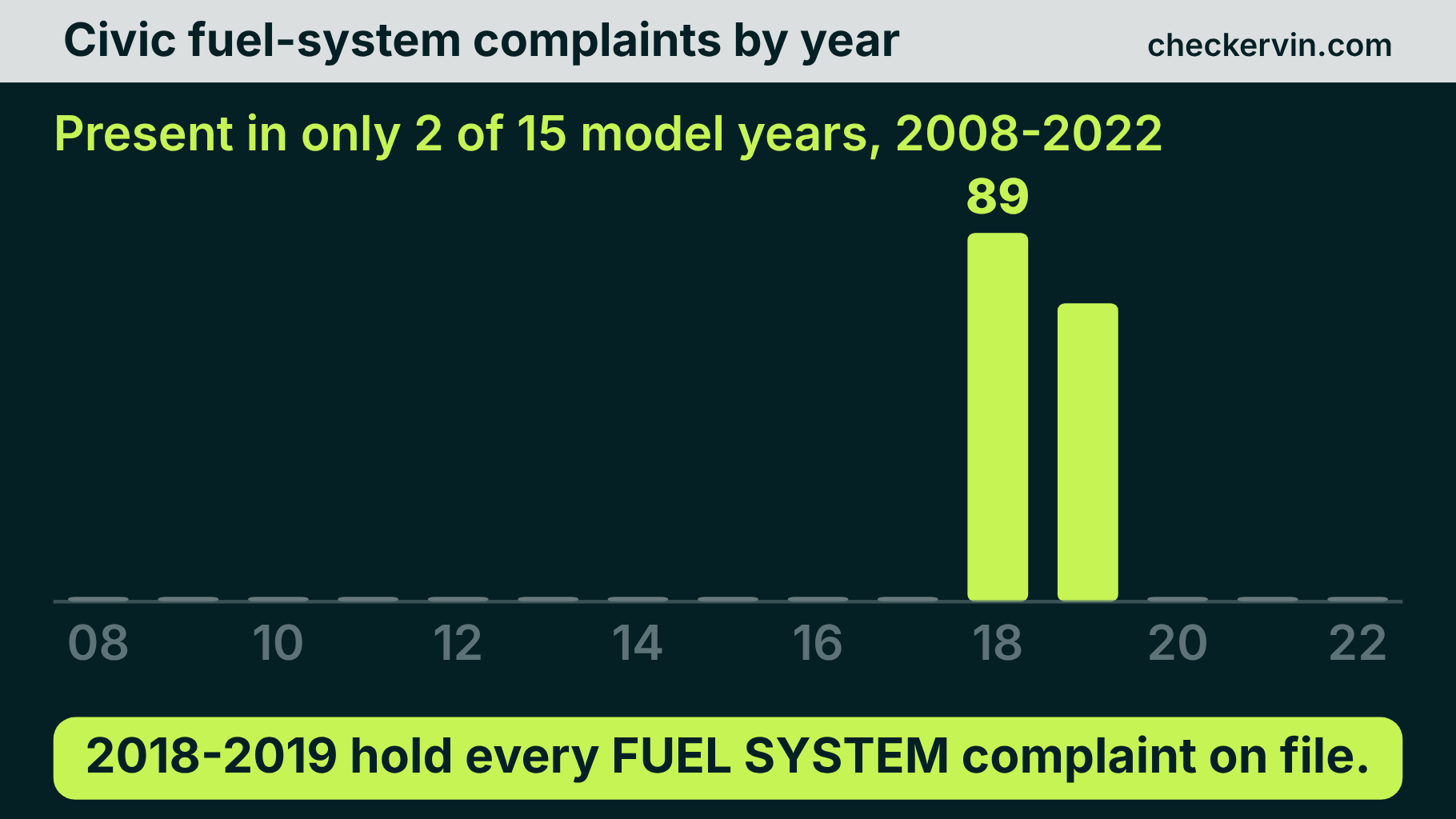
Our corpus holds 7,598 federal NHTSA complaints against the 2008–2022 Civic, across 15model years. Most of that record has nothing to do with maintenance at all — AIR BAGS, STEERING and ELECTRICAL SYSTEM dominate most individual years, and no service interval changes an airbag design. The category worth isolating here is fuel-related: three separate NHTSA component tags — FUEL SYSTEM, GASOLINE and FUEL/PROPULSION SYSTEM — are each individually absent from the year’s own top-5 complaint categories in 13 of the Civic’s 15 model years. Then, in exactly 2018 and 2019, all three appear in the same two years — and in no other year, before or since.
The two years fuel-system complaints spike, and why
Inside the window, 2018 logs 89 FUEL SYSTEM, 89 GASOLINE and 70 FUEL/PROPULSION SYSTEM complaints; 2019 logs 72, 71 and 73 respectively — three different tags, same two years, and none of them appears in any other year's top-5 at all. That is not a coincidence of categorization; it matches a real NHTSA safety campaign covering the low-pressure fuel pump inside the tank, which can fail and stall the engine. Reporting on the campaign shows it has been expanded more than once since its first filing — initially covering 2018–19 Civic hatchbacks, then widened to 2018–2020 Civic coupes, sedans and hatchbacks, and widened again in later campaigns naming specific VIN ranges.
| Program | What it actually resolves |
|---|---|
| NHTSA safety recall | Free dealer repair for a named defect — the fuel-pump campaigns above |
| Technical service bulletin | Repair instructions to dealers — doesn't guarantee a free fix by itself |
| Scheduled maintenance | A wear item on a timer or Minder code — not a remedy for either of the above |
None of the three fuel-related categories above would have been prevented by following any maintenance schedule, generous or strict. A recalled part fails on its own defect, not on a missed service interval — which is exactly why a VIN-based recall check matters more for a 2018–2019 Civic than any mileage number quoted for it.
A second, better-known issue our own record doesn't flag
The Civic’s other widely reported maintenance-adjacent issue is the 1.5-liter turbo engine’s oil dilution, introduced with the 2016 model year. Reporting describes gasoline seeping into the engine oil during cold, short-trip driving, diluting it and triggering Honda technical service bulletins — 18-137 covering 2016–18 Civics, later revised and replaced by 19-033 — which called for an ECU/TCU software update, in some cases an air-conditioning control unit change, and an extended powertrain warranty. A proposed class action, Wolf v. American Honda, filed in 2022 and covering 1.5T Civic, CR-V and Accord models, was still pending in the sources checked for this page. Honda’s own public position is that some dilution in cold, short-trip conditions is normal for this engine and rarely causes drivability problems.
Here is the honest part: our corpus does notshow an ENGINE complaint spike in the 2016–2018 window this issue concerns. ENGINE complaints fall from 95 in 2016 to 66in 2017, and the category drops out of the year’s own top-5 entirely by 2018. That is not evidence the issue isn’t real — the TSBs and the warranty extension are documented facts, independent of this corpus — it is evidence that a problem Honda handled quietly through a bulletin and a warranty extension, with no open safety recall attached, leaves a far smaller mark on this complaint record than the recalled fuel pump does. The two issues sit a few model years apart and produce two different signatures in the same dataset.
Schedule, bulletin, or recall — three different tracks
A Civic owner researching “maintenance schedule” is usually trying to answer one question — what do I owe this car, and when — and the honest answer splits three ways that a single search result rarely separates:
- Scheduled maintenance — the Minder's A/B codes and sub-items, paid by the owner on a rolling basis
- A technical service bulletin — a dealer repair procedure for a known issue, which may or may not come with an extended warranty, like the 1.5T oil-dilution bulletins above
- A safety recall — a free remedy for a named defect, like the fuel-pump campaigns above, with no mileage or ownership condition attached
A VIN decode settles which of the three actually applies to one specific car, because open recalls and factory build data are encoded in the VIN itself — a Minder code on the dash cannot tell an owner whether a recall is open, and a forum thread about “the Civic’s known issues” cannot tell them whether their own car is even in the affected range.
Before you pay for anything
- Check the Minder code on the dash before accepting a flat-rate quote keyed only to mileage
- Pull the VIN's open recalls first — a 2018-2020 Civic should specifically be checked against the fuel-pump campaigns above
- On a 2016-2018 1.5T car, ask whether the ECU/TCU software update (TSB 18-137/19-033) has already been done, and check remaining powertrain warranty
- Confirm whether a quoted service is routine maintenance, a bulletin-covered repair, or a recall remedy — they are not priced or covered the same way
- Get any paid service itemized by part and labor rather than one blended line
If you are buying a Civic, not maintaining one
The same record reads as a shopping checklist. On a 2018–2020 Civic, confirm the fuel-pump recall has been completed before treating the car as sorted — it is a free dealer repair, and a seller who hasn’t had it done is leaving value on the table either way. On a 2016–2018 1.5T car, ask for service records showing the oil has been changed on a short-trip-appropriate interval, and confirm whether the ECU software update has been applied. A Honda VIN decode confirms the exact build, and checking remaining factory coverage by VIN settles whether anything above is still someone else’s responsibility to fix.
Run the recall lookup on any candidate car before negotiating, and check which Civic model years show the most complaints overall rather than judging the nameplate by either figure on this page alone — both the fuel-pump window and the 1.5T oil-dilution years are a small slice of a fifteen-year record dominated by entirely different categories.
Where this information comes from
- NHTSA — 2018 Civic complaint databaseThe federal complaint record this page's figures are computed from, browsable by model year.
- NHTSA — recalls by VINThe official lookup that settles whether a specific Civic has an open fuel-pump or other safety campaign.
- NPR — Honda and Acura fuel pump recall, 2.5 million vehiclesReporting on the scope and multiple expansions of the low-pressure fuel pump campaign covering 2018-2020 Civics.
- Consumer Reports — Honda extends warranty on 1.5L turbo oil dilutionReporting on the TSB-based software fix and warranty extension for the 1.5T oil-dilution issue, cited for the oil-dilution section above.
- RepairPal — Civic maintenance schedule estimatorSource for the 37-service-types-over-150,000-miles figure, attributed in the 'mileage figures' section.
Keep reading
Frequently asked questions
What is the Honda Civic's actual maintenance schedule?
There isn't one fixed table. Since the mid-2000s, Honda's Maintenance Minder tracks oil condition, mileage and driving pattern through an algorithm and displays a code on the dash only when a specific service is actually due, rather than publishing one mileage chart every Civic follows. Third-party aggregators still publish reference tables — Middletown Honda lists a first service at 7,500 miles (oil, filter, tire rotation), and RepairPal describes 37 distinct service types spread across 150,000 miles — but those are published estimates, not a single Honda-issued schedule.
What do the Maintenance Minder codes A1, B123, etc. mean?
The letter is the main item: A means an oil-only change; B means oil, filter and an inspection round. The numbers are sub-items that ride along with it — 1 means rotate the tires, 2 means replace the air cleaner element and inspect the drive belt, and 3 means replace the transmission fluid, per Honda-focused mechanic references (YourMechanic, RepairSmith). Sub-items 4 through 7 cover things like spark plugs and brake fluid but vary by model and generation — Honda's own owner's manual for the specific car is the only source for those.
Does the Honda Civic need a timing belt?
No Civic in our corpus does. Every model year we track, 2008–2022, falls inside the generation Honda switched the US-market Civic to a timing chain — multiple independent repair references place that switch at the 2006 model year, with chains carrying through the 8th, 9th, 10th and 11th generations. A chain is not a scheduled replacement item the way a belt is, so no "timing belt interval" exists on this nameplate's schedule for any year this page's figures cover.
Why do Honda Civic complaints spike in fuel-system categories for 2018 and 2019?
Three separate NHTSA component categories — FUEL SYSTEM, GASOLINE, and FUEL/PROPULSION SYSTEM — are each individually absent from the Civic's own year-level top-5 complaint categories in 13 of its 15 model years in our corpus, then all three appear together in exactly 2018 and 2019 and nowhere else: FUEL SYSTEM at 89 and 72 complaints, GASOLINE at 89 and 71, FUEL/PROPULSION SYSTEM at 70 and 73. That window matches a real, several-times-expanded NHTSA low-pressure fuel-pump recall covering 2018-2020 Civics, reported by outlets including NPR and Consumer Reports — a safety recall with a free dealer remedy, not anything a maintenance interval would have prevented.
Is the Honda Civic 1.5T oil-dilution problem a recall?
No — it was handled through technical service bulletins (18-137, later 19-033), an extended powertrain warranty, and Honda's public position that some dilution in cold, short-trip driving is normal for that engine, not through an open NHTSA safety recall. A 2022 proposed class action (Wolf v. American Honda) covering 1.5T Civic, CR-V and Accord models was still pending as of the sources checked for this page. Notably, our own corpus does not show an ENGINE complaint spike in the 2016-2018 window this issue concerns — ENGINE complaints actually fall from 95 in 2016 to 66 in 2017 — which is itself informative: a bulletin-only issue with no recall does not leave the same mark on this complaint record that a recalled defect does.
Check what's actually open before you price a service
A free CheckerVIN report shows the factory build, specifications and open recalls for any VIN — confirm whether a maintenance item, a bulletin, or a recall is actually what you're pricing.
Run a free VIN check